




About this worksheet
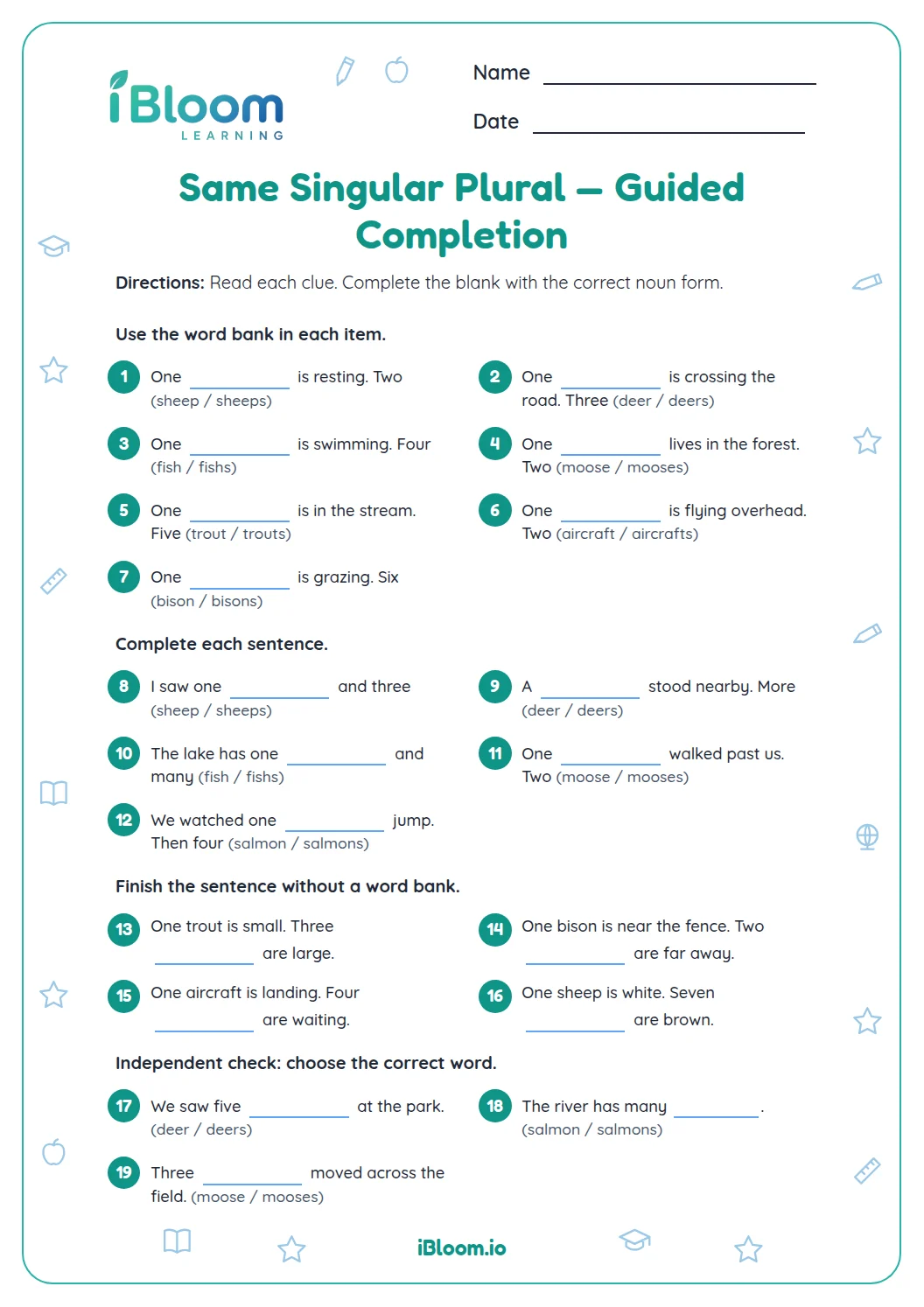
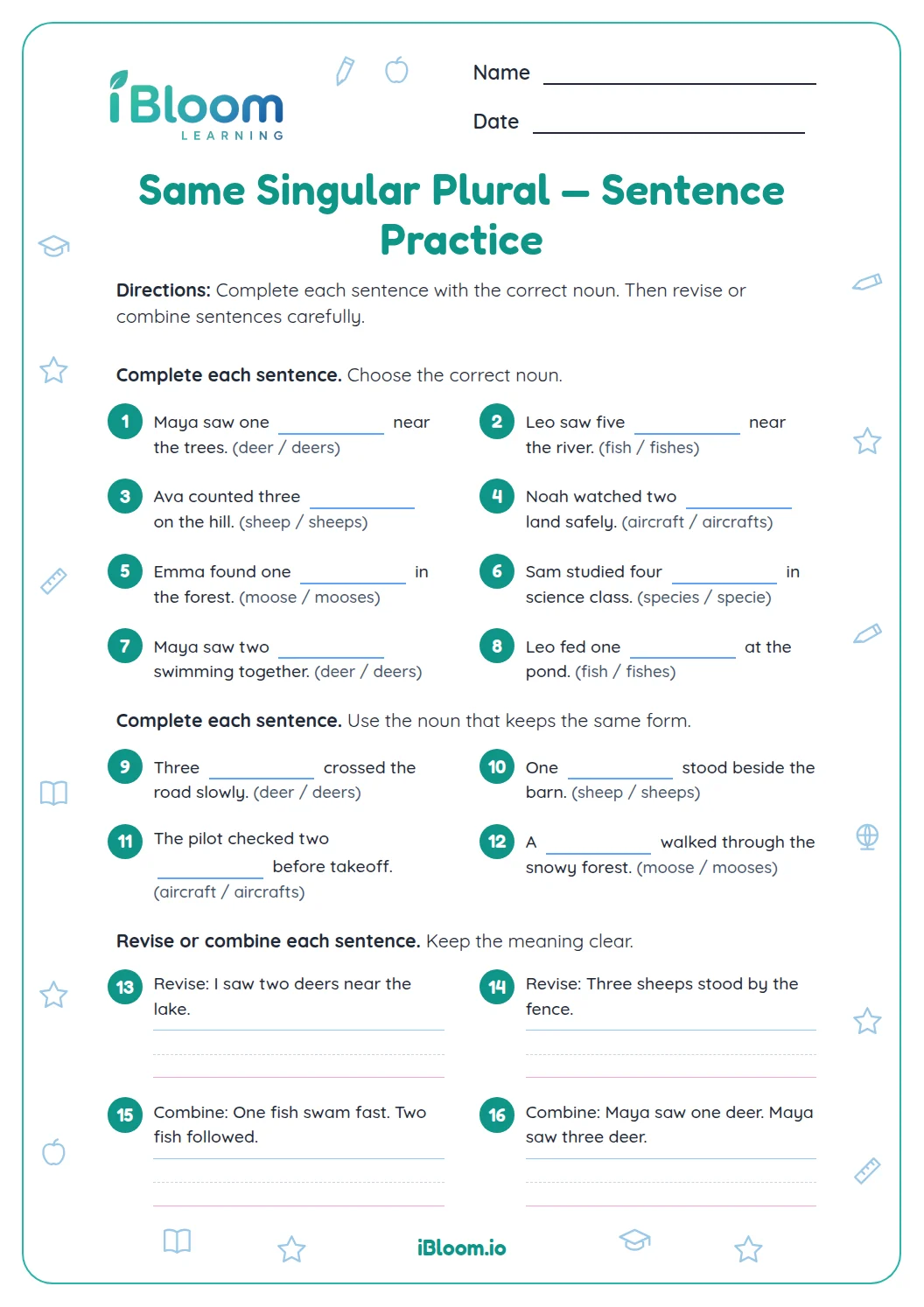
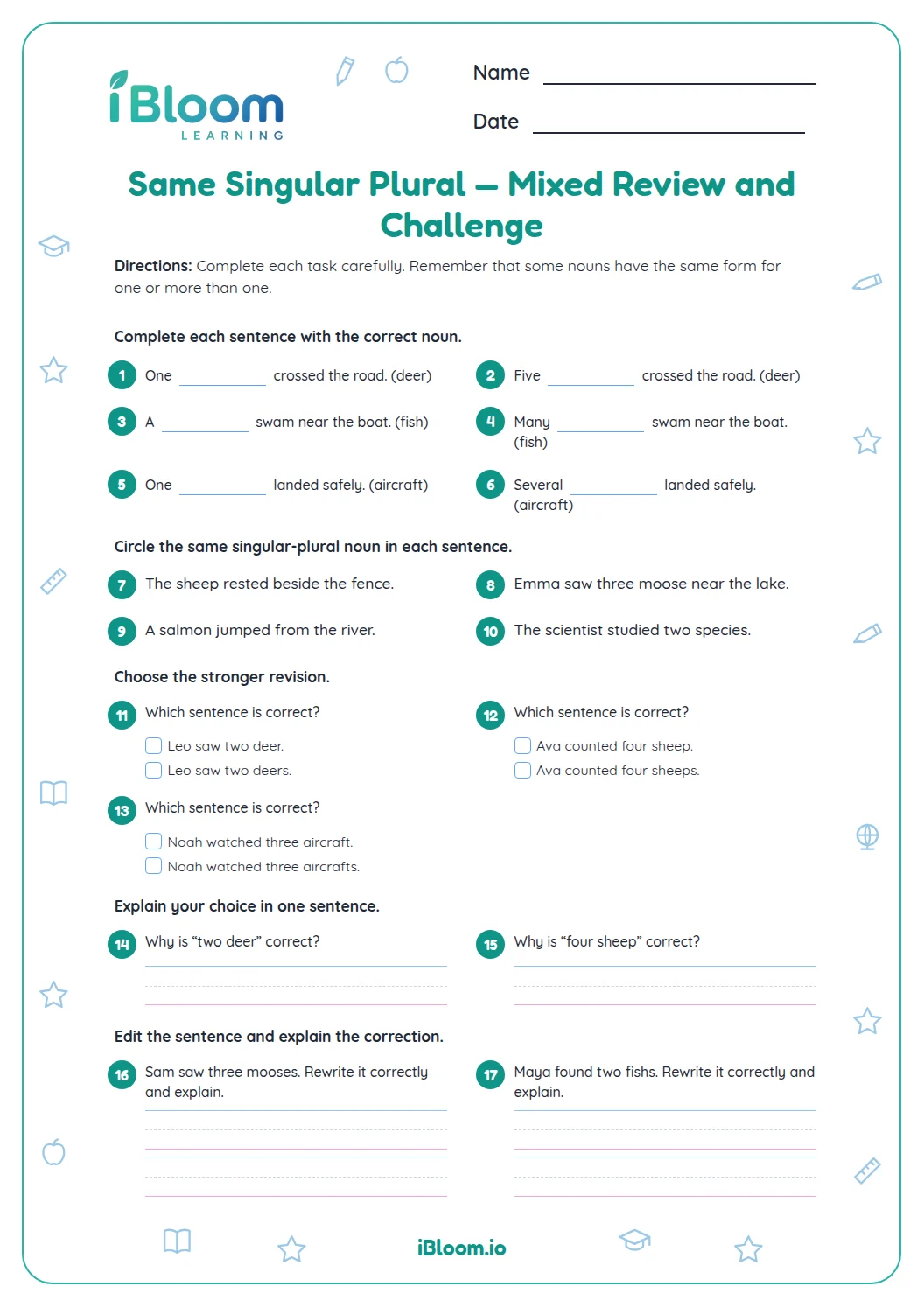
This Grade 3 grammar worksheet focuses on nouns whose spelling stays the same for one or more than one. Students read sentences about deer, sheep, fish, moose and other nouns, then use number words and verbs to recognize singular and plural meaning. The answer key supports quick review. The skill aligns with CCSS L.3.1.b.
Aligned to L.3.1.b
What clues show one or many?
Quantity words such as one, several and many tell how much the noun means. Verbs such as is and are can also help. Same-form nouns do not add an ending, so readers rely on these clues.
- 1“Three deer grazed.” Three and grazed show that deer means more than one.
How do sentences change around the noun?
The noun may stay deer in both cases, while the quantity word and verb change: one deer is, several deer are.
How should students check their choice?
Read the whole sentence and name the quantity before labeling the noun.
How to use this worksheet
- 1Find the noun in the sentence.
- 2Underline a quantity word if there is one.
- 3Check the verb for another clue.
- 4Decide whether the sentence means one or more than one.
- 5Reread the sentence to confirm.
Common mistakes and quick fixes
The mistake
Adding an s to every plural noun.
The fix
Some nouns keep the same form.
The mistake
Choosing by spelling alone.
The fix
Use the sentence meaning and verb clues.
The mistake
Calling “scissors” singular because it names one tool.
The fix
Notice its plural form.
Students use singular and plural noun forms in sentence context.
Recognize nouns whose singular and plural forms are the same.
On this sheet:
Show the official wordingHide the official wording
Form and use regular and irregular plural nouns.
What to practice next
Make more practice
Further reading
Questions parents and teachers ask
How many questions are on the sheet?
There are 14 questions on the sheet. Students classify a noun as singular or plural, count the quantity named, or select the sentence that matches one or more than one. The answer key gives the intended form or sentence. Read the context clues before choosing.
What does same singular and plural form mean?
Some nouns use the same spelling for one and for more than one. Deer is one deer or several deer; sheep is one sheep or a group of sheep. The sentence gives context that shows which meaning the writer intends.
How can a student identify the noun form?
Look at number words such as one, two, several or many. Also check the verb: a singular subject often pairs with is, while a plural subject often pairs with are. These clues help distinguish meaning even when the noun itself does not change.
Does an unchanged noun always mean one?
No. The quantity and sentence context determine whether it means one or more than one. “A fish swims” describes one, while “Four fish swim” describes several. Pay attention to the words around the noun as well as its spelling. Use the verb clue too.
Why is “scissors” included?
Scissors is plural in form even when it names one tool, as in “a pair of scissors.” This example reminds students that noun number depends on English usage and context. The question asks about its form, and the answer key identifies it as plural.