



About this worksheet
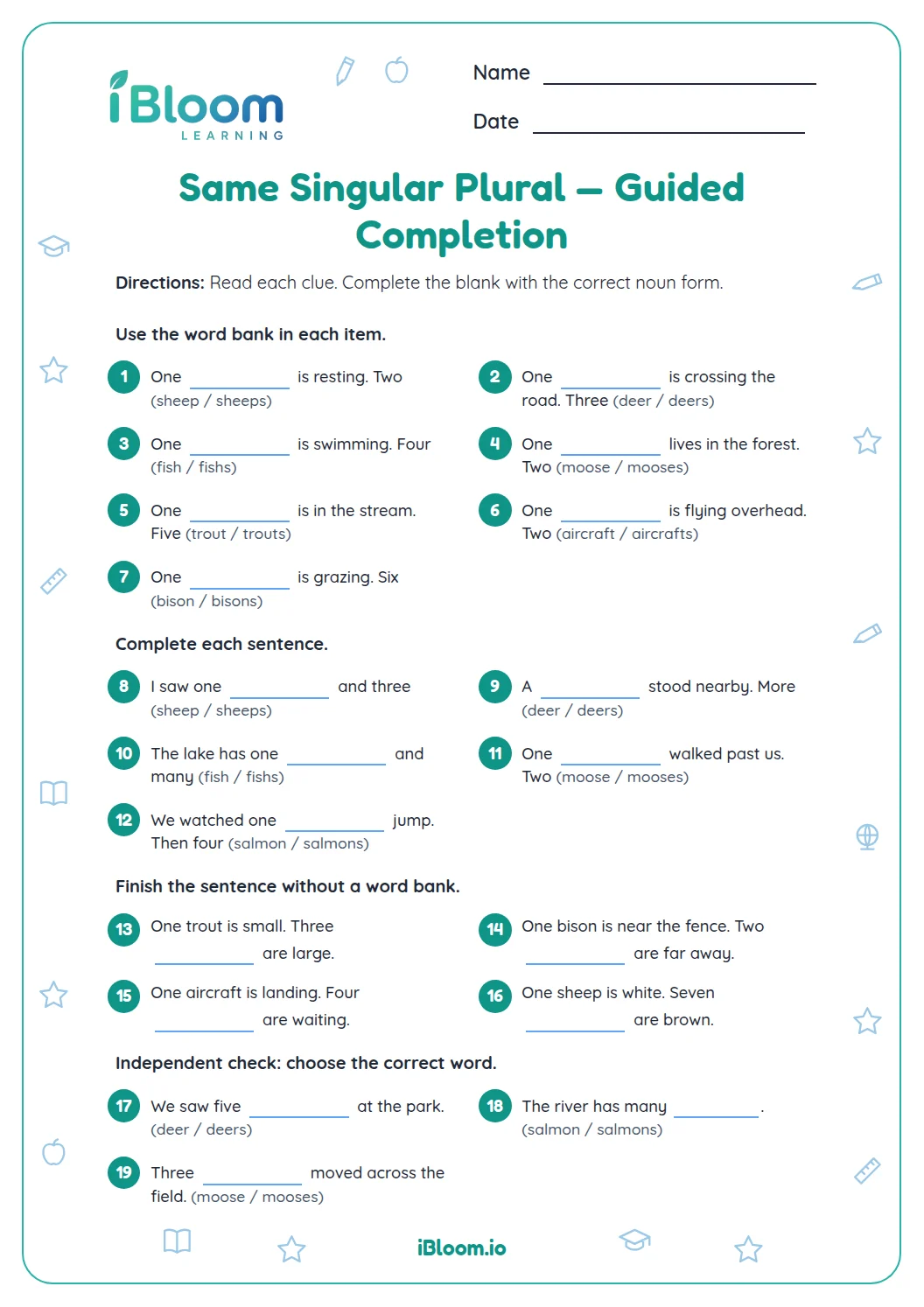
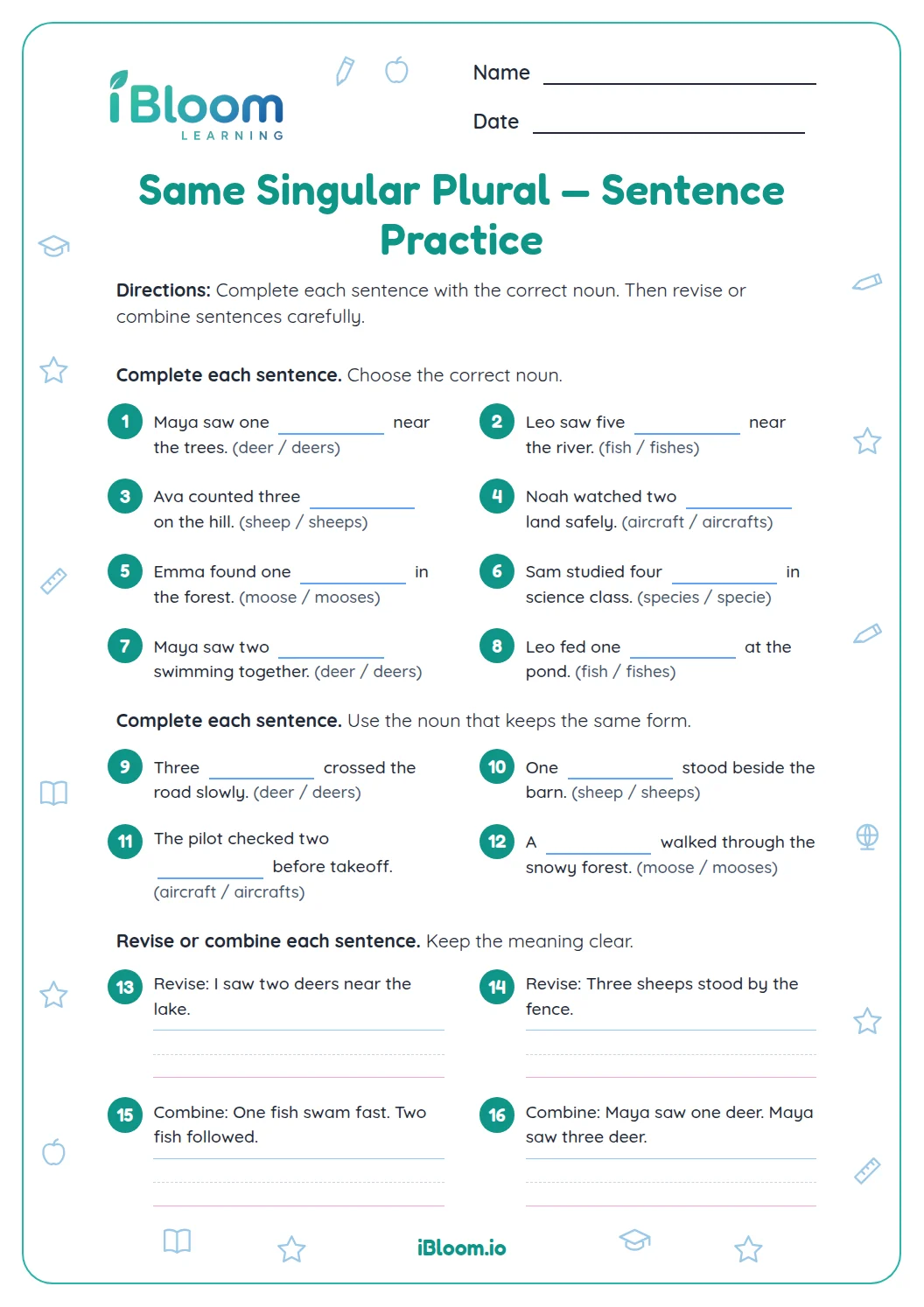
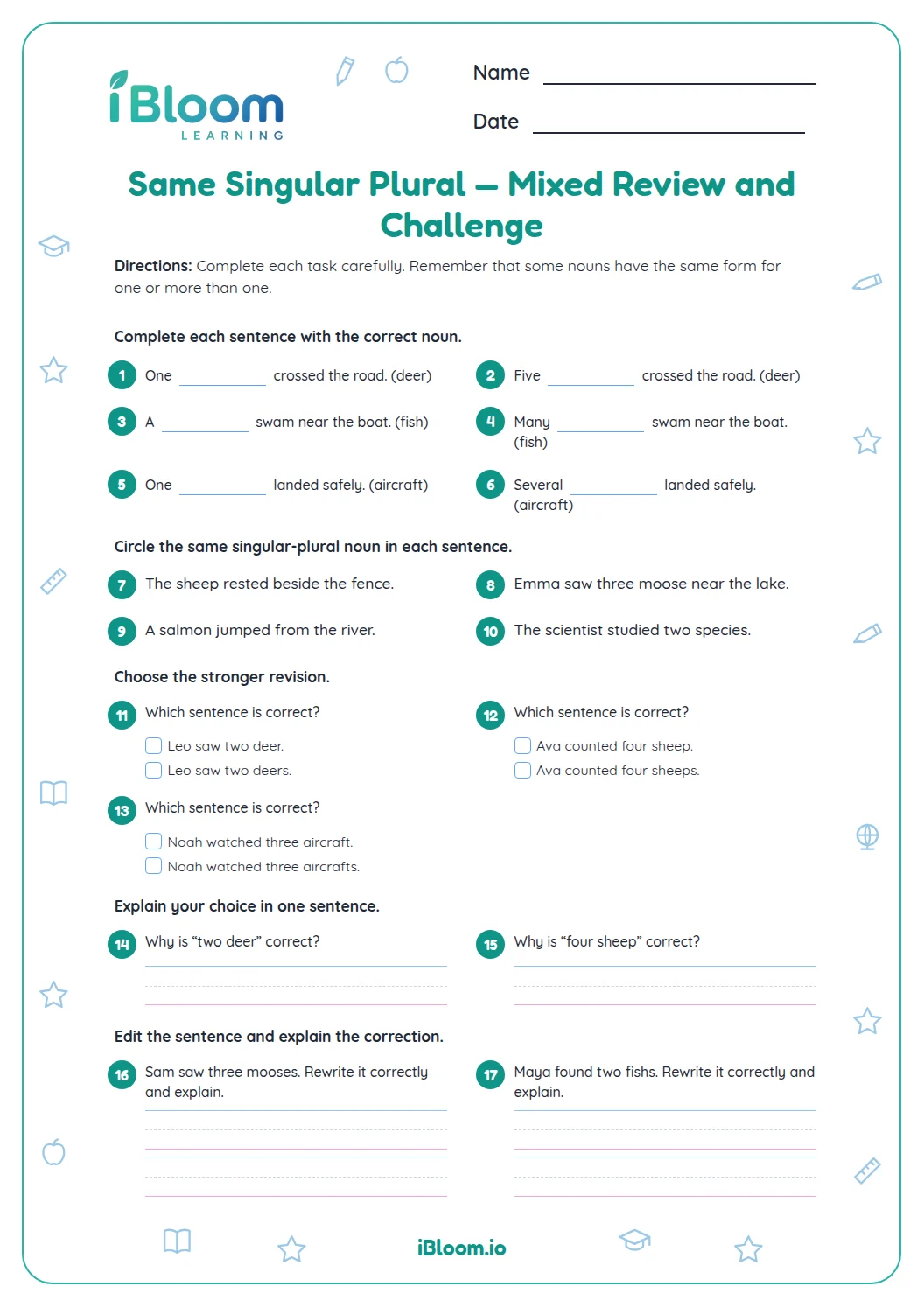
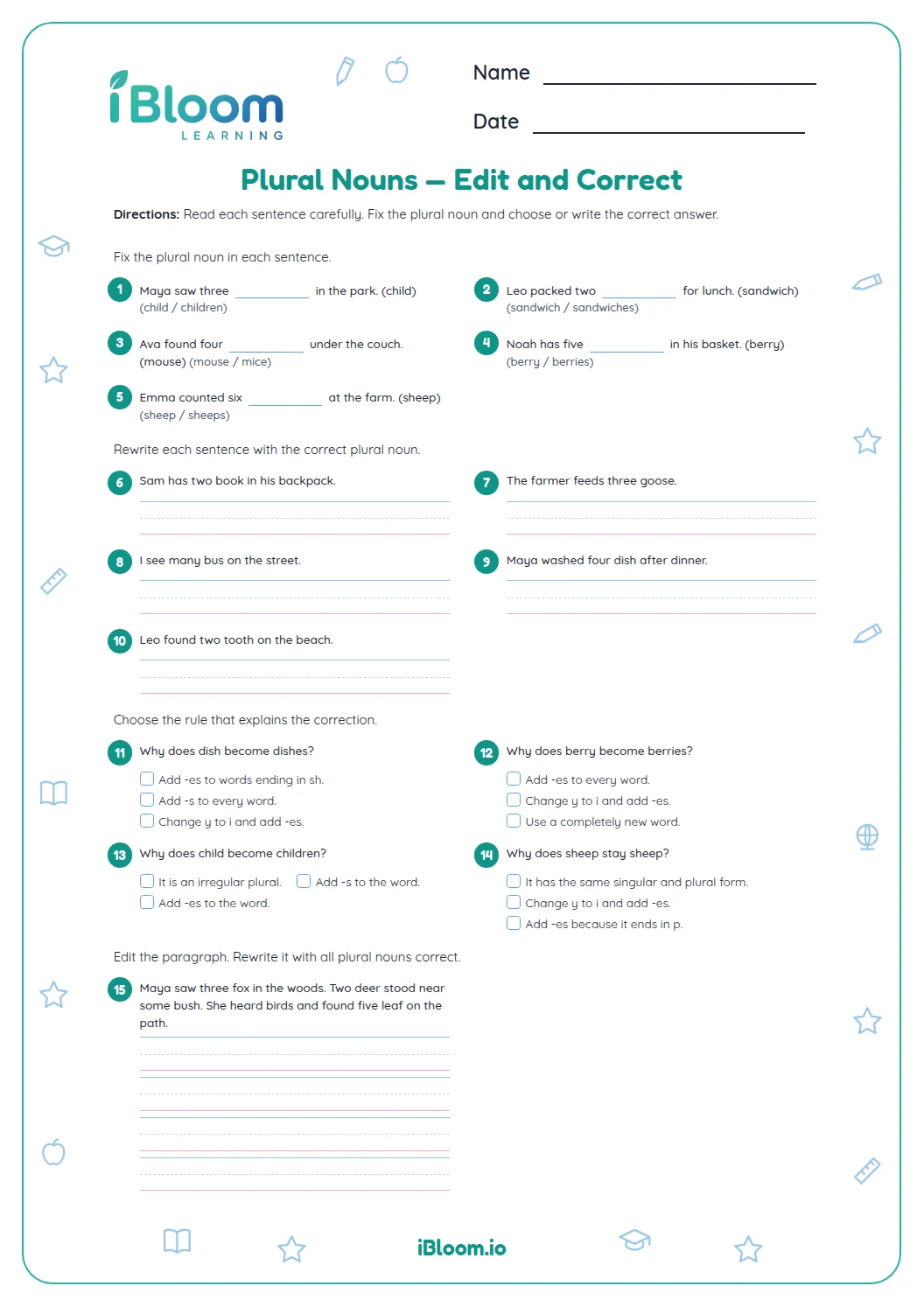
This free printable Grade 3 worksheet practices nouns whose singular and plural forms stay the same: sheep, deer, moose, fish and aircraft. Children complete six sentences, correct five noun-and-verb errors, and write three original responses, including a short connected pair of sentences. Number words help show how many the noun names, while is and are agree with the subject. This supports Common Core L.3.1b and L.3.1f. The answer key includes corrections and sample writing.
Aligned to L.3.1b and L.3.1f
Which nouns keep the same form?
This worksheet practices sheep, deer, moose, fish and aircraft. Write two deer, not two deers, and three moose, not three mooses. The first part places one and many side by side so children can compare the unchanged noun.
The noun form stays the same, but the sentence still needs a verb that agrees with the number being described.
What changes when the noun stays the same?
Number words such as one, two and three tell whether the subject is singular or plural. Use is with a singular subject and are with a plural subject. The correction items ask children to check both the noun and the verb.
- 1Three mooses is on the trail.
- 2Three means more than one.
- 3Keep moose unchanged and use are.
- 4Corrected: Three moose are on the trail.
What should the original sentences include?
The final three questions ask children to write about one and many using target nouns. Each one-and-many sentence should use the same noun spelling and match is or are to its subject. The final prompt asks for two connected sentences about a pond.
The answer key gives samples rather than the only possible wording. Accept other complete sentences when the noun form stays unchanged and the verbs agree.
How can children check their work?
Read the number word and subject together, then choose the verb. After writing, circle the target noun in each sentence and compare its spelling for one and many. The noun should stay the same even when the verb changes.
Check the noun and the verb
- 1Read the number word before filling a blank.
- 2Keep the target noun form unchanged after numbers greater than one.
- 3In correction items, rewrite the whole sentence with the correct noun and verb.
- 4Write complete one-and-many sentences using the required nouns.
- 5Read each sentence again and check capitals, verbs and end punctuation.
Noun and verb errors to check
The mistake
Adding s to deer or aircraft after a number.
The fix
Keep the form unchanged: two deer and two aircraft.
The mistake
Changing moose to meese by copying goose and geese.
The fix
Use the practiced pair: one moose, three moose.
The mistake
Using is with three sheep because sheep has no s ending.
The fix
Use the number word to decide: three sheep are.
Common Core alignment
Use sheep, deer, moose, fish and aircraft as singular and irregular plural nouns.
On this sheet: Children complete and write sentences with nouns whose plural form stays unchanged.
Show the official wordingHide the official wording
Form and use regular and irregular plural nouns.
Match is and are to singular or plural subjects.
On this sheet: Children correct agreement errors and choose singular or plural wording in their own sentences.
Show the official wordingHide the official wording
Ensure subject-verb and pronoun-antecedent agreement.*
What to practice next
Make more practice
Further reading
Questions parents and teachers ask
Which nouns are practiced on this page?
The five nouns are sheep, deer, moose, fish and aircraft. Each can name one or more than one without changing its form. The first six prompts provide the target noun, and later questions ask children to correct sentences and use these forms in original writing.
Should a child add s after a number such as three?
No. For these target words, the spelling stays the same after a number greater than one: three sheep, three deer and three moose. Have the child compare the singular and plural phrase side by side, then read the number word to decide whether the verb should be is or are.
Why does the worksheet include is and are?
The verb shows whether the subject names one or more than one. One sheep is by the fence, while three sheep are grazing. Several correction items include both a noun-form issue and an agreement issue, so children should identify the number before rewriting.
Do original sentences have to match the answer key?
No. The key gives sample sentences. A child’s answer can use different details if it includes the required noun, keeps that noun’s spelling the same for one and many, and matches the verbs to the subjects. The final response should contain two connected sentences about a pond.
How can I help if a child writes meese?
Say and write one moose and three moose together. Explain that irregular plural nouns have different patterns, so knowing goose and geese does not tell us how moose changes. This page repeats the unchanged form in completions, sentence corrections and writing.