






About this worksheet
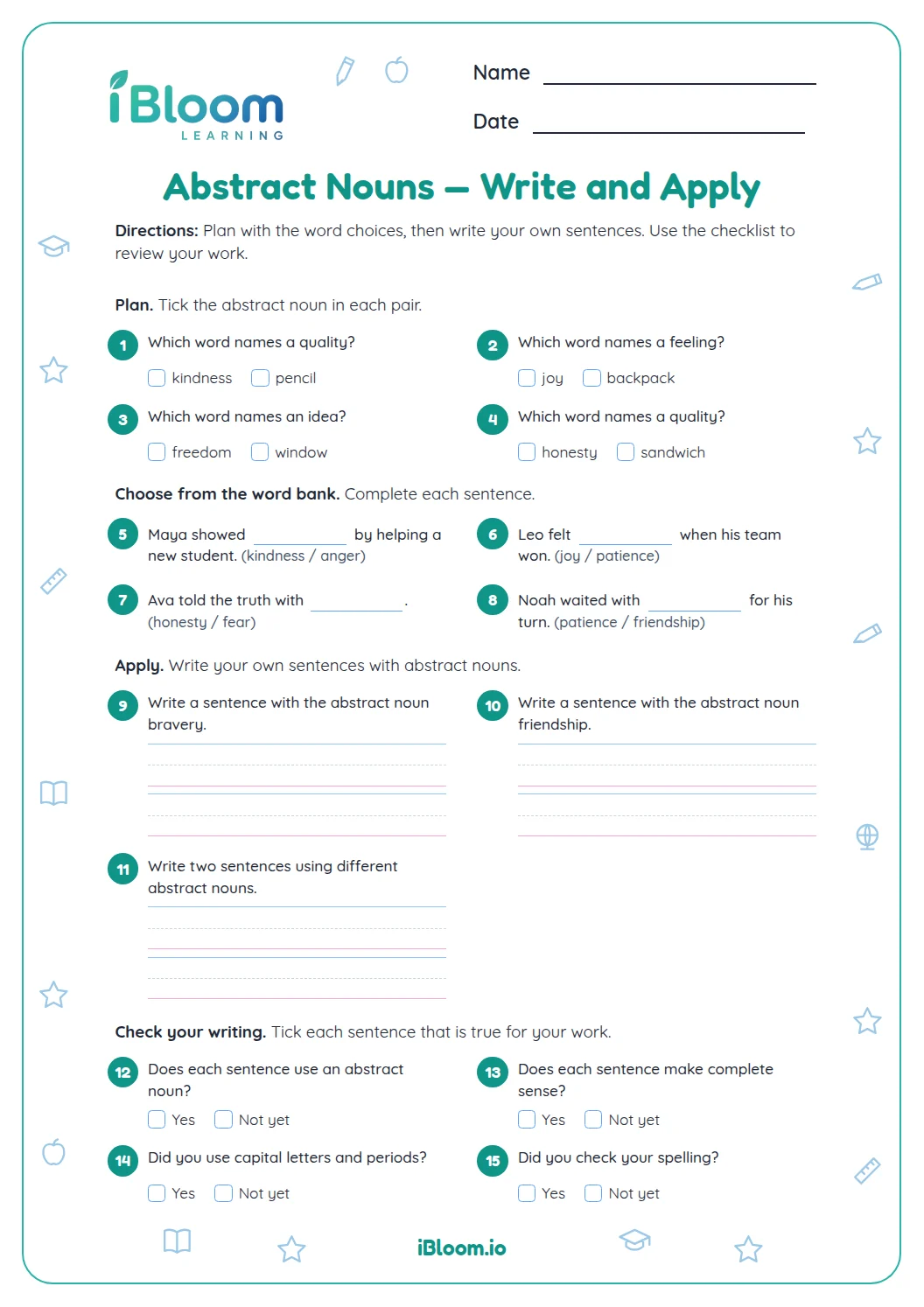
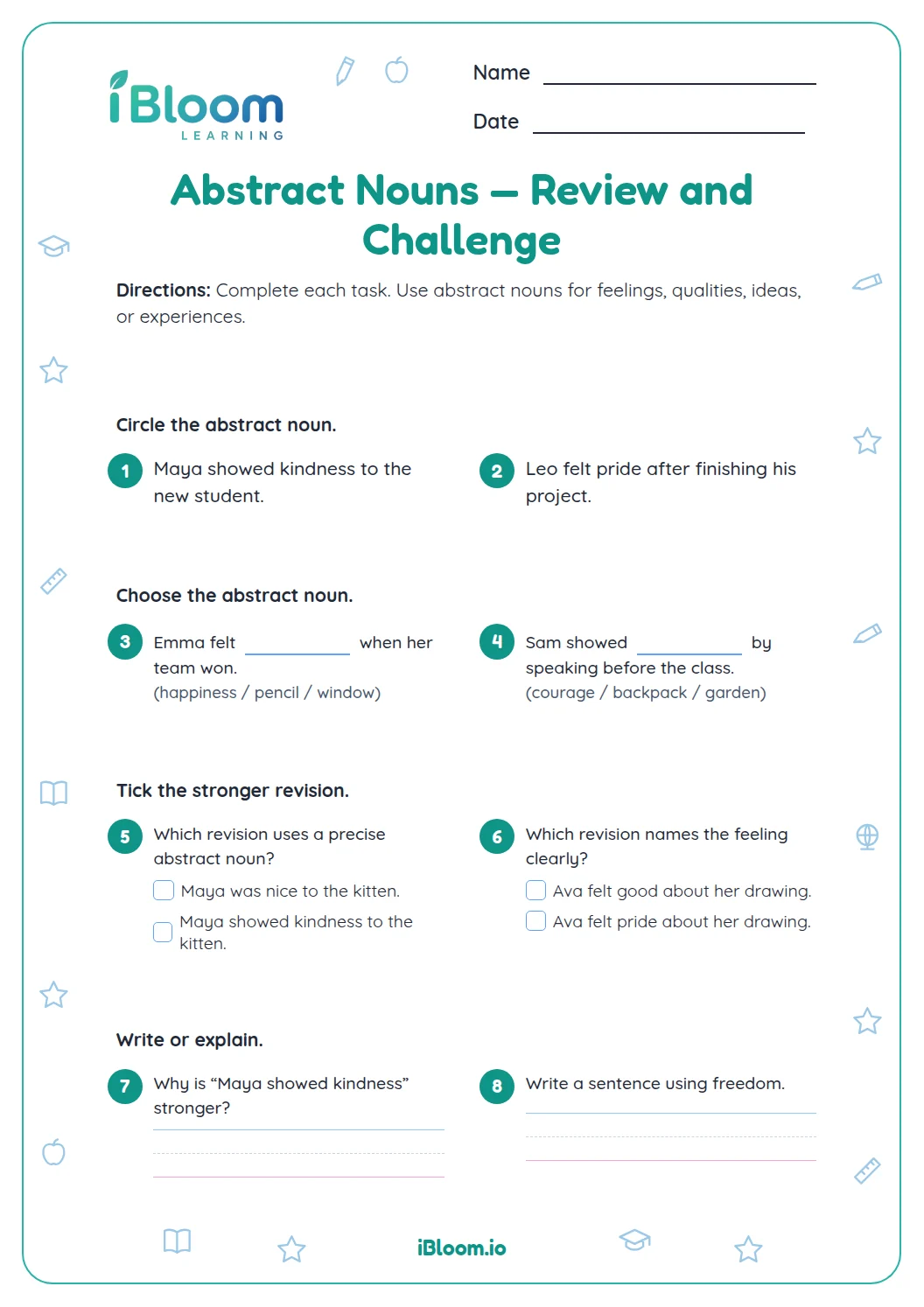
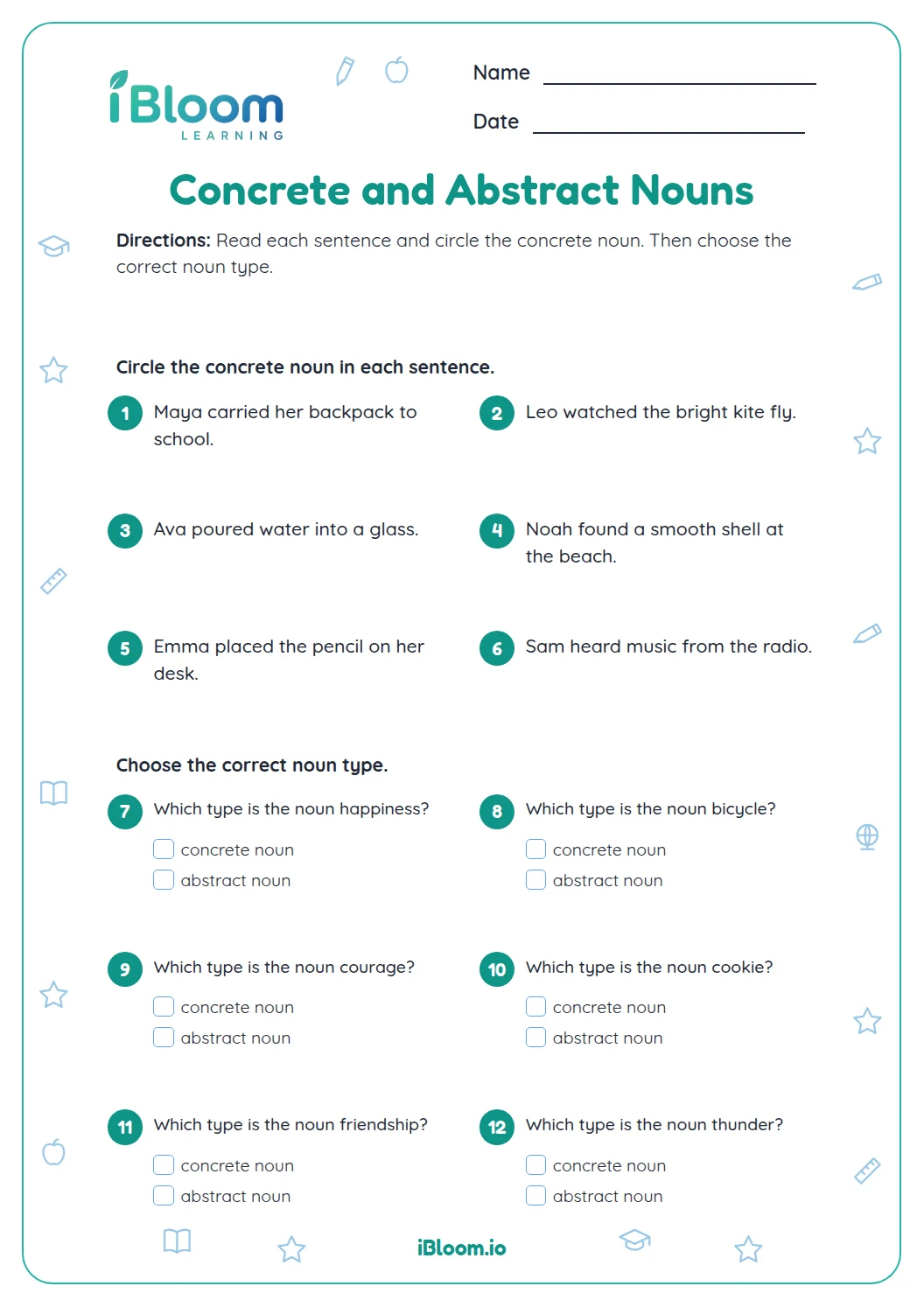
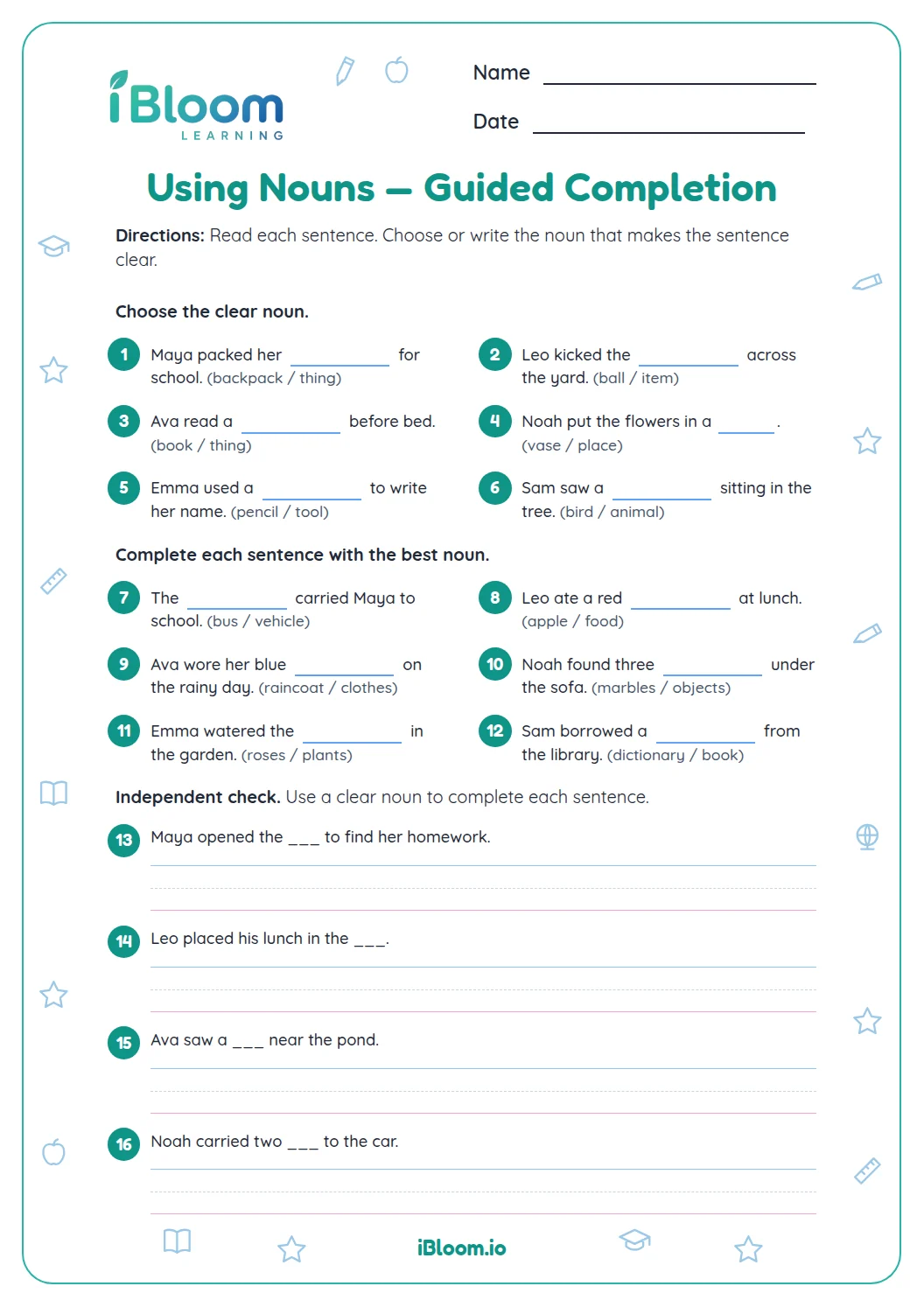
This free Grade 3 worksheet practices abstract nouns in context. Learners classify words such as joy, bravery, teacher, and sandwich, identify abstract nouns in sentences, correct mixed-up labels, and edit sentences that use an adjective where a noun is needed. The sentence practice connects to CCSS L.3.1.a, explaining how nouns work in particular sentences. The answer key gives the target noun forms and sample sentence corrections.
Aligned to L.3.1.a
How can I tell an abstract noun from a concrete noun?
An abstract noun names a feeling, quality, or idea. A concrete noun names a person, place, or thing. Part A asks learners to classify eight words, including “bravery” and “teacher.”
- 1“Bravery” names a quality, so it is abstract.
How do the noun clues and labels work?
Part B asks learners to find abstract nouns in two sentences. Part C asks them to correct two noun labels. Classify the noun itself, not the person or thing connected with it.
What changes when I edit a sentence?
Part D replaces an adjective with a related abstract noun in four sentences. For example, “Maya showed brave” becomes “Maya showed bravery.” The answer key gives the target noun for each prompt.
How to use this worksheet
- 1Read the target word in its sentence or clue.
- 2Ask whether it names a feeling, quality, or idea, or a tangible person or thing.
- 3For Part B, find each abstract noun; in Part C, correct each noun label.
- 4In Part D, replace each adjective with its related abstract noun.
- 5Read each revised sentence aloud and compare it with the key.
Common mistakes and quick fixes
The mistake
Calling “teacher” abstract because the teacher has feelings.
The fix
Classify the noun itself: teacher names a person, so it is concrete.
The mistake
Writing “brave” when a sentence needs a noun.
The fix
Use the related noun “bravery” after a verb such as showed.
The mistake
Changing the whole sentence when only the noun form needs correction.
The fix
Keep the sentence meaning and replace only the incorrect word.
Common Core alignment
This practice asks learners to explain how nouns function in particular sentences.
Identify nouns that name feelings and qualities in context.
On this sheet: The worksheet asks learners to practice this skill directly.
Show the official wordingHide the official wording
Explain the function of nouns, pronouns, verbs, adjectives, and adverbs in general and their functions in particular sentences.
What to practice next
Make more practice
Further reading
Questions parents and teachers ask
What does abstract noun mean?
An abstract noun names a feeling, quality, or idea rather than a tangible person, place, or thing. Pride, kindness, and bravery are examples. The worksheet contrasts those nouns with concrete nouns such as teacher, table, and backpack, then asks learners to edit sentences.
What does “edit and correct” mean on this page?
Learners first correct noun labels and find abstract nouns in sentences. In the final four items, they replace an adjective with its related noun form, such as changing brave to bravery. The answer key shows the target word for each sentence.
How is “brave” different from “bravery”?
Brave is an adjective that describes someone. Bravery is a noun naming the quality. In “Maya showed bravery,” the noun names what Maya showed, so bravery fits where the sentence needs a noun. Question 11 asks the learner to make that change.
How many questions does the worksheet include?
There are 14 questions across three parts: six noun classifications, four noun clues or label corrections, and four sentence edits. The printable has two worksheet pages and a separate two-page answer key, with examples that move from word meaning to sentence editing.
What should I do if a corrected sentence uses different words?
Check that the response keeps the original idea and uses an abstract noun in the sentence. The key gives sample corrections, but a learner may use another clear sentence with the correct noun form. Ask which feeling or quality the noun names.