



About this worksheet
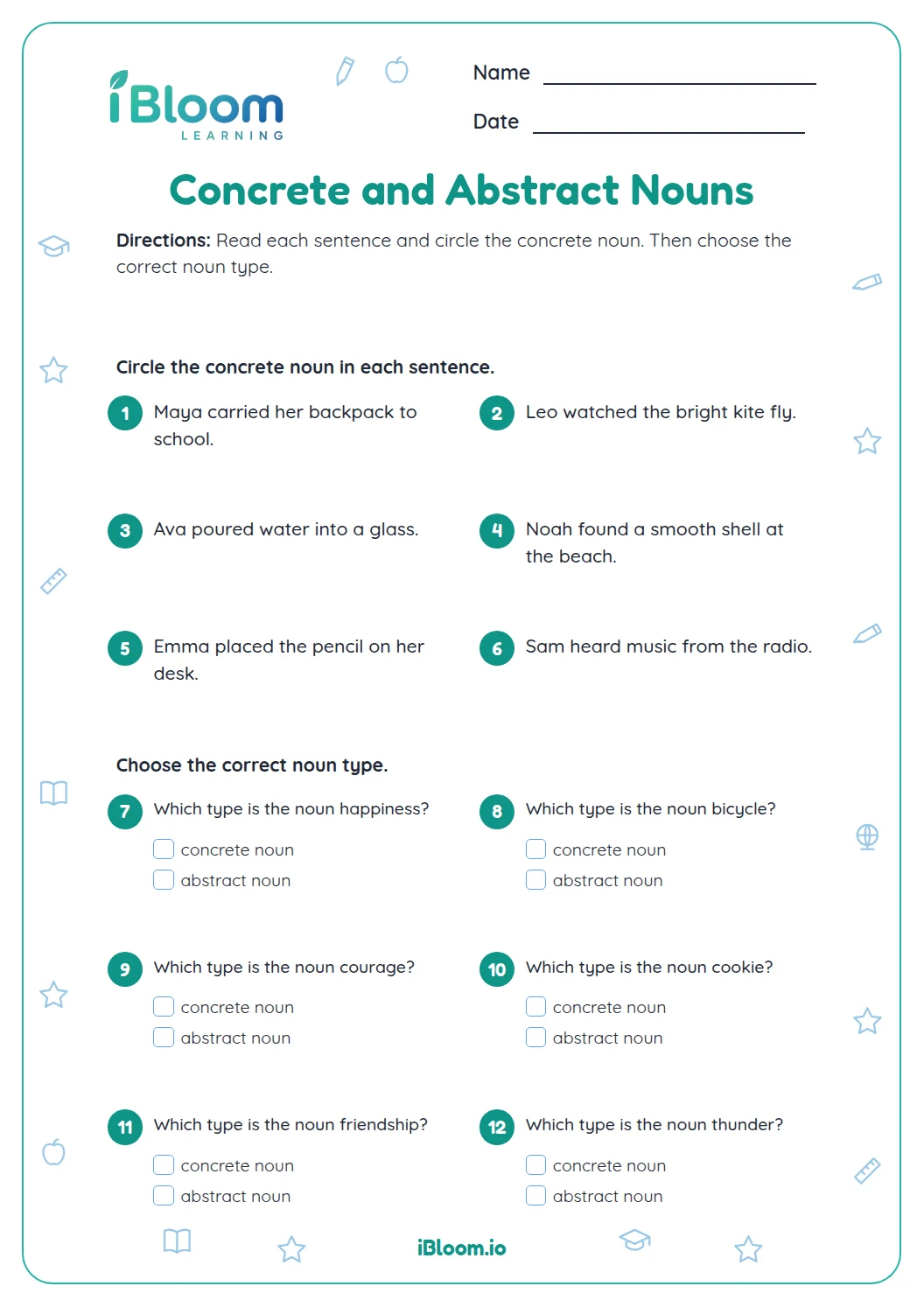
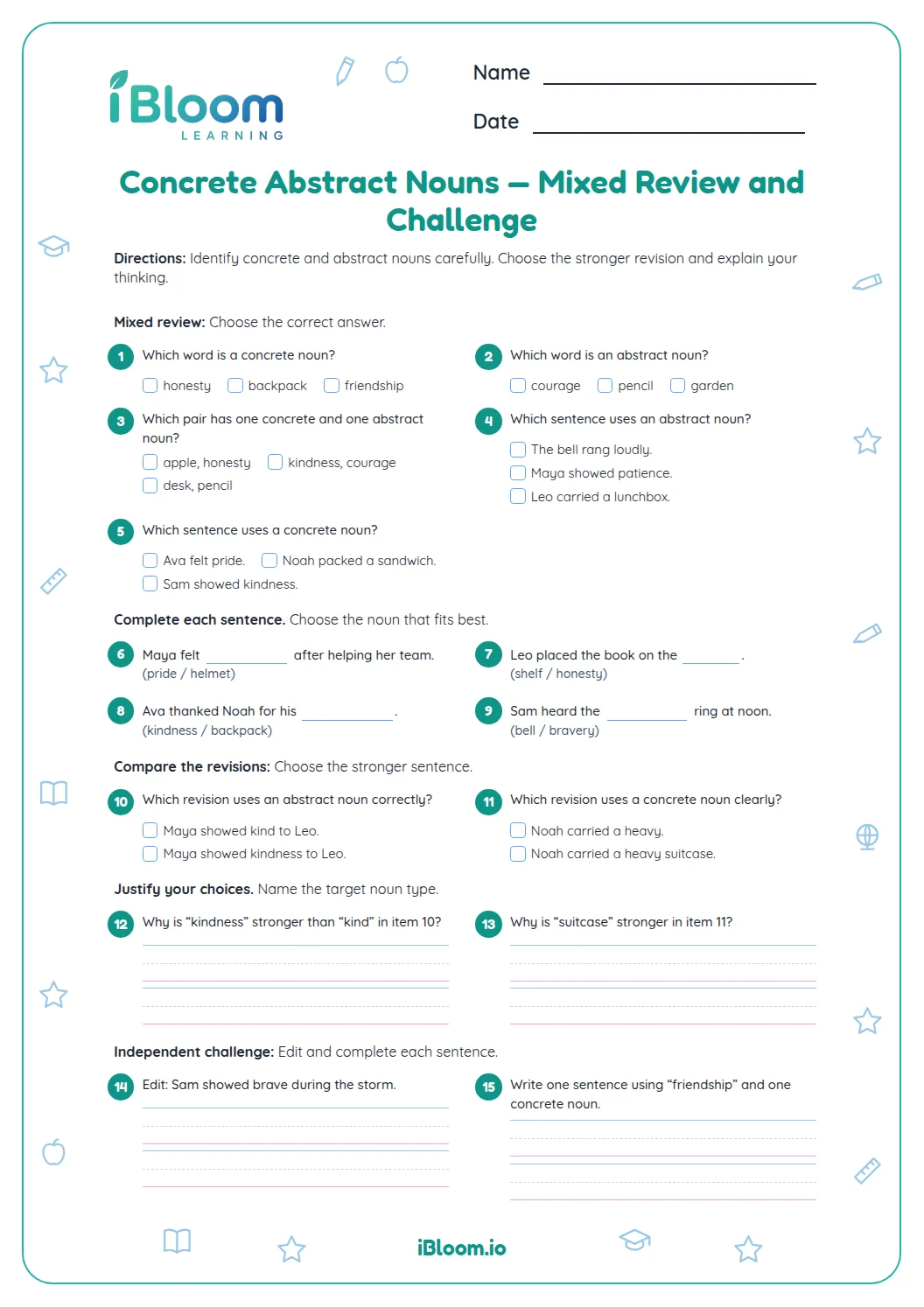
This Grade 3 worksheet guides learners to tell concrete nouns from abstract nouns in short sentence contexts. Concrete nouns name people, places, or things experienced through the senses; abstract nouns name ideas, feelings, and qualities. Fourteen completions and choices come with a separate answer key.
Aligned to L.3.1.a
How can you tell which kind of noun it is?
Ask whether the noun names a person, place, or thing you can experience through a sense. A pencil can be seen and held, so it is concrete. Kindness names a quality, so it is abstract. Sentence context helps identify what the noun names.
- 1In “The puppy showed joy,” puppy is a ___ noun.
- 2A puppy is an animal you can see and hear.
- 3Puppy is a concrete noun.
What noun clues are on the worksheet?
Part A completes statements about nouns in sentences, including puppy and joy. Part B chooses an abstract or concrete noun from three options. Part C returns to sentence clues, including excitement and bell. The 14 questions ask learners to classify the noun being discussed.
How can an adult help with a tricky word?
Ask what the word names in that sentence. A noun can name an idea even though it does not name an object to touch, and a sound such as music is concrete because it can be heard. Have the learner explain the clue before checking the key.
How to use this worksheet
- 1Find the noun named in the question or sentence.
- 2Ask whether it names a person, place, thing, feeling, idea, or quality.
- 3Use the sentence clue to decide what the noun names.
- 4Choose or write concrete or abstract as requested.
- 5Explain one clue and check the response with the answer key.
Common mistakes and quick fixes
The mistake
Calling a noun abstract just because it names a feeling in a sentence.
The fix
Classify the noun itself: joy names a feeling, so it is abstract.
The mistake
Thinking concrete means only something that can be touched.
The fix
Concrete nouns can be seen, heard, smelled, tasted, or touched; music is heard.
The mistake
Classifying the whole sentence instead of the named word.
The fix
Find the specific noun named in the prompt, then decide what that noun represents.
Common Core alignment
This printable practices the standard below through focused questions.
Explain how nouns name people, places, things, and ideas in sentences.
On this sheet: The prompts classify nouns by what they name in short sentences.
Show the official wordingHide the official wording
Explain the function of nouns, pronouns, verbs, adjectives, and adverbs in general and their functions in particular sentences.
What to practice next
Make more practice
Further reading
Questions parents and teachers ask
How many questions are included?
The worksheet has 14 questions in three parts. Learners complete noun descriptions, choose a concrete or abstract noun, and classify nouns in sentence contexts. A separate answer key lists the intended response for each item. Each prompt names the word to classify so learners can focus on its meaning.
Is music a concrete or abstract noun?
Music is concrete in the question on this page because it can be heard. Concrete nouns can be experienced through any of the senses, not only touched. Abstract nouns instead name ideas, feelings, or qualities, such as honesty or courage.
Can a noun be abstract if it is in a sentence about an action?
Yes. Classify the noun by what it names. In “The puppy showed joy,” puppy names an animal and is concrete, while joy names a feeling and is abstract. The action in the sentence does not change the noun’s category.
What does “guided completion” mean on this page?
Several prompts provide a sentence clue and a blank for the noun type, so learners can use meaning to complete the response. Other items provide choices. The format moves from supported examples toward identifying the noun type in a sentence.
Does the answer key accept other examples?
The answer key gives the intended response for the printed questions. Since learners classify named words rather than invent their own examples, the answers are concrete or abstract, or the one matching word choice. Discuss the sentence clue if a response needs review.