




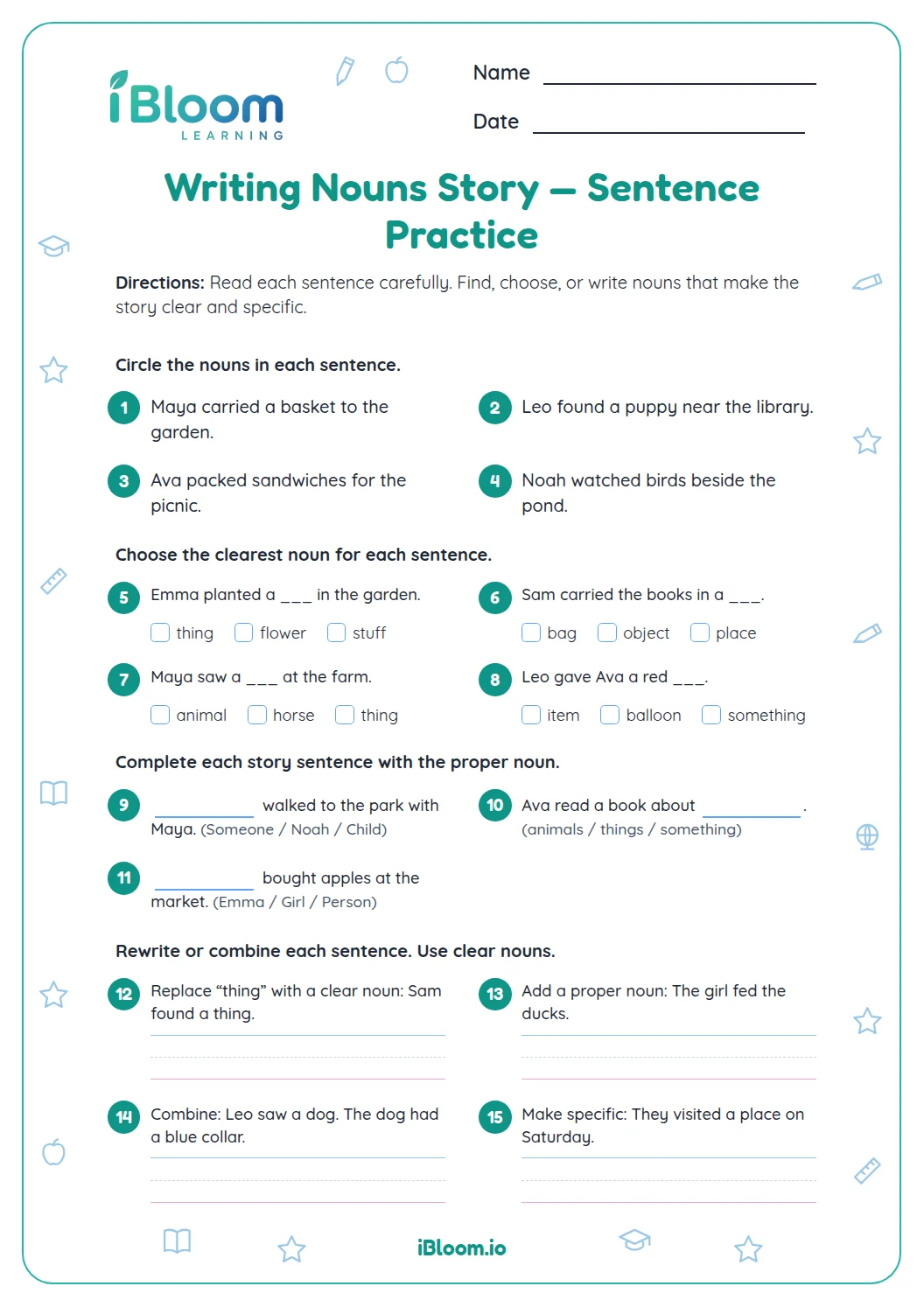
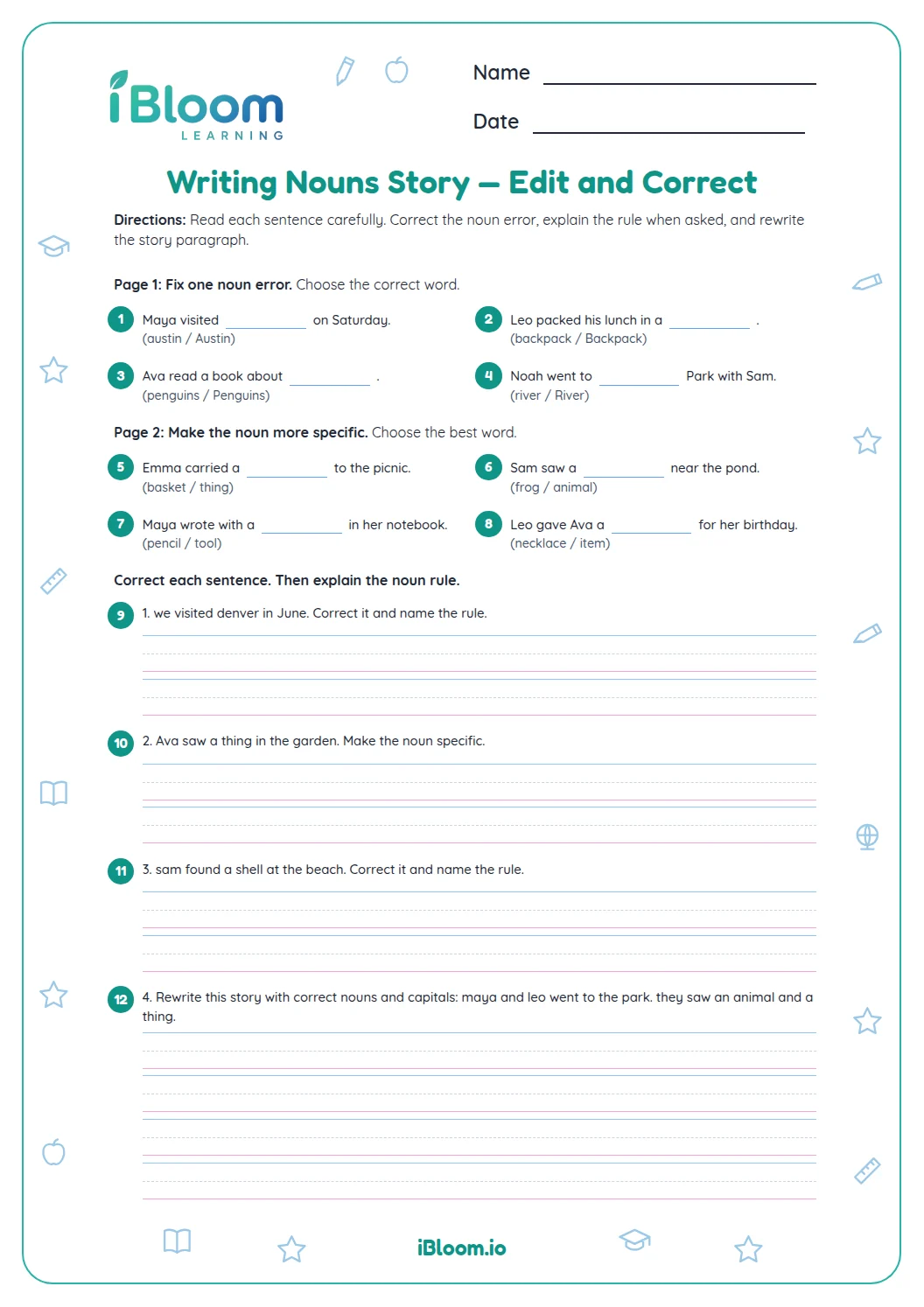
About this worksheet
This printable Grade 3 worksheet gives children focused practice with abstract nouns. It includes 16 questions across 8 noun recognition choices, 8 sentence identification items, moving from recognition to using the skill in new examples. The answer key is provided on its own page. The worksheet aligns with L.3.1.
Aligned to L.3.1
What makes a noun abstract?
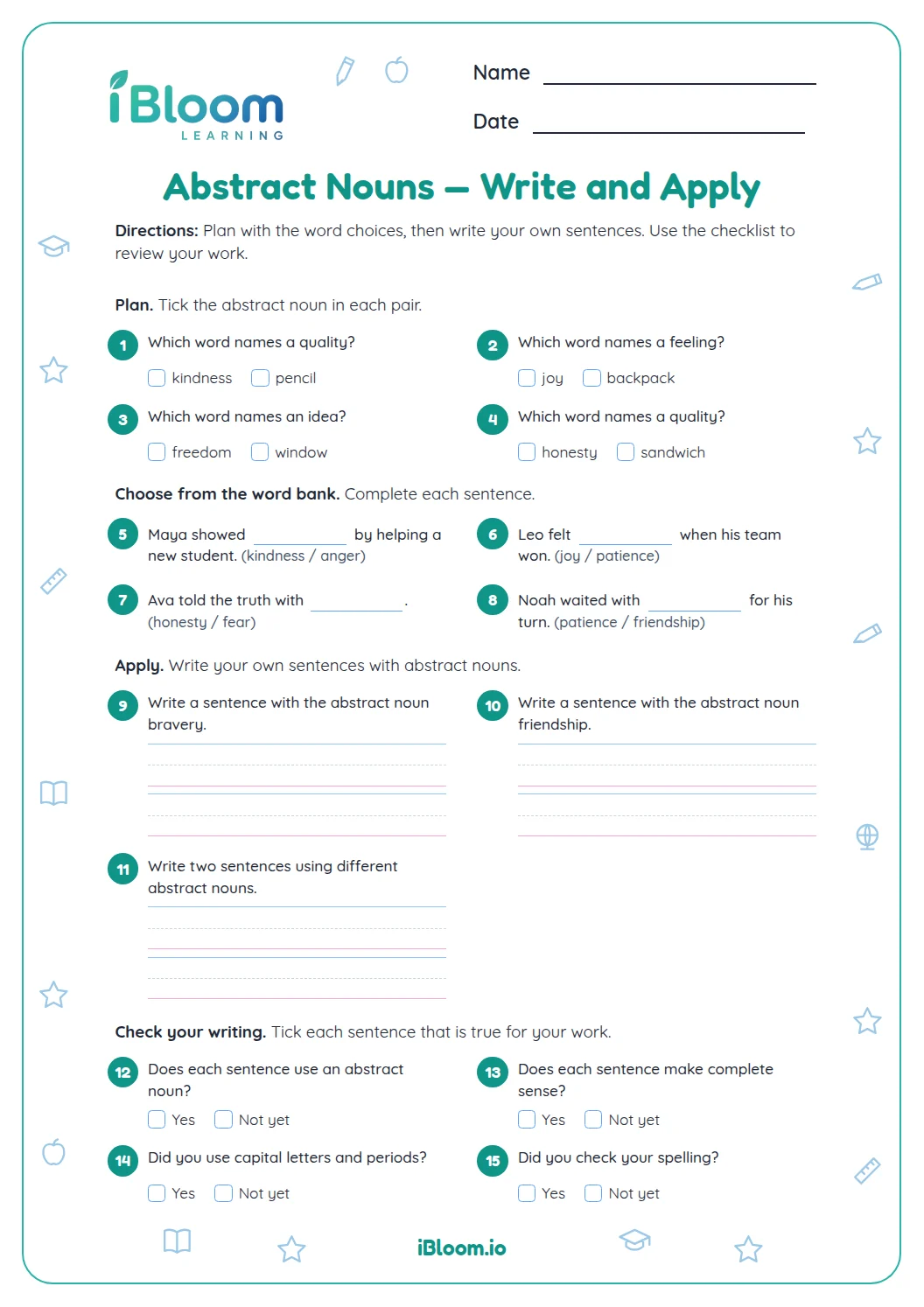
An abstract noun names an idea, feeling, quality, or state rather than a person, place, or thing that can be touched. Bravery, joy, patience, and childhood are abstract nouns. A backpack, garden, or pencil is concrete. Part A asks children to identify an abstract noun among three choices.
How can a sentence help identify one?
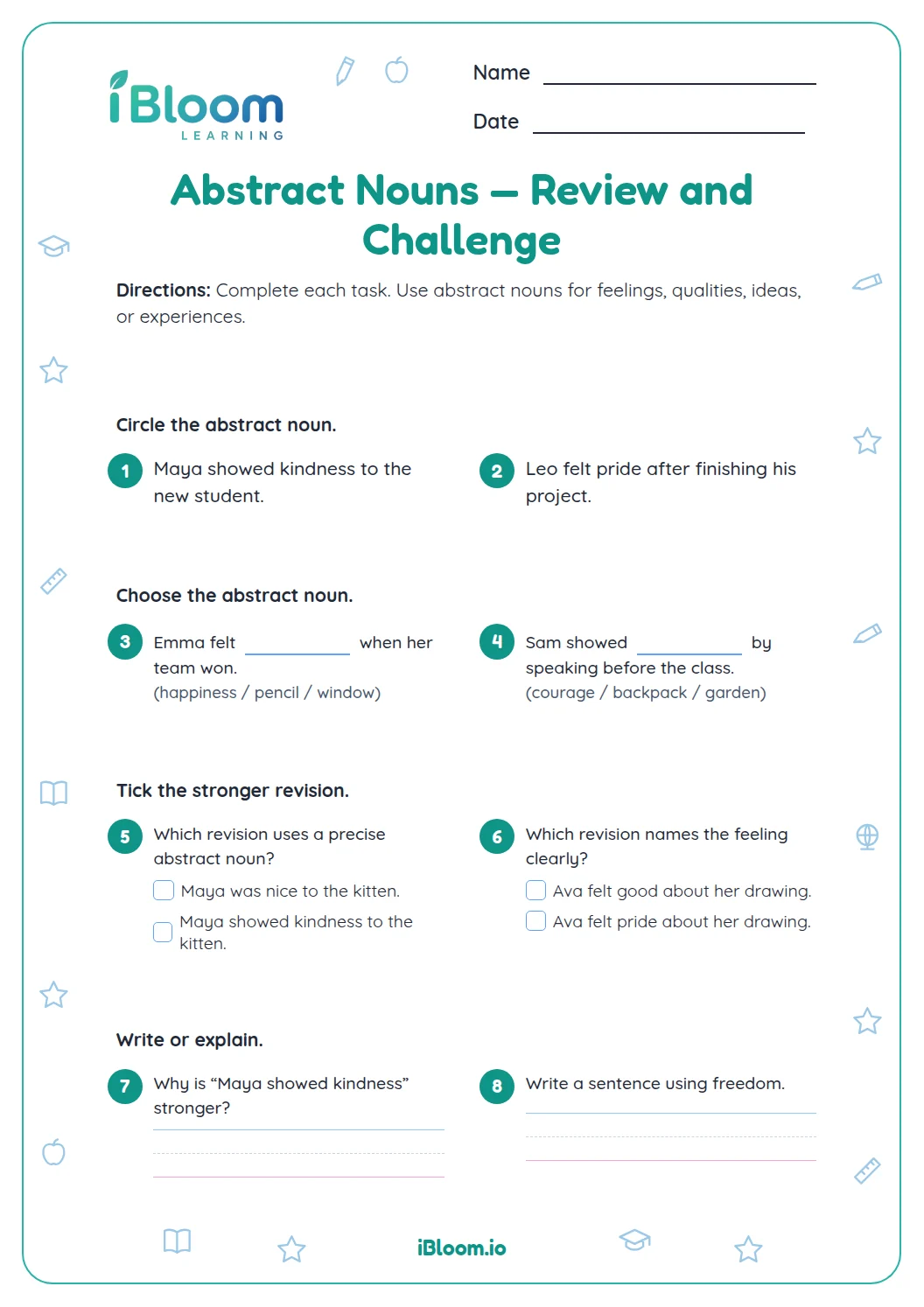
Read the whole sentence, then ask what kind of thing the noun names. In “The team showed courage,” courage names a quality, not an object. Part B places each abstract noun in a short sentence and asks children to circle that word.
- 1The team showed courage
- 2Courage names a quality.
- 3Circle courage.
What does this worksheet include?
Part A has eight recognition questions about feelings, ideas, and qualities. Part B has eight short sentences containing nouns such as excitement, friendship, honesty, success, childhood, loyalty, and patience. The key shows each selected word.
How to use this worksheet
- 1Review the difference between an idea word and a touchable object.
- 2For each choice group, say what each word names.
- 3In Part B, read the whole sentence before circling a noun.
- 4Check the key and explain why the selected word is abstract.
Common mistakes and quick fixes
The mistake
Choosing a concrete object because it is a noun.
The fix
Ask whether the word names something touchable or an idea, feeling, or quality.
The mistake
Circling the first noun in a sentence.
The fix
Check what each noun names; a sentence can include people or things as well as an abstract noun.
The mistake
Mistaking an adjective for an abstract noun.
The fix
Choose the noun itself, such as honesty, rather than a describing word like honest.
Common Core alignment
This worksheet practices the listed Grade-level language or mathematics skills through short, varied items.
Apply standard English grammar and usage, including abstract nouns.
On this sheet: Every item practices the Grade 3 grammar skill of recognizing abstract nouns.
Show the official wordingHide the official wording
Demonstrate command of the conventions of standard English grammar and usage when writing or speaking.
What to practice next
Make more practice
Further reading
Questions parents and teachers ask
What is an abstract noun for Grade 3?
An abstract noun names an idea, feeling, quality, or state. Courage, honesty, friendship, and childhood are examples on this sheet. Children contrast those words with concrete nouns such as pencil, garden, and backpack, which name things that can be seen or touched.
What should my child circle in Part B?
Circle the abstract noun in each sentence. For example, in “The team showed courage,” courage names a quality. The answer key identifies one word in each of the eight sentences, including excitement, friendship, honesty, success, childhood, loyalty, and patience. Ask whether the word names an idea, feeling, or quality.
Are concrete nouns included?
Concrete words appear as distractors in Part A so learners can distinguish them from abstract nouns. Words such as pencil, garden, and spoon name objects. The directions ask for the abstract noun, so choose a word naming an idea, feeling, or quality.
Does this worksheet include an answer key?
Yes. The separate answer key marks the correct choice for the eight multiple-choice items and circles the target word in each of the eight sentences. Use it after practice to talk through why an abstract noun names something a person thinks or feels.
How can I help if my child is unsure?
Ask what the word names and whether someone could touch it. A pencil can be held, while patience is a quality and joy is a feeling. Then reread the sentence and use the surrounding words to make sure the chosen noun fits.