
About this worksheet
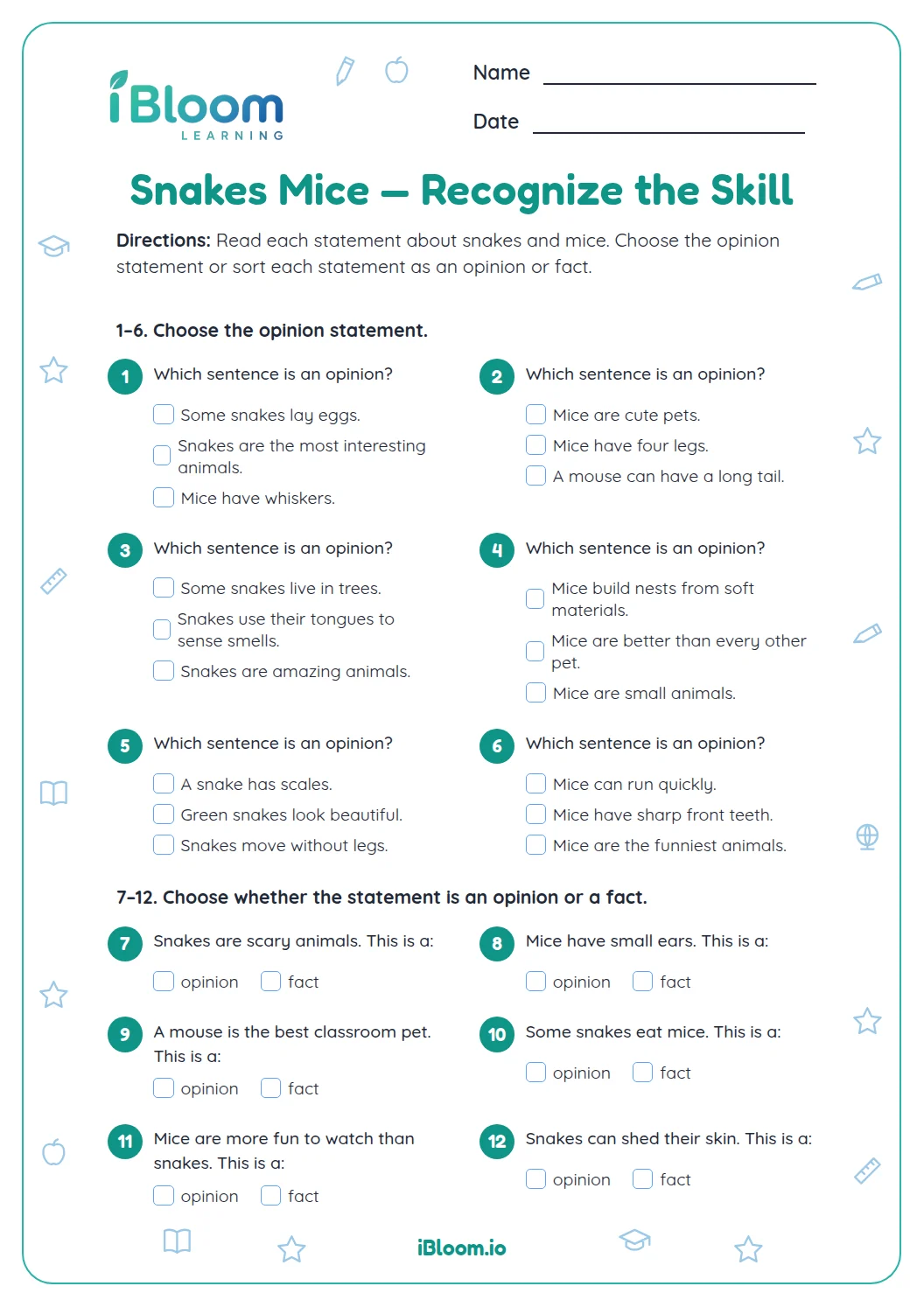
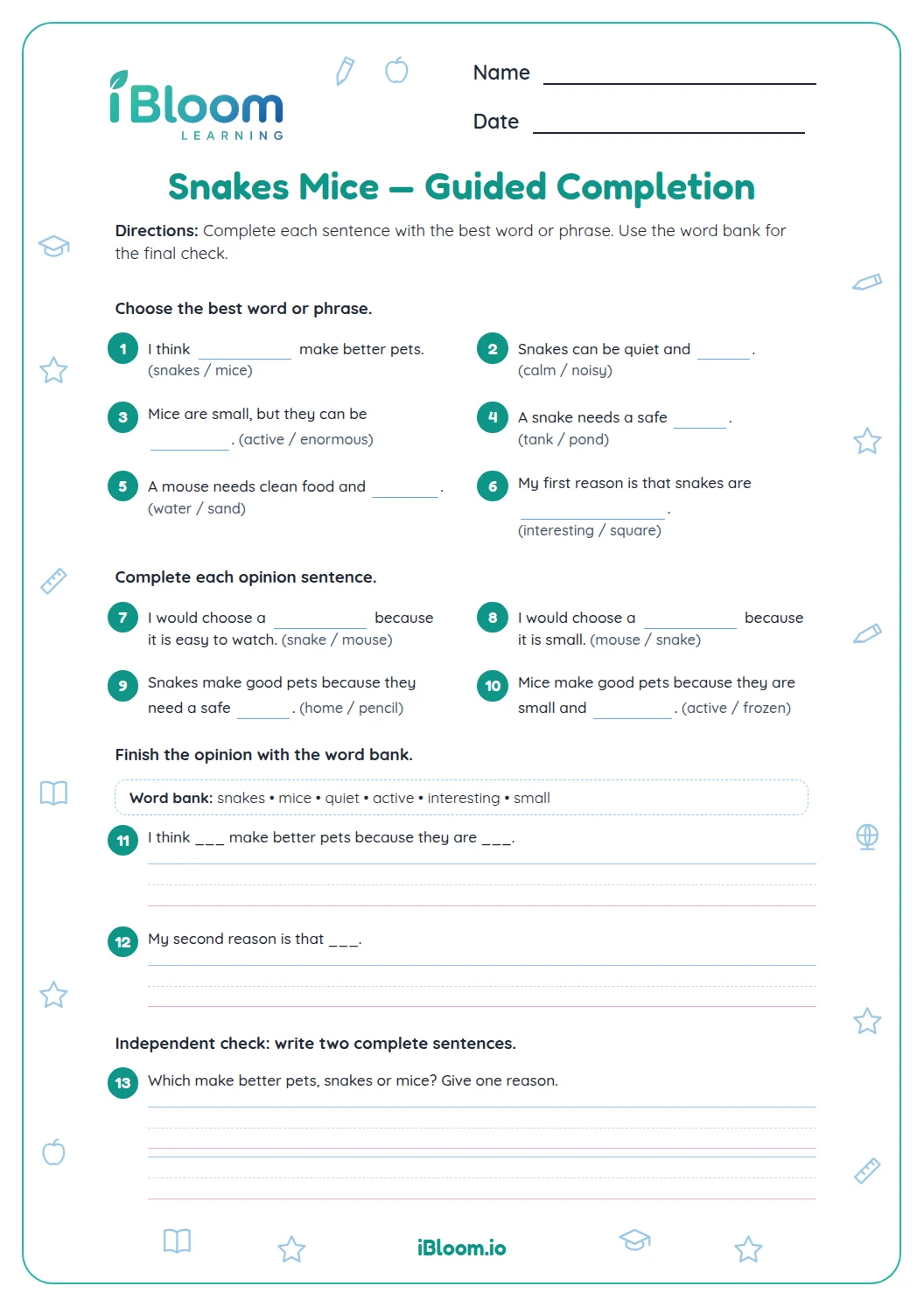
Students weigh a playful choice—snakes or mice—while reviewing the parts of a clear opinion piece. The first part distinguishes opinions from facts and matches reasons with details. The second completes short sentences about reasons, supporting details, linking words, and conclusions.
Aligned to W.3.1.b and W.3.1.c
What is on this worksheet?
Fourteen items review the parts of a short opinion piece. Students identify an opinion, reason, detail, linking word, and closing statement, then complete sentences using those terms.
- Part A: choose an opinion-writing element (8 items)
- Part B: name an opinion-writing element (6 items)
- Snakes and mice appear in the example sentences
What makes an opinion convincing?
A clear opinion tells the reader what the writer thinks. Reasons explain why the writer thinks it, and details make those reasons easier to understand. Linking words such as also and for example show how ideas fit together. A closing sentence reminds the reader of the opinion.
Can students choose either animal?
Yes. The prompt is a writing choice, not a science quiz. Students may prefer snakes or mice, but they should give reasons that match their opinion and details that support those reasons.
How does a detail support a reason?
A reason explains why a writer holds an opinion. A detail gives a fact or example that supports that reason. In question 3, a lid that keeps a snake in supports the idea that snakes need a safe home; a pattern on a snake does not explain safety.
How to use this worksheet
- 1Decide whether the sentence states a belief or a checkable fact.
- 2Match each reason or detail to the opinion it supports.
- 3Read the sentence around a linking word to see how the ideas connect.
- 4Complete the final items with the name of the opinion-writing part.
- 5Check responses with the answer key.
Common mistakes and quick fixes
The mistake
Treating a fact as an opinion
The fix
A fact can be checked, such as “A mouse has whiskers.” An opinion expresses a judgment, such as “Snakes make good pets.”
The mistake
Choosing a detail that does not support the reason
The fix
For “Snakes need a safe home,” a lid that keeps a snake in is relevant evidence. A pattern on its skin does not explain why the home is safe.
The mistake
Using a linking phrase that changes the relationship
The fix
“Another reason” adds support; “On the other hand” signals contrast. Choose the phrase that matches how the second idea relates to the first.
Common Core alignment
This worksheet gives focused Grade 3 practice with the skill named in its title.
Give reasons that support an opinion.
On this sheet: Students choose and write reasons that support a choice between snakes and mice.
Show the official wordingHide the official wording
Provide reasons that support the opinion.
Connect opinions and reasons with linking words.
On this sheet: Questions ask students to select linking words that connect an opinion and its reasons.
Show the official wordingHide the official wording
Use linking words and phrases (e.g., because, therefore, since, for example) to connect opinion and reasons.
What to practice next
Make more practice
Further reading
Questions parents and teachers ask
Is there one right choice between snakes and mice?
No. Students may choose either animal. The writing goal is to state a clear opinion, support it with relevant reasons and details, and use linking words to help the reader follow each idea. Ask the student to explain the clue aloud and point to the detail that supports the answer.
What makes a reason different from a detail?
A reason explains why the writer holds an opinion. A detail adds a concrete example or fact that helps the reader understand that reason. For instance, observing mice build nests can support a reason about learning animal behavior. Ask the student to explain the clue aloud and point to the detail that supports the answer.
How can a student check the completed sentences?
Read each sentence aloud after filling the blank. The chosen term should fit both the meaning and the grammar. For example, a concluding statement wraps up an opinion, while a supporting detail gives an example or fact. This rereading also catches small mismatches.
Why practice linking words in an opinion paragraph?
Linking words such as also and for example show how reasons and details connect. They help a reader follow the writer’s thinking and make a paragraph sound organized rather than like a list of unrelated statements. Ask the student to explain the clue aloud and point to the detail that supports the answer.
Does the worksheet ask students to choose a favorite animal?
No. The questions use snakes and mice as examples for identifying opinion-writing parts. Students choose strong opinions, reasons, relevant details, linking words, and a closing statement; they do not have to prefer either animal. Either viewpoint is acceptable in a separate writing task.