
About this worksheet
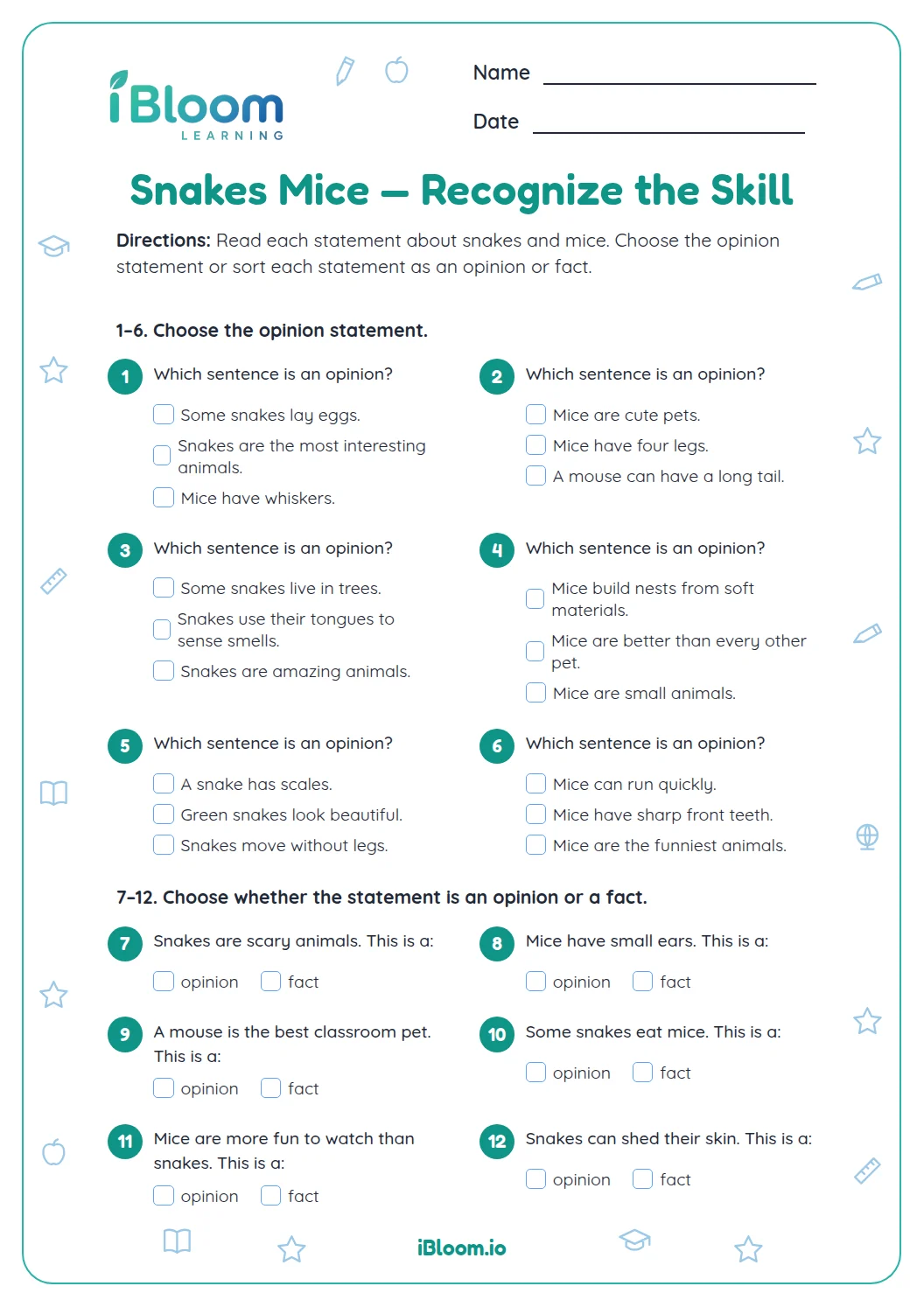
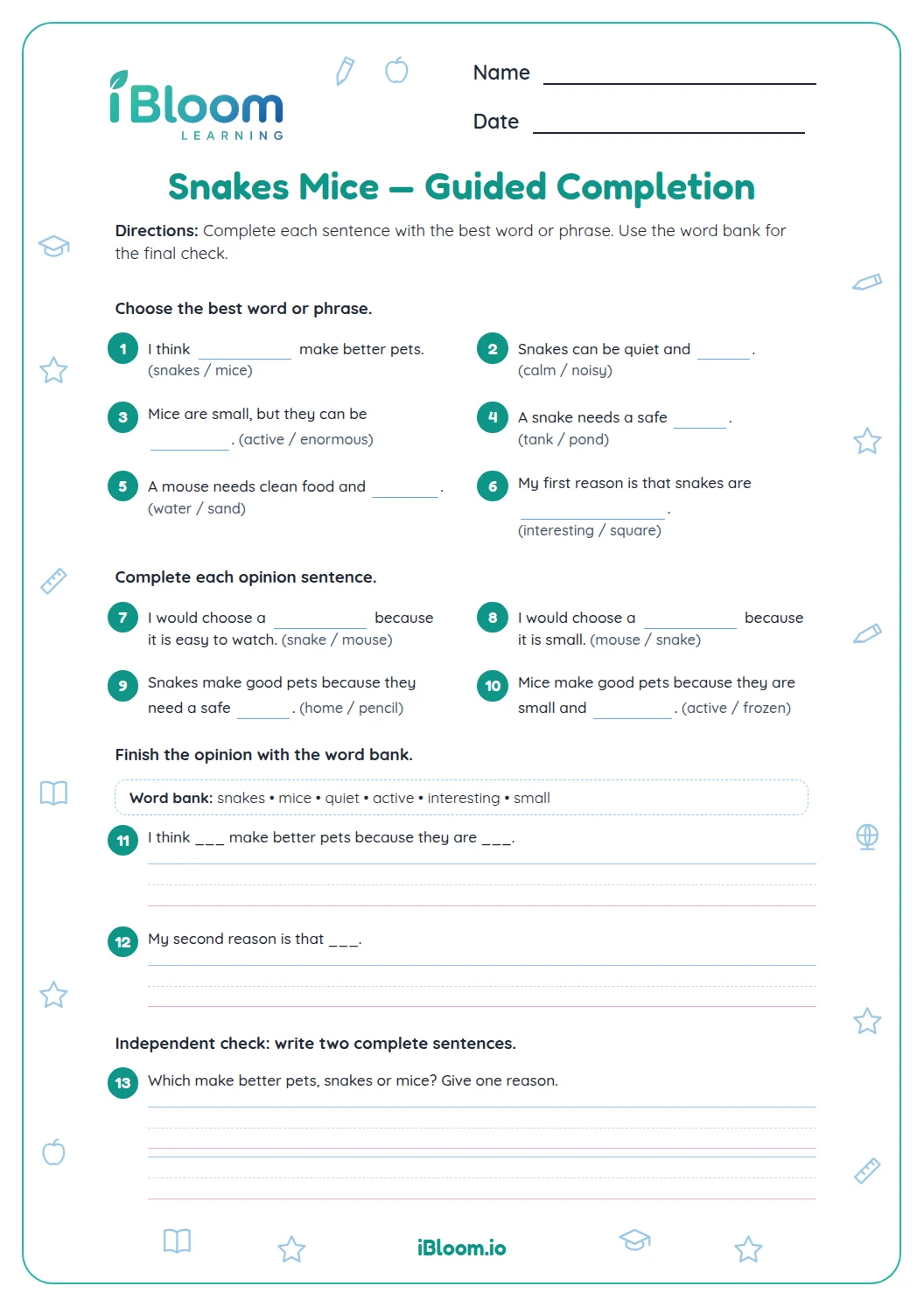
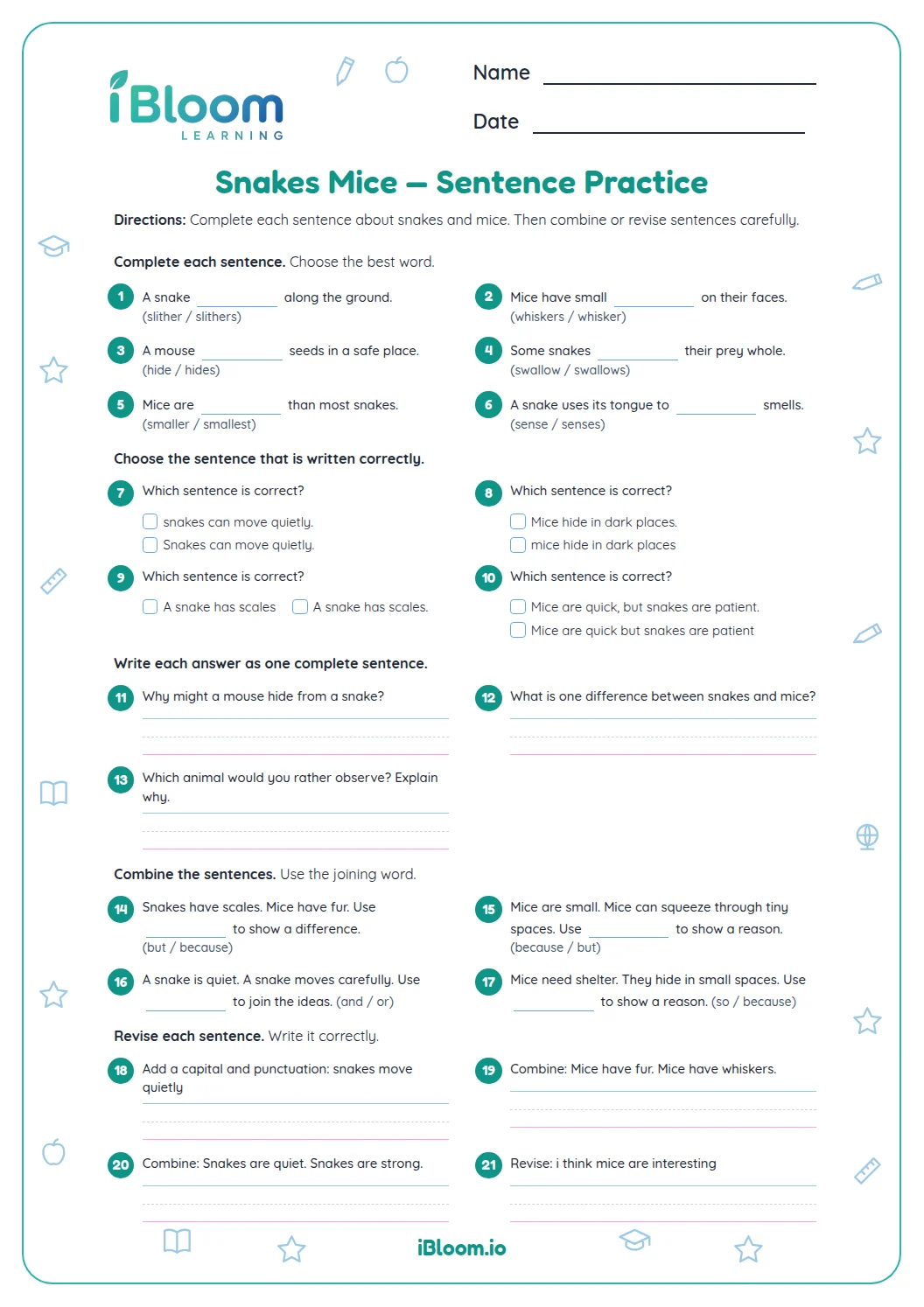
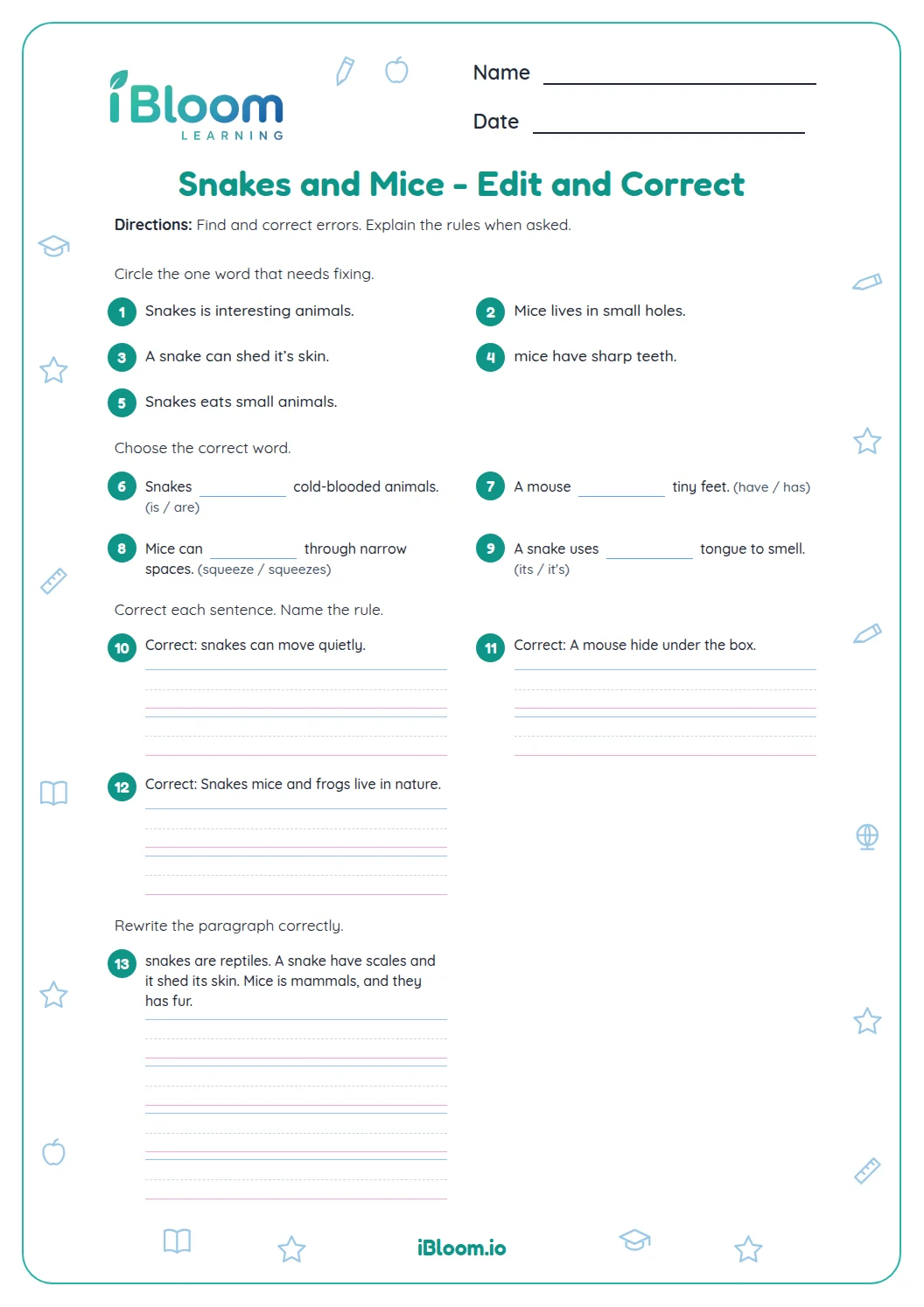
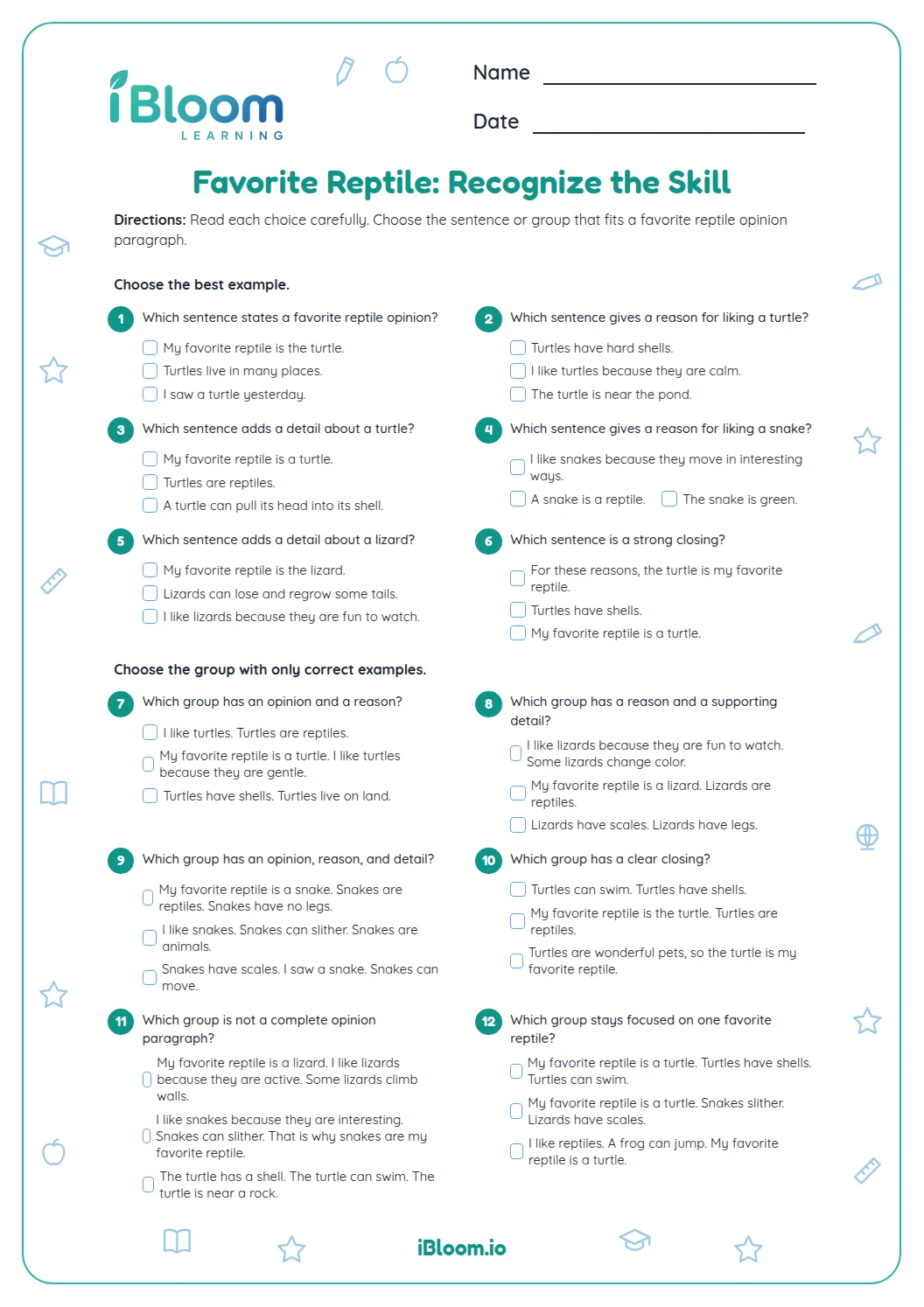
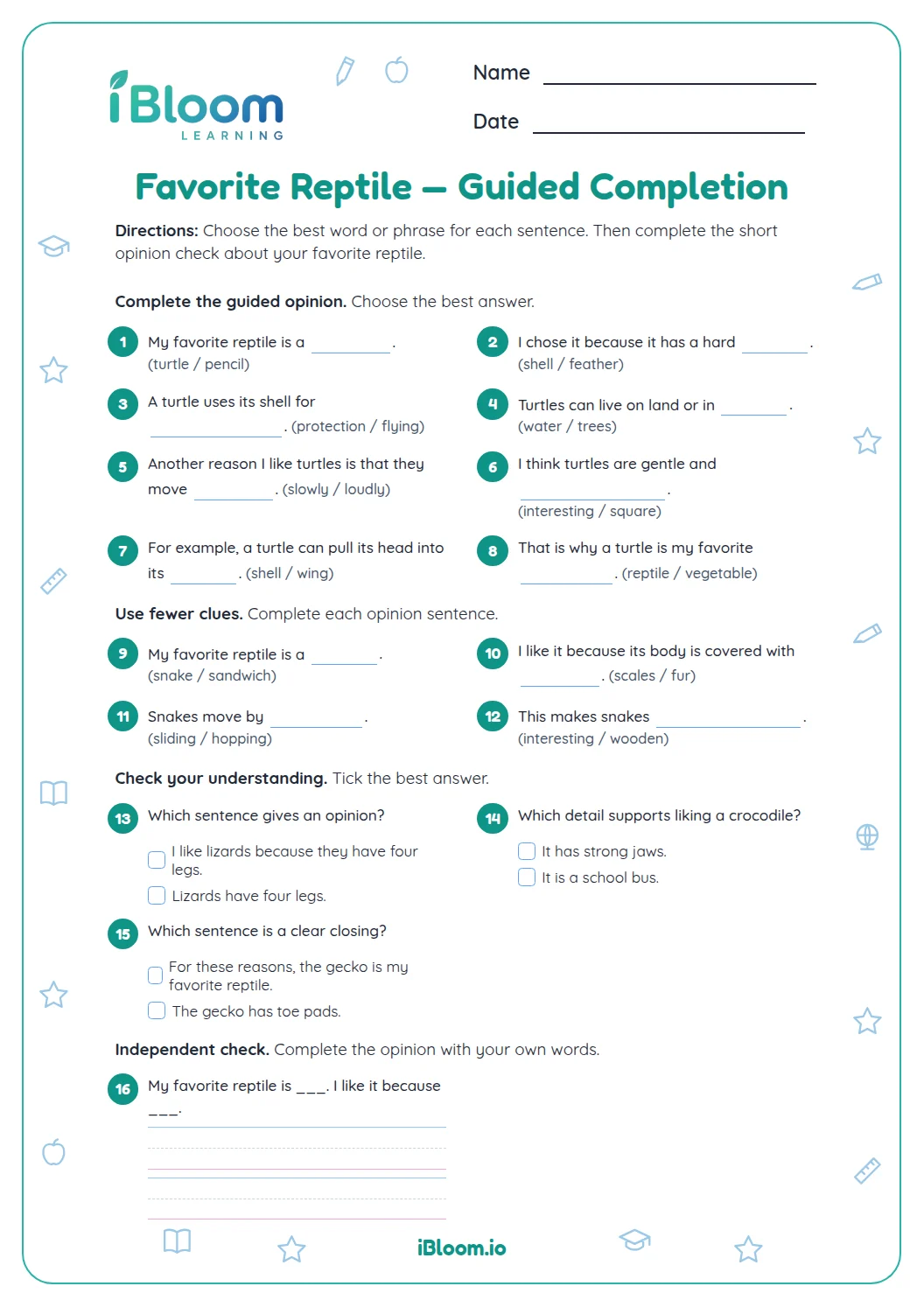
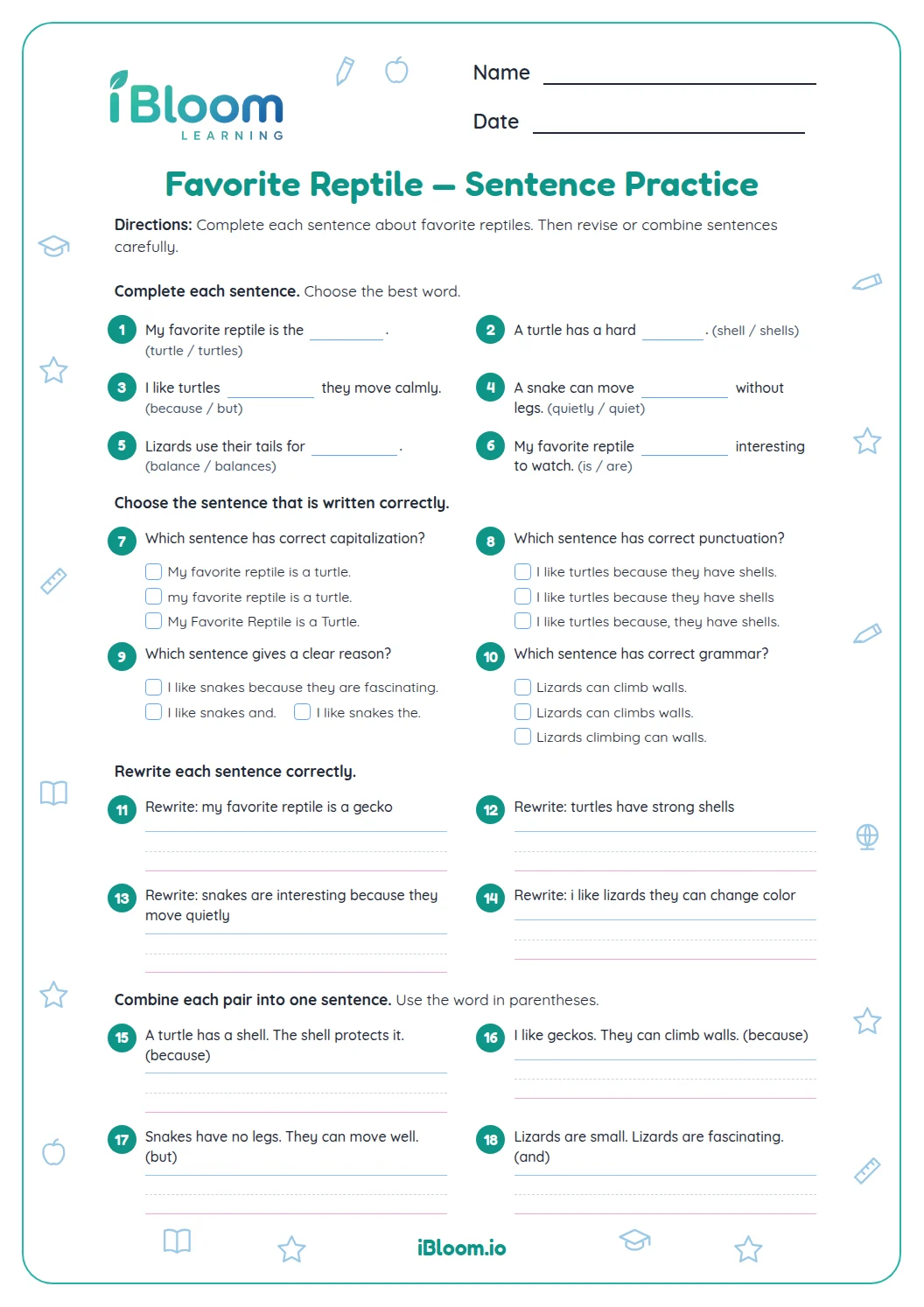
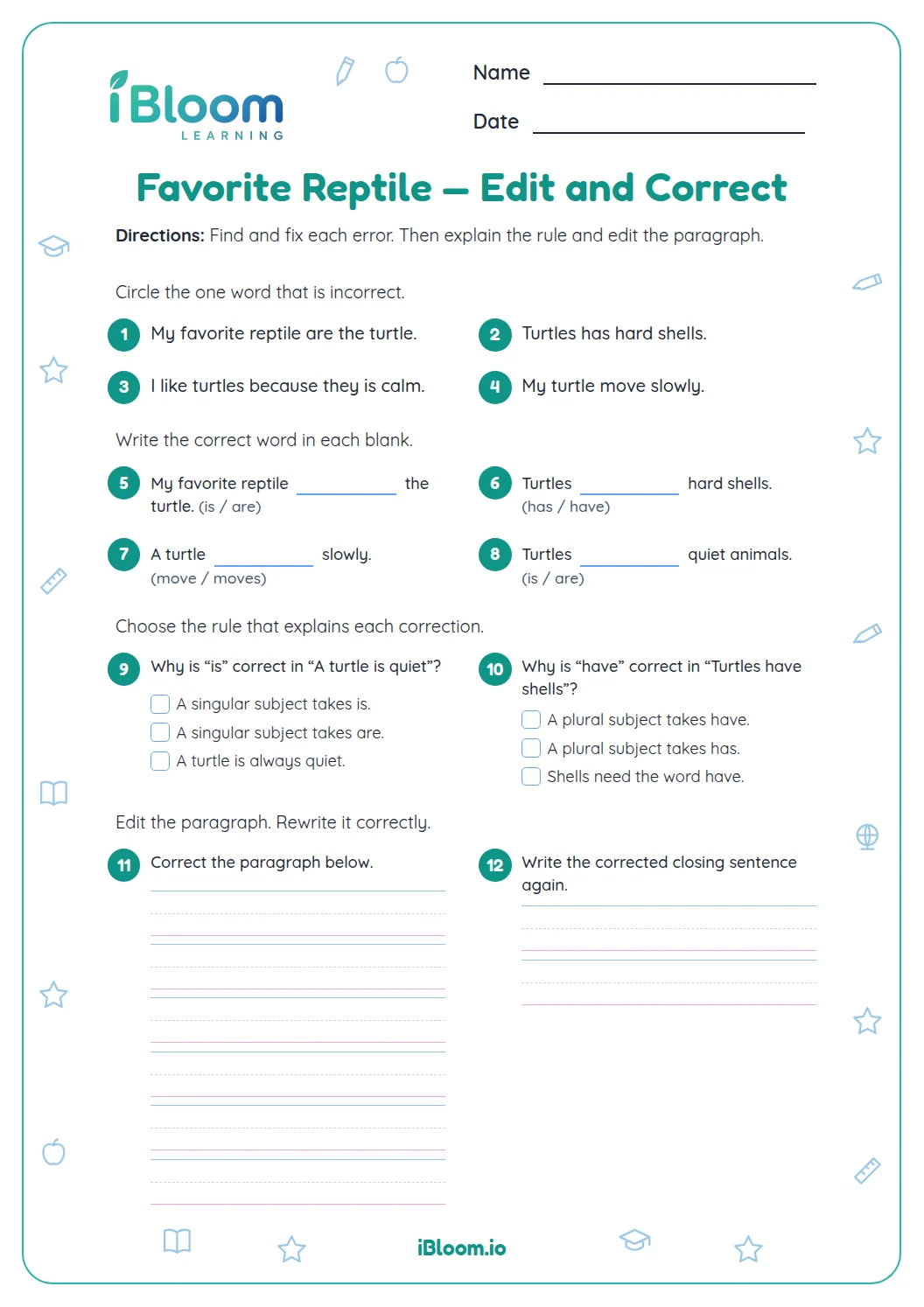
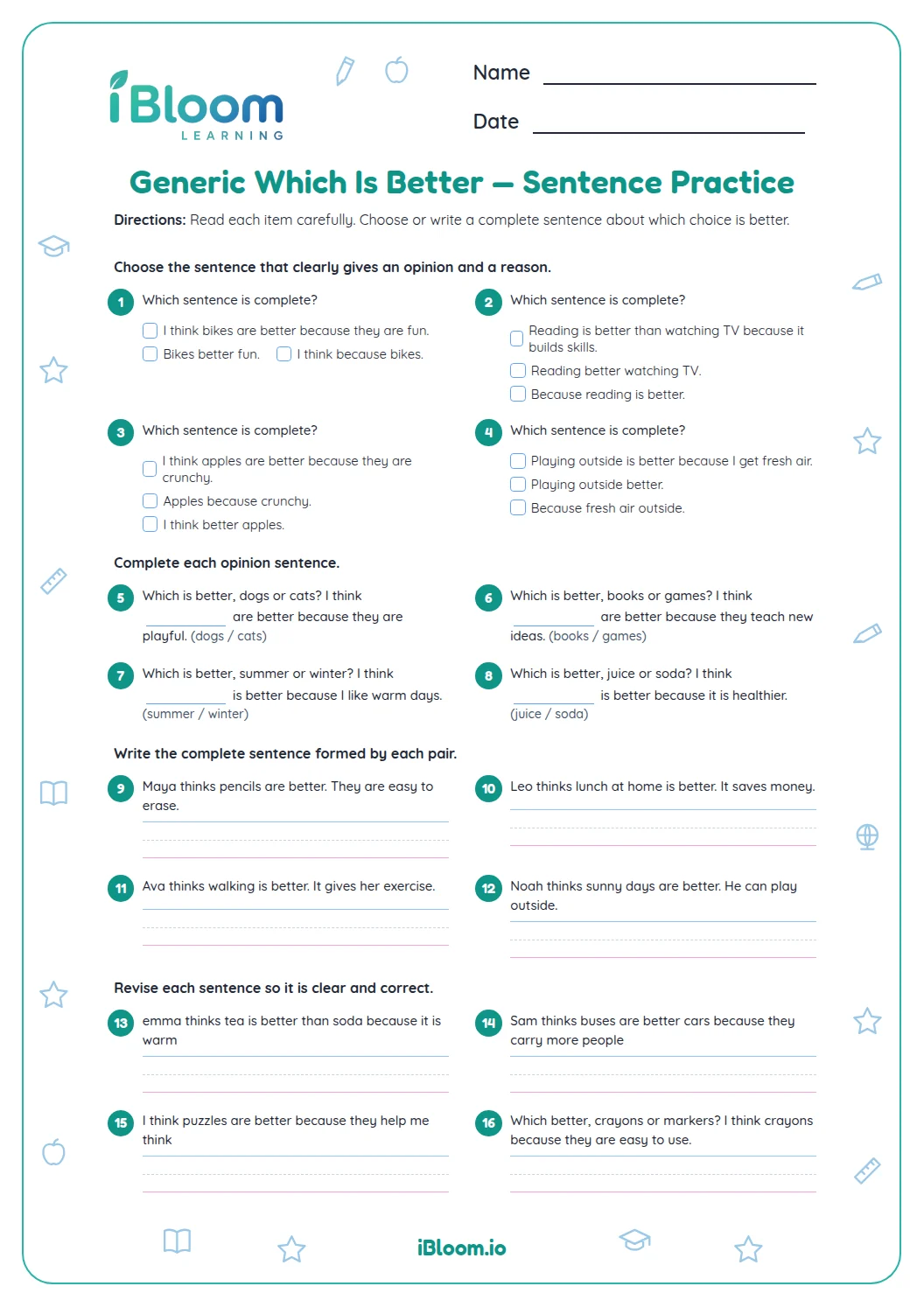
This free Grade 3 printable keeps the original snakes-or-mice opinion task and gives writers a clear path from choosing a claim to planning reasons and writing a paragraph. Six questions identify opinions and supporting details; seven sentence completions practice reasons, linking ideas, and closings; one final response applies the parts in a short paragraph. The page practices Common Core W.3.1.a and W.3.1.b. The answer key provides fixed choices and sample responses.
Aligned to W.3.1.a and W.3.1.b
How do you tell an opinion from a fact?
An opinion tells what a writer thinks or prefers. A fact can be checked. The first six questions help children choose a clear claim and find details that support it.
- 1“Snakes make better pets than mice” is an opinion because “better” states a preference.
- 2“A mouse has four feet” is a fact that can be checked.
What makes a reason fit a claim?
A reason explains why the writer holds an opinion. A related detail makes the reason clearer. For example, “I prefer mice” can be supported with a reason about their behavior; a fact about snakes does not support that choice.
How do claims, reasons, and closings fit together?
Questions 7–13 build a plan with reasons, a linking idea, and a closing. Question 14 asks students to compose a short opinion response. The key gives models, while other supported opinions can be correct.
What should a writer check before finishing?
Reread each completed sentence to see whether its reason supports the stated preference. Check for a linking word such as because or also, then notice how the closing phrase signals a final thought.
How to use this worksheet
- 1Read each choice and identify an opinion or supporting detail.
- 2Complete the sentence frames with reasons that fit the stated choice.
- 3Use a linking word or closing phrase where the prompt calls for one.
- 4Write a short paragraph for question 14 that states a choice and gives two reasons.
- 5Reread the paragraph to check that each reason supports the opinion.
Common mistakes and quick fixes
The mistake
Choosing an interesting fact as a reason for a preference.
The fix
Ask whether the detail explains why the writer likes that animal; “because” can help test the link.
The mistake
Repeating the opinion as the only reason.
The fix
Add a separate detail, such as a behavior or care feature, that supports the choice.
The mistake
Ending with a new reason instead of closing the point.
The fix
Use a closing phrase such as “For these reasons” to return to the preference.
Common Core alignment
This Grade 3 worksheet practices stating an opinion and supporting it with reasons.
Introduce the topic, state an opinion, and organize reasons.
On this sheet: The writing prompts move from choosing an opinion to planning reasons and drafting a paragraph.
Show the official wordingHide the official wording
Introduce the topic or text they are writing about, state an opinion, and create an organizational structure that lists reasons.
Give reasons that support the opinion.
On this sheet: Children choose and write reasons that fit a snakes-or-mice preference.
Show the official wordingHide the official wording
Provide reasons that support the opinion.
What to practice next
Make more practice
Further reading
Questions parents and teachers ask
Can my child choose either snakes or mice?
Yes. The writing prompts allow either choice. The answer key models a preference for mice, but a clear preference for snakes can work too when its reasons fit. Questions 1–6 have fixed choices; sentence completions and the final paragraph should be checked for ideas that fit the prompt.
What does the worksheet mean by a reason?
A reason explains why a writer holds an opinion. “I prefer mice because they build nests” gives a preference and a supporting reason. A fact such as “Mice are mammals” may be true, but by itself it does not explain why the writer prefers them.
How much writing is on this page?
There are eight written responses after six multiple-choice questions: seven sentence completions and one short paragraph. The completions practice reasons, linking ideas, and closings. The paragraph applies those parts, and the answer key provides sample completions and a model response.
Does the answer key require the exact sample wording?
No. The answer key gives one model for each sentence completion and a short sample paragraph. A child may use a different completion when it fits the sentence and may choose either animal in the paragraph, as long as the opinion is clear and the reasons support it.
What should I review in the opinion responses?
Check that the paragraph states a choice and gives two reasons that support it. A linking word can show how a reason connects, and a closing phrase can return to the choice. The key offers one short model; clear, supported opinions about either animal are acceptable.