
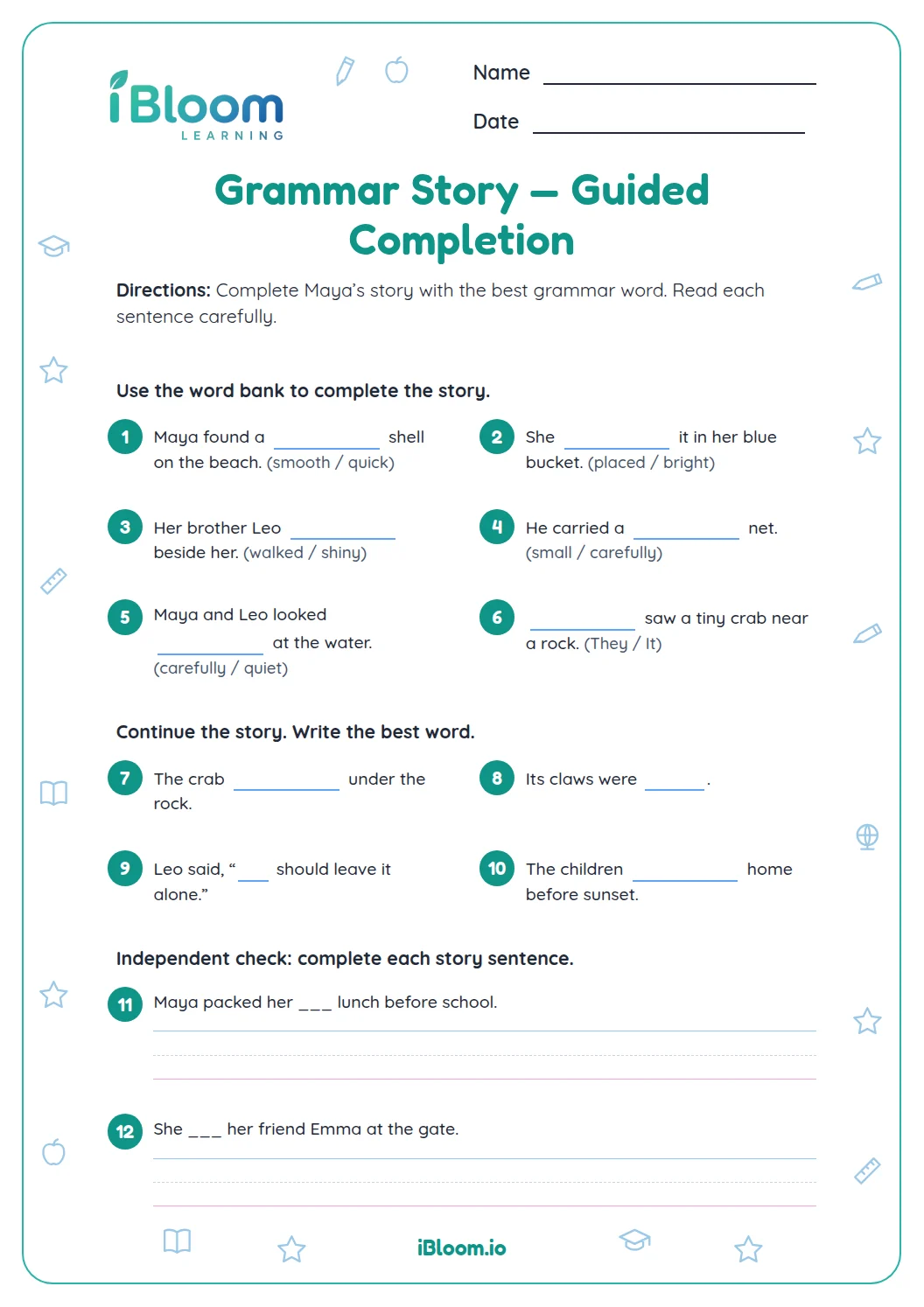
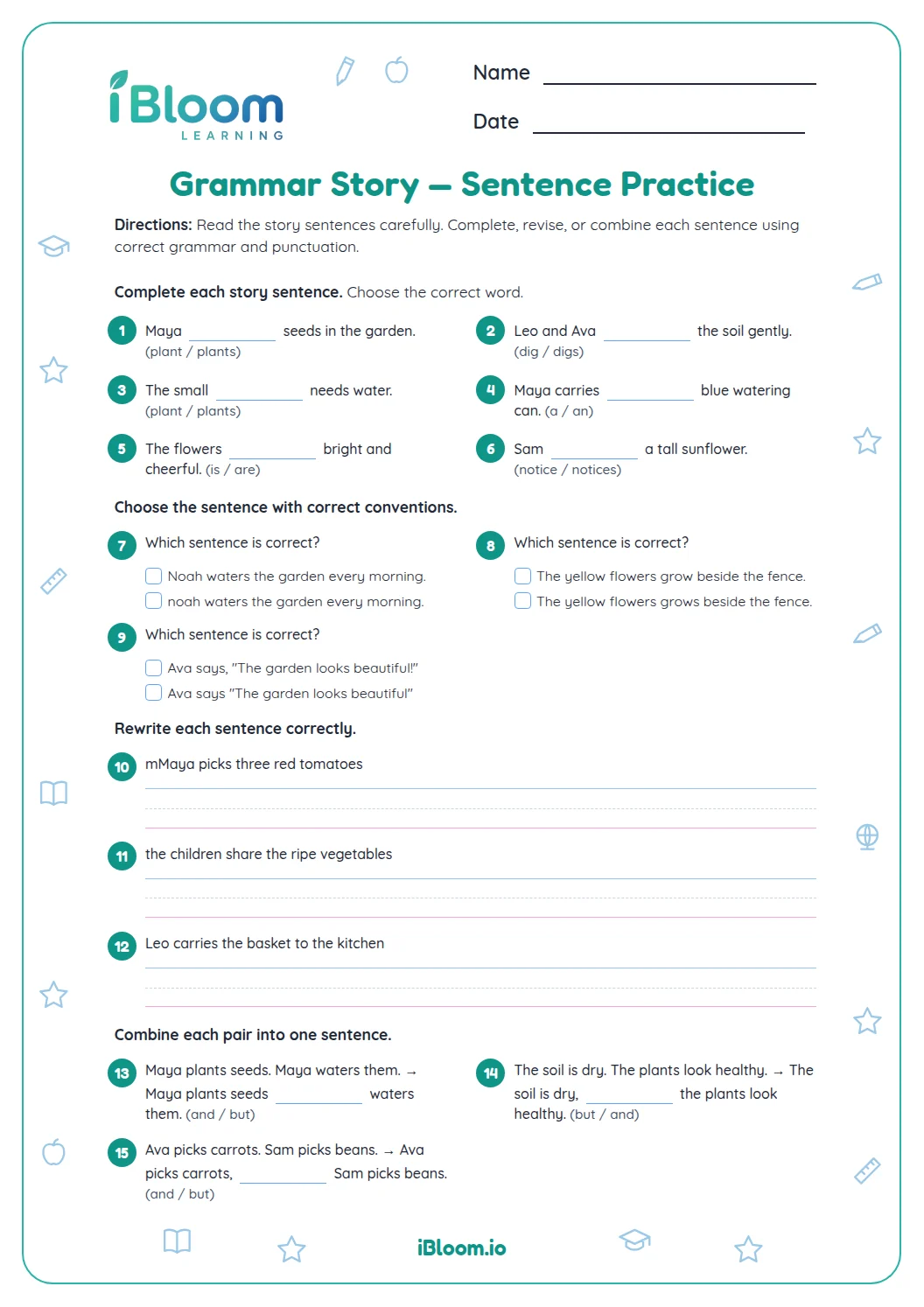


About this worksheet
This Grade 3 grammar worksheet asks learners to recognize parts of speech in complete sentences. Across 18 multiple-choice questions, children identify nouns and pronouns, action verbs, adjectives, and an adverb. Each item gives sentence context so learners can use a word’s role, not just its appearance, to identify it. The work practices CCSS L.3.1a.
Aligned to L.3.1a
How do I find a noun or pronoun?
A noun names a person, place, animal, or thing. A pronoun takes the place of a noun. Read the whole sentence so the word’s role is clear.
- 1In “The rabbit hopped over the log,” which word names an animal?
- 2Answer: rabbit
Which word tells what happened?
A verb can tell an action. In Part B, use the sentence to find what a person, animal, or thing did.
- 1In “Dad baked bread,” which word tells what Dad did?
- 2Answer: baked
How can I tell an adjective from an adverb?
An adjective describes a noun. An adverb can tell how an action happens. Part C asks readers to use these clues in context.
- 1In “The brave rabbit hopped,” which word describes the rabbit?
- 2Answer: brave
How to identify the target word
- 1Read the whole sentence before looking at the choices.
- 2Use the question to decide whether it asks for a noun, pronoun, verb, adjective, or adverb.
- 3Check how each choice works in that sentence.
- 4Choose the word that matches the requested job.
- 5Read the sentence again with your choice to confirm it fits.
Parts-of-speech clues to check
The mistake
Choosing a word by its meaning alone
The fix
Check what job the word does in this particular sentence.
The mistake
Mixing up a noun and a pronoun
The fix
A noun names something; a pronoun such as it, we, or they stands in for a noun.
The mistake
Calling every describing word an adjective
The fix
An adjective describes a noun; an adverb such as sweetly tells how an action happens.
Common Core alignment
Explain how parts of speech function in sentences.
On this sheet: Items ask learners to identify nouns, verbs, adjectives, and an adverb in sentences.
Show the official wordingHide the official wording
Explain the function of nouns, pronouns, verbs, adjectives, and adverbs in general and their functions in particular sentences.
What to practice next
Further reading
Questions parents and teachers ask
What parts of speech are practiced?
The worksheet covers nouns, pronouns, verbs, adjectives, and one adverb. Each question places a target word in a complete sentence and asks what role it plays. This helps learners use context to distinguish words that name, act, or describe. The key gives the target word for every item.
How is a pronoun different from a noun?
A noun names a person, place, animal, or thing; a pronoun can stand in for a noun. In “They packed a lunch,” they is a pronoun. Part A includes both naming words and pronouns so learners can compare how each works in a sentence.
What is the difference between an adjective and an adverb?
An adjective describes a noun, as brave describes rabbit. An adverb can tell how an action happens, as sweetly tells how the birds sang. Part C asks learners to use the sentence and the question to identify the right kind of describing word.
How many questions are on the worksheet?
There are 18 multiple-choice questions in three parts. Six focus on nouns and pronouns, six on verbs, and six on adjectives or an adverb. A separate answer key names the correct word for each sentence and can support a quick review of the word’s job.
Does the worksheet include an answer key?
Yes. The separate key identifies the target word in every sentence. After choosing an answer, learners can reread the sentence and explain why that word is a noun, pronoun, verb, adjective, or adverb. This gives an adult a clear starting point for a short review.