







About this worksheet
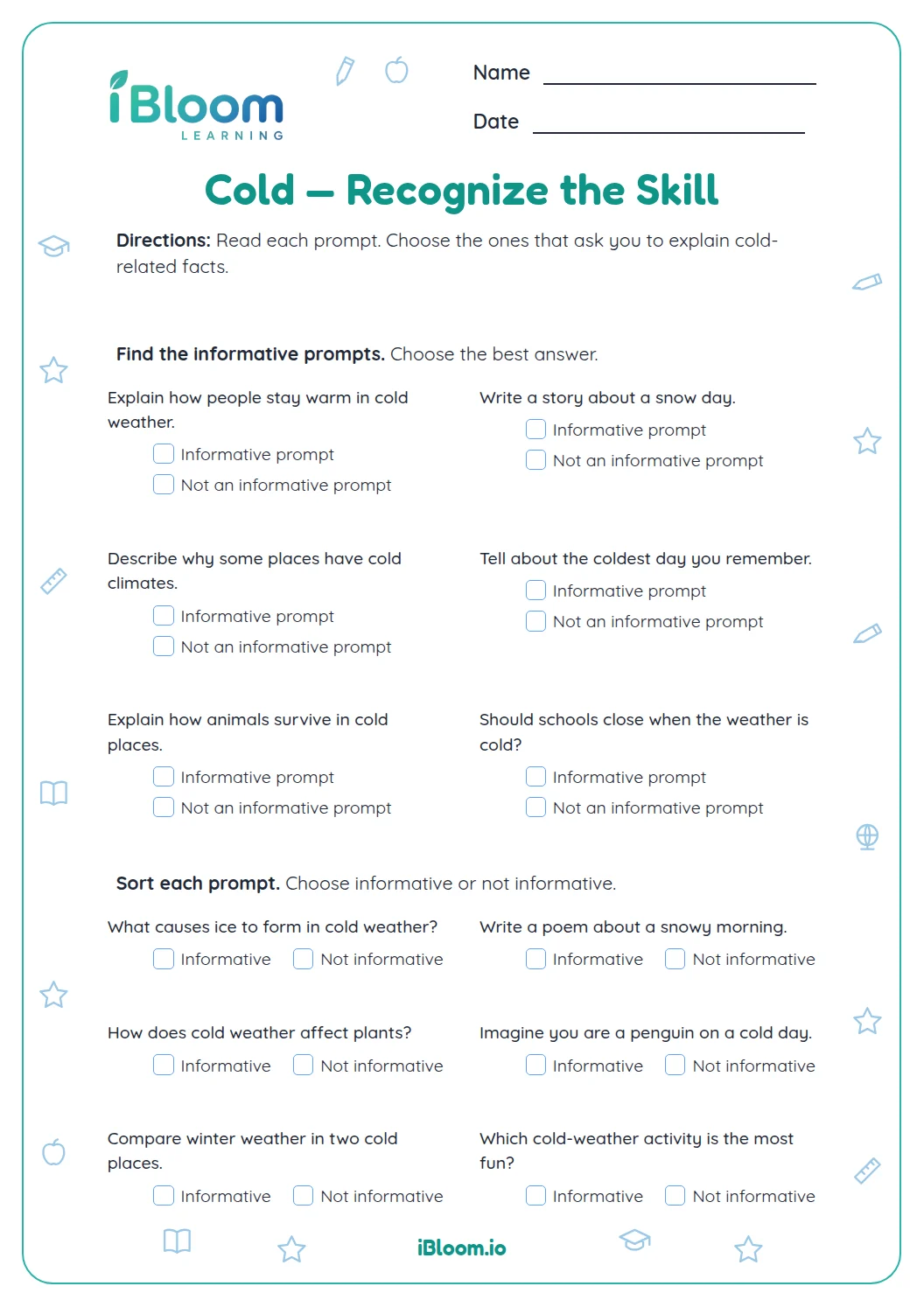
This Grade 4 music worksheet helps students recognize what an informative writing prompt asks them to do. Across 16 questions, they distinguish explanatory questions from preference or imaginative prompts, then select focused topics, relevant facts, definitions, and supporting details. The music examples make each choice concrete, and the answer key explains the intended selection.
How can you spot an informative prompt?
Look for a question that asks how or why something works, or asks for facts about a topic. Questions about favorites ask for opinions; story prompts invite imagination.
- 1Question 1: “How do musicians make a song together?”
- 2It asks for an explanation a reader can learn from.
Which music details belong in an informative response?
A helpful detail defines a term, explains a process, or supports the paragraph focus. For instance, “Tempo means how fast or slow music is played” defines a term directly.
How can I use this worksheet?
- 1Read the whole prompt before choosing.
- 2Ask whether it calls for facts, an opinion, or an imagined story.
- 3For a detail, check how it supports the topic sentence.
- 4Prefer a focused explanation over a broad or unrelated statement.
- 5Use the answer key to discuss why a distractor does not fit.
What mistakes should learners check?
The mistake
Choosing an opinion prompt because it mentions music.
The fix
Check whether the writer must teach facts or share a preference.
The mistake
Picking a true detail that does not support the focus.
The fix
Connect the detail directly to the paragraph topic.
The mistake
Choosing a topic that is too broad to explain clearly.
The fix
Narrow it to one process, instrument, or music idea.
What to practice next
Make more practice
Questions parents and teachers ask
What does an informative prompt ask a writer to do?
It asks the writer to explain a topic with accurate information, facts, examples, or steps. This music worksheet asks students to identify questions that invite explanation and distinguish them from opinion or imaginative prompts. A useful check is whether the response would teach a reader something new.
Does this worksheet ask children to write a full report?
No. It focuses on recognizing informative prompts and choosing useful facts, focus statements, and supporting details. These decisions help students understand what belongs in an informative response before they plan or draft one. The questions focus on making choices before drafting an informative response.
Why are some music questions not informative prompts?
Questions about a favorite song ask for a personal preference, while imaginative prompts invite a made-up story. Comparing them with how and what questions helps children notice when a writer is being asked to teach the reader. Name the task the prompt asks for: explain, share a preference, or imagine.
What is one example of a useful supporting fact?
For a paragraph about a guitar, a fact such as “A hammer strikes a string inside the piano” explains how an instrument works. A preference like “I like the piano best” tells about the writer instead of the topic. Use the piano example as a model for choosing a relevant explanatory fact.
How many questions are on this worksheet?
There are 16 multiple-choice questions about informative prompts, focus, topic sentences, definitions, facts, and conclusions. A separate answer key lists the correct choices. The worksheet is three pages, with a three-page key after the questions. The worksheet is three pages, with a three-page key after the questions.
How can a student check a chosen detail?
Ask whether the detail teaches the reader something about the topic and supports the paragraph’s focus. A useful fact explains, defines, or gives an example; an unrelated personal comment does not. A detail should connect clearly to the report focus.