




About this worksheet
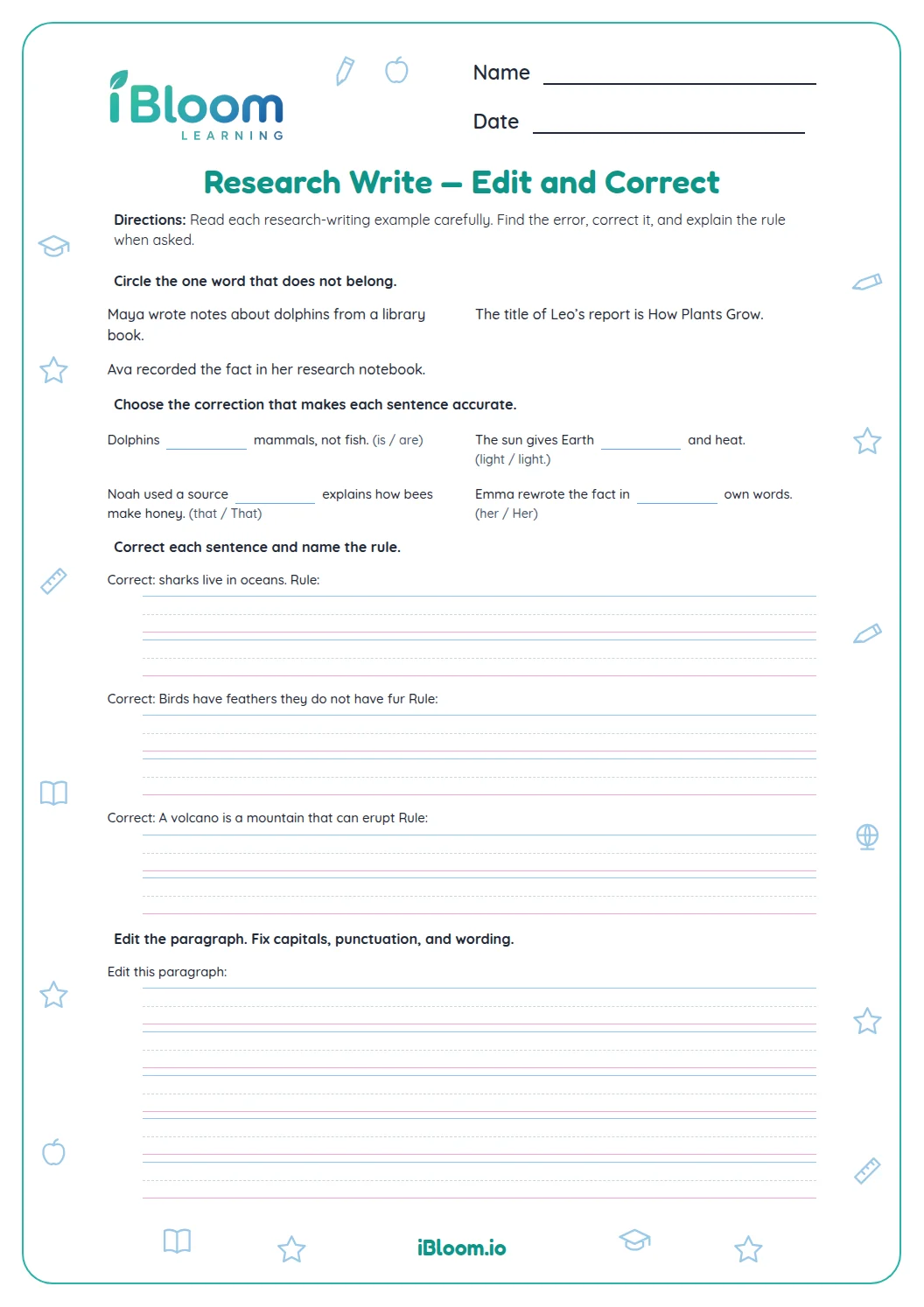
This Grade 4 worksheet moves from focused research questions to useful sources, notes in a student’s own words, and clear report sentences. Fourteen items include eight choices and six sentence completions. The answer key gives the intended responses. The work practices the research skills described in W.4.7 and W.4.8.
Aligned to W.4.7 and W.4.8
What is on this worksheet?
Fourteen items build a short research routine: choose a focused question, select useful evidence and sources, and complete sentences about notes and report writing.
- Part A: choose a research question or source that fits (4 items)
- Part B: choose useful notes and evidence (4 items)
- Part C: complete research sentences (6 items)
What makes a research question useful?
A research question names a topic that can be explored with facts. A focused question such as “How do trees cool sidewalks?” gives a reader a clear direction. A very broad topic or a question asking for a personal favorite is harder to answer with evidence.
How can students use notes without copying?
Notes capture the important idea in brief language. Students can read a source, look away, and explain the idea in their own words. Recording the author and title also makes it easier to find the source again.
How to use this worksheet
- 1Read the question and identify its topic before choosing an answer.
- 2Check whether a fact or source directly helps answer that question.
- 3Complete each sentence with a word that makes the research idea precise.
- 4Use the separate key to check the choices and missing words.
Common mistakes and quick fixes
The mistake
Choosing a source just because it is a book
The fix
Match the source to the question. A local weather report can give rainfall information; a dinosaur book cannot answer a question about local rainfall.
The mistake
Copying a source sentence into notes
The fix
Read the source, look away, and restate its main fact in your own words. Keep the author and title so you can locate the source again.
The mistake
Keeping a question too broad
The fix
Narrow a broad subject to one answerable question. “How do trees cool sidewalks?” gives a clearer research direction than simply “trees.”
Common Core alignment
This worksheet gives focused Grade 4 practice with the skill named in its title.
Investigate a topic through a short research project.
On this sheet: The questions ask students to apply this skill in short, checkable steps.
Show the official wordingHide the official wording
Conduct short research projects that build knowledge through investigation of different aspects of a topic.
Take notes from relevant sources and provide a source list.
On this sheet: The questions ask students to apply this skill in short, checkable steps.
Show the official wordingHide the official wording
Recall relevant information from experiences or gather relevant information from print and digital sources; take notes and categorize information, and provide a list of sources.
What to practice next
Make more practice
Further reading
Questions parents and teachers ask
How is a research question different from a topic?
A topic names a broad subject, such as animals. A research question narrows it to something a student can investigate. “How do bats find insects at night?” gives a clear direction and can be answered with information from reliable sources.
Why should students take notes in their own words?
Paraphrasing shows that a student understood the source, instead of copying a sentence without thinking about it. It also makes it easier to combine ideas from more than one source and explain them in a report. Ask the student to explain the clue aloud and point to the detail that supports the answer.
What source details should a student record?
When available, students should record the author, title, and date of a source. These details help them locate the book or webpage again and let readers check where the information came from. Ask the student to explain the clue aloud and point to the detail that supports the answer.
What makes a detail useful for a report?
A useful detail answers the research question or supports the report’s main idea. Students can ask whether the fact is relevant, whether a source supports it, and whether they can explain it clearly in their own words. Ask the student to explain the clue aloud and point to the detail that supports the answer.
Why does a research report need source details?
Recording an author and title helps a reader locate information again. It also helps students track where a fact came from while organizing notes. One sentence-completion item asks students to apply this idea by naming what they can find again.