







About this worksheet
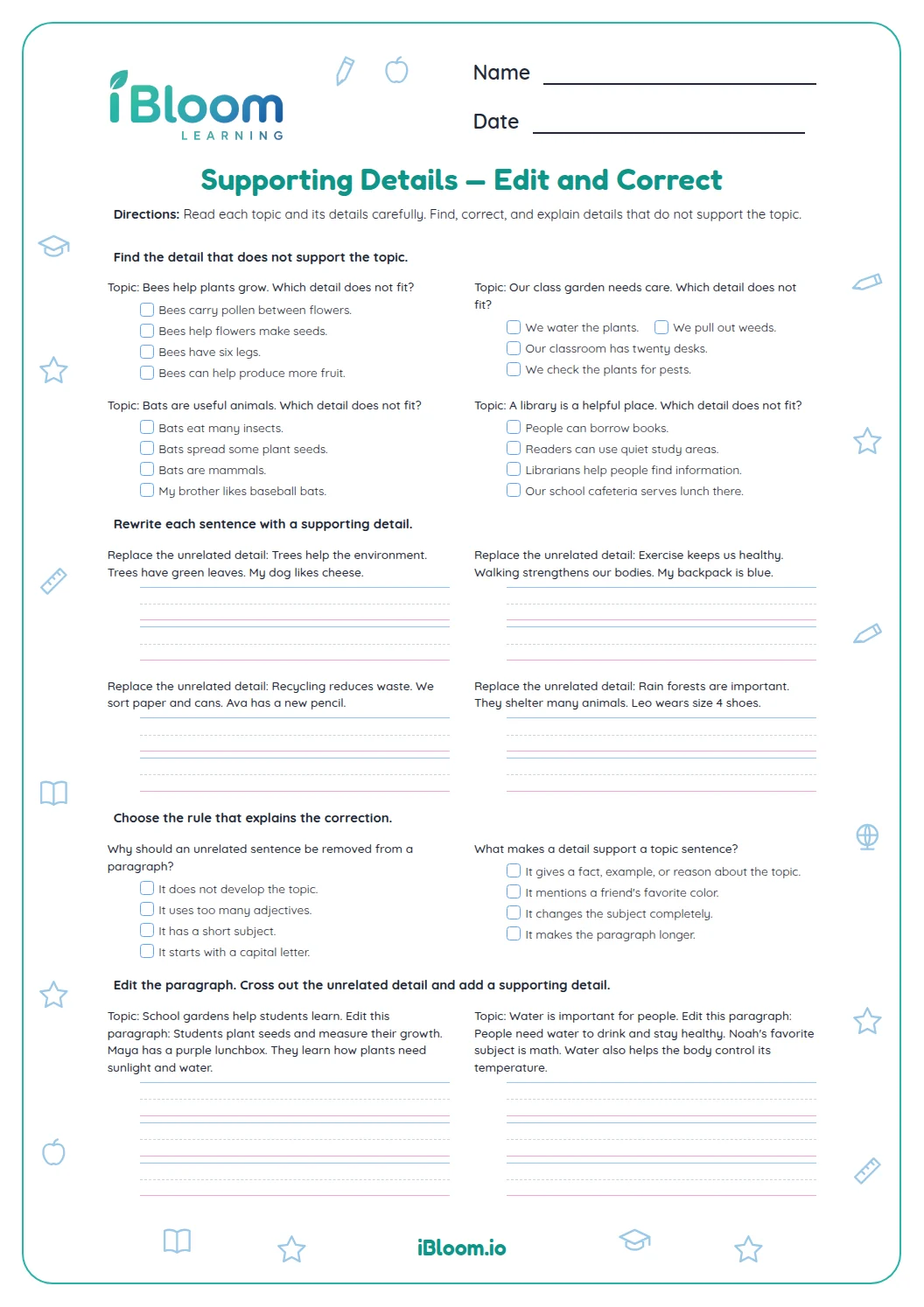
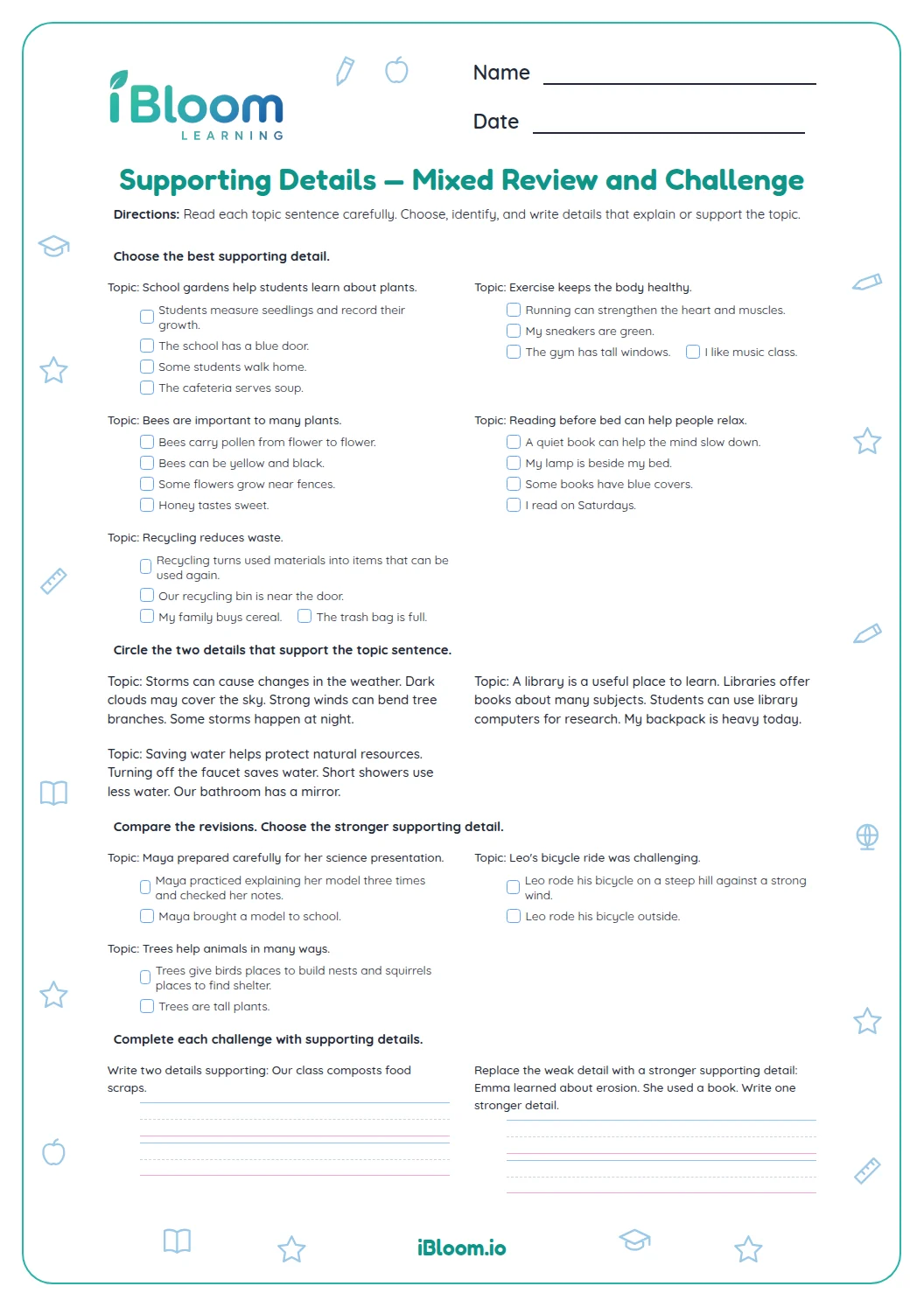
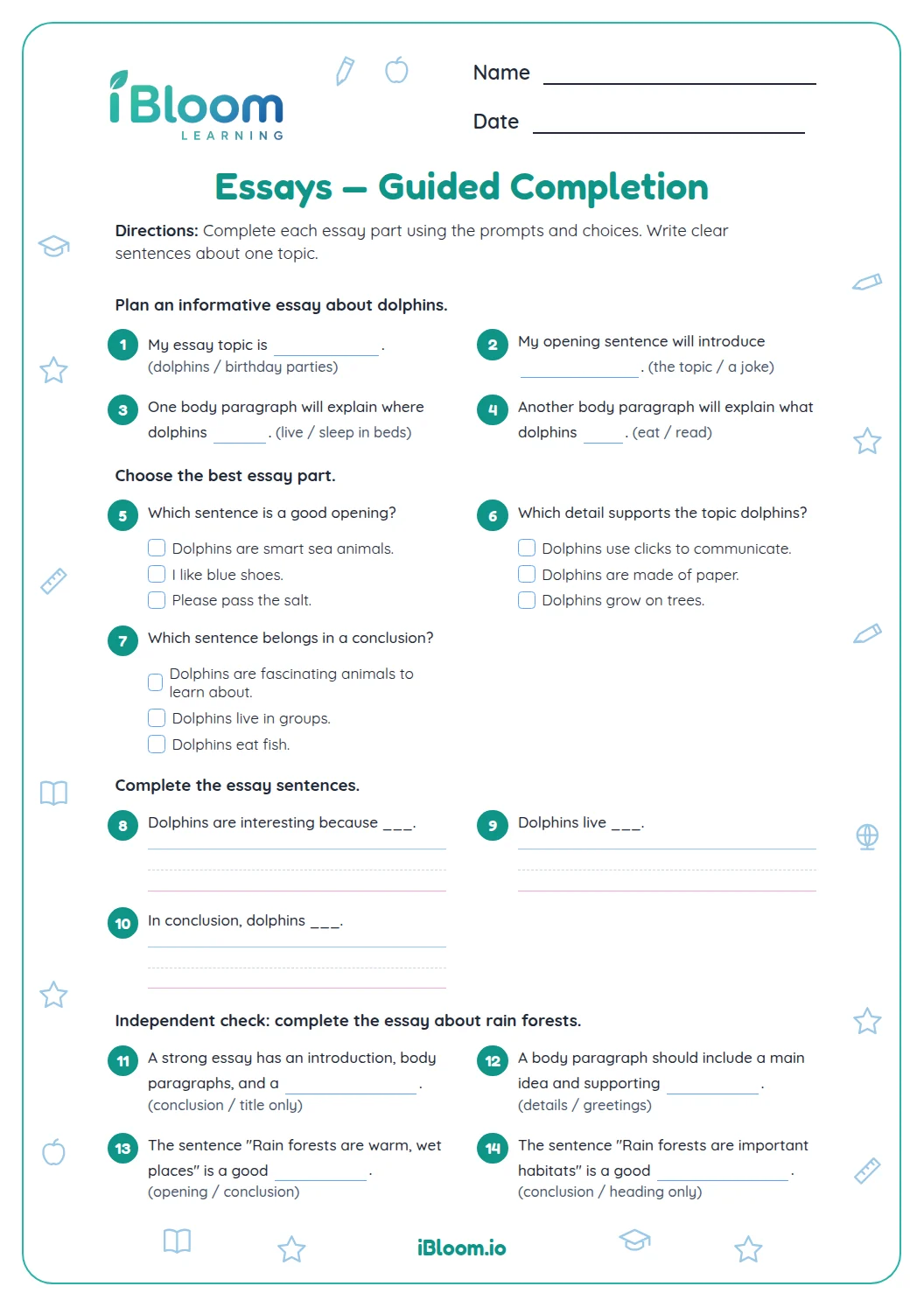
This guided page pairs short topic sentences with concrete details. Students first choose how a detail supports the point, then select relevant evidence and write a few explanations of their own. The later items ask them to create a detail and connect it back to its topic.
Aligned to W.4.2.b
Connect evidence to its topic
A supporting detail gives a specific fact or example related to a topic sentence. Bees carrying pollen is evidence; the explanation that this helps plants make seeds shows why the evidence matters to a garden.
In the first part, complete each sentence with a word that makes the detail support its main idea. Read the full sentence afterward to check that the connection makes sense.
- Part A uses details about measurement, reuse, health, and learning.
- Look for the missing idea that links the evidence back to its topic.
Add a useful explanation
An informative paragraph should not leave a reader to guess why a fact matters. A detail about measuring a sunflower becomes stronger when the writer explains that weekly measurements show how its height changes.
Later items ask how a detail supports a topic. A useful response names the connection: for example, shade blocks sunlight, which helps a playground area stay cooler.
- Part B completes additional supporting sentences.
- Check that each answer fits both the grammar and the topic.
How to work through this page
- 1Read the topic sentence and the detail together.
- 2Choose a missing idea that explains or strengthens the topic.
- 3Read the completed sentence aloud to check its meaning.
- 4For open answers, accept another clear, relevant connection.
Common mistakes and how to check
The mistake
Choosing a true fact that does not support the topic
The fix
A detail can be true and still be unrelated. A blue library carpet does not explain how students find information; learning to use the catalog does.
The mistake
Repeating the detail without explaining it
The fix
After giving evidence, tell why it matters. “Students measure the plant” is a detail; explaining that the measurements show growth connects it to learning.
Curriculum alignment
This worksheet practices a specific Common Core skill for this grade.
Supporting Details
On this sheet: Students develop an informative topic with relevant facts, details, and examples, and explain the information.
Show the official wordingHide the official wording
Develop the topic with facts, definitions, concrete details, quotations, or other information and examples related to the topic.
What to practice next
Make more practice
Questions parents and teachers ask
What is a supporting detail?
A supporting detail gives a specific fact, example, or observation related to a topic. For instance, weekly measurements of a sunflower support a topic about learning how plants grow. The worksheet asks children to complete details and explanations so the connection to each topic is clear.
How is an explanation different from evidence?
Evidence gives information a reader can check, such as measuring a plant each week. An explanation tells why that information matters: comparing the measurements shows how tall the plant grows. Several prompts on this page ask students to complete that connection in a short sentence.
How do I choose the strongest detail?
Choose information that clearly helps explain the topic sentence. A fact about a helmet cushioning a rider’s head supports a topic about bike safety. A fact about the color of a bike basket does not explain protection, even if it is true.
What should my written answer include?
A written answer should add a relevant fact or example and make its connection to the topic clear. The final prompts give a topic and a sentence frame; the key offers sample completions. Another answer can work when it is grammatical and supports the stated idea.