




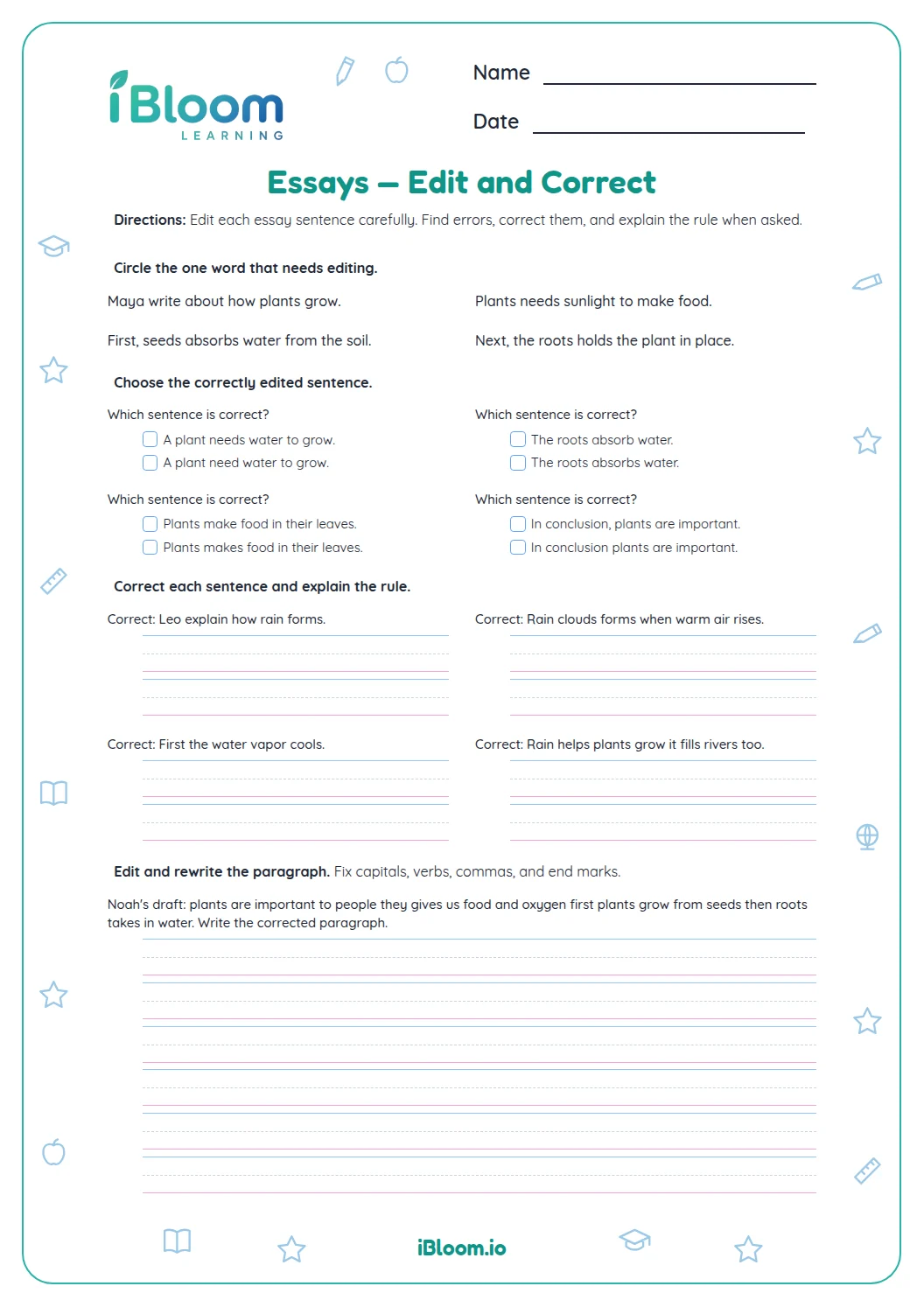


About this worksheet
This Grade 4 printable uses short biography sentences to practice grammar, accurate facts, capitalization, punctuation, and joining ideas. Students complete 14 questions, moving from word choices to sentence corrections and links between related ideas. The included answer key gives the correct choices and sample wording for the open response. The conventions practice aligns with CCSS L.4.1.
Aligned to L.4.1
Which sentence skills are practiced?
Students choose words that make biography sentences grammatical, identify clear facts, and check capitalization and punctuation. The final items ask them to connect related ideas and write a correctly formed biography sentence.
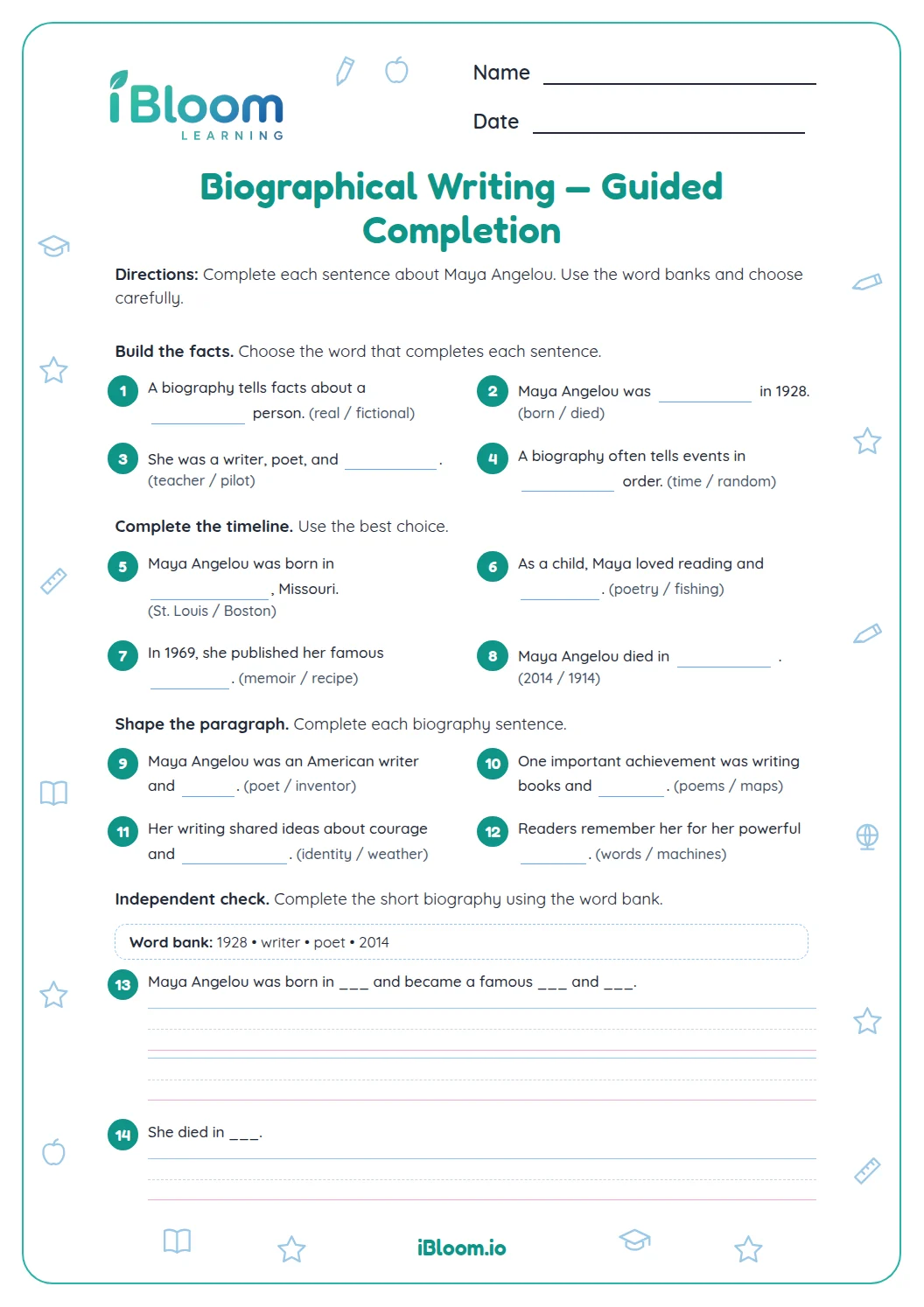
How do you complete “Maya Angelou ___ born in 1928”?
Choose “was.” Maya Angelou is one person, so the singular verb agrees with her name. Reread the whole sentence to check that it is complete.
- 1Maya Angelou ___ born in 1928.
- 2Choose “was” to match the singular subject.
How can a student check a biography sentence?
A clear biography sentence gives a specific detail that can be stated accurately. Then check the sentence for capitals in names, a complete thought, and the right end mark.
How to use this worksheet
- 1Read the entire sentence before choosing a word.
- 2Check that the verb agrees with the person named.
- 3Look for capitals at the start of a sentence and in names.
- 4Reread punctuation and connectors to check that each sentence is complete.
Common mistakes and quick fixes
The mistake
Choosing “were” for Maya Angelou.
The fix
Match the verb to the singular subject: Maya Angelou was born in 1928.
The mistake
Leaving a person’s name lowercase.
The fix
Capitalize each part of a name, such as Nelson Mandela.
The mistake
Joining two ideas without a connector.
The fix
Use “and” to connect Leo wrote poems with Leo won awards.
Curriculum alignment
This page gives students focused practice with a standard that connects to the skill.
Write informative sentences that develop a topic with facts and details.
On this sheet: Students choose correct agreement, capitalization, and punctuation in biographical sentences.
Show the official wordingHide the official wording
Demonstrate command of the conventions of standard English grammar and usage when writing or speaking.
What to practice next
Make more practice
Further reading
Questions parents and teachers ask
Why does Maya Angelou take “was” rather than “were”?
Maya Angelou is one person, so the singular verb “was” agrees with the subject. Read the completed sentence aloud: “Maya Angelou was born in 1928.” This subject-and-verb check also helps students review biography sentences about other people and choose verbs that fit each named subject.
What makes a biography fact clear?
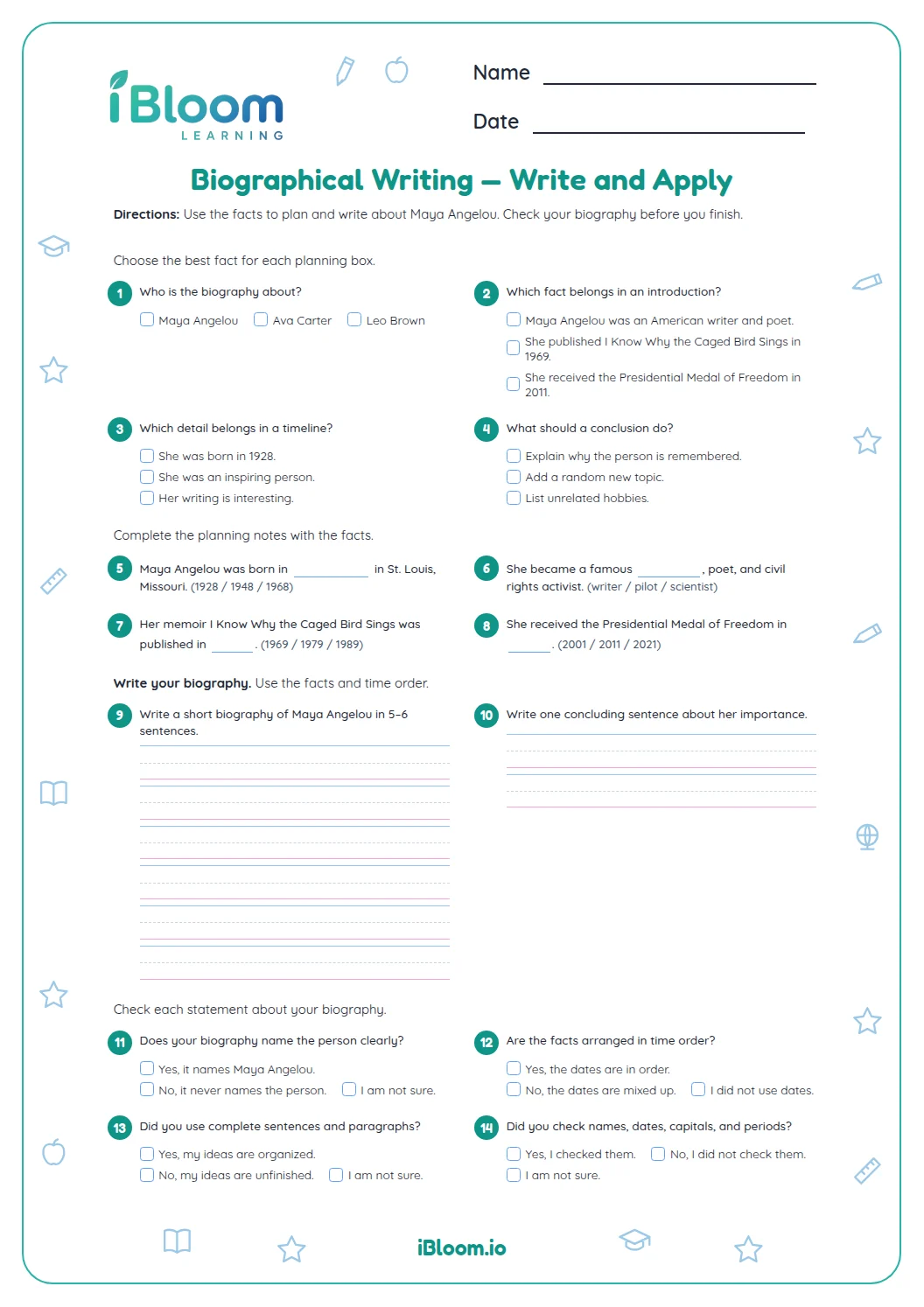
A clear biography fact gives a specific, accurate detail about a person. “She flew across the Atlantic” names an event, while “She was really famous” is broad. Questions 9, 10, and 14 ask students to distinguish concrete information from general praise.
Which names need capital letters?
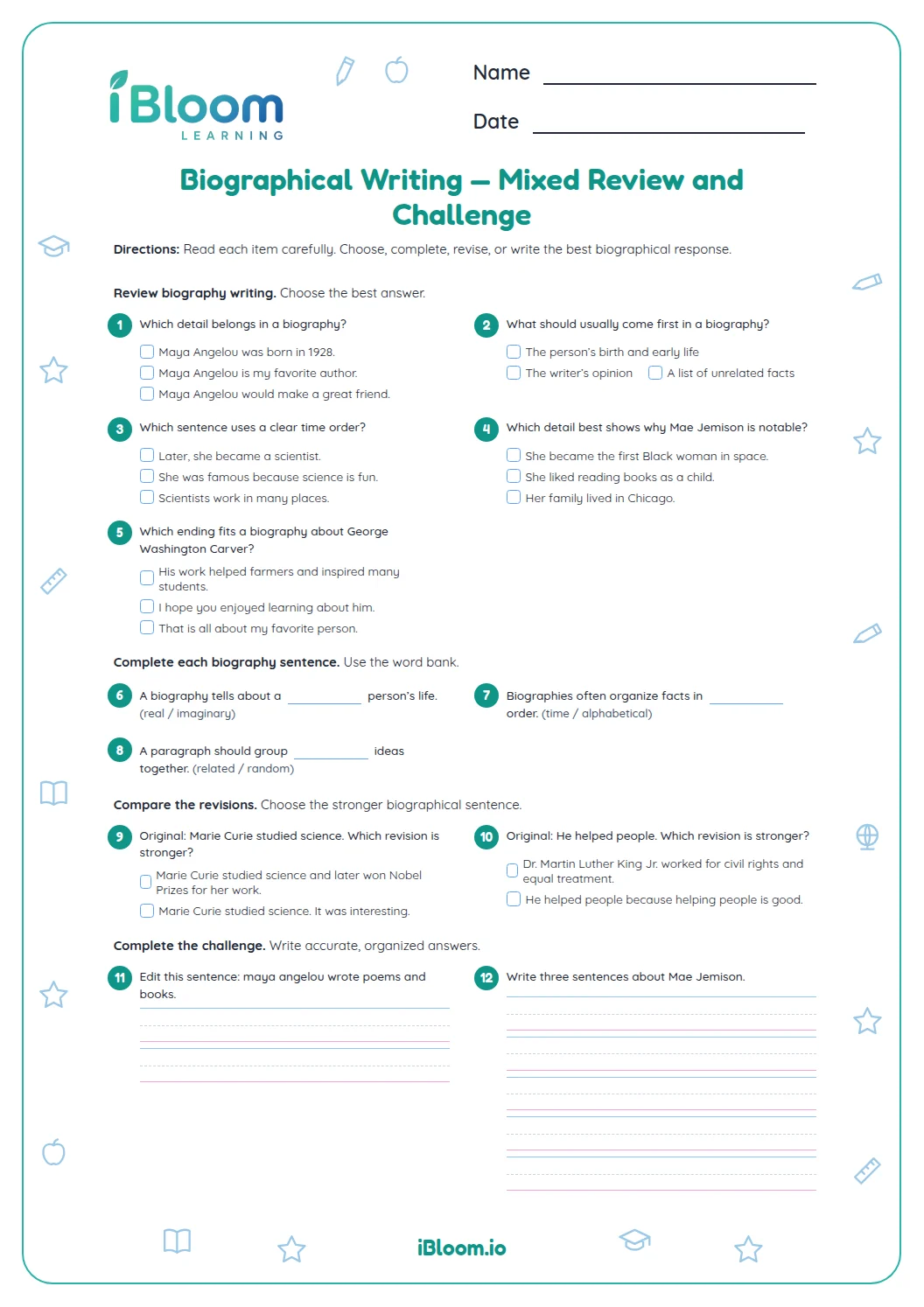
Capitalize each part of a person’s proper name, including Nelson Mandela, Marie Curie, and Rosa Parks. The worksheet asks students to notice those capitals in short sentences so the correction is easy to see. Capitals help readers recognize each person’s proper name.
How does “and” connect two biography ideas?
In “Leo wrote poems. Leo won awards,” the word “and” joins the two related facts: “Leo wrote poems and won awards.” It keeps both details while making one connected sentence. That keeps both achievements while avoiding two choppy sentences. That keeps both achievements in one clear, complete sentence.
What does the answer key show?
The key marks the best choice for all 14 questions. It includes the verb, name capitalization, punctuation, factual detail, and sentence connector students should select, so an adult can review the reason for a missed choice. Read the chosen sentence aloud to hear whether it is complete.