





About this worksheet
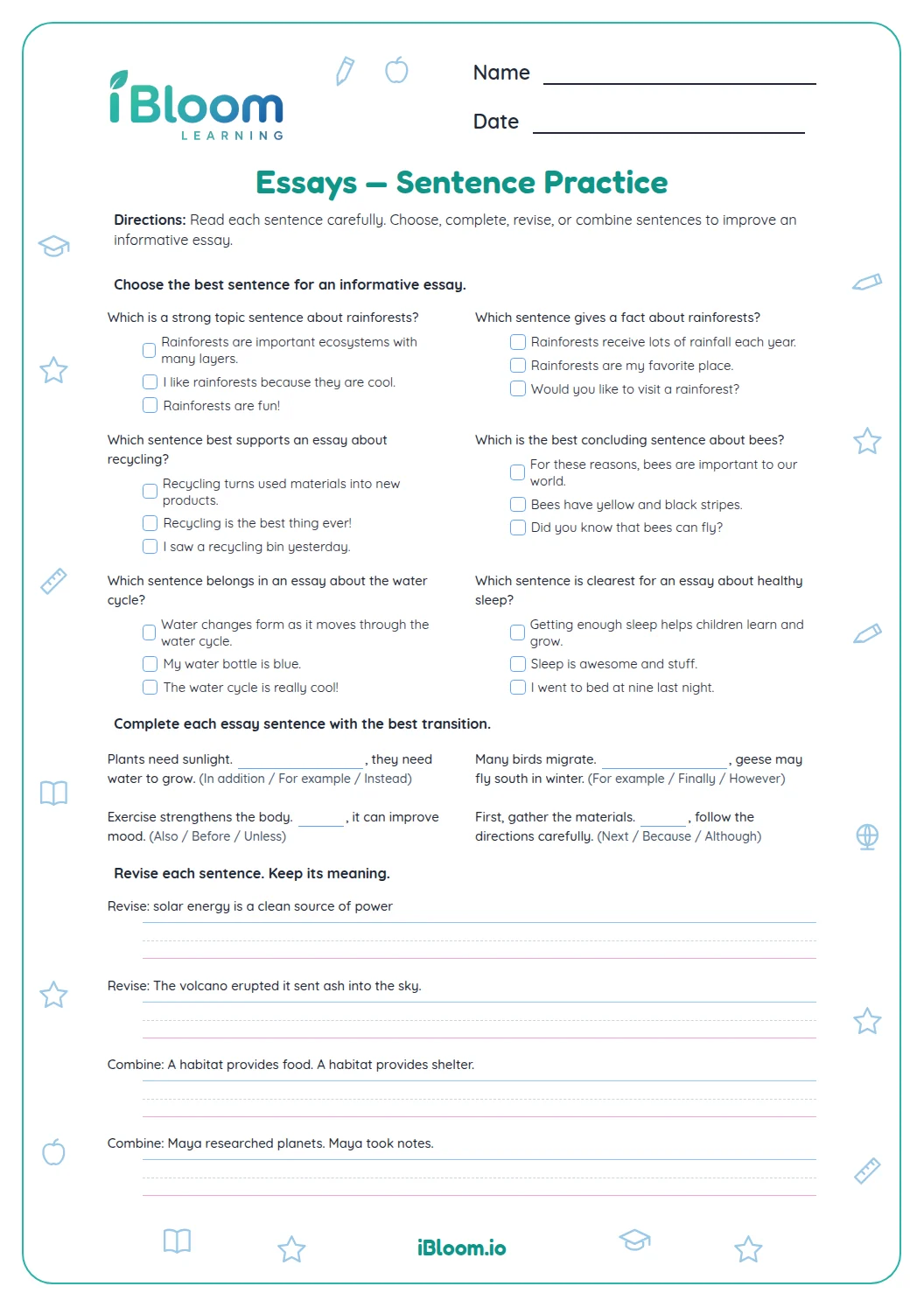
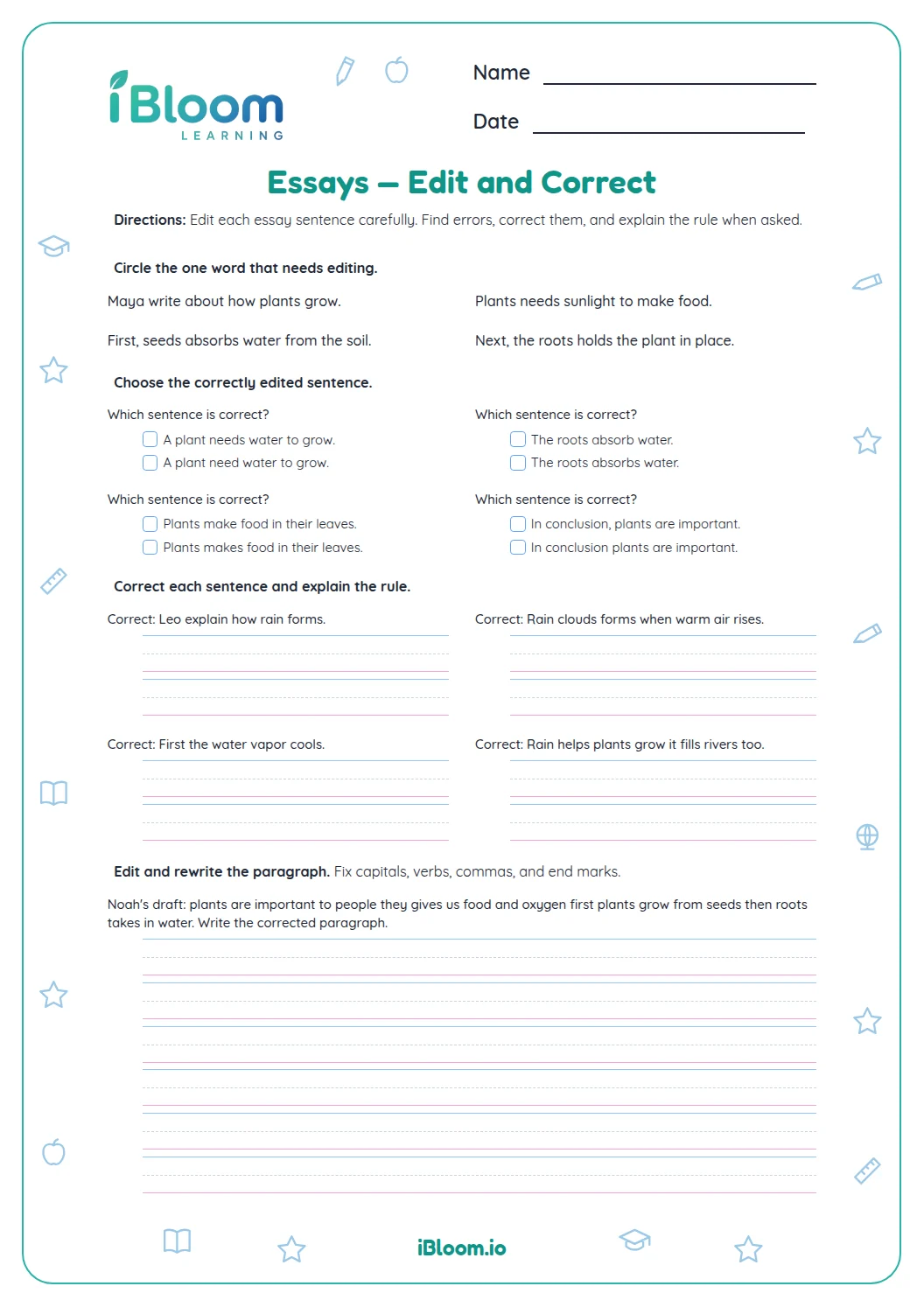
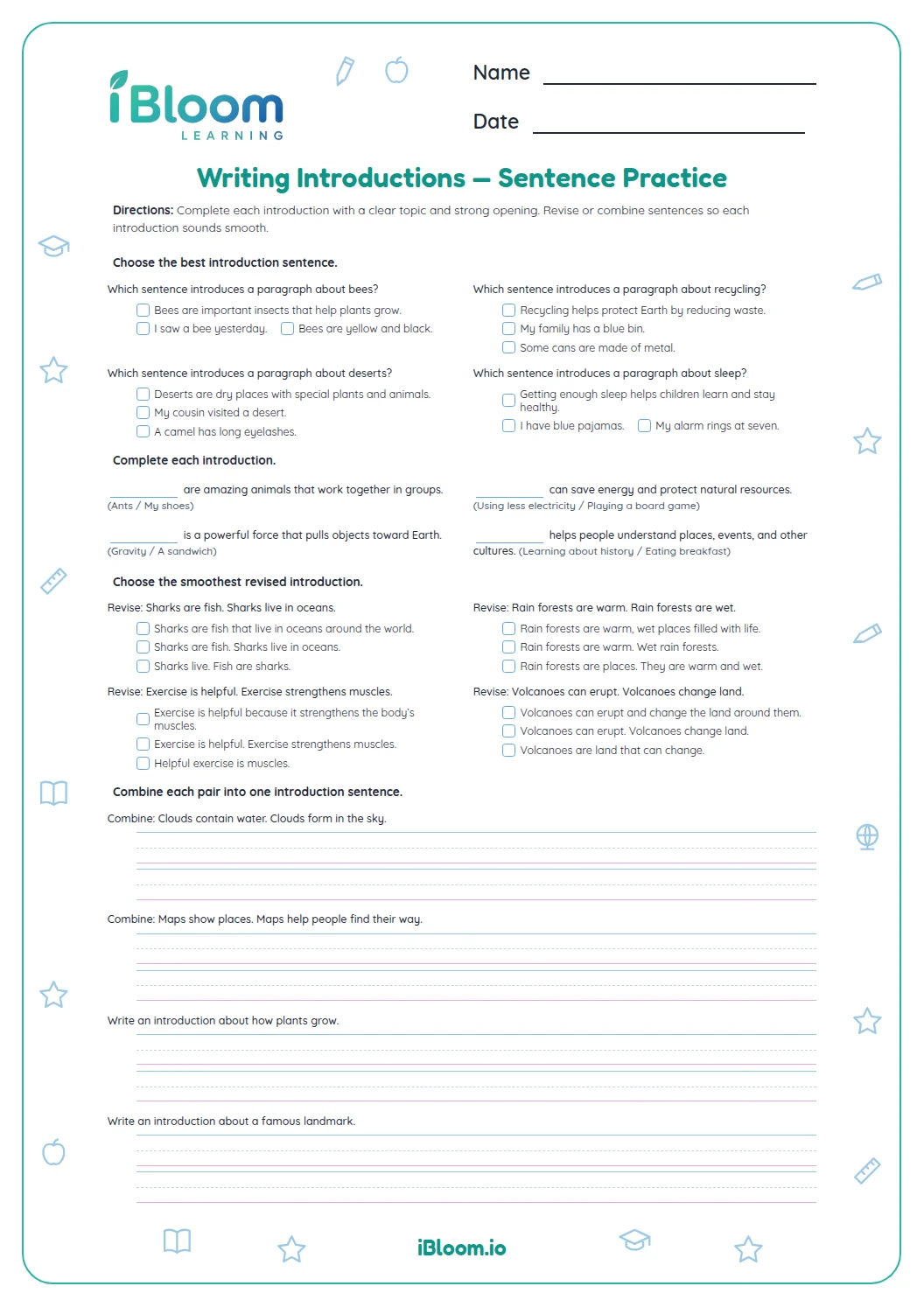
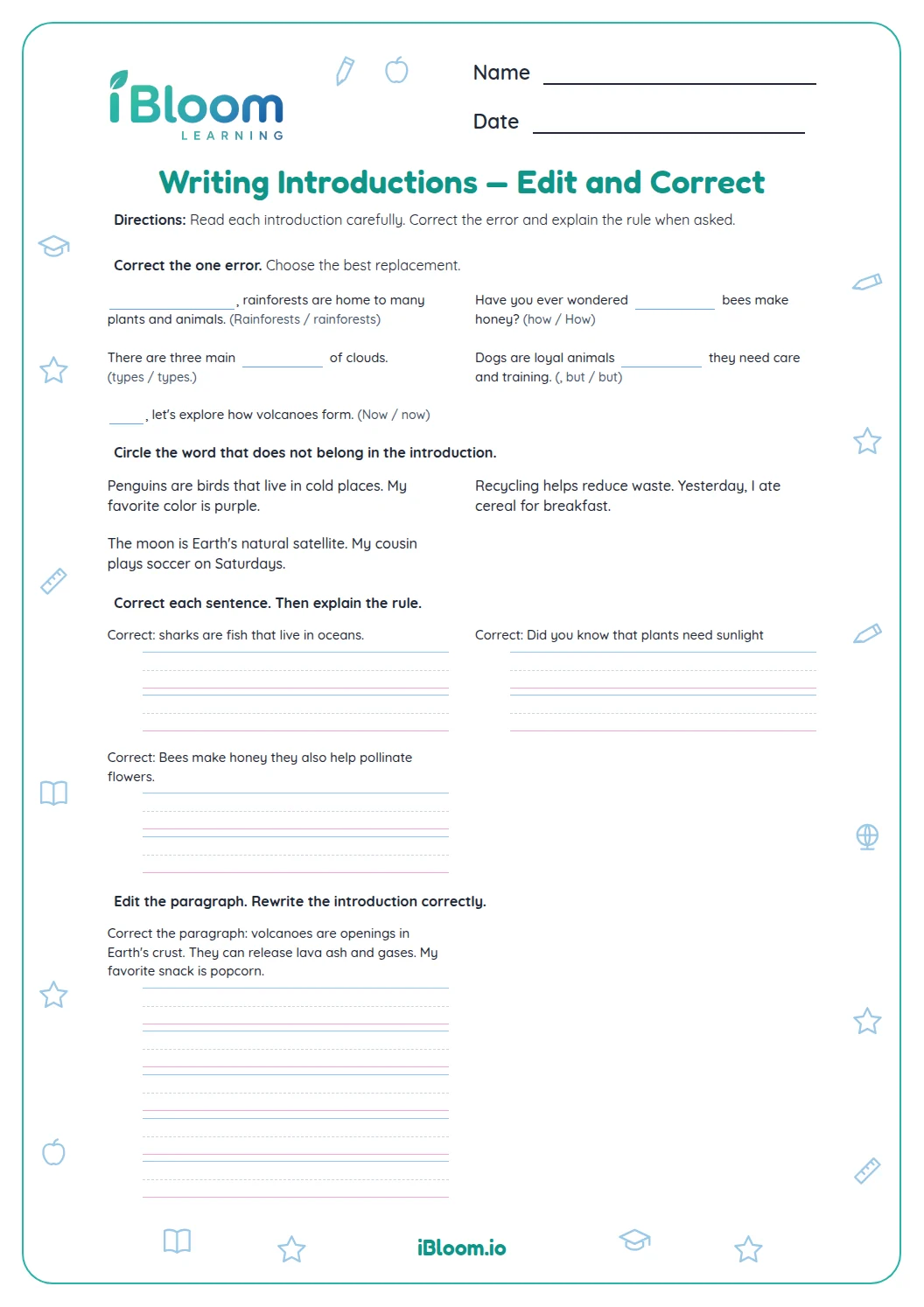
This Grade 4 informative-writing worksheet asks students to complete sentence corrections and select details that support a clear topic. Part A focuses on capitalization, spelling, punctuation, and sentence completeness. Part B asks students to choose relevant facts and topic sentences. The 16 questions use plant examples and include an answer key.
Aligned to L.4.2 and W.4.2
What should I check when I edit a sentence?
Look for capitalization, spelling, punctuation, and complete thoughts. Part A provides a blank for the missing correction; reread the whole sentence to check it.
- 1Question 4: add a comma after “Friday” to complete the date phrase.
How do I choose a useful supporting detail?
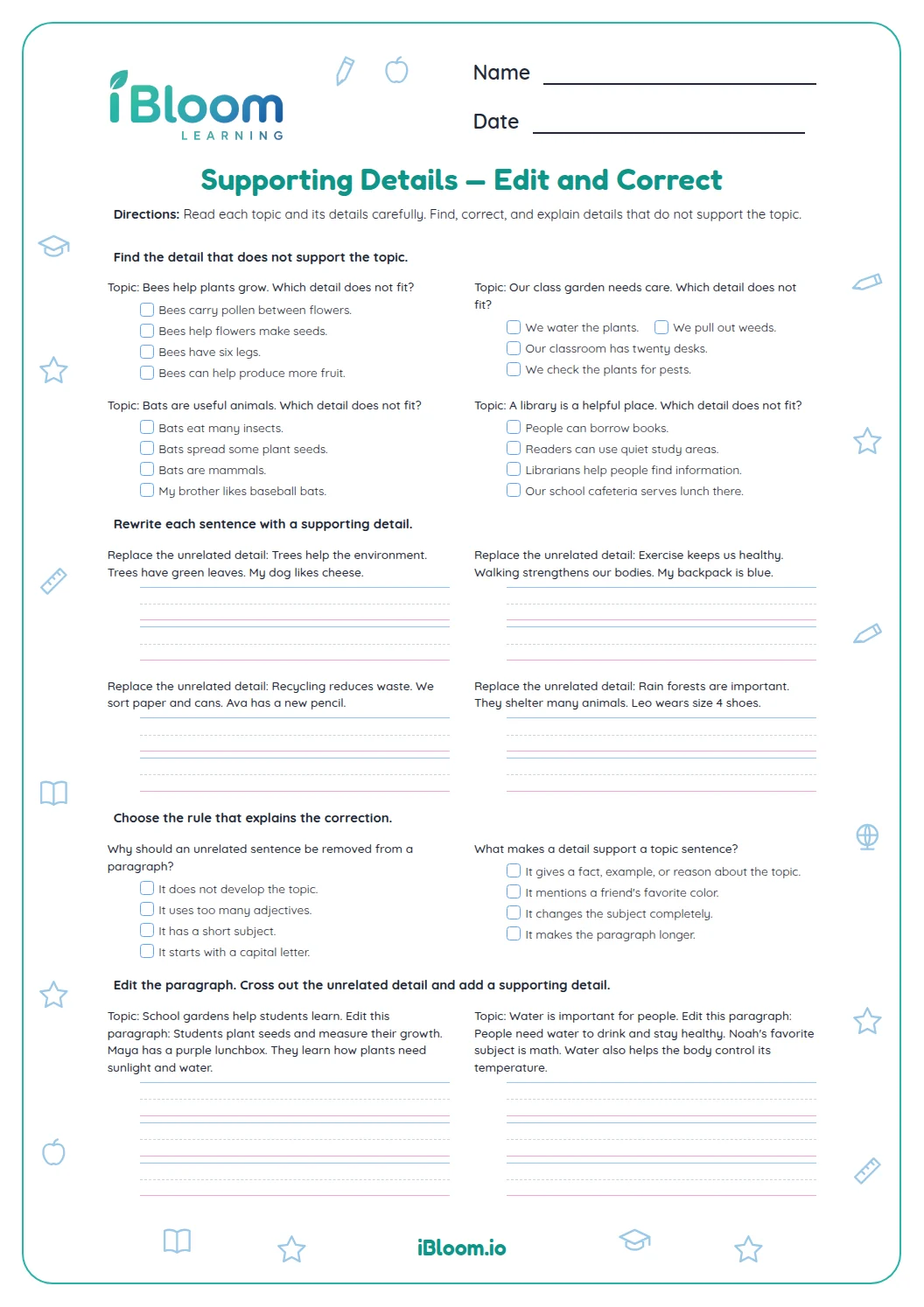
A useful detail explains or gives evidence for the paragraph topic. A sentence can be true but still not belong if it changes the subject. Part B asks students to select focused details and a topic sentence.
- 1Question 11: “A seedling grew after watering” supports the idea that plants need water.
How do focused details strengthen informative writing?
Correct conventions make ideas easier to read. Focused details help readers follow one topic from the opening sentence through supporting facts. In Part B, students choose details about plants, seeds, roots, and pollination.
How to use this worksheet
- 1Read the complete sentence before changing it.
- 2In Part A, look for capitalization, spelling, punctuation, or a fragment.
- 3Fill the missing word or punctuation mark, then reread the sentence.
- 4In Part B, repeat the paragraph topic in your mind.
- 5Choose the detail that directly supports that topic.
Common mistakes and quick fixes
The mistake
Adding a period to a question.
The fix
Use a question mark when the sentence asks something.
The mistake
Choosing a true sentence that is unrelated to the paragraph.
The fix
Check whether the detail explains the exact topic, not just the same broad subject.
The mistake
Fixing only the first visible error.
The fix
Reread for capitals, spelling, commas, and end punctuation after editing.
Common Core alignment
Edit capitalization, punctuation, and spelling in complete sentences.
On this sheet: Part A asks students to correct capitalization, punctuation, spelling, and sentence completeness.
Show the official wordingHide the official wording
Demonstrate command of the conventions of standard English capitalization, punctuation, and spelling when writing.
Choose focused facts and details for informative writing.
On this sheet: Part B selects details and topic sentences that keep an informative paragraph focused.
Show the official wordingHide the official wording
Write informative/explanatory texts to examine a topic and convey ideas and information clearly.
What to practice next
Make more practice
Further reading
Questions parents and teachers ask
How many items does this worksheet include?
There are 16 questions in two parts. Part A has 10 sentences with blanks for spelling, capitalization, or punctuation corrections. Part B has six choices about topic focus and supporting details. The answer key gives corrected completions and the best choices.
Can students phrase sentence corrections differently?
Yes. The key supplies one corrected version for each sentence, but a different rewrite is fine if it fixes the same issue and keeps the intended meaning. For example, students may make a small wording change while correcting capitalization or punctuation.
What is a supporting detail?
A supporting detail gives information that helps explain the paragraph topic. If the topic is plant roots, “Roots take in water” fits. A fact about a bird or a fence may be true, but it does not help explain how roots work.
Why does the worksheet include sentence fragments?
A fragment is not a complete sentence, so readers may not know the full idea. Question 8 begins with “Because roots need water,” and asks students to complete the thought. A suitable completion adds a main clause, such as “plants grow.”
Should students reread the whole sentence after editing?
Yes. Rereading makes it easier to see whether the correction fits the whole sentence and preserves its meaning. It also helps students notice a second issue, such as a missing end mark, after they fill the blank. The answer key shows one correct completion for each item.