



About this worksheet
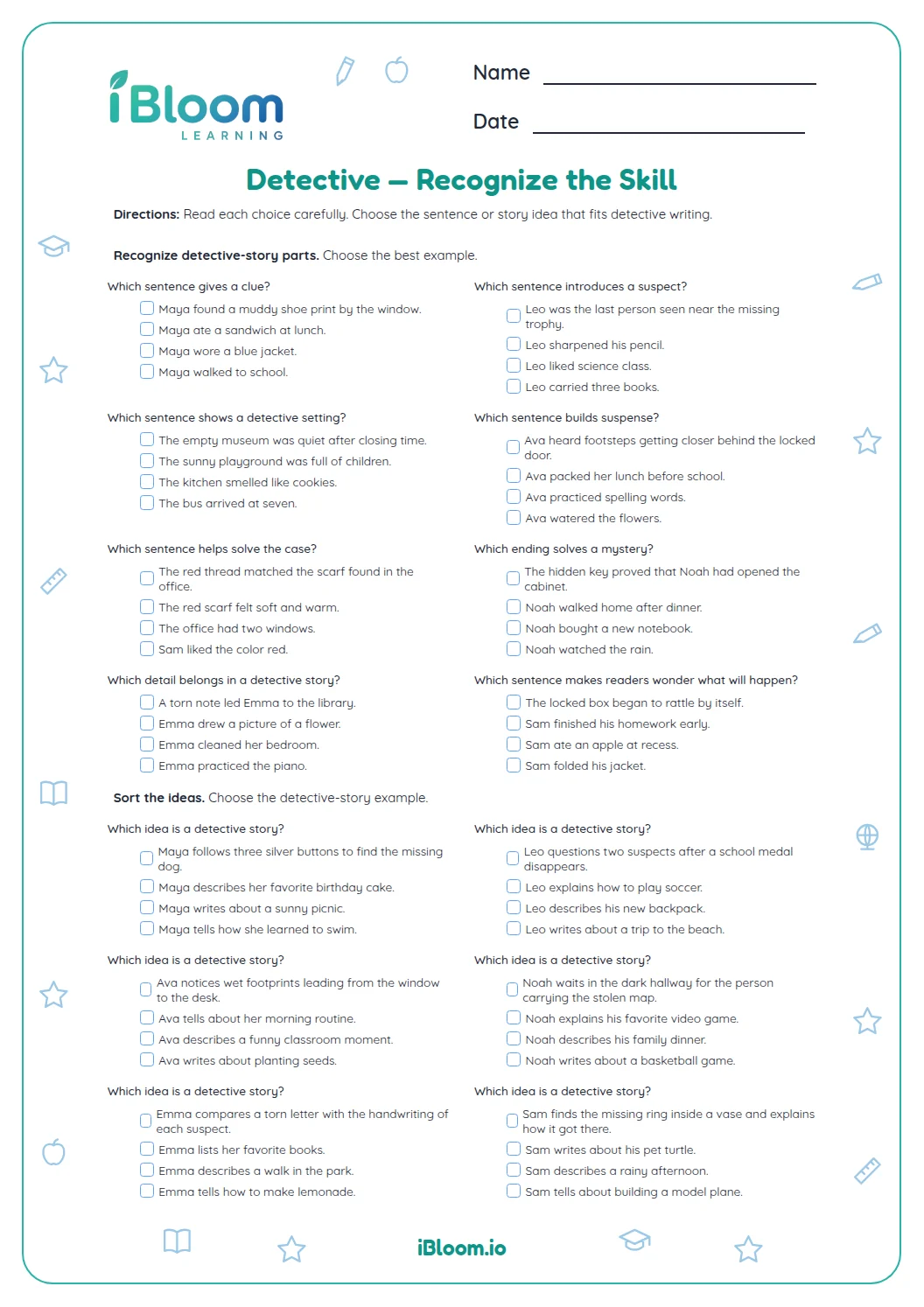
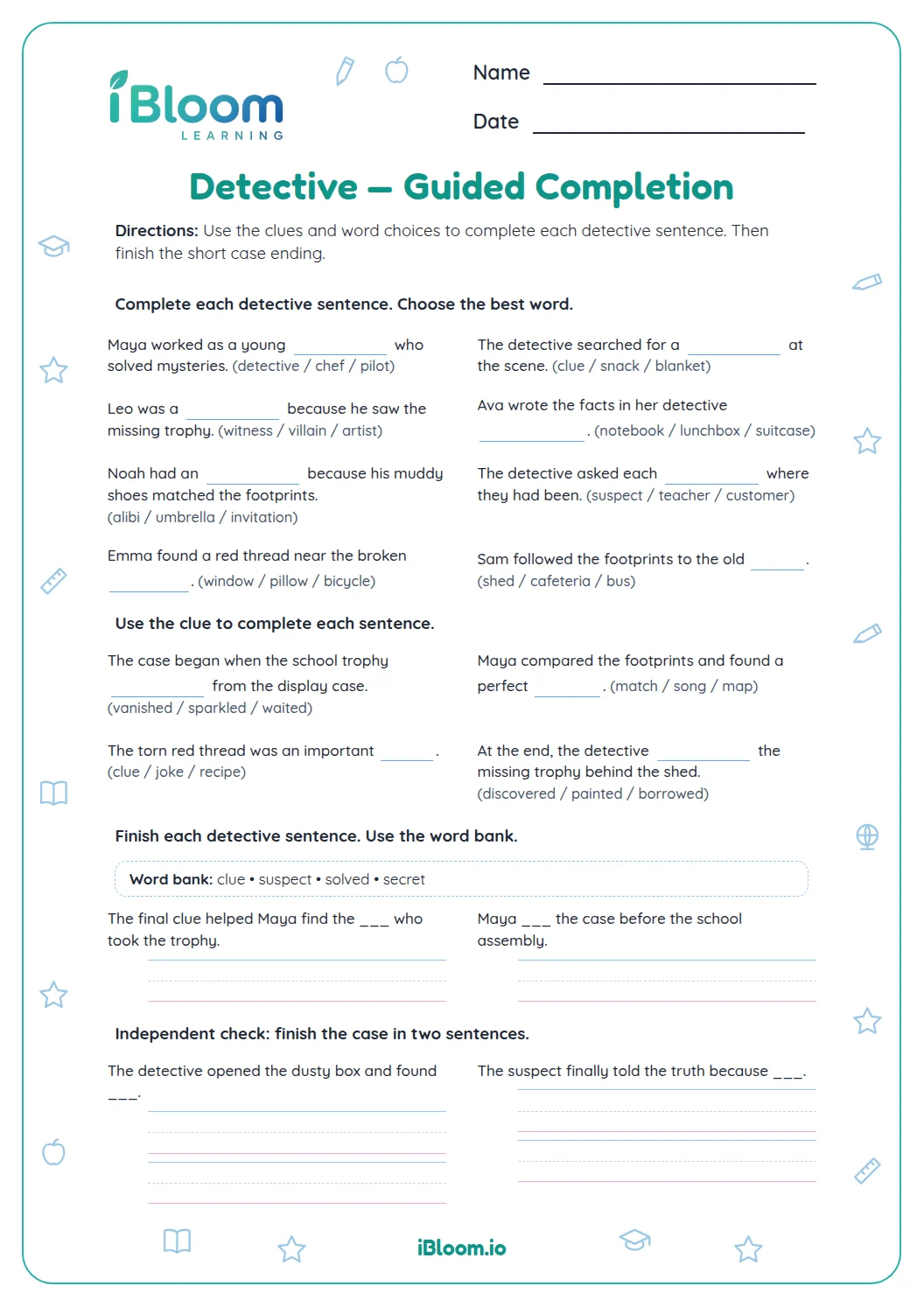
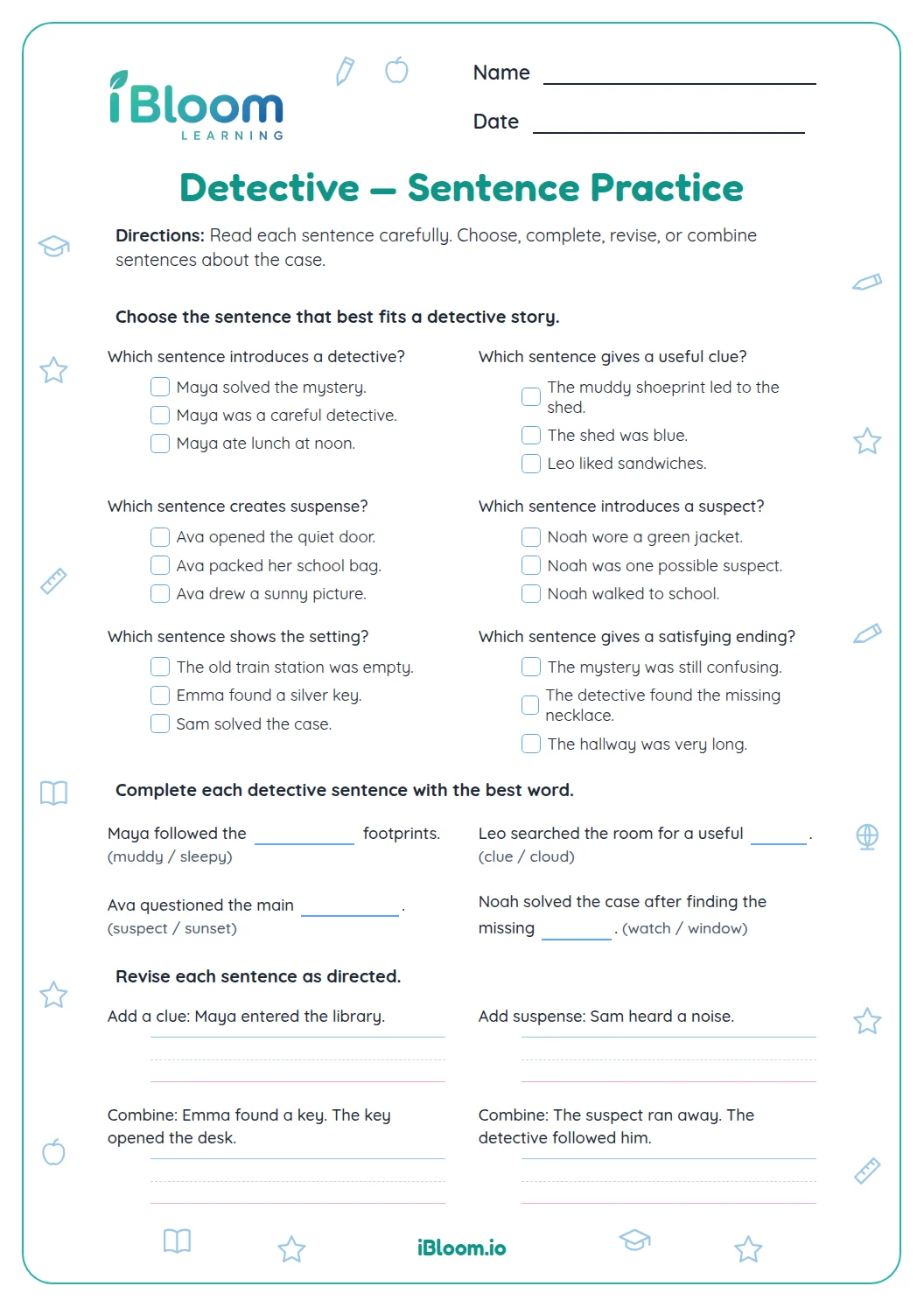
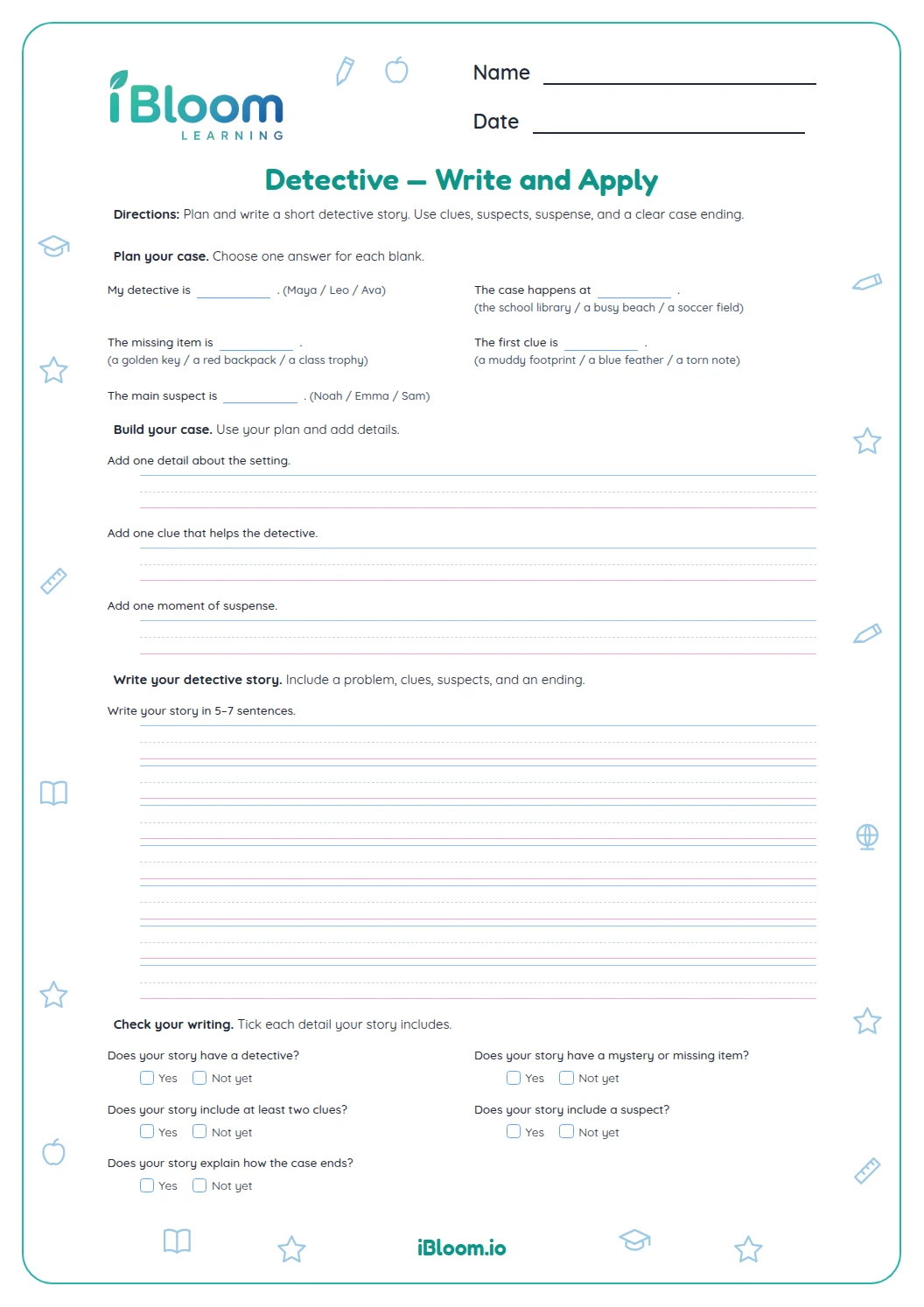
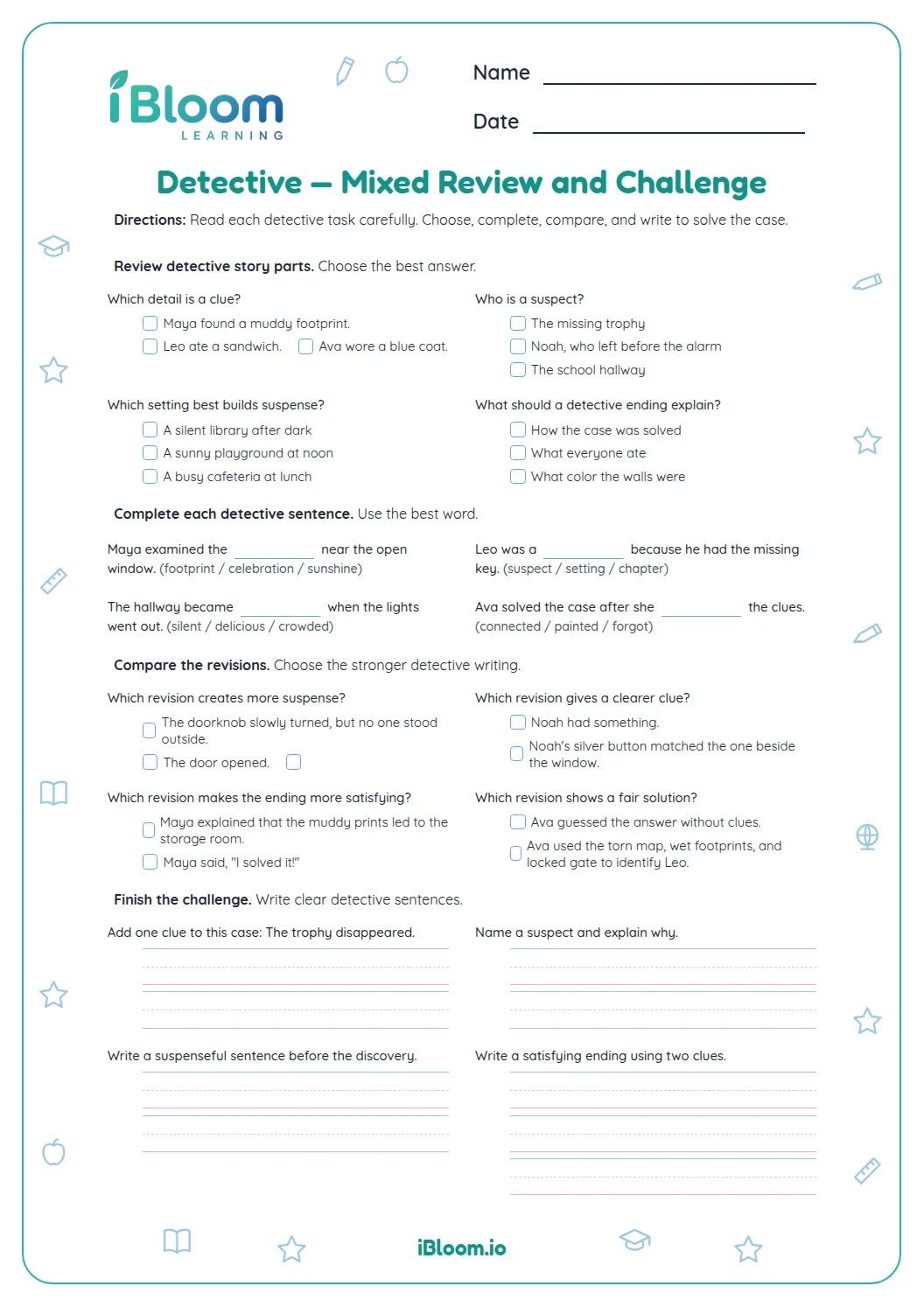
This free Grade 4 detective writing worksheet combines focused editing with a short narrative task. Students make seven choices about capitalization, dialogue punctuation, sentence boundaries, transitions, and precise details; complete five missing-mark items; and write two parts of a mystery. The narrative work supports CCSS W.4.3 by developing an imagined experience with descriptive details and a clear event sequence. Editing and correction also practice revision under W.4.5. A key gives corrections and sample story responses.
Aligned to W.4.3 and W.4.5
What should you check in a detective sentence?
Part A has seven brief choices about capitals, dialogue punctuation, sentence boundaries, sequence words, and precise details. Read each sentence closely and select the correction or detail that makes it clearer.
For question 3, “so” connects the quiet hallway to Riley’s decision to listen.
- 1The hall was quiet, so Riley listened.
How can punctuation make dialogue clear?
Part B asks for missing capitals or punctuation marks in five short detective sentences. A capital begins the detective’s name, commas can set off spoken words, and question marks show direct questions.
In question 11, Jo’s words continue into the dialogue tag, so a comma belongs before the closing quotation mark.
How can a clue lead a reader through a mystery?
Part C asks students to introduce a detective and clue, then add a transition into a search. Concrete details help a reader picture the evidence; a transition makes the next event clear.
The key offers one possible mystery. Students may choose another character or clue as long as the opening introduces evidence and the next event follows it.
- 1Detective Noor found a tiny brass key by the school gate.
- 2Afterward, Noor searched the garden shed for a lock.
How to use this worksheet at home or in class
- 1Read each choice carefully before selecting a correction.
- 2Check names, dialogue marks, sentence boundaries, and transition words.
- 3Write the detective and clue before drafting the search events.
- 4Use a sequence word to show which action happens next.
- 5Compare edits with the key and accept other connected story ideas.
Common mistakes and quick fixes
The mistake
Using a comma alone between two complete thoughts.
The fix
Use a period or add a coordinating conjunction after a comma when the ideas belong together.
The mistake
Describing a clue with a vague word such as “thing.”
The fix
Add a visible feature or location so the reader can picture the evidence.
The mistake
Listing search actions without showing their order.
The fix
Add a transition such as first, next, or after to guide the reader.
Common Core alignment
The mystery prompts practice narrative development, and the editing items ask students to revise and strengthen sentences.
Develop a mystery with descriptive details and events in a clear sequence.
On this sheet:
Show the official wordingHide the official wording
Write narratives to develop real or imagined experiences or events using effective technique, descriptive details, and clear event sequences.
Revise and edit writing with guidance and support.
On this sheet:
Show the official wordingHide the official wording
With guidance and support from peers and adults, develop and strengthen writing as needed by planning, revising, and editing. (Editing for conventions should demonstrate command of Language standards 1–3 up to and including grade 4 here.)
What to practice next
Make more practice
Further reading
Questions parents and teachers ask
What does this Grade 4 detective worksheet cover?
Students answer seven editing and detail choices, fill five missing capitals or punctuation marks, and write two short parts of a detective story. The answer key gives the selected corrections, missing marks, and sample narrative responses for checking.
What should a short mystery include?
A short mystery needs a detective, a situation or clue, actions that unfold in an understandable order, and details that help a reader picture what happened. The writing prompts divide those parts into an opening and a search sequence.
How can students make a clue more precise?
Choose something a detective could notice and describe a concrete feature such as its color, shape, texture, sound, or location. “A tiny brass key” gives a reader more to picture than a vague label. Add where the clue was found to make the detail more useful.
Why does dialogue punctuation matter?
Quotation marks show which words a character says, and punctuation separates those spoken words from the dialogue tag. A question mark belongs inside the quotation marks when the character is asking. Correct marks help readers tell who spoke and how the line should sound.
Can students write a different mystery from the answer key?
Yes. The two sample responses show one way to answer each writing prompt. Students may choose a different detective, clue, or setting, as long as the opening introduces a character and evidence and the later events show a search in order.