


About this worksheet
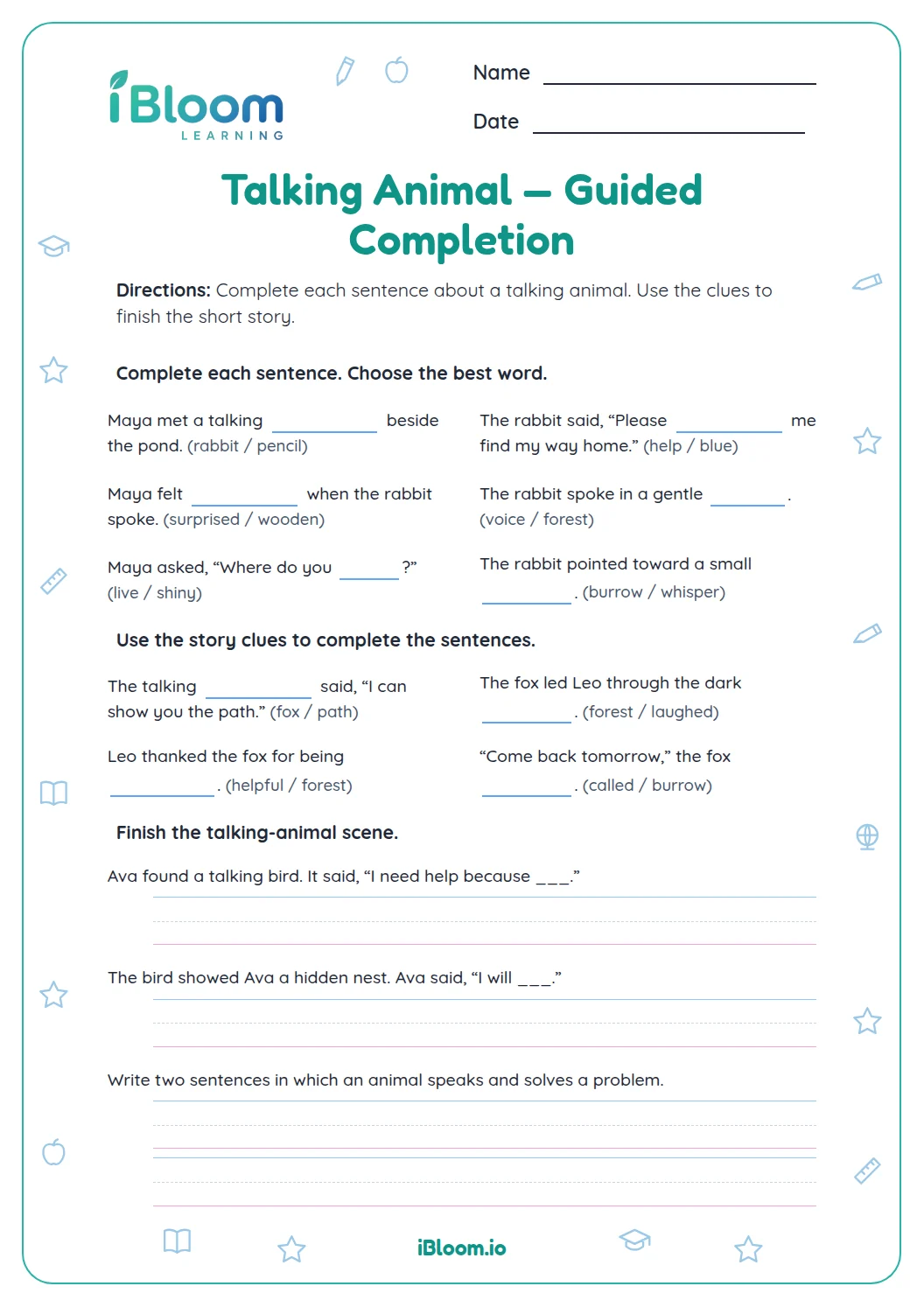
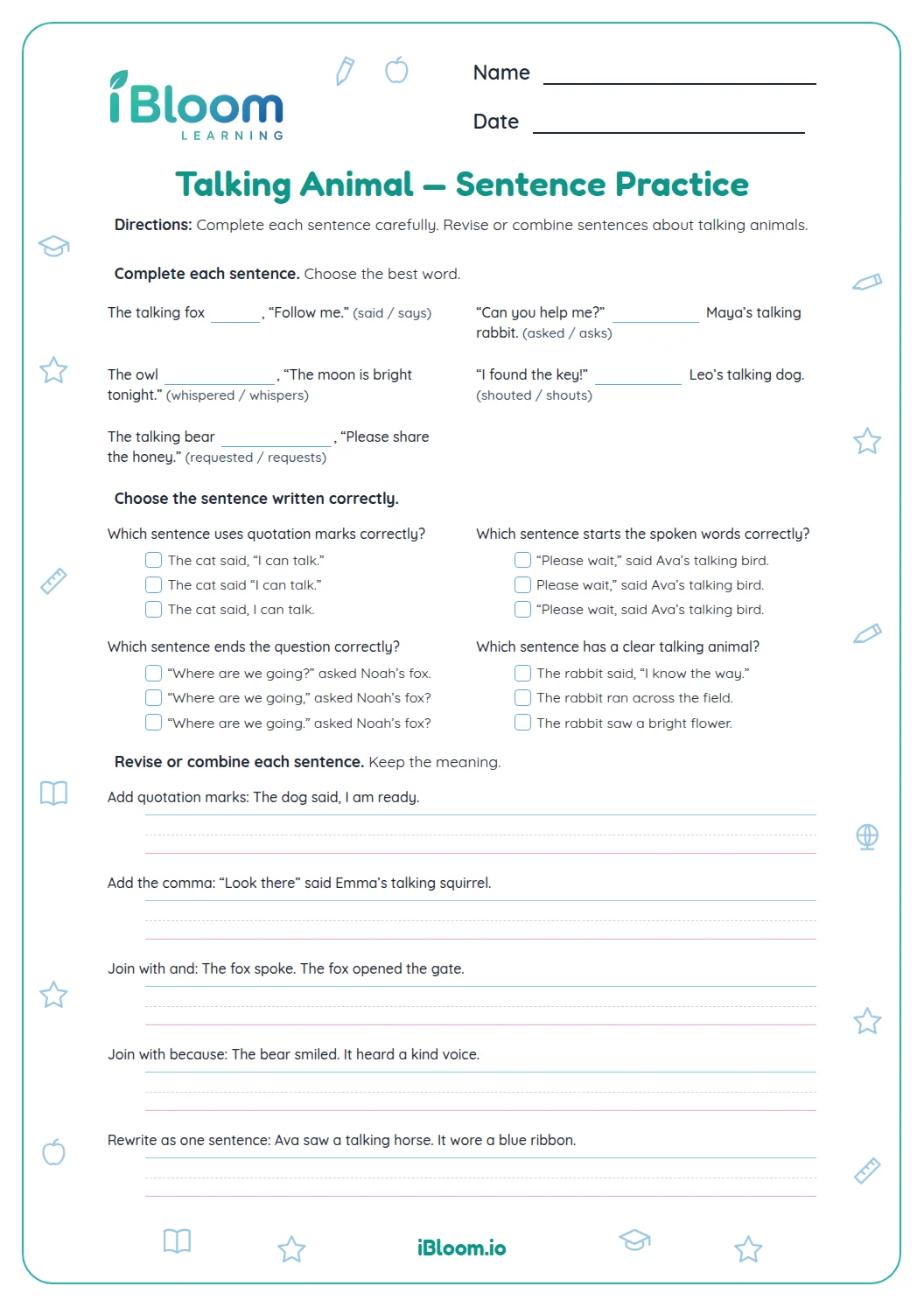
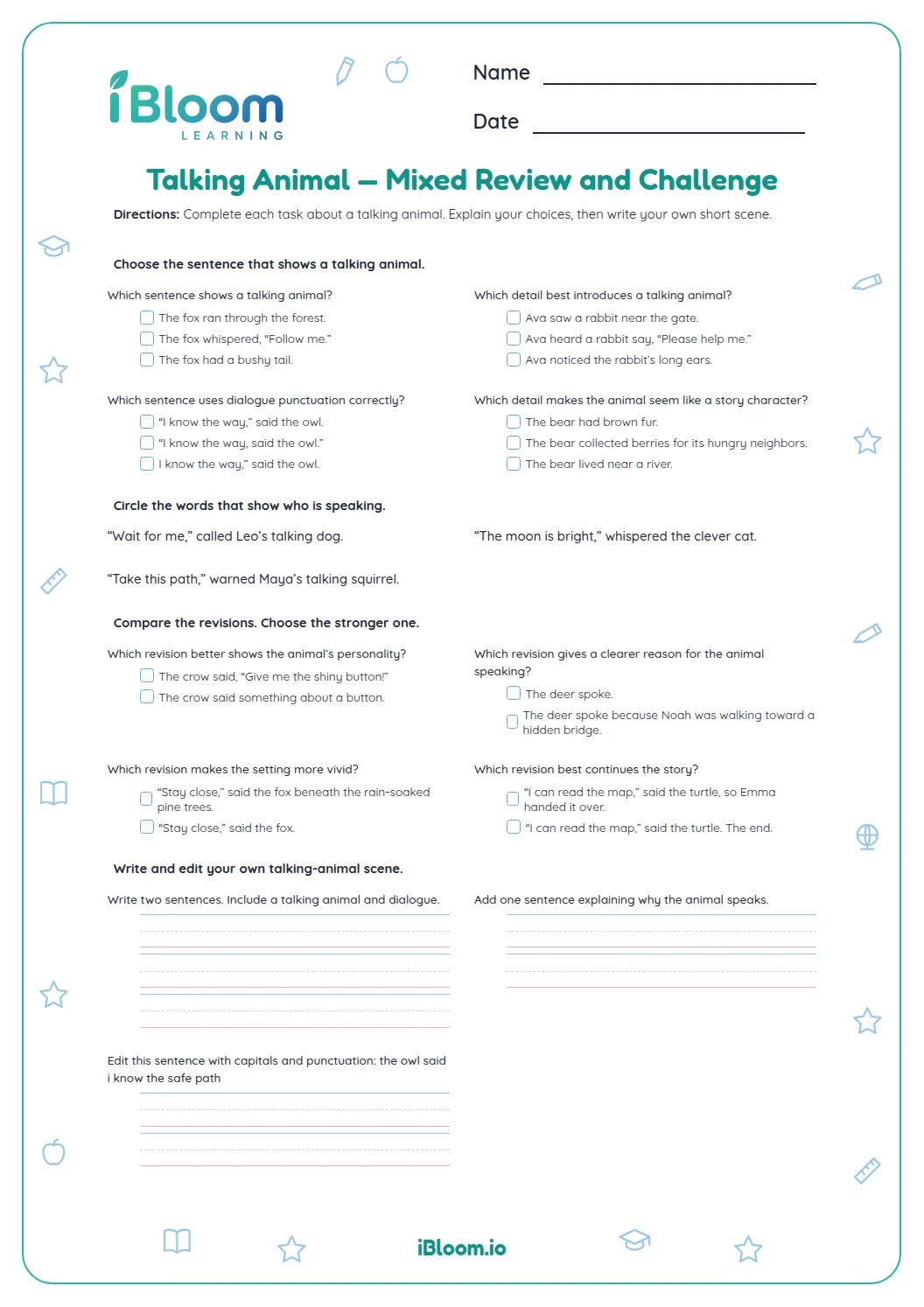
This Grade 4 narrative writing worksheet focuses on talking animals. Students label six sentences as talking or not talking, choose among four dialogue examples, then write four sentences that give an animal a voice. The answer key marks the fixed answers and offers sample dialogue for the writing prompts. The practice connects to CCSS W.4.3, especially using dialogue to develop events and characters.
Aligned to W.4.3.b
How can you tell when an animal is talking?
Quotation marks and a speech tag show spoken words, as in “I can find the path,” whispered the fox. A bark, croak, or gallop describes an animal or its sound; it does not give the animal spoken words. Part A asks students to make that distinction.
- 1Quotation marks and a speech tag show spoken words, as in “I can find the path,” whispered the fox.
What clues help identify dialogue?
Part B asks students to choose the sentence in each pair that gives an animal human speech. Read the whole sentence and look for words the character says. The turtle crawling under a log is an action; “Follow me,” said the turtle, is dialogue.
- 1Part B asks students to choose the sentence in each pair that gives an animal human speech.
How can a talking animal move a story forward?
In Part C, each prompt gives a purpose: offer advice, ask a question, welcome a visitor, or explain a plan. For example, “Have you seen my nest?” asked the robin gives the bird a voice and asks another character for information.
- 1In Part C, each prompt gives a purpose: offer advice, ask a question, welcome a visitor, or explain a plan.
How to work through the page
- 1Read each sentence and decide whether the animal speaks words.
- 2For a dialogue choice, find the animal’s spoken words.
- 3In Part C, make the animal say something that fits the requested purpose.
- 4Use quotation marks around spoken words and identify the speaker.
- 5Check fixed answers with the key; compare writing with the prompt.
Common errors to check
The mistake
Mistake: treating a bark or croak as dialogue.
The fix
Look for words spoken by the animal.
The mistake
Mistake: choosing a sentence that only describes an action.
The fix
Find the character’s actual words.
The mistake
Mistake: writing dialogue that misses the requested purpose.
The fix
Check that it advises, asks, welcomes, or explains as directed.
Common Core alignment
Add dialogue to develop narrative events and show a character’s response.
On this sheet: Part C asks students to write animal dialogue for a purpose; Parts A and B recognize dialogue in narrative sentences.
Show the official wordingHide the official wording
Use dialogue and description to develop experiences and events or show the responses of characters to situations.
What to practice next
Make more practice
Further reading
Questions parents and teachers ask
What counts as a talking animal?
A talking animal says words as a character, such as “I can find the path,” whispered the fox. An animal sound or action alone does not count. The worksheet begins with this distinction, then moves to dialogue choices and original writing.
What is included in the answer key?
The key gives answers for the classification and choice items, plus sample sentences for the four writing prompts. Since students can write many valid lines, compare each response with the requested purpose rather than requiring the sample wording. Ask the student to explain one answer using the sentence or number relationship that supports it.
How many questions are on the worksheet?
There are 14 questions in three parts: six classification items, four sentence choices, and four short writing prompts. Students first recognize speech, then identify it in choices, and finally create dialogue of their own. Ask the student to explain one answer using the sentence or number relationship that supports it.
How should students punctuate their dialogue?
Use quotation marks around the animal’s spoken words and include a speech tag or clear speaker. For example, “Take the bridge,” said the beaver. The worksheet asks for one sentence at a time, so students can focus on making each line fit its prompt.
Can a student use an animal other than the one in the sample?
Yes. The writing prompts invite students to choose an animal and invent suitable words for it. A response is successful when an animal speaks and the sentence matches that prompt, whether it uses a fox, bird, turtle, or another animal.