




About this worksheet
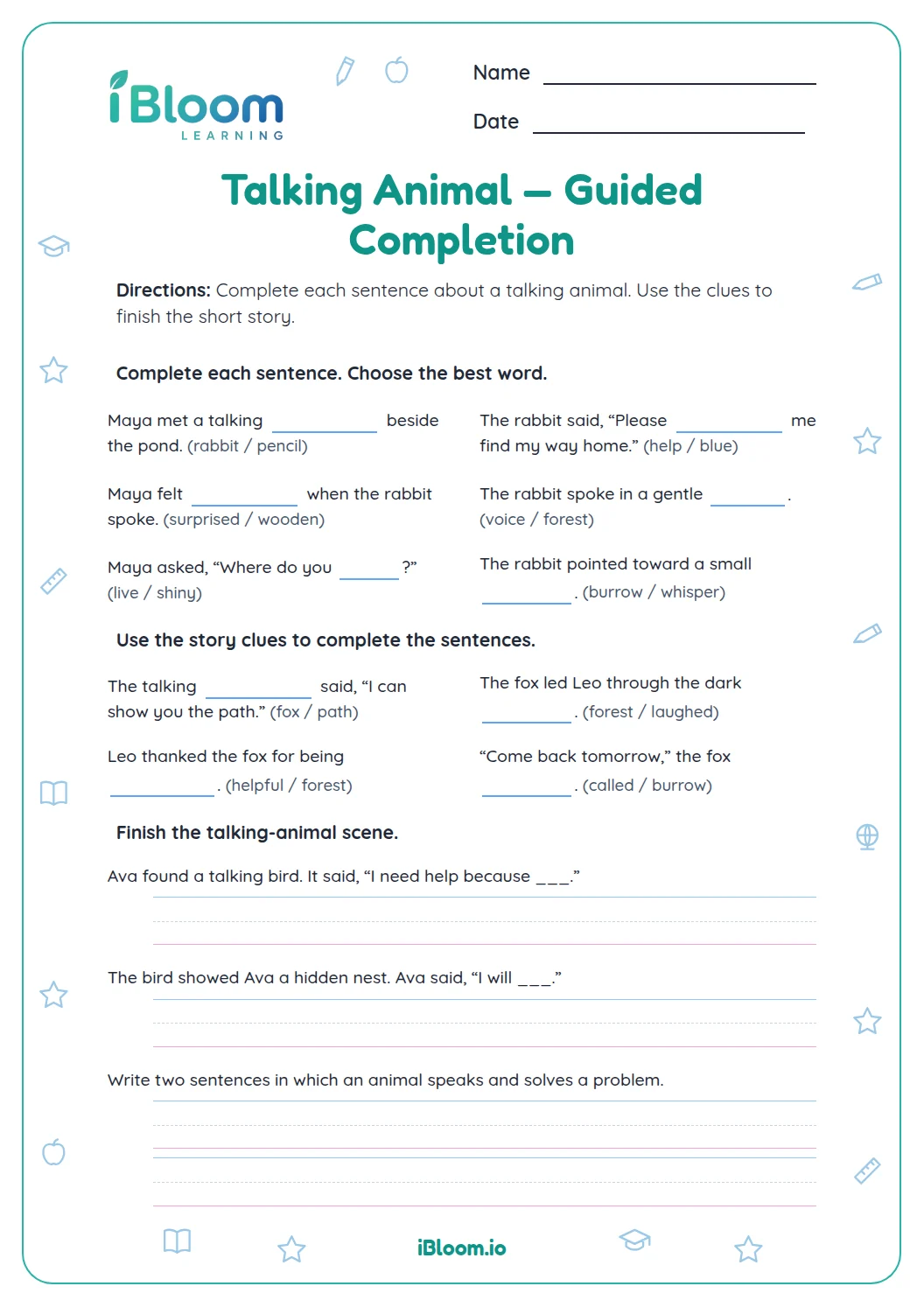
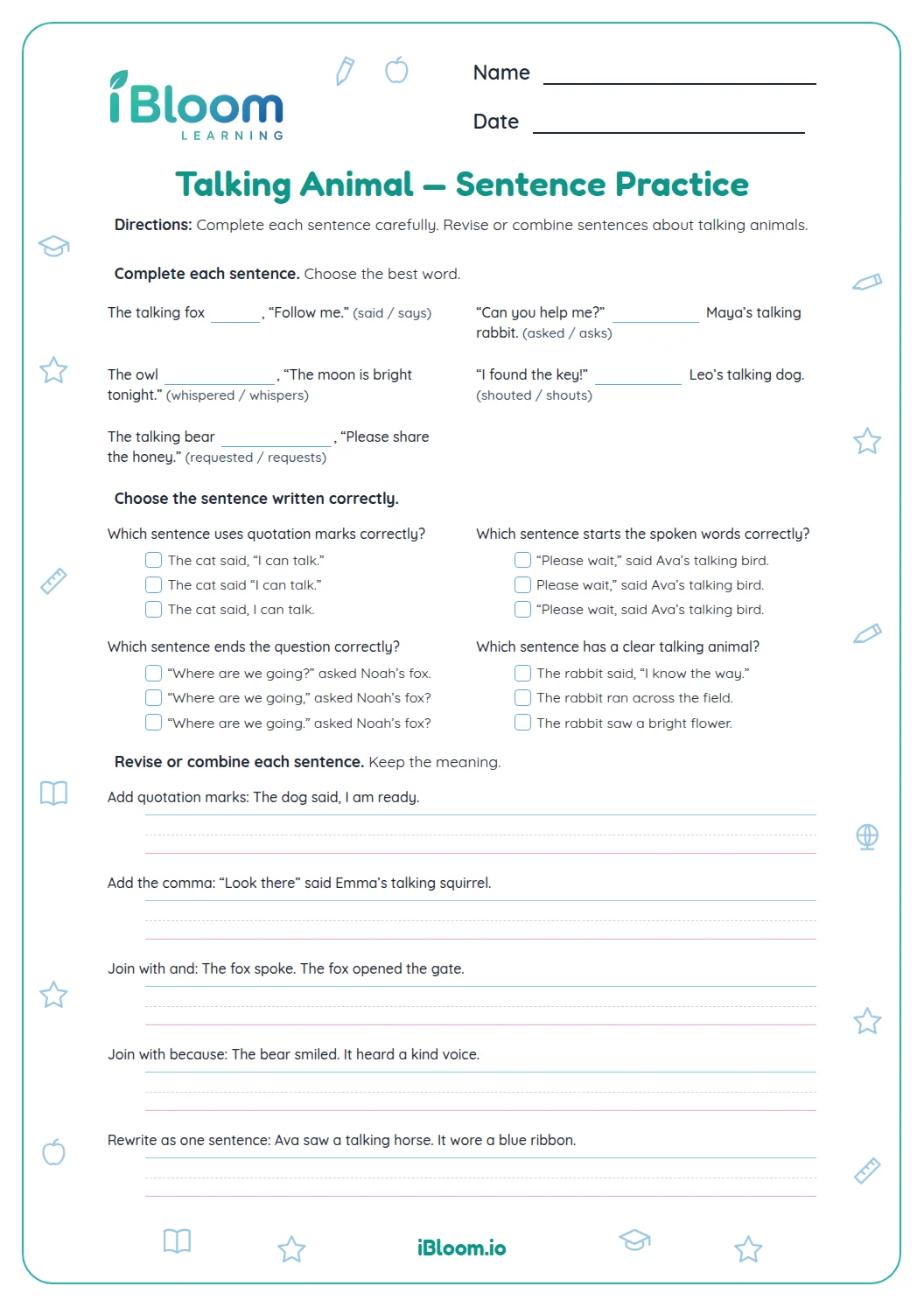
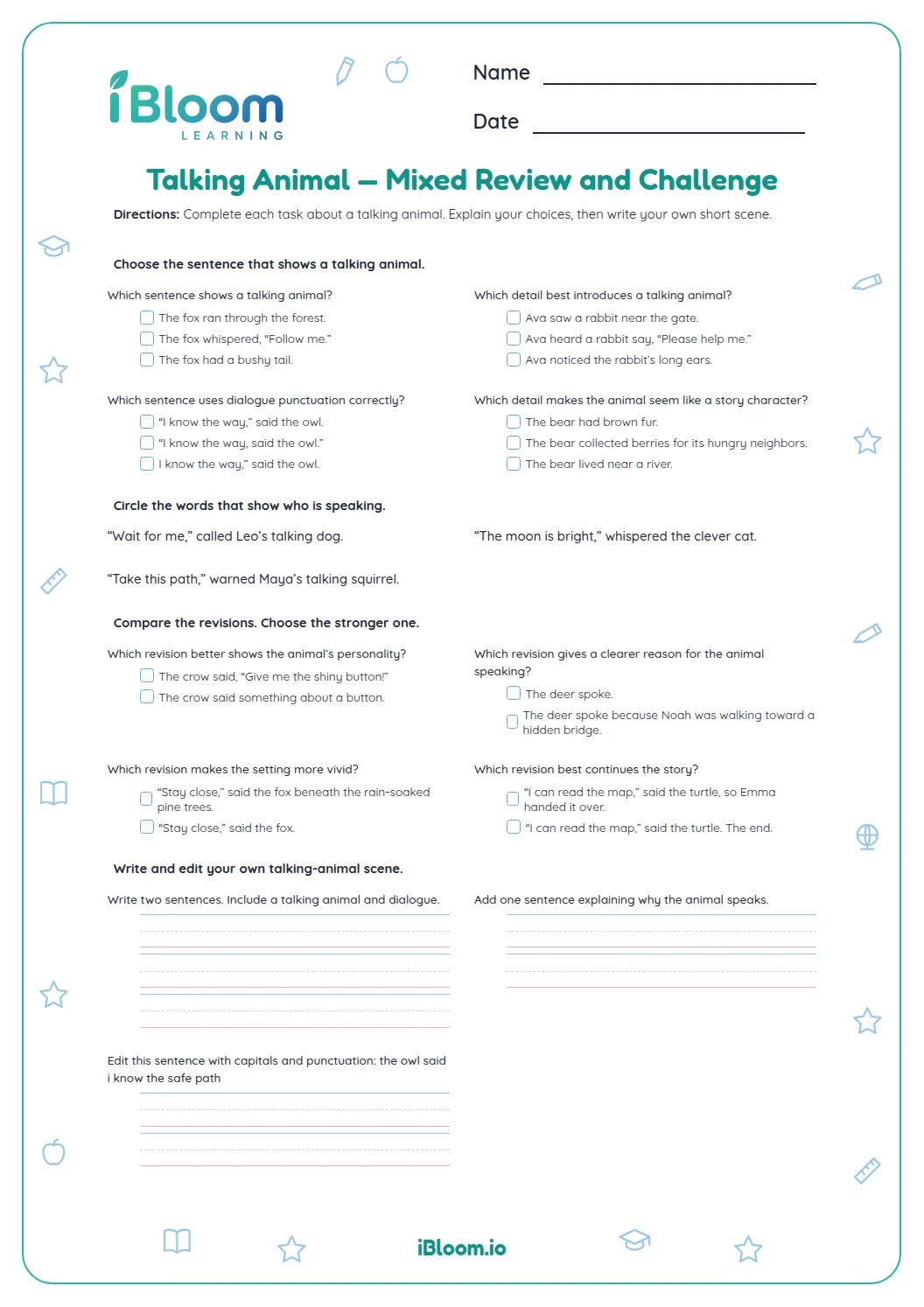
This Grade 4 printable asks students to edit 15 lines spoken by animal characters. They add quotation marks and commas around dialogue, capitalize the first word spoken, and choose the punctuation that belongs inside the quotes. A separate key shows a corrected version of each line.
Aligned to L.4.2.b
What will students edit?
All 15 items use dialogue spoken by animal characters. Part A focuses on quotation marks, commas, and capitals in speech and tags. Part B checks end marks and tag punctuation, including questions and exclamations.
- Part A: edit dialogue marks, tags, and capitals
- Part B: correct end marks and dialogue punctuation
- 15 rewrite prompts with a separate answer key
Where does the comma go in dialogue?
When a dialogue tag follows a statement, the comma goes inside the closing quotation mark: “I can help,” said Pip. A question mark or exclamation point stays inside the quotes when it belongs to the spoken words.
How can a student correct a dialogue line?
For “Follow me” said the fox, the words Follow me are spoken and said the fox is the tag. Add a comma inside the closing quotation mark: “Follow me,” said the fox.
A dialogue editing routine
- 1Read the full line and find the exact words spoken.
- 2Put quotation marks around the spoken words.
- 3Check whether a dialogue tag needs a comma.
- 4Capitalize the first word inside the quotation marks.
- 5Choose a period, question mark, or exclamation point that matches the speech.
- 6Compare the repaired line with the answer key.
Dialogue punctuation slips
The mistake
Leaving the comma outside the closing quotation mark before a tag.
The fix
Place the comma inside the quotation marks: “I can help,” said Pip.
The mistake
Using a period when the spoken words ask a question.
The fix
Put the question mark inside the closing quotation mark.
The mistake
Forgetting to capitalize the first spoken word.
The fix
Start the quoted sentence with a capital letter, even when the original line begins lowercase.
Common Core alignment
This worksheet practices punctuation and capitalization in direct speech.
Use quotation marks and commas in dialogue.
On this sheet: Students correct quotation marks and commas in spoken lines and dialogue tags.
Show the official wordingHide the official wording
Use commas and quotation marks to mark direct speech and quotations from a text.
What to practice next
Make more practice
Further reading
Questions parents and teachers ask
What does this worksheet practice?
It practices quotation marks, commas with dialogue tags, capitals, and end punctuation. Students rewrite 15 animal dialogue lines and compare their edits with the separate answer key. The examples move from a simple quoted line to more detailed dialogue edits.
Where does the comma go before a dialogue tag?
When a statement is followed by a tag, the comma goes inside the closing quotation mark: “I can help,” said Pip. The comma separates the spoken words from the tag that names the speaker. The tag tells who is speaking, and the punctuation separates it from speech.
Where does a question mark go in dialogue?
Put the question mark inside the closing quotation mark when the spoken words form the question: “Where is the path?” asked Nia. The tag after the quote begins with a lowercase letter. Keeping the tag lowercase helps distinguish it from the quoted sentence.
Are the animal characters part of a story?
The worksheet uses animal characters across short dialogue lines, but each item can be edited on its own. Students can focus on punctuation without needing to follow a longer plot. The repeated animal setting keeps attention on editing each individual line.
How should students check their edits?
After rewriting a line, compare it with the answer key and look at the quotation marks, comma, capital, and final mark. If something differs, reread only the spoken words and decide what punctuation they need. Checking one mark at a time makes it easier to locate an editing error.