




About this worksheet
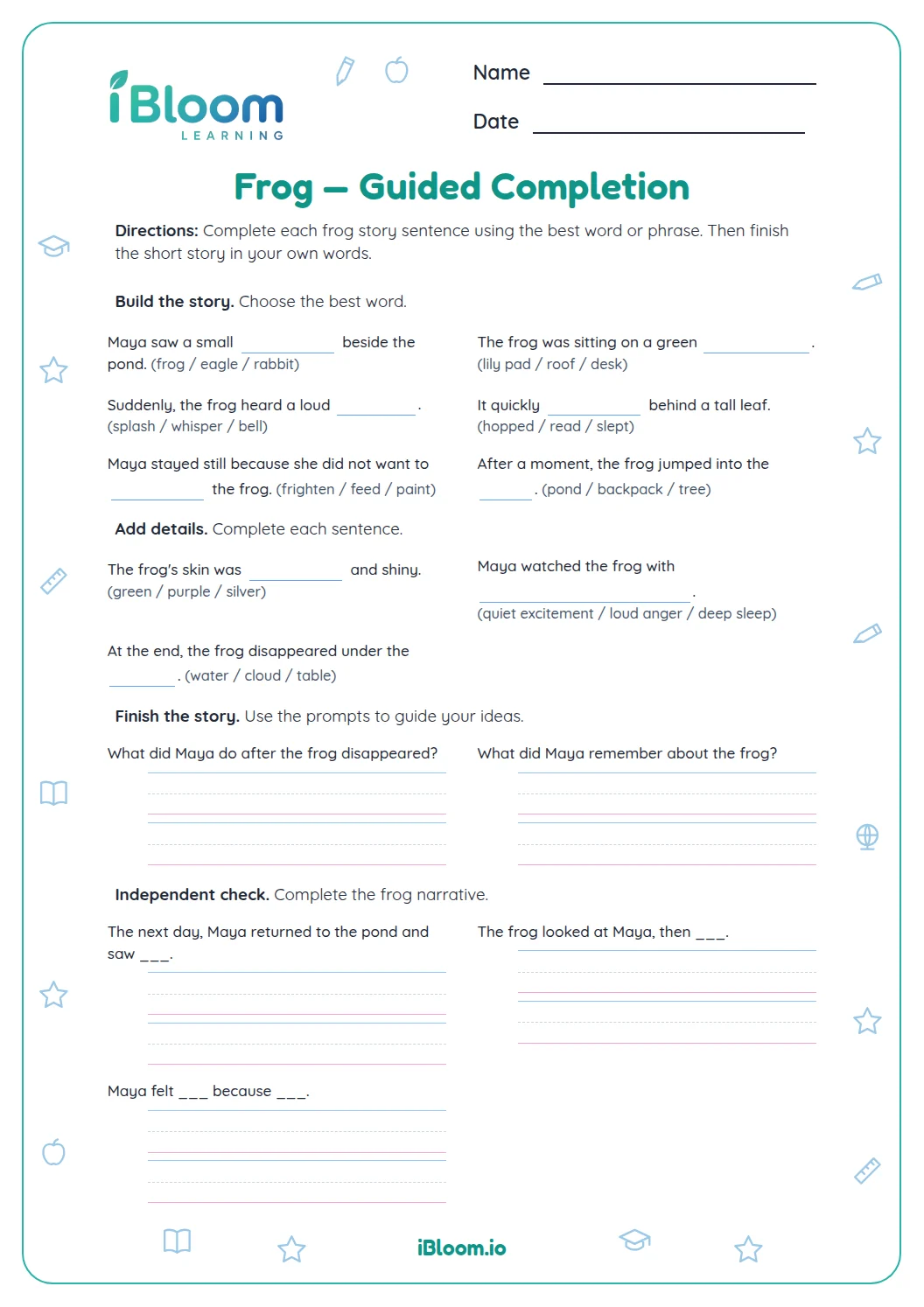
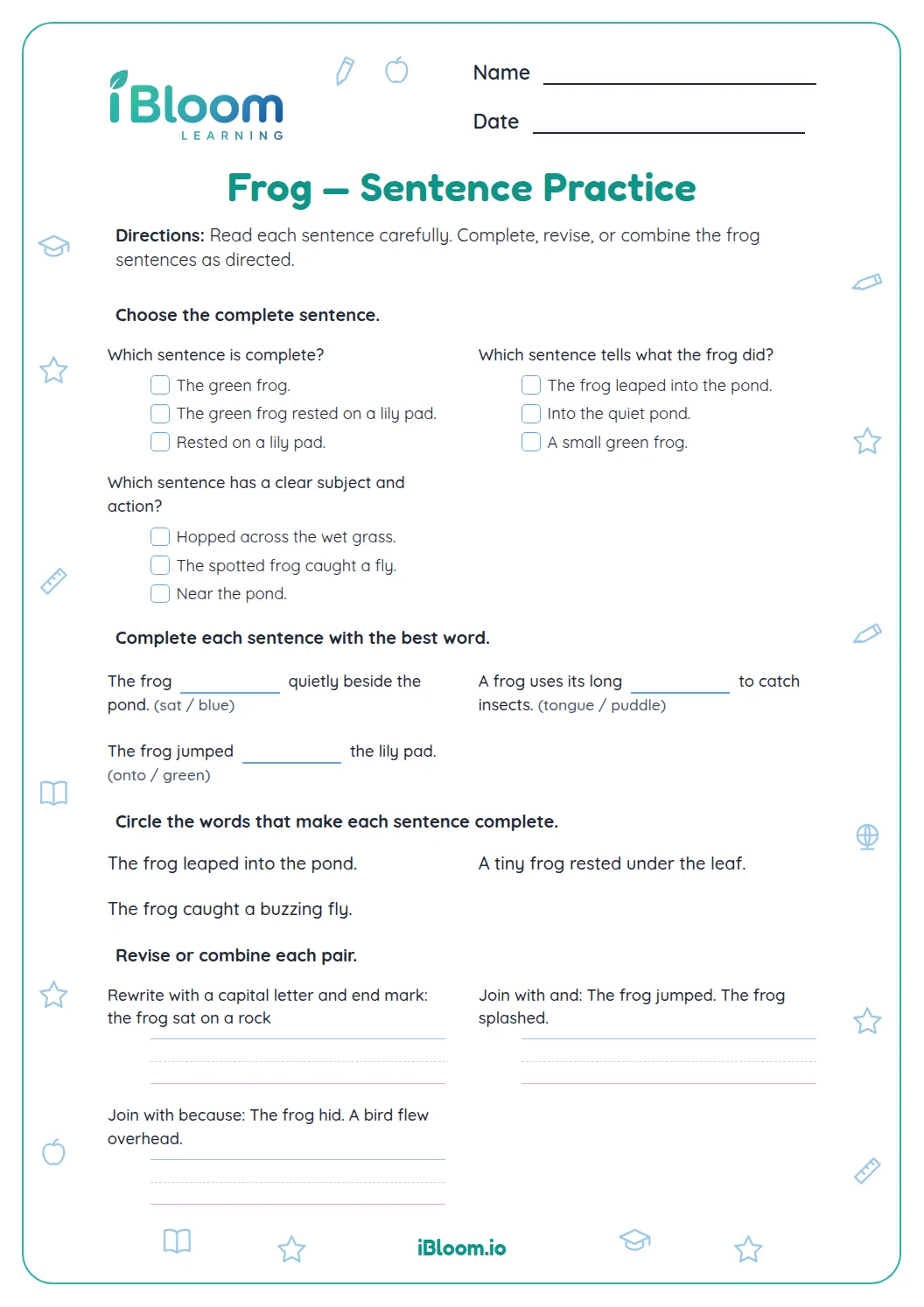
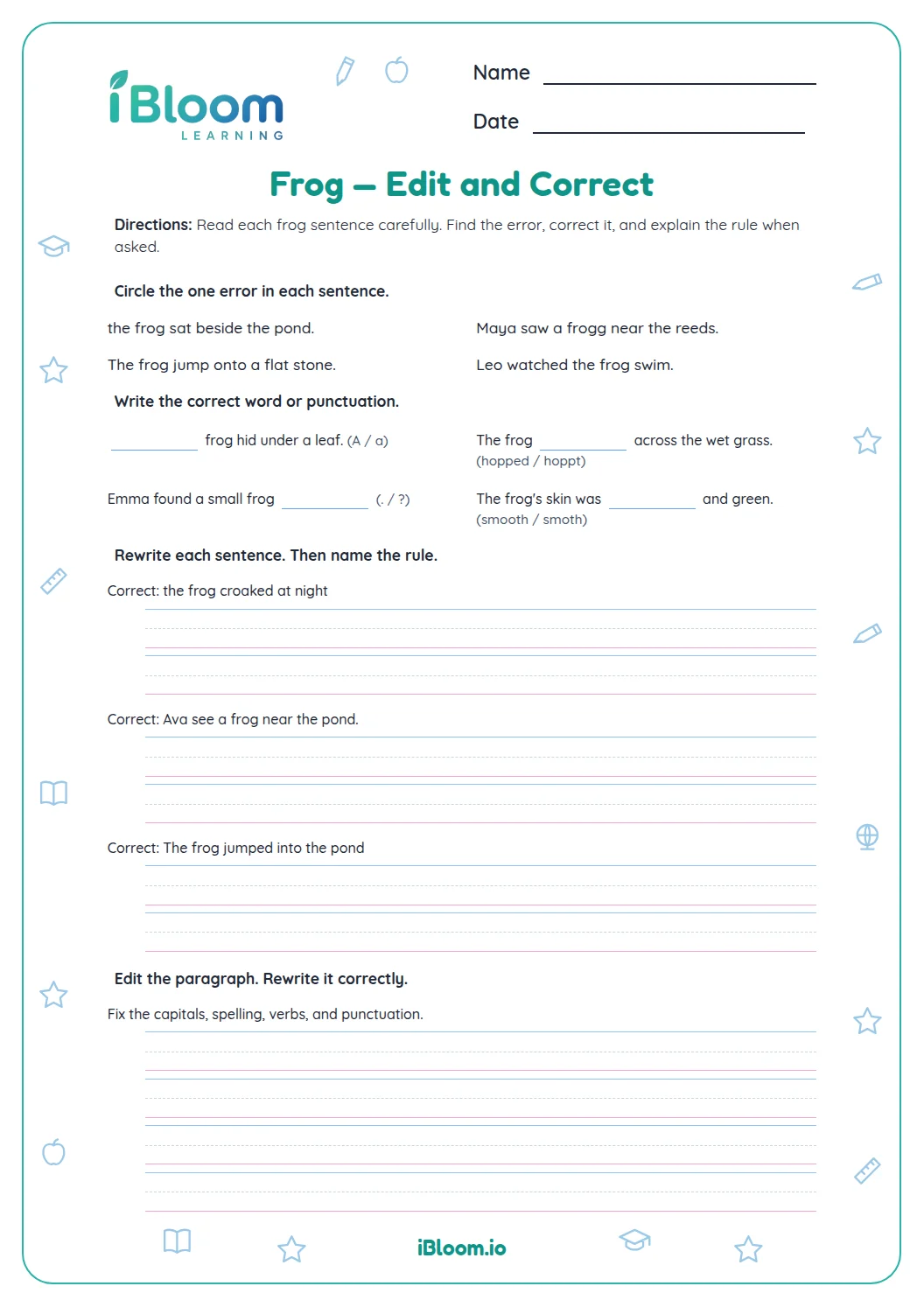
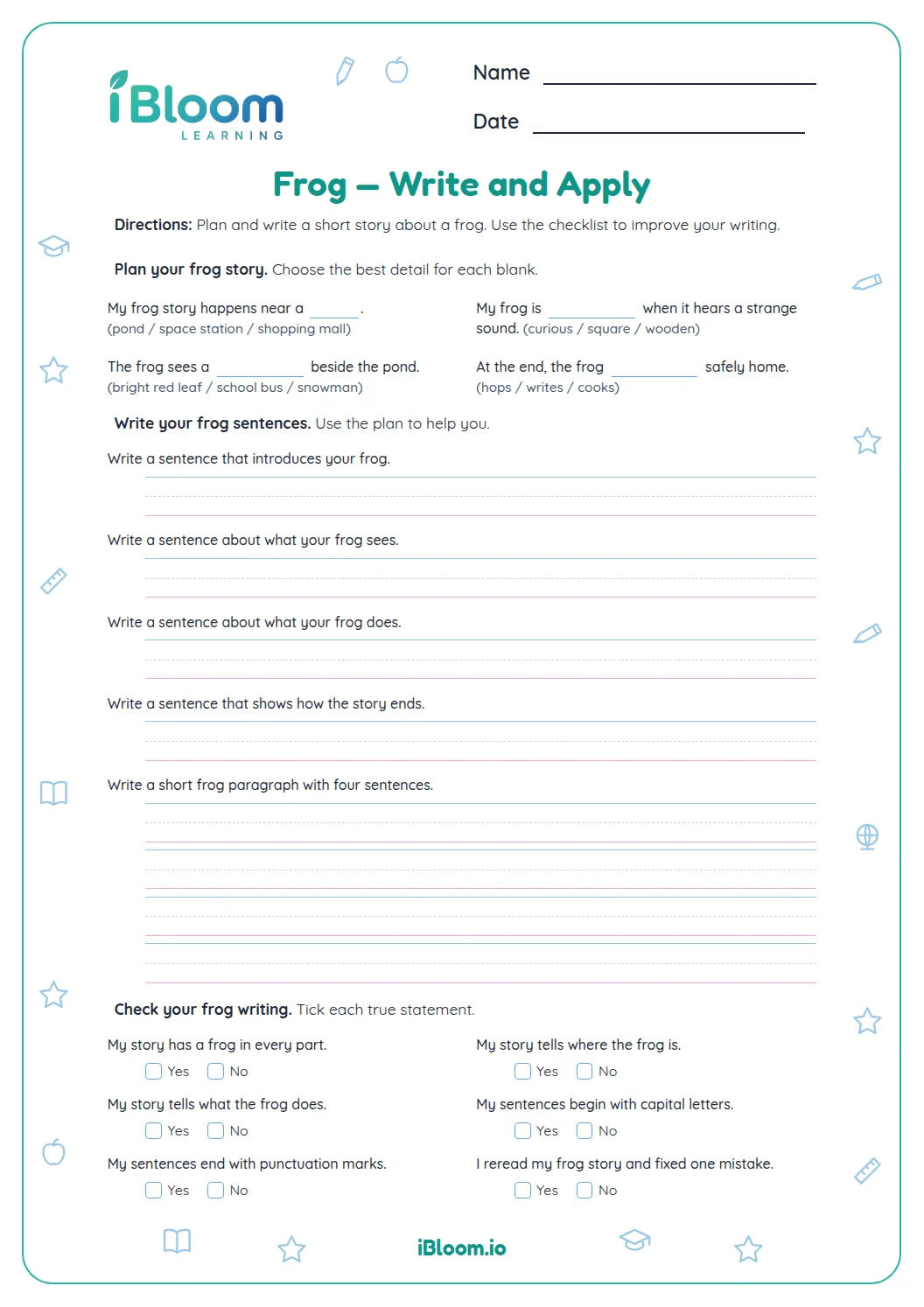
This Grade 4 printable helps learners recognize how a narrative uses a character, setting, events, and details. Across 14 questions on three worksheet pages, children identify parts of Milo’s frog story, choose details that strengthen it, and write four original sentences. A separate answer key includes sample responses.
Aligned to W.4.3
How can a writer make a frog story clearer and more vivid?
This Grade 4 printable helps learners recognize how a narrative uses a character, setting, events, and details. Across 14 questions on three worksheet pages, children identify parts of Milo’s frog story, choose details that strengthen it, and write four original sentences. A separate answer key includes sample responses.
- 1“Milo leaped onto a wet lily pad” is a complete action.
- 2A stronger version can add a sensory detail: “Milo sprang onto a shiny, rain-wet lily pad.”
What will learners practice?
Fourteen questions identify narrative features and choose details, then ask learners to write four sentences about Milo. The worksheet and answer key each have three pages.
How can I use the answer key?
Check each answer after the learner completes the page. For written responses, use the sample as a guide; other clear answers that meet the prompt are valid.
How to use this worksheet
- 1Read each sentence choice aloud.
- 2Ask whether it gives a complete action or idea.
- 3Notice words that help picture the pond or Milo’s feelings.
- 4Choose details that make an event clearer.
- 5Use the final prompts to write complete, connected sentences.
Common mistakes and quick fixes
The mistake
Choosing a fragment because it names the character or setting.
The fix
Check that the sentence tells a complete thought or event.
The mistake
Adding a detail that does not fit a pond frog story.
The fix
Keep new details connected to Milo, his setting, or the story problem.
The mistake
Ending with another event but no sense of closure.
The fix
Show what changed or how Milo feels at the end.
Common Core alignment
The worksheet asks learners to identify and develop narrative events and details.
Use details and event sequences to develop a frog narrative.
On this sheet:
Show the official wordingHide the official wording
Write narratives to develop real or imagined experiences or events using effective technique, descriptive details, and clear event sequences.
What to practice next
Make more practice
Further reading
Questions parents and teachers ask
What narrative skills does the frog worksheet cover?
Learners identify complete events, setting details, character wants and feelings, and sentences that move the plot forward. They also choose vivid details and write four original sentences for Milo’s story. The key includes sample responses for the writing prompts. Look for a complete thought with a clear action.
Is there a reading passage about a frog?
This page uses short sentence choices about Milo, a frog living by a pond. It focuses on recognizing narrative craft and adding story sentences rather than reading a long passage. The answer key includes examples for the four open-ended writing items.
What makes a sentence a story event?
A story event tells what a character does or what happens. “Milo leaped onto a wet lily pad” gives an action, while a fragment such as “Milo near the pond” does not express a complete event. Learners can look for a subject and an action.
What should a strong setting detail include?
A useful setting detail helps readers imagine where and when a scene happens. Pond ripples, rain, reeds, or a sunny bank make Milo’s setting more specific. Ask the learner to choose a detail that gives a reader information about the scene.
How should I score the written answers?
The answer key gives sample responses for the four writing prompts. Accept other complete sentences that match the prompt and make sense in Milo’s frog story. A response should do the requested job, such as introducing a problem or showing how Milo solves it.
How long does the worksheet take?
Plan about 25 minutes for 14 questions across three worksheet pages. Learners first identify narrative features, then write four sentences that could fit into Milo’s story. Allow extra time if they want to revise a sentence for clearer details.