



About this worksheet
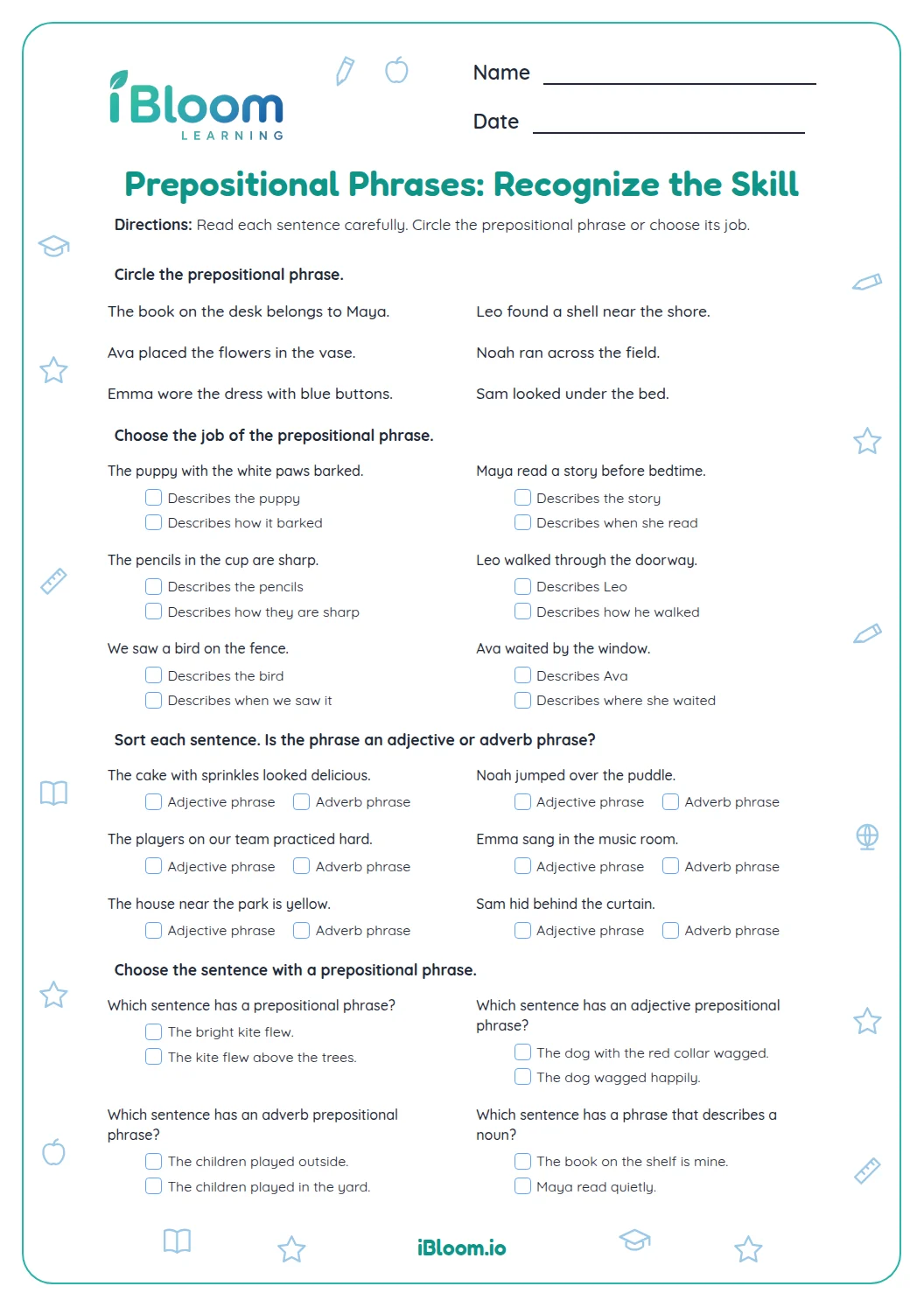
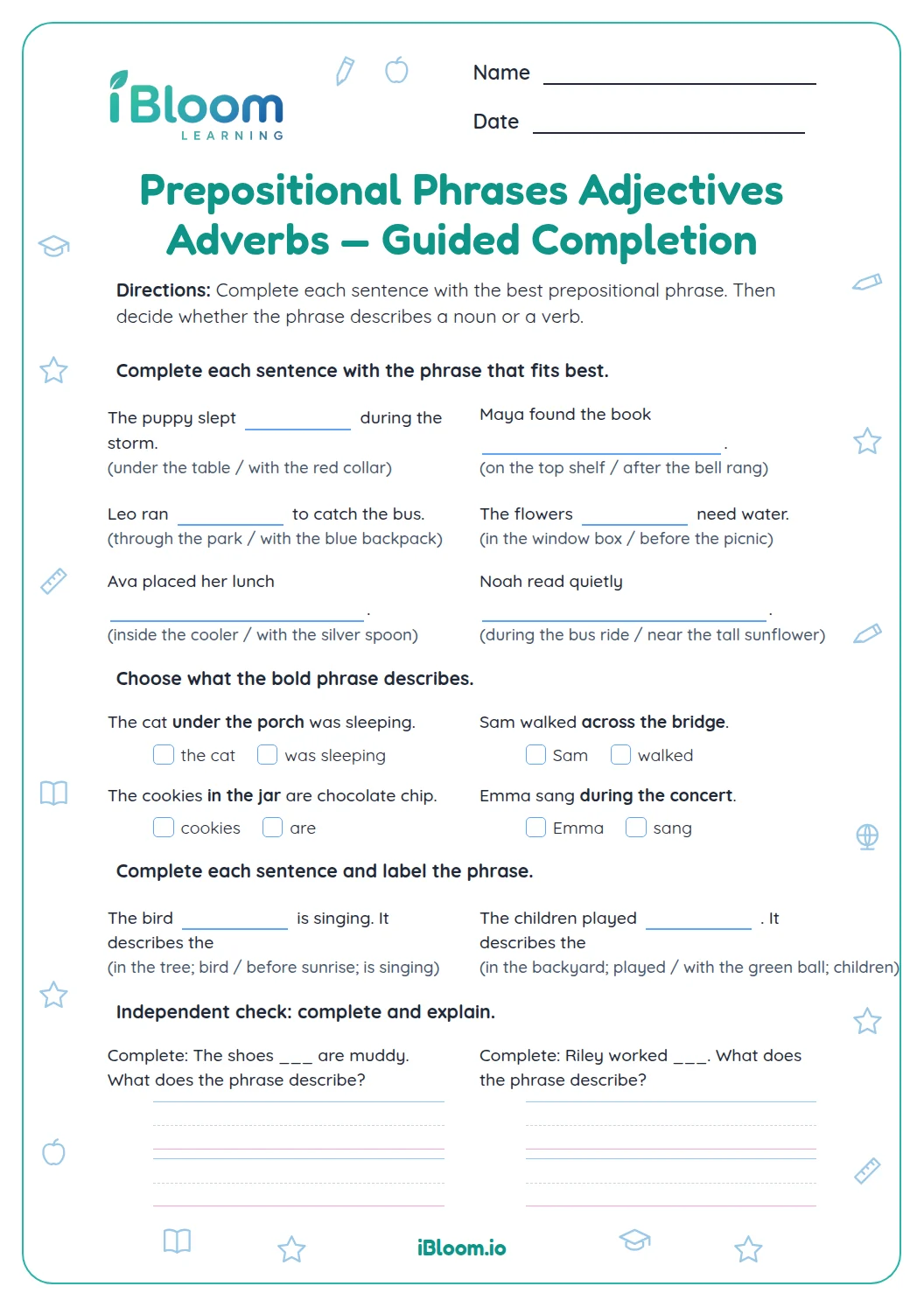
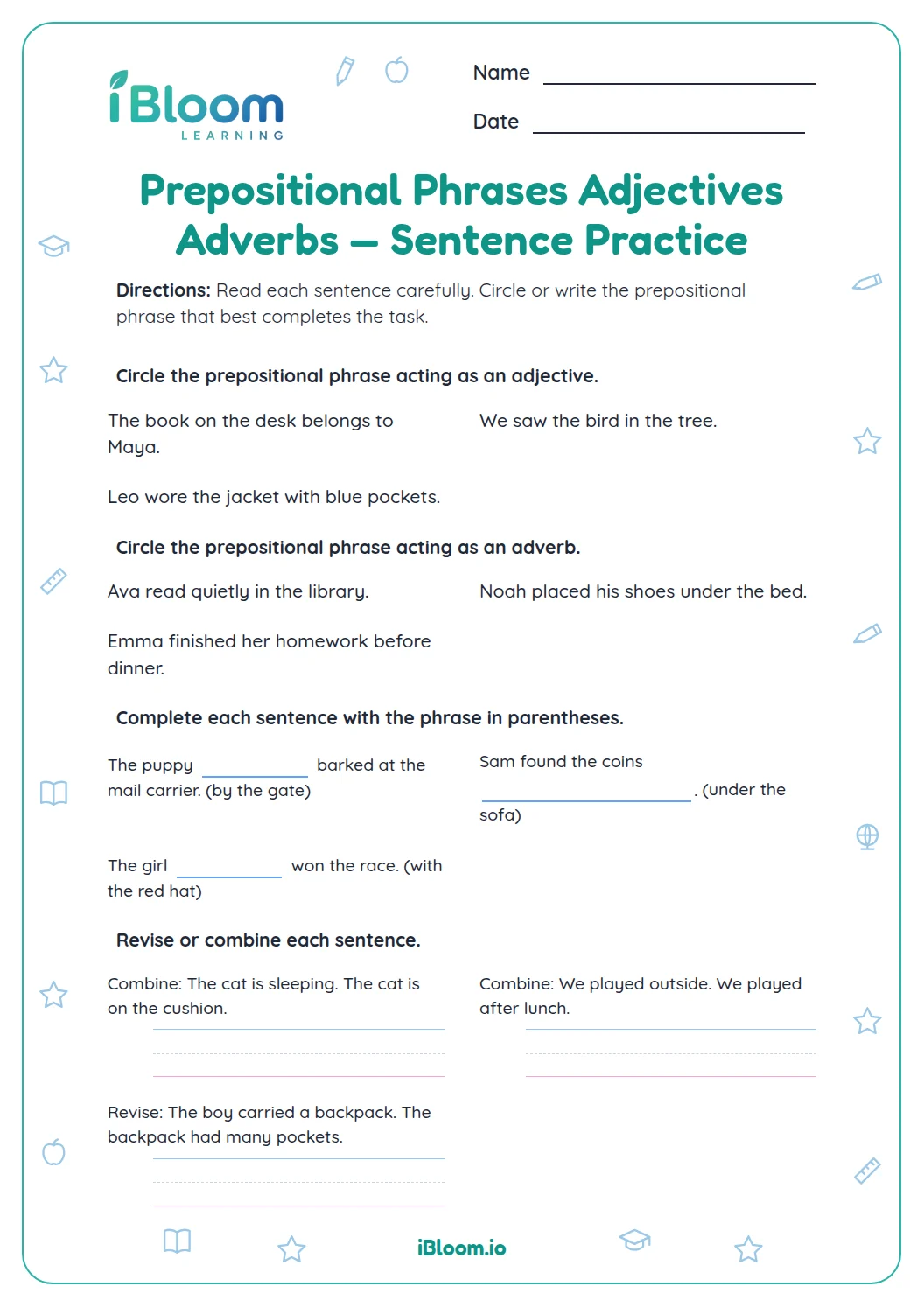
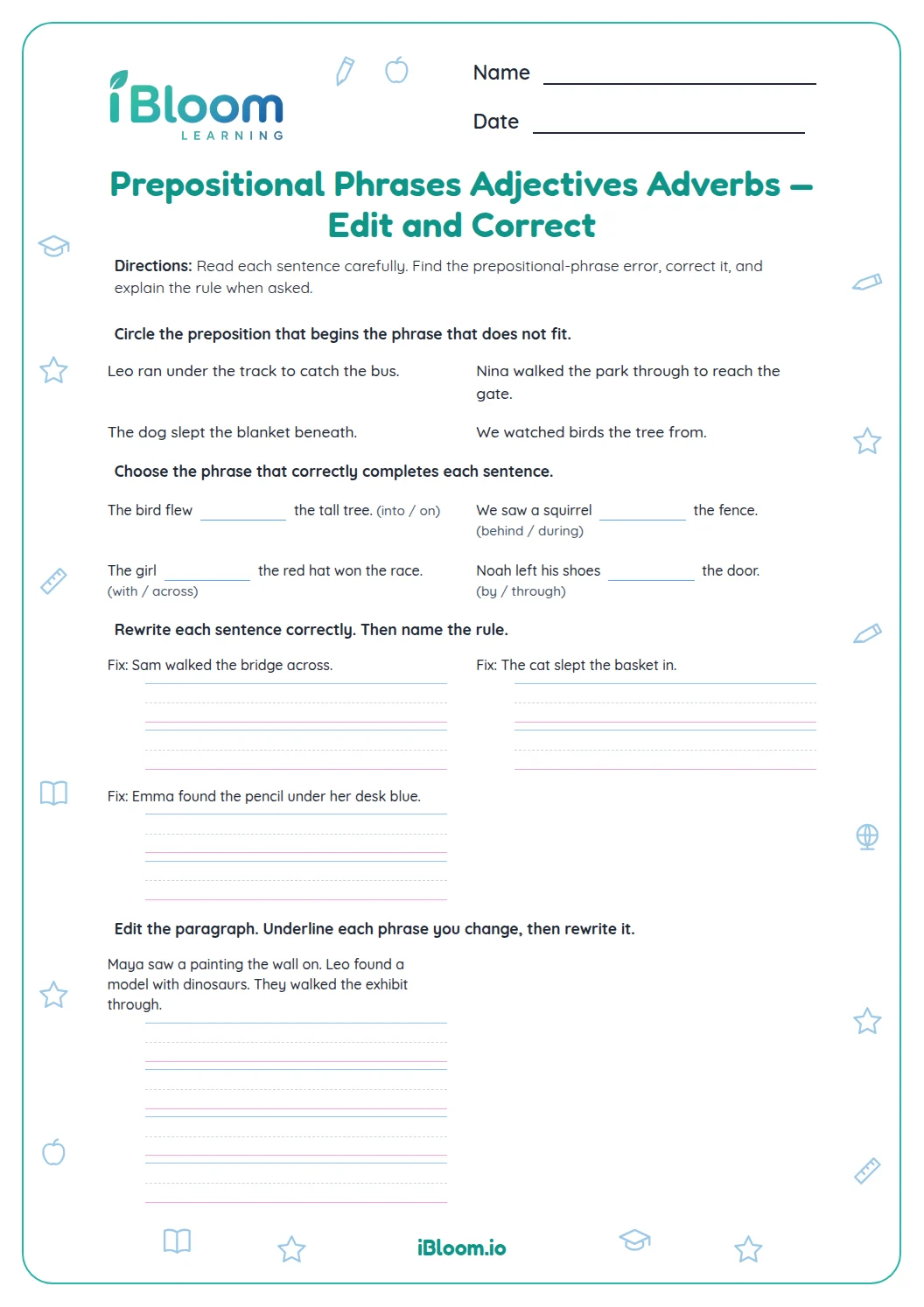
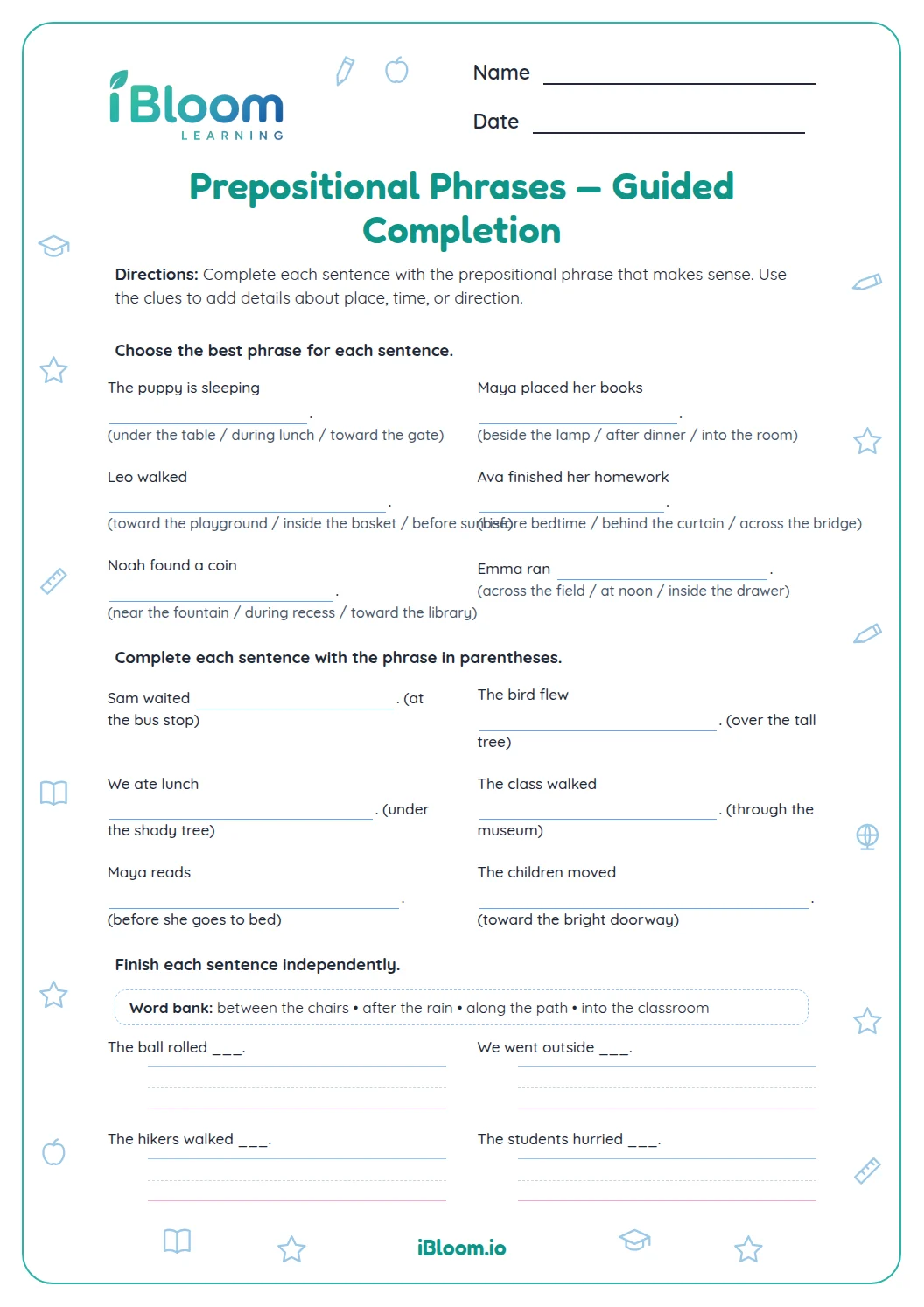
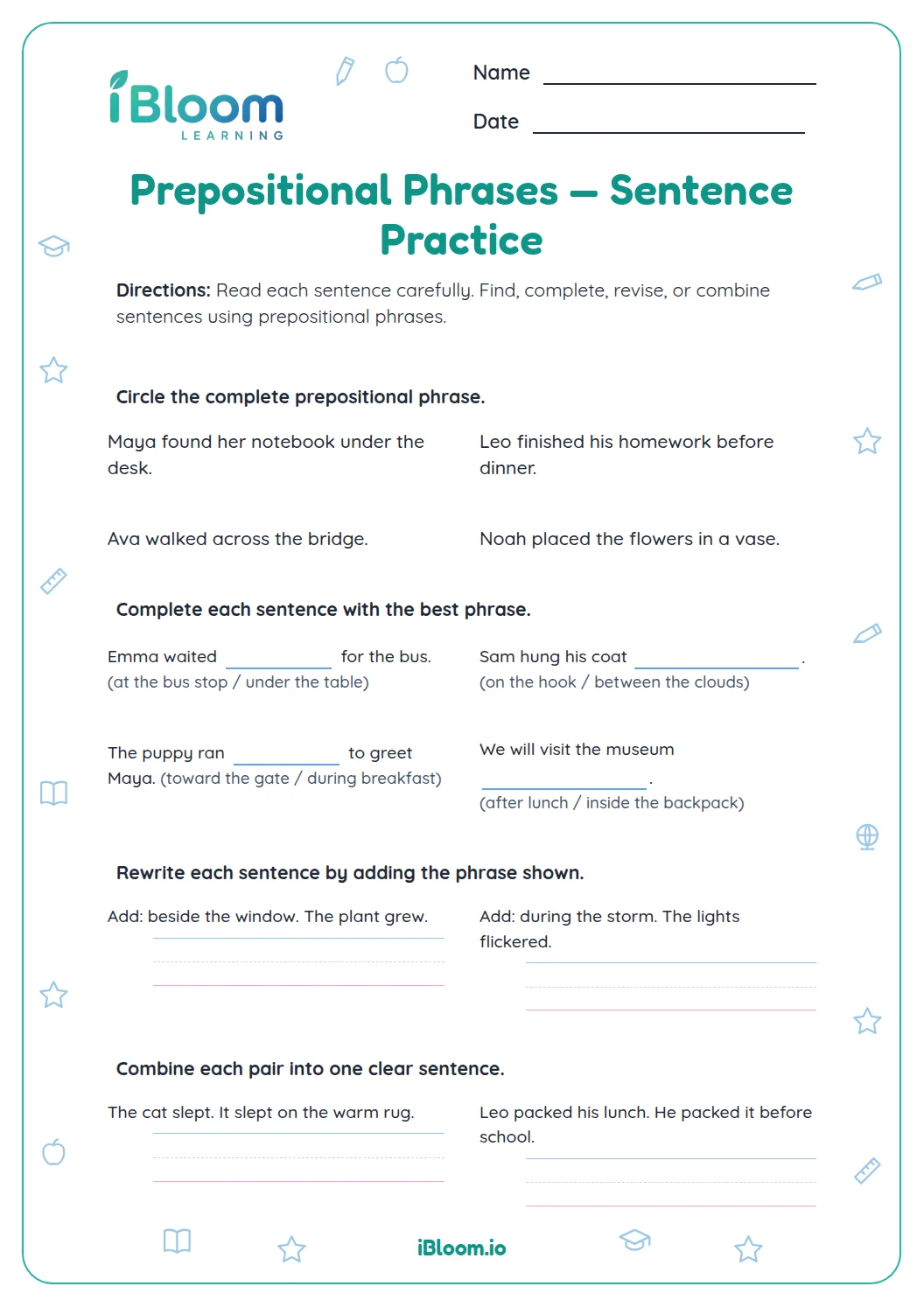
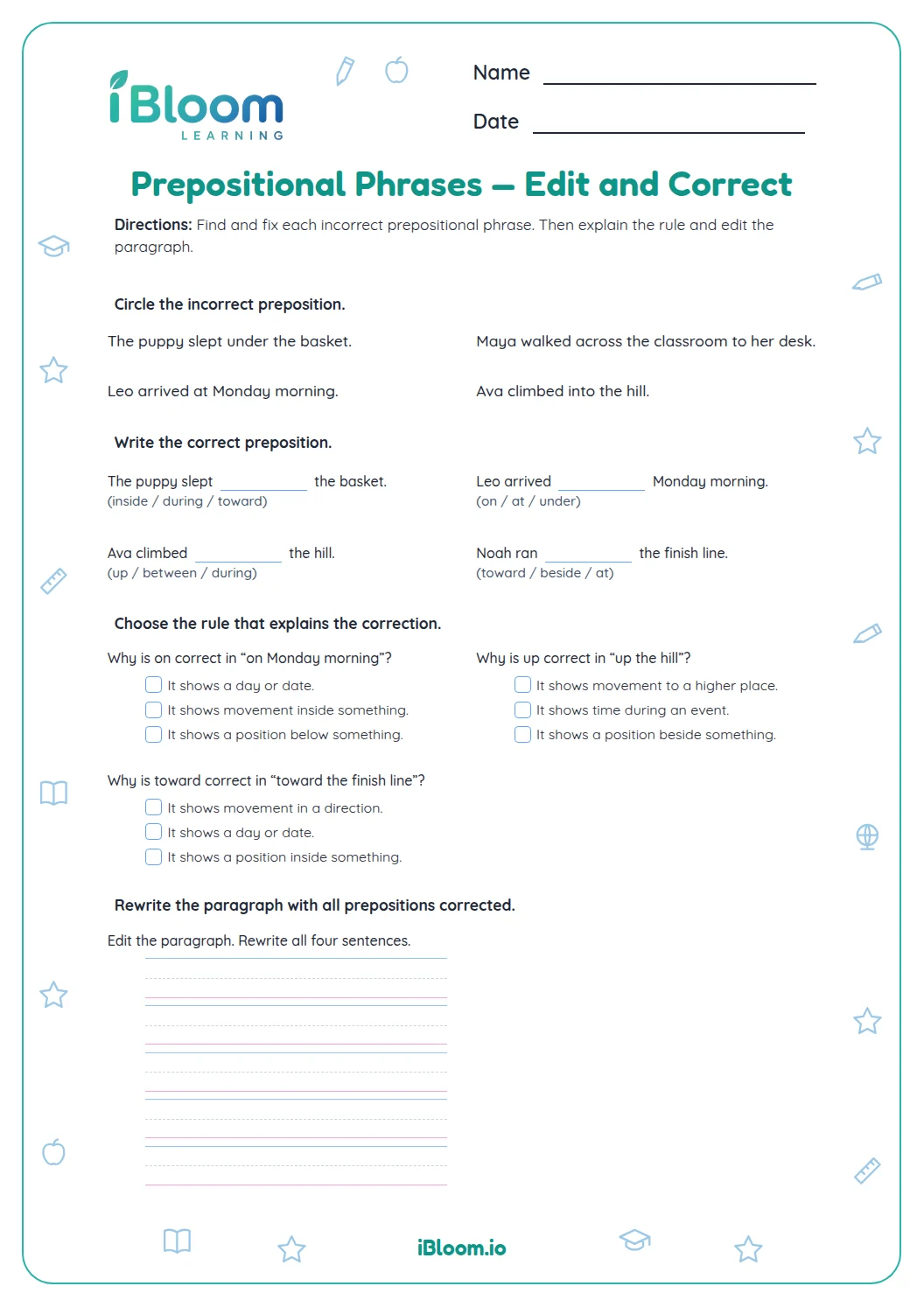
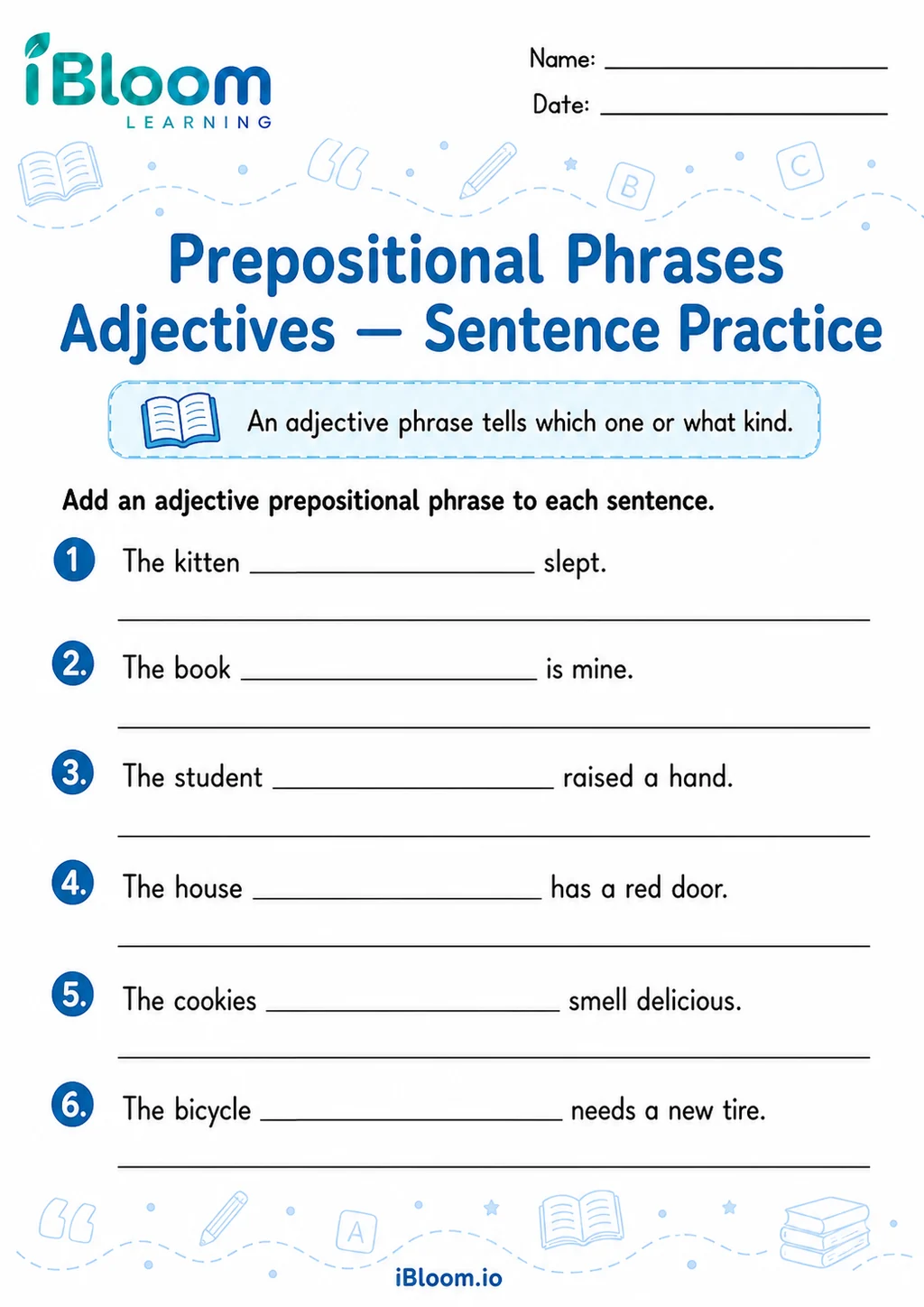
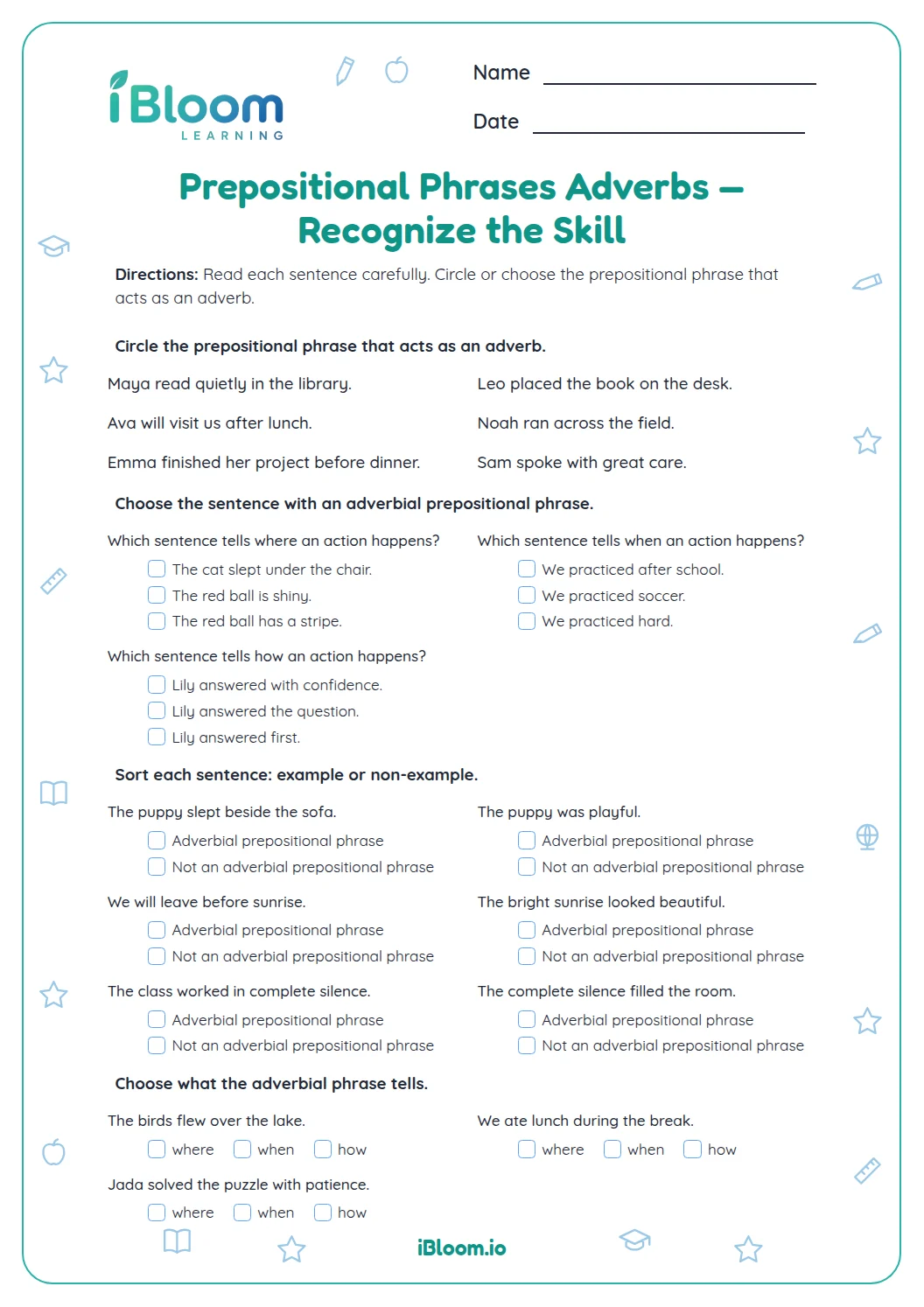
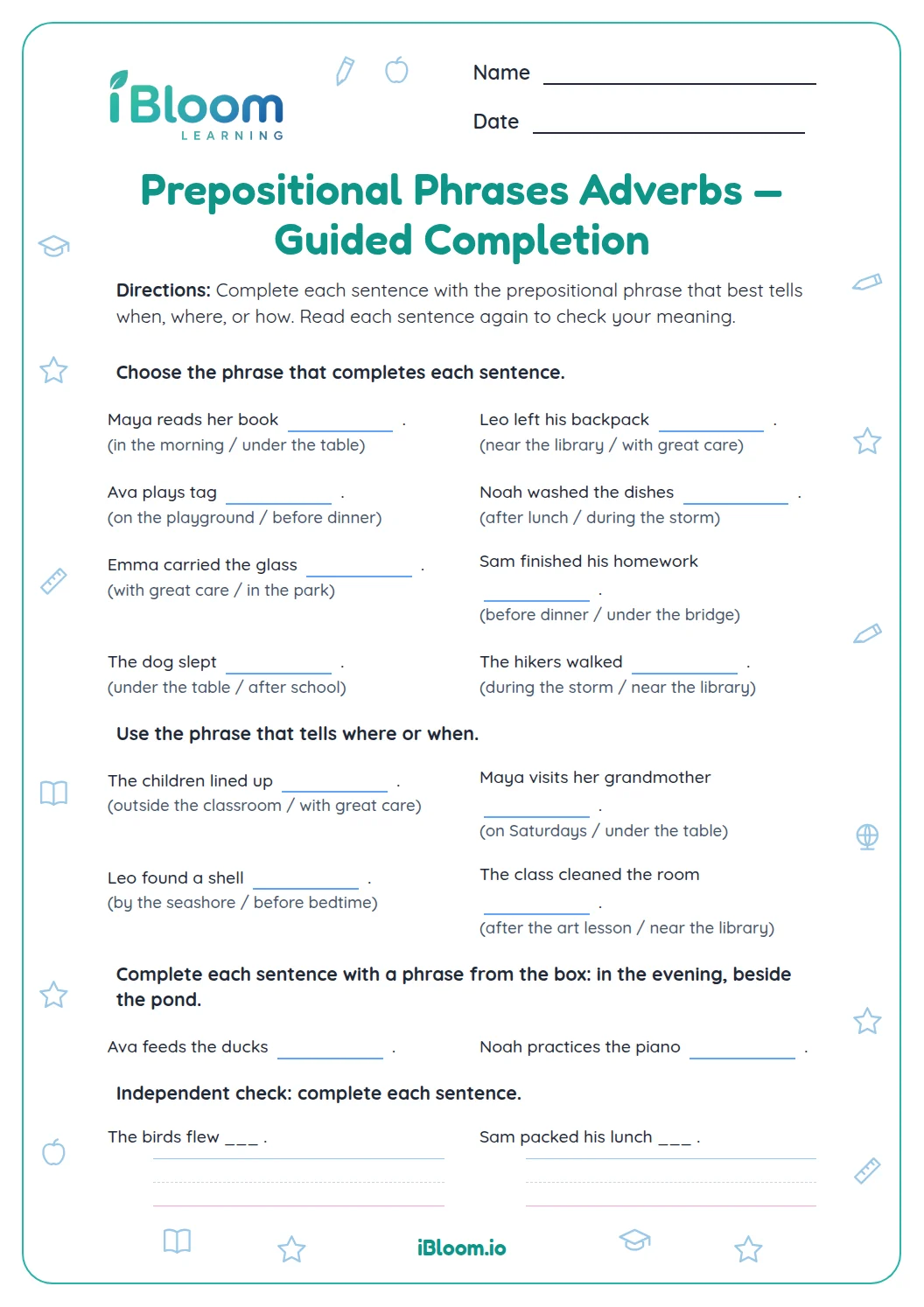
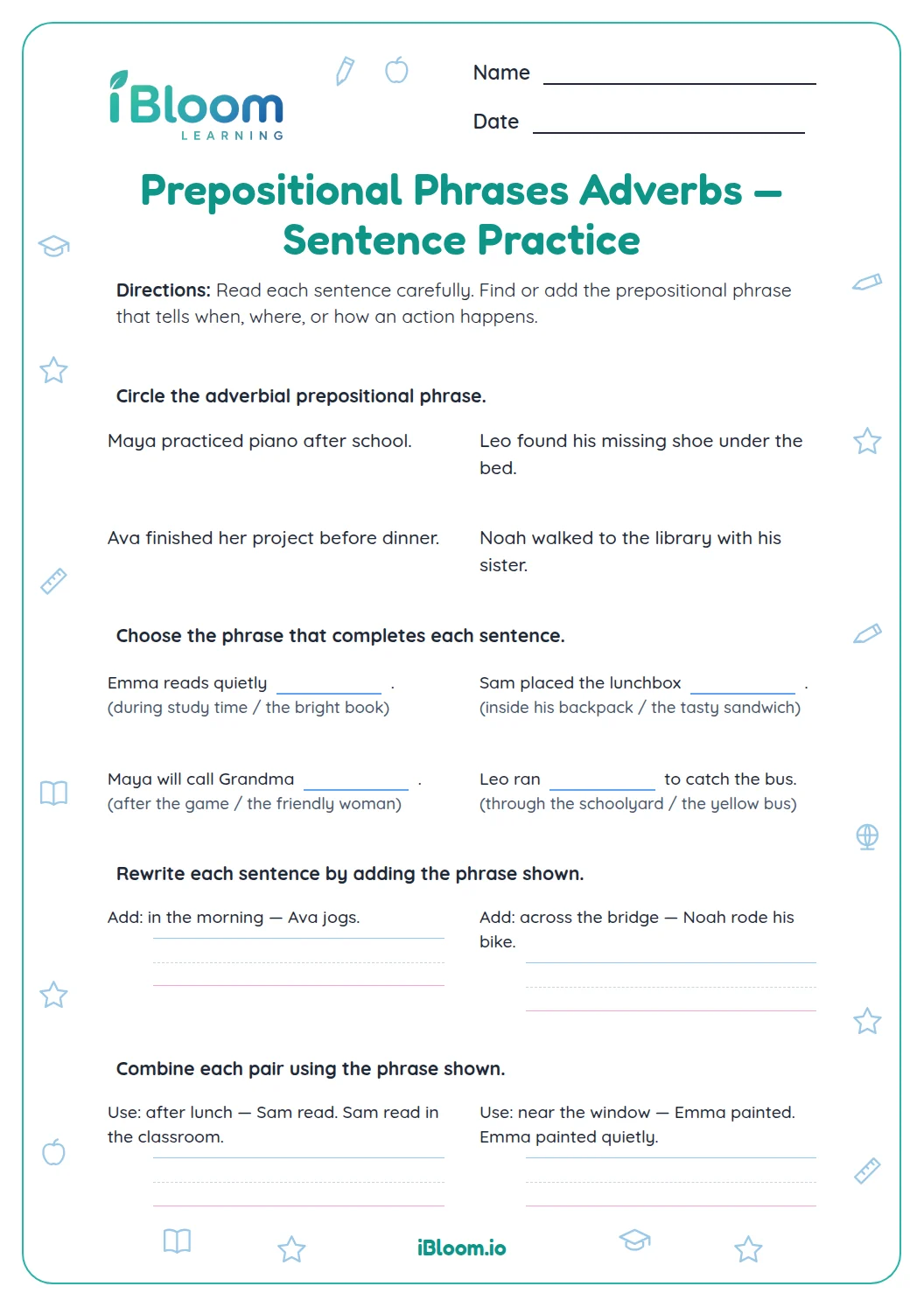
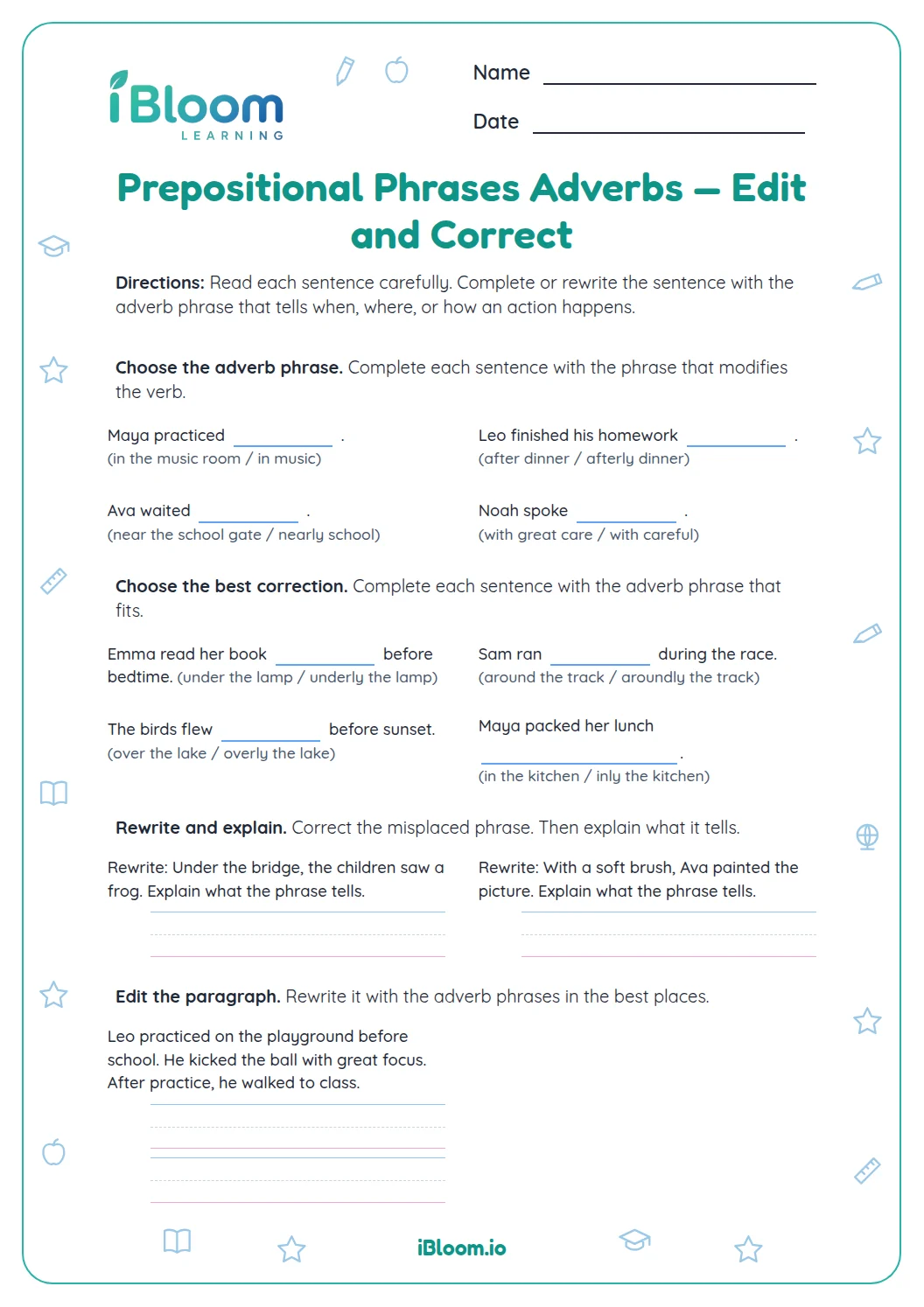
This Grade 4 grammar worksheet reviews prepositional phrases, adjectives, and adverbs through 16 short responses in four parts. Students identify phrases that tell where, name adjectives and adverbs in context, and give their own examples. Part A practices CCSS L.4.1e by forming and using prepositional phrases. The answer key provides sample answers for open responses.
Aligned to L.4.1
What makes a prepositional phrase?
A prepositional phrase begins with a preposition and includes its object, often with words describing that object. “Under the chair” begins with under and names where the cat slept.
- 1The cat slept under the chair. → under the chair is the prepositional phrase.
How does an adjective work?
An adjective describes a noun. In “a small lunch,” small describes the lunch.
How does an adverb work?
An adverb can describe a verb by telling how an action happens. In “barked loudly,” loudly tells how the puppy barked.
A quick way to analyze a sentence
- 1Read the whole sentence first.
- 2For a prepositional phrase, find the preposition and its object.
- 3For an adjective, ask which noun is being described.
- 4For an adverb, ask whether it tells how an action happens.
- 5Check that your chosen word fits the sentence, not just the word type.
Common grammar mix-ups
The mistake
Writing only the preposition instead of the whole phrase.
The fix
Include the object and any words that belong with it, as in “under the chair.”
The mistake
Calling every describing word an adjective.
The fix
Check what the word describes: adjectives describe nouns; many adverbs describe actions.
The mistake
Confusing an adjective and adverb in the same sentence.
The fix
In “noisy truck drove slowly,” noisy describes truck and slowly tells how it drove.
Common Core alignment
This worksheet practices the listed Common Core skill through its questions and written responses.
Use standard English grammar and usage through phrase and modifier practice.
On this sheet: The four parts ask students to identify and use prepositional phrases, adjectives, and adverbs in sentence contexts.
Show the official wordingHide the official wording
Demonstrate command of the conventions of standard English grammar and usage when writing or speaking.
What to practice next
Make more practice
Further reading
Questions parents and teachers ask
What words belong in a prepositional phrase?
Include the preposition, its object and any words that go with the object. “Under the chair” is the full phrase in the first question. Rereading the full sentence helps identify what the word modifies and keeps the answer connected to its grammatical job.
How do adjectives differ from adverbs?
Adjectives describe nouns. Adverbs can describe verbs by telling how an action happens; “noisy” describes truck, while “slowly” describes drove. Rereading the full sentence helps identify what the word modifies and keeps the answer connected to its grammatical job.
Can a sentence have more than one prepositional phrase?
Yes. A sentence can include several phrases that tell where, when or other relationships. Most items here focus on one target at a time for clear identification. Rereading the full sentence helps identify what the word modifies and keeps the answer connected to its grammatical job.
Do the writing items have only one correct answer?
No. The writing prompts allow different complete sentences. The answer key gives a sample; responses should use the requested modifier correctly and make sense. Rereading the full sentence helps identify what the word modifies and keeps the answer connected to its grammatical job.
What does the object of a preposition do?
It completes the phrase by naming what the preposition relates to. In “down the hill,” hill is the object of down. Rereading the full sentence helps identify what the word modifies and keeps the answer connected to its grammatical job.