
About this worksheet
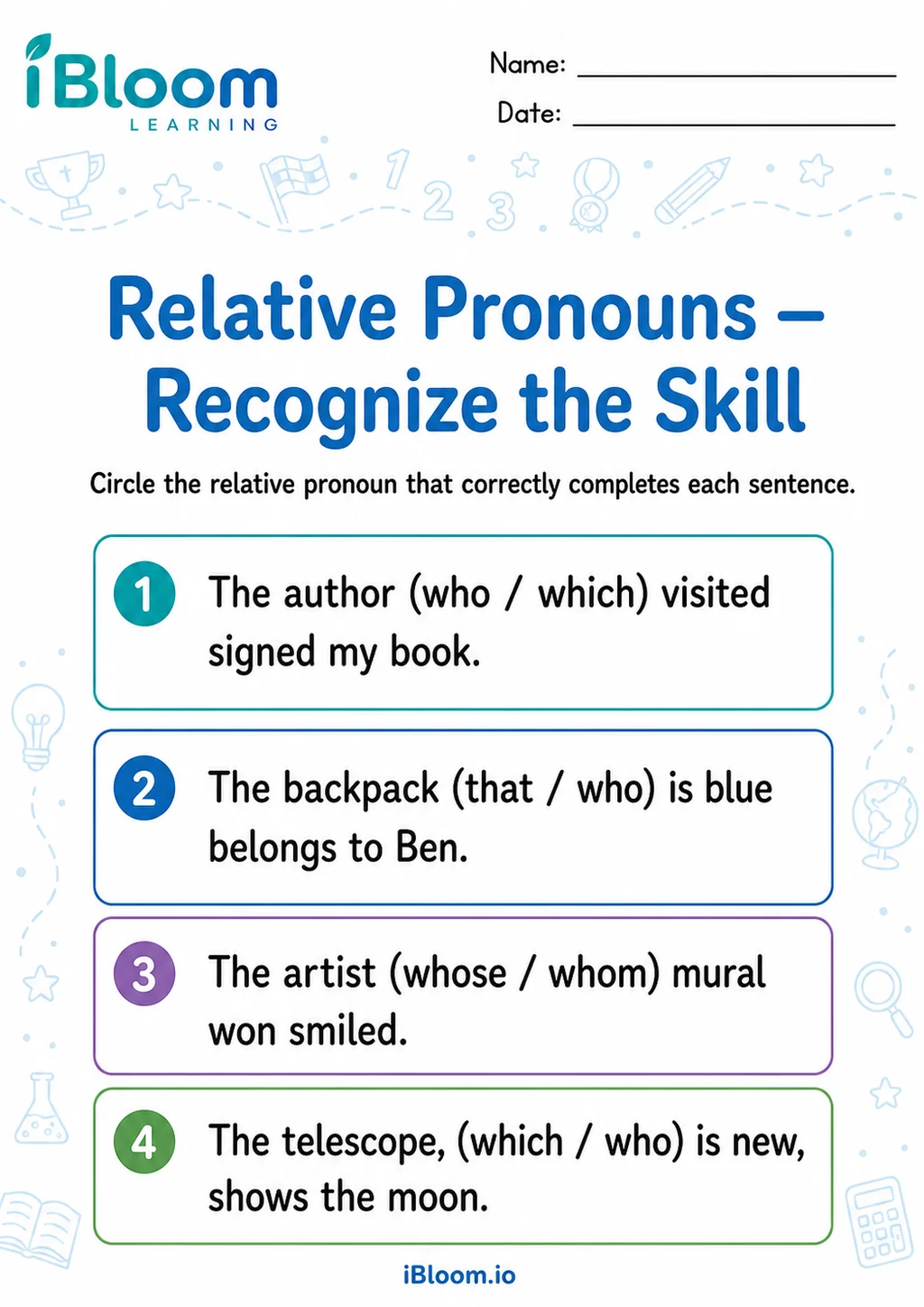
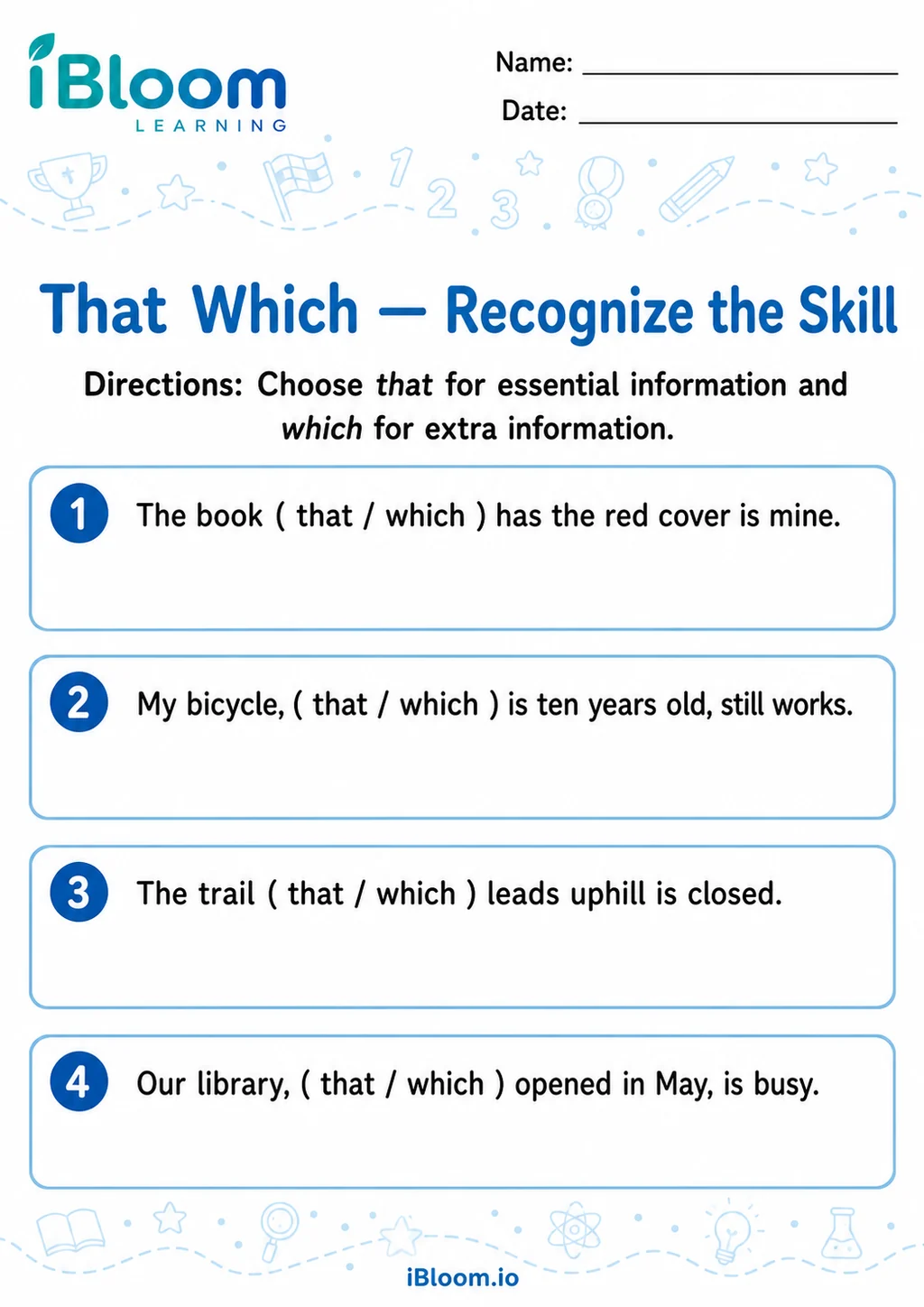
This free printable Grade 4 worksheet turns pronoun agreement into sentence writing. Students first complete four sentences, then repair four mismatched pronouns, and finally write four original sentences choosing pronouns for given nouns. The practice applies Common Core L.3.1f, ensuring pronoun-antecedent agreement. Children work with singular things, plural groups of people, and a speaker included in a group. A separate key gives fixed answers for the blanks and corrections, plus sample sentences for the open writing tasks.
Aligned to L.3.1f
What does a pronoun refer to?
An antecedent is the noun or noun phrase a pronoun stands for. In “The backpack is blue. It has two pockets,” It refers to the backpack. In “Our neighbors waved as they left,” they refers to our neighbors. Read both parts of the sentence before choosing the pronoun.
Agreement also includes the speaker. “My brother and I” includes the person talking, so its pronoun is we or our. In the original writing prompts, students choose a pronoun themselves and make its connection to the given noun clear.
How can students repair a mismatched pronoun?
In Part B, keep the meaning and replace the one capitalized pronoun so it refers to the subject. Check the subject noun first, then read the complete corrected sentence. This keeps editing focused on a specific grammatical decision.
- 1Question 6: The twins packed HIS lunches.
- 2The antecedent is the twins: two people.
- 3Corrected sentence: The twins packed their lunches.
What makes an original sentence successful?
Part C asks for one complete sentence containing the given noun phrase and an agreeing pronoun. A useful response adds an action or detail: “Our neighbors smiled as they planted flowers.” The noun phrase makes the reference clear, and they agrees with the plural neighbors.
Check each response for a clear reference, correct agreement, and a complete thought. The sample key shows one possible sentence per prompt. Different actions and details are welcome when the chosen pronoun agrees with the noun and refers clearly to it.
A routine for checking pronouns
- 1Read the Part A direction and identify who or what each sentence is about.
- 2Fill each blank with one of the two pronouns printed in its prompt.
- 3In Part B, underline the noun that the capitalized pronoun should refer to.
- 4Rewrite each Part B sentence with the corrected pronoun.
- 5Write the four Part C sentences, then connect each pronoun to its noun with your finger.
- 6Use the key to check agreement; accept original wording that meets the prompt.
Mistakes to notice and fix
The mistake
Writing “The twins packed his lunches.”
The fix
The direction says the pronoun refers to the twins. Twins is plural, so replace his with their.
The mistake
Using they for “my brother and I.”
The fix
Include the speaker: use we when the group does the action.
The mistake
Writing a Part C sentence with only the pronoun.
The fix
Include the given noun phrase too, so the reader knows exactly whom or what the pronoun means.
Curriculum alignment
Match pronouns with their antecedents when completing, editing, and writing sentences.
On this sheet: All three parts practice pronoun-antecedent agreement in complete sentences.
Show the official wordingHide the official wording
Ensure subject-verb and pronoun-antecedent agreement.*
What to practice next
Make more practice
Further reading
Questions parents and teachers ask
What are the three parts of this worksheet?
Part A has four blanks with two pronouns to choose from. Part B has four sentences to rewrite by correcting the capitalized pronoun. Part C has four original sentence prompts. Students move from selecting a matching form to choosing an agreeing pronoun for their own writing.
Does each original sentence have to match the key?
No. The four original writing tasks have sample answers, so students may choose different actions and details. Each sentence must include the given noun phrase and an agreeing pronoun, express a complete thought, and make the reference clear. Use those requirements to check the response instead of matching every word.
Why does the sheet use we for my brother and I?
We includes the speaker and at least one other person. In question 4, the speaker and a brother are doing the action together, so we fits. Ask the child to say who is included in the group before choosing between we and they in the blank.
What should students change in the editing section?
Students should replace the capitalized pronoun and copy the whole corrected sentence. For example, HIS becomes their in the sentence about the twins. Keeping the other words gives children a clear editing target and lets an adult see whether the revised pronoun agrees with its antecedent.
How can I help without writing the sentences for my child?
Ask your child to name the noun and say whether it means one thing or more than one. Then have the child say a complete sentence aloud using a pronoun that refers to that noun. After the sentence is written, ask what the pronoun refers to and check the connection together.