
About this worksheet
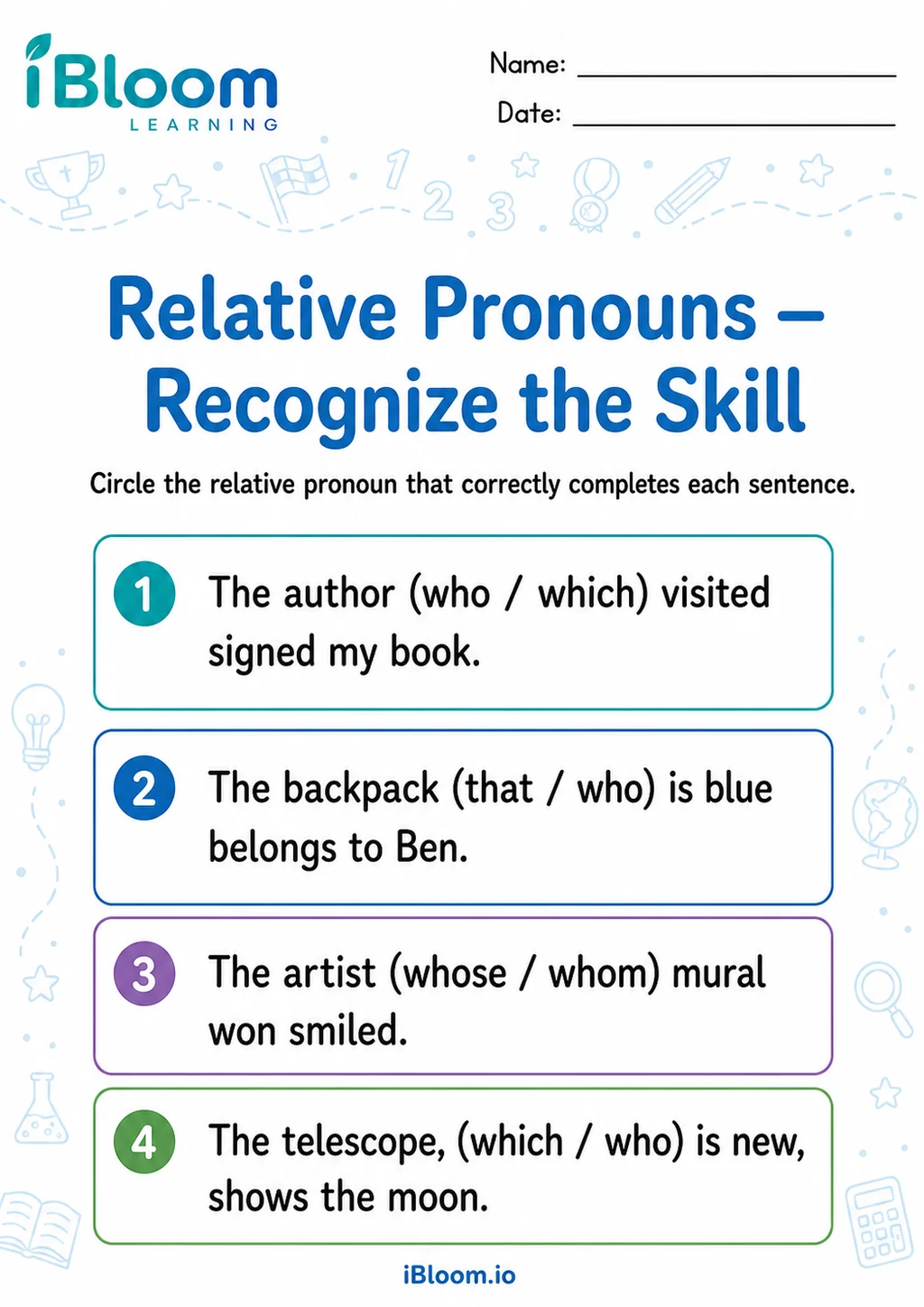
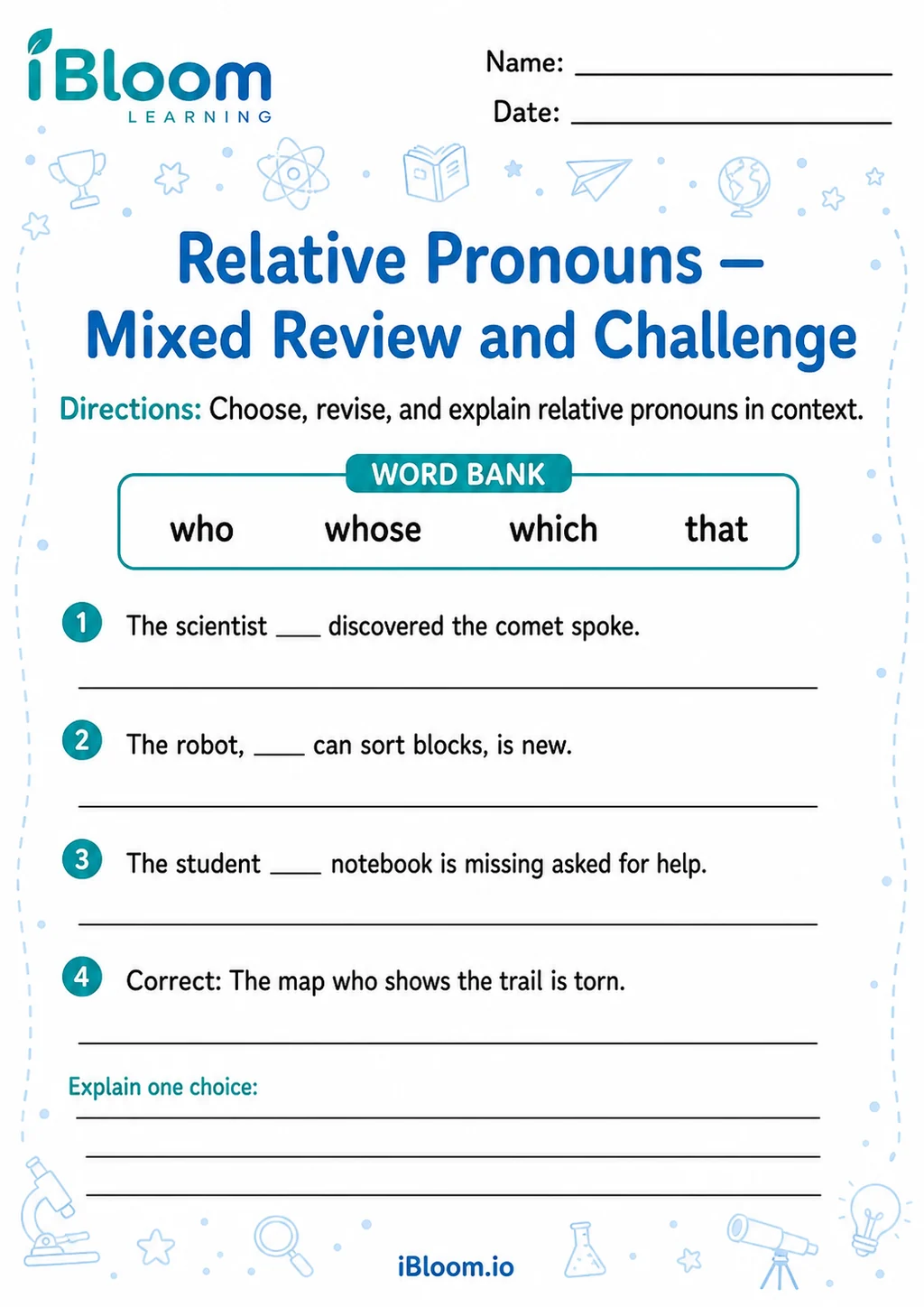
This Grade 4 printable gives students 16 chances to complete a sentence with a relative pronoun. Students choose who, whose, that, or which to complete each sentence, using the noun and clause as clues. The two parts move from straightforward clauses to sentences with varied pronoun clues. The page practices Common Core L.4.1a and includes a two-page answer key with answers.
Aligned to L.4.1a
How does a relative pronoun join two ideas?
A relative pronoun begins a clause that describes a person or thing named in the sentence. The correct word depends on the noun and what the clause says about it. Who describes a person, whose shows a connection or possession, and that or which describe things.
Read the full sentence around the blank, then choose the pronoun that makes the clause clear and grammatical.
- 1The baker greeted the neighbors ___ made fresh rolls.
- 2The baker greeted the neighbors who made fresh rolls.
- 3Who refers to the neighbors, the people who made the rolls.
How do you choose who, whose, that, or which?
Use who when the describing clause tells about a person. Use whose when the clause names something linked to that person or thing. That and which can describe things. Look at the noun being described and the job the next clause must do.
Part A builds the sentence pattern with people and objects. Part B keeps the same skill but varies whether the clause comes before or after the main idea.
How can the answer key support revision?
Compare the finished sentence with the two original ideas. Check that the relative pronoun matches the clue and both facts remain. Some sentences allow another natural word order; use the model as a guide rather than requiring identical punctuation where the meaning is clear.
How can you use this worksheet?
- 1Read the whole sentence and identify the person or thing being described.
- 2Choose who, whose, that, or which to complete the sentence.
- 3Reread the sentence with the word in place.
- 4Check that the pronoun matches the noun and the clause.
- 5Compare your choice with the answer key.
Common mistakes and quick fixes
The mistake
Repeating the noun instead of joining the ideas.
The fix
Check whether the clause describes a person, names a possession, or adds information about a thing.
The mistake
Using whose without naming what is connected to the noun.
The fix
Read the words after whose and check they name the related possession or feature.
The mistake
Leaving out part of one original statement.
The fix
Read the whole sentence aloud to make sure the clause fits smoothly.
Common Core alignment
This practice connects the worksheet tasks to the stated Common Core skill.
Use relative pronouns to connect related ideas.
On this sheet: Students complete sentences with who, whose, that, or which.
Show the official wordingHide the official wording
Use relative pronouns (who, whose, whom, which, that) and relative adverbs (where, when, why).
What to practice next
Make more practice
Further reading
Questions parents and teachers ask
Which relative pronouns appear on the page?
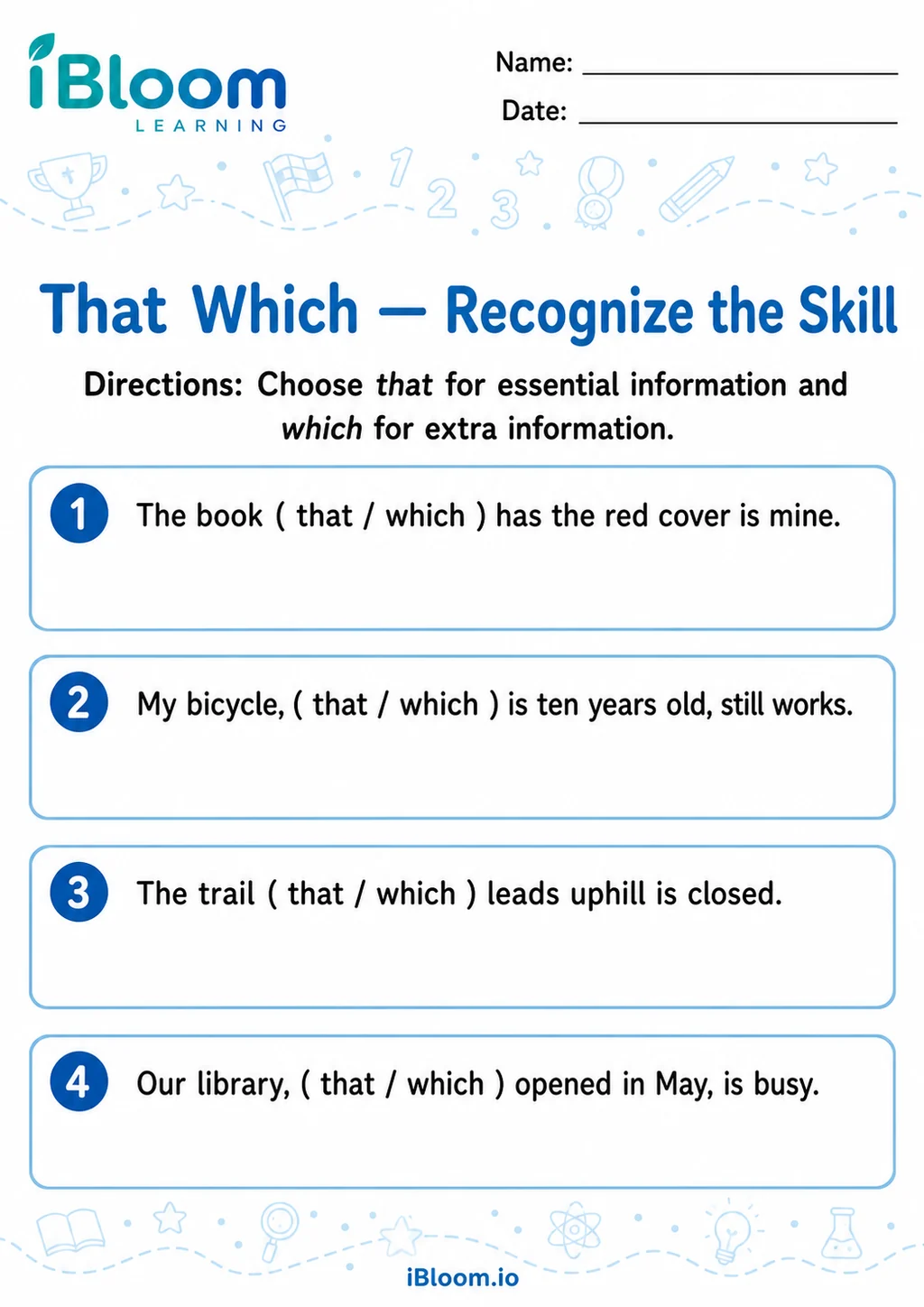
The blanks use who, whose, that, or which. Who connects a person to an action, whose links a person or thing to something belonging to it, and that or which can connect a thing to a describing clause. Students select the word that fits the noun and the clause.
How should my child punctuate a clause with which?
The which sentences on this page add extra information about a noun, so the model answer sets that clause off with commas. Read the sentence without the extra clause; it should still make sense. Clauses beginning with that are written without those commas here.
Can a sentence have more than one correct word order?
Sometimes more than one pronoun can fit a sentence, depending on how the clause is written. For each blank here, use the clue in the sentence: a person, a possession, or a describing clause about a thing. The key lists the intended choice.
What does whose show in a sentence?
Whose connects a noun to something associated with or belonging to it. In “the gardener whose roses won,” the roses are linked to the gardener. The sentence should include the noun after whose; using who instead would not express that relationship.
How many questions and pages are included?
There are 16 sentence-completion prompts arranged in two parts, with the answer key on two pages. The first part gives practice with people and things; the second continues with varied subjects and clause placement. Allow about 20 minutes for careful writing and checking.