







About this worksheet
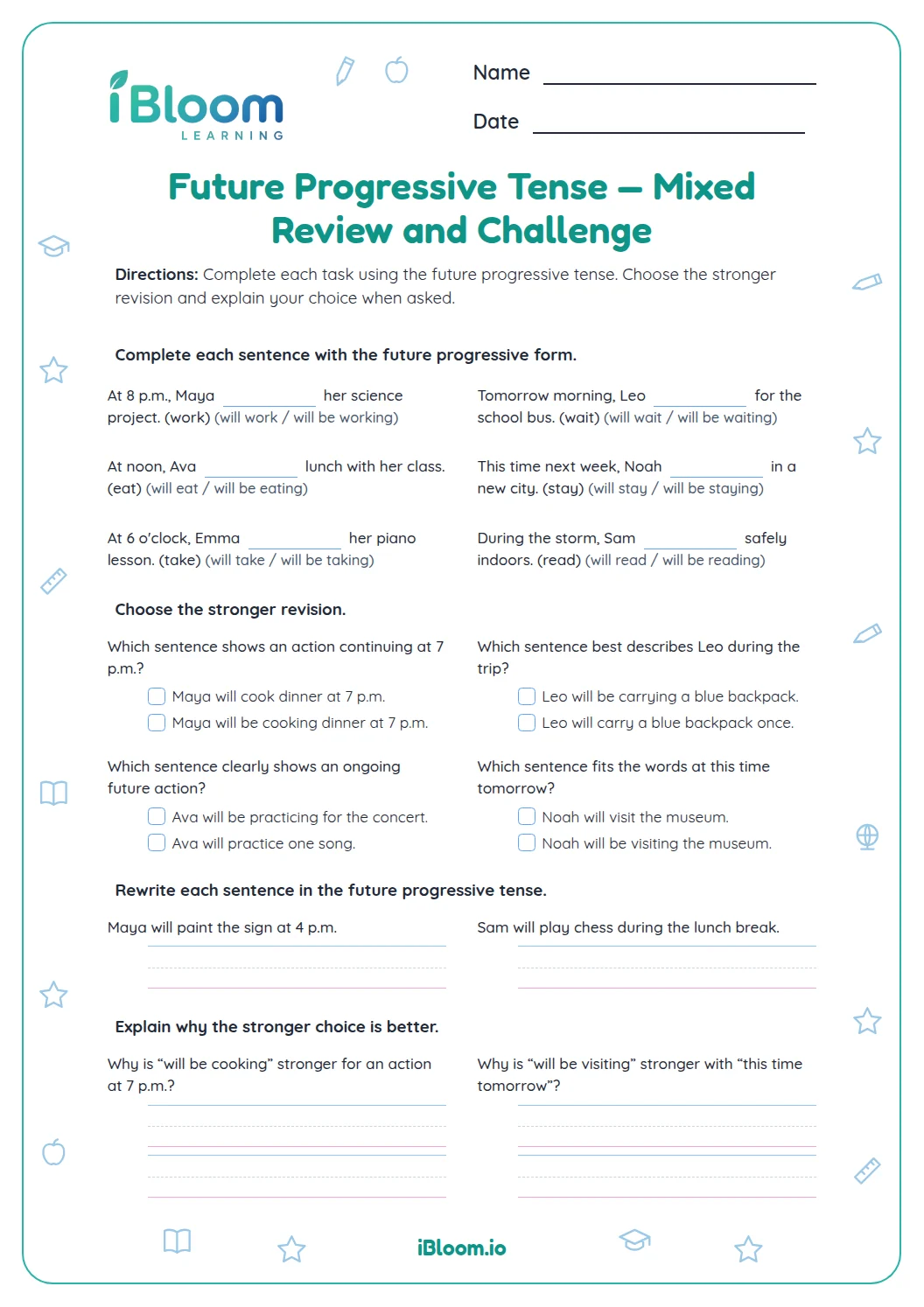
This Grade 4 grammar worksheet gives children 15 chances to recognize the future progressive tense in sentences and verb phrases. They identify “will be” plus an -ing verb, distinguish it from simple future and other tenses, and complete short sentence frames. It practices the verb tense expectations in CCSS L.4.1.b. A separate answer key supports quick review.
Aligned to L.4.1.b
What words signal future progressive tense?
The pattern is will be followed by a verb ending in -ing. In “will be visiting,” will be helps the main verb visiting show an action that will be in progress.
- 1The class will be visiting the museum.
- 2“will be visiting” names an action in progress at a future time.
How is it different from simple future?
“Will paint” tells that something will happen. “Will be painting” emphasizes that the action will be in progress at a future time. Question 10 asks readers to distinguish those forms.
How can a reader check a whole sentence?
Find the verb phrase first, then check that the sentence places the action in the future. Words such as tomorrow, at noon, or after school can give a time clue.
How to use this worksheet
- 1Read the whole sentence before choosing a verb phrase.
- 2Find will be, then check that the next verb ends in -ing.
- 3Compare will be painting with will paint; they are different forms.
- 4Use a future-time clue to confirm when the action happens.
- 5Review any missed item by underlining the helping words and main verb.
Common mistakes and quick fixes
The mistake
Calling “will paint” future progressive.
The fix
Check for be and an -ing verb after will.
The mistake
Choosing “is painting” because it ends in -ing.
The fix
Check the helping words: future progressive uses will be.
The mistake
Selecting only “will be” when asked for the whole phrase.
The fix
Include the main -ing verb, too.
Common Core alignment
These items ask students to recognize and use standard English verb forms.
Form and use the progressive verb tenses.
On this sheet: The questions identify and complete future progressive verb phrases.
Show the official wordingHide the official wording
Form and use the progressive (e.g., I was walking; I am walking; I will be walking) verb tenses.
What to practice next
Make more practice
Further reading
Questions parents and teachers ask
What is the future progressive tense?
The future progressive describes an action that will be in progress at a future time. It uses a form of “will be” followed by a verb ending in -ing, as in “will be practicing.” The worksheet asks learners to spot that complete pattern.
How many questions are on this page?
There are 15 questions in four parts. Children identify verb phrases, choose full sentences, complete sentence blanks, and name parts of the future progressive pattern. A separate key gives each correct response and helps learners review the form.
Does “will walk” count as future progressive?
No. “Will walk” is simple future. Future progressive adds “be” and an -ing verb: “will be walking.” Several items compare these forms so children can notice the different verb patterns in context. The answer key also models the complete phrase so children can compare every word.
Is there an answer key?
Yes. A separate answer key lists the correct sentence, word, or verb phrase for each question. Children can use it to check the form after completing the page and revisit any item they missed during practice. It is useful to read the full item aloud and name the helping words before checking.
What time words can help identify this tense?
Words and phrases such as tomorrow, at noon, or after school can point to a future time. The verb phrase still needs the pattern “will be” plus an -ing verb; a time clue by itself does not make the tense progressive.