



About this worksheet
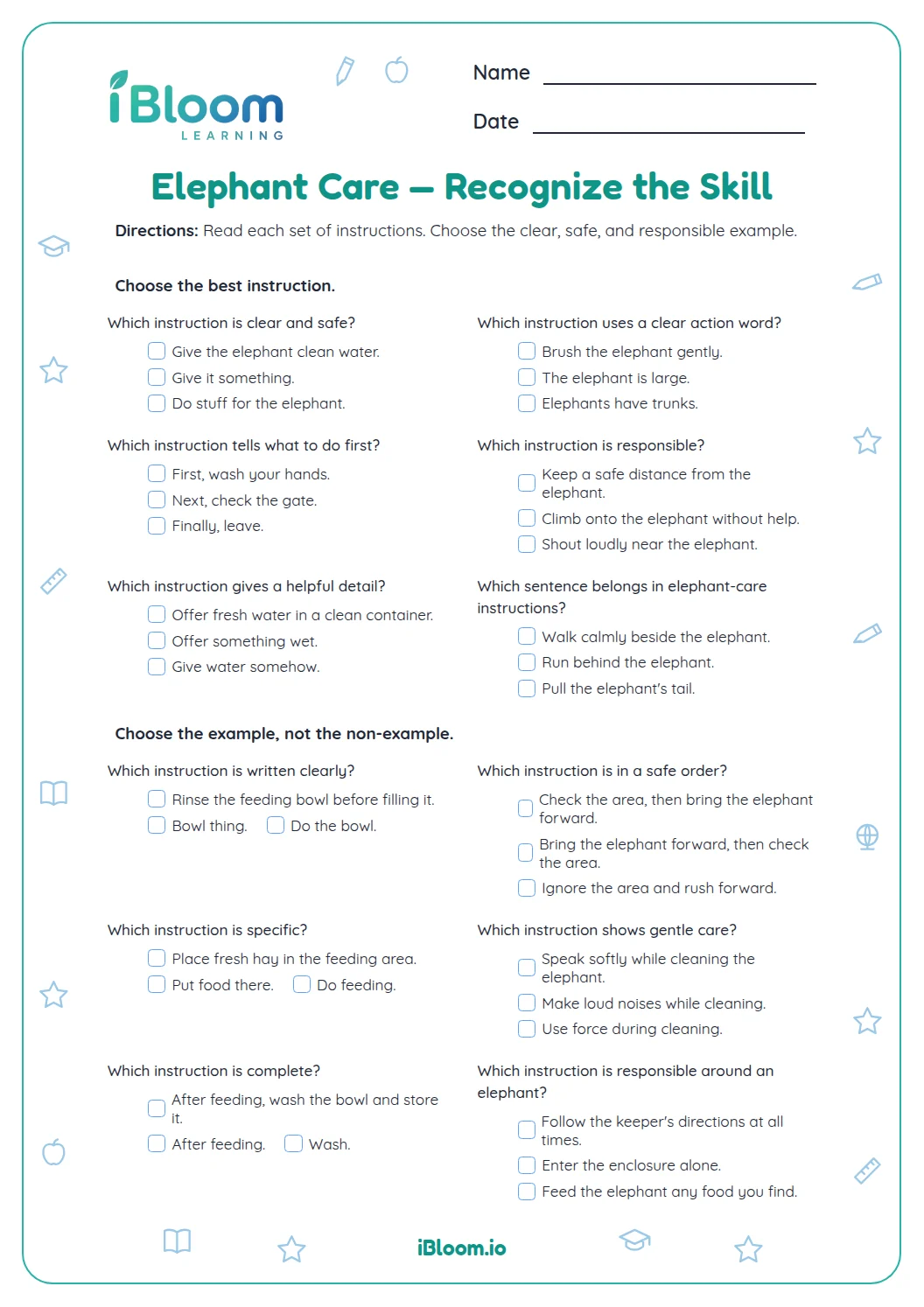
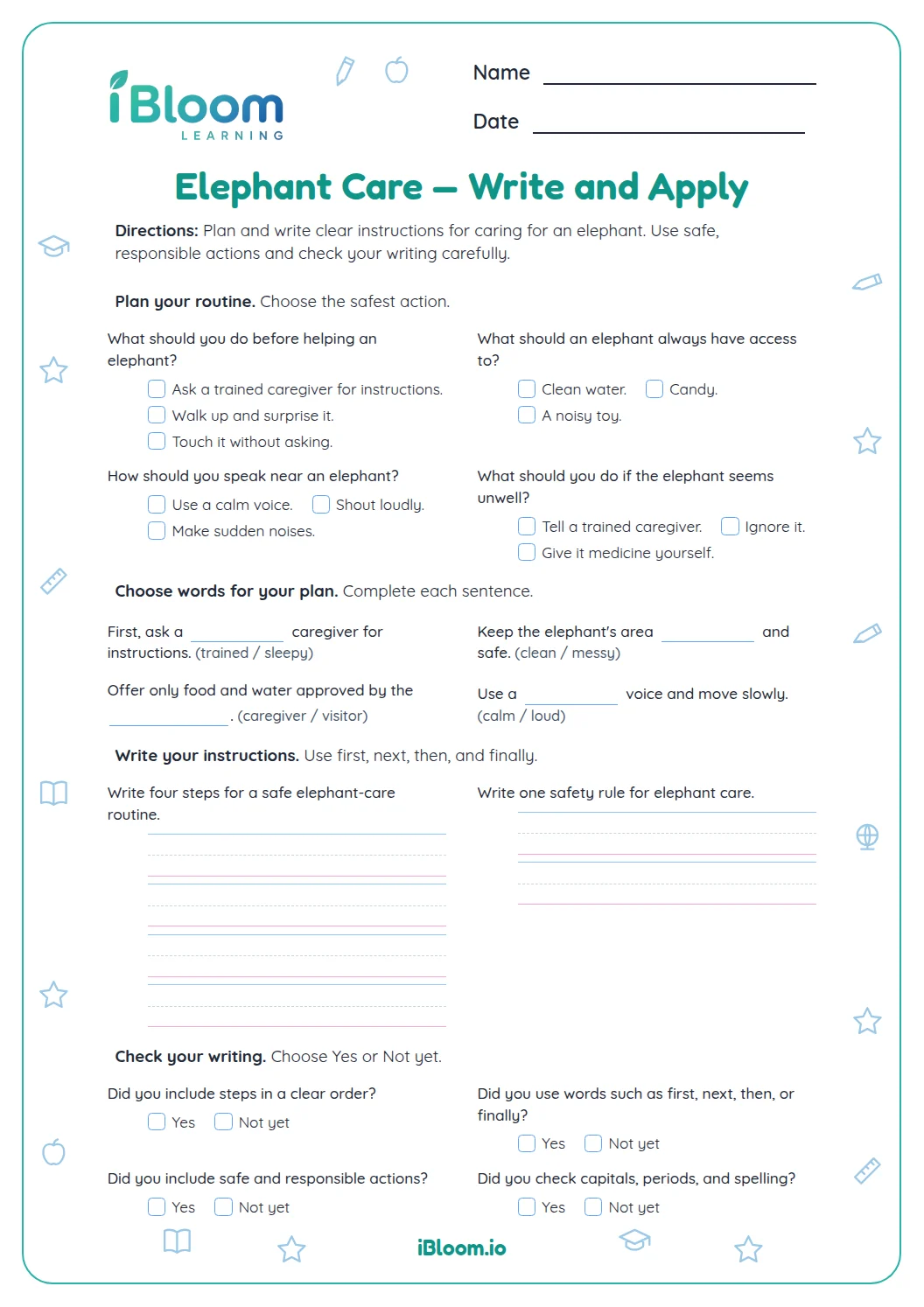
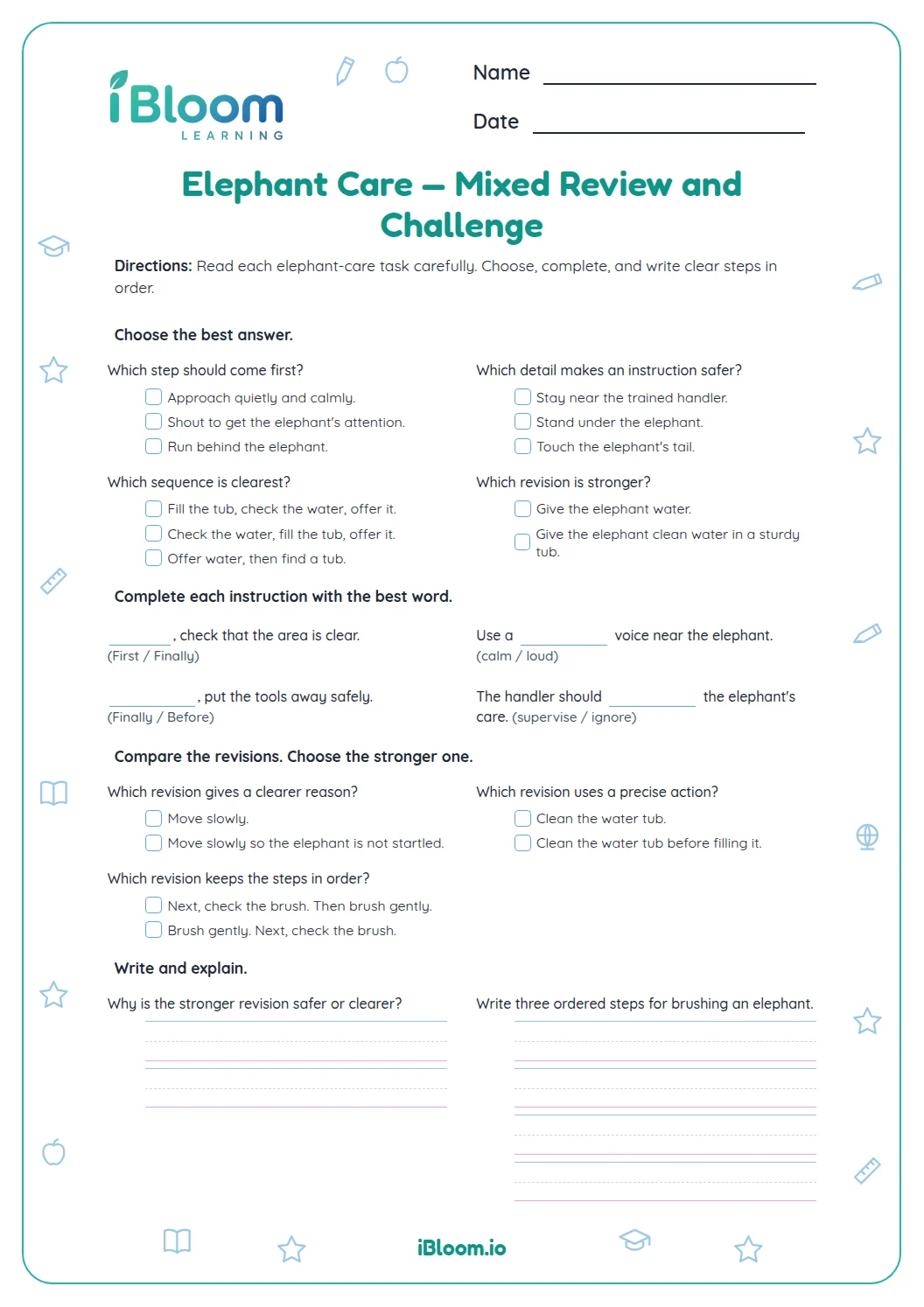
This Grade 4 printable gives writers practice editing instructional sentences about an elephant-care checklist. Twenty concise items ask learners to supply missing capitals, punctuation, precise words and matching verbs. The directions keep the keeper responsible for care decisions, so the writing task stays focused on how instructions are edited. This work aligns with CCSS W.4.5. A separate answer key records each correction.
Aligned to W.4.5
What does this editing worksheet cover?
The first ten questions focus on sentence conventions and precise words: capitals, end marks, commas and clear directions. The final ten ask writers to complete instructions with matching verbs or specific language. Each prompt contains one blank for one correction.
The topic is a care checklist, but the learner is editing the writing rather than deciding how an elephant should be cared for. The keeper’s plan guides every care choice.
- Questions 1–10: capitals, end punctuation, commas and precise words
- Questions 11–20: verb agreement and clear directions
How can a writer make an instruction precise?
A precise instruction names an action and enough detail for a reader to follow it. “Set out the clean brush and bucket” gives the reader concrete supplies. “Set out some things” leaves the reader guessing.
Sequence words such as first and next show when a step belongs. Readers can check whether each direction has a clear action and whether it appears in a sensible order.
- 1Set out the clean ___ and bucket.
- 2Name a specific supply that belongs in a checklist.
- 3The answer key gives “brush” as one precise completion.
What should a writer check before finishing?
Read each sentence aloud and check its first word, end mark and subject-verb match. A plural subject such as “tools” pairs with “are”; a singular subject such as “keeper” pairs with “checks.”
For a series, commas separate the listed items. When one direction contains two steps, separate the complete thoughts with punctuation so the reader can follow the order.
How can this practice transfer to a real draft?
After the multiple-choice review, ask the child to revise one instruction from a class project or home routine. Look for one action per step, specific nouns and sequence words that show what comes first.
Then read the steps in order. A reader should be able to tell what to do and when to do it without guessing.
How to use the worksheet
- 1Read the full sentence and identify the blank’s job.
- 2Check whether a capital or end mark is missing.
- 3For a direction, look for a precise action or object.
- 4Match each verb to its subject.
- 5Use the answer key to review the completed sentence.
Editing slips to watch for
The mistake
Leaving the first word lowercase after a period.
The fix
Start each sentence with a capital letter and reread it from the beginning.
The mistake
Using a vague word such as “thing” in a direction.
The fix
Name the actual action or supply so a reader knows what to do.
The mistake
Pairing a plural subject with a singular verb, as in “tools is.”
The fix
Find the subject first, then check whether its verb form matches: “tools are.”
Common Core alignment
The revision task aligns with the Grade 4 expectation for developing and editing writing.
Revise and edit writing with guidance and support.
On this sheet: Learners revise instructional sentences for conventions, order and clarity.
Show the official wordingHide the official wording
With guidance and support from peers and adults, develop and strengthen writing as needed by planning, revising, and editing. (Editing for conventions should demonstrate command of Language standards 1–3 up to and including grade 4 here.)
What to practice next
Make more practice
Further reading
Questions parents and teachers ask
What kinds of editing appear on this page?
The 20 questions cover capitals and end punctuation, precise action words, sequence signals, subject-verb agreement and commas in a list. Each prompt contains one blank for a correction, and the separate answer key provides a model completion for review. here.
Is the worksheet giving elephant-care advice?
The page is a writing activity about editing a care checklist. Its sample directions tell the writer to follow the keeper’s plan and ask the keeper when unsure; the questions do not ask students to make animal-care decisions. The focus stays on editing language.
How does a student use the answer key?
After completing a blank, compare it with the corresponding answer on the key. Ask the student to name the clue that helped, such as the capital at the start, the end mark, or the plural subject before a verb. The key models each completion.
What is an example of a corrected sentence?
Question 11 reads “The clean tools ___ ready.” The correct word is “are.” Tools is plural, so it needs the plural verb are. This sentence gives students one clear subject-verb agreement correction to complete. A learner can say the corrected sentence aloud afterward.
Can this worksheet support another writing assignment?
Yes. After finishing, a student can review a set of classroom directions or steps for a project. Check whether every sentence begins correctly, names a clear action and appears in an order that another reader can follow. This transfers the same editing routine.