




About this worksheet
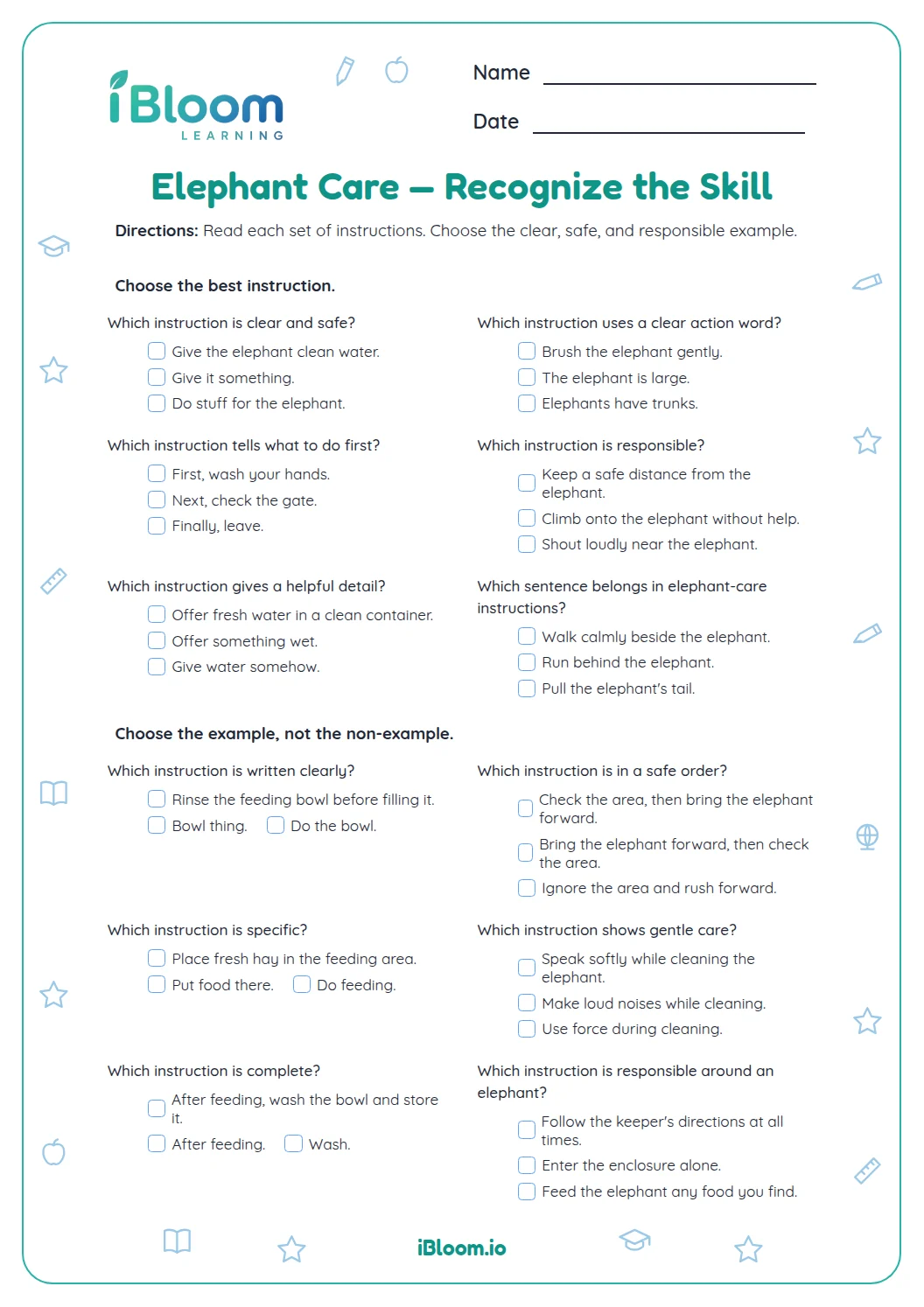
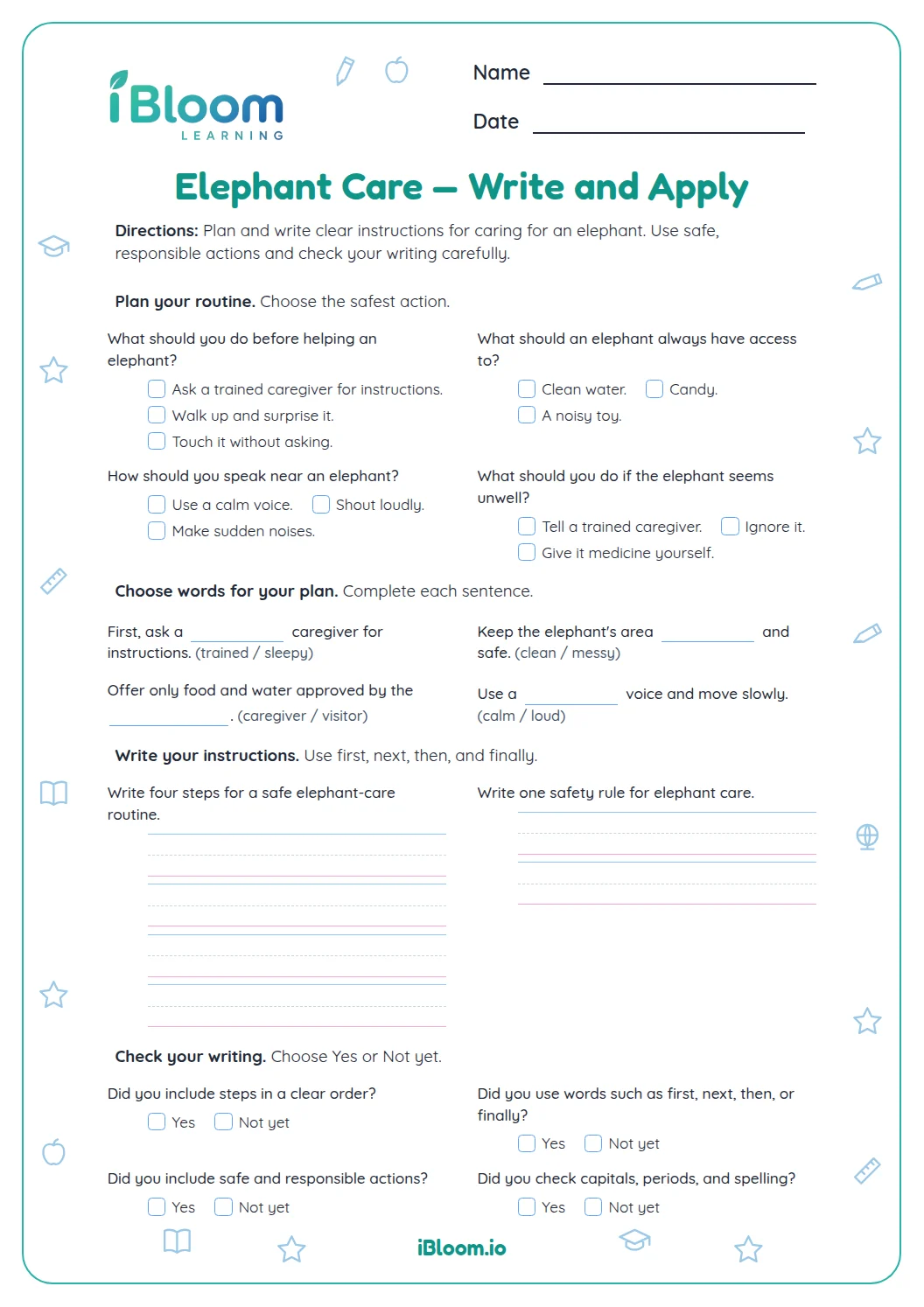
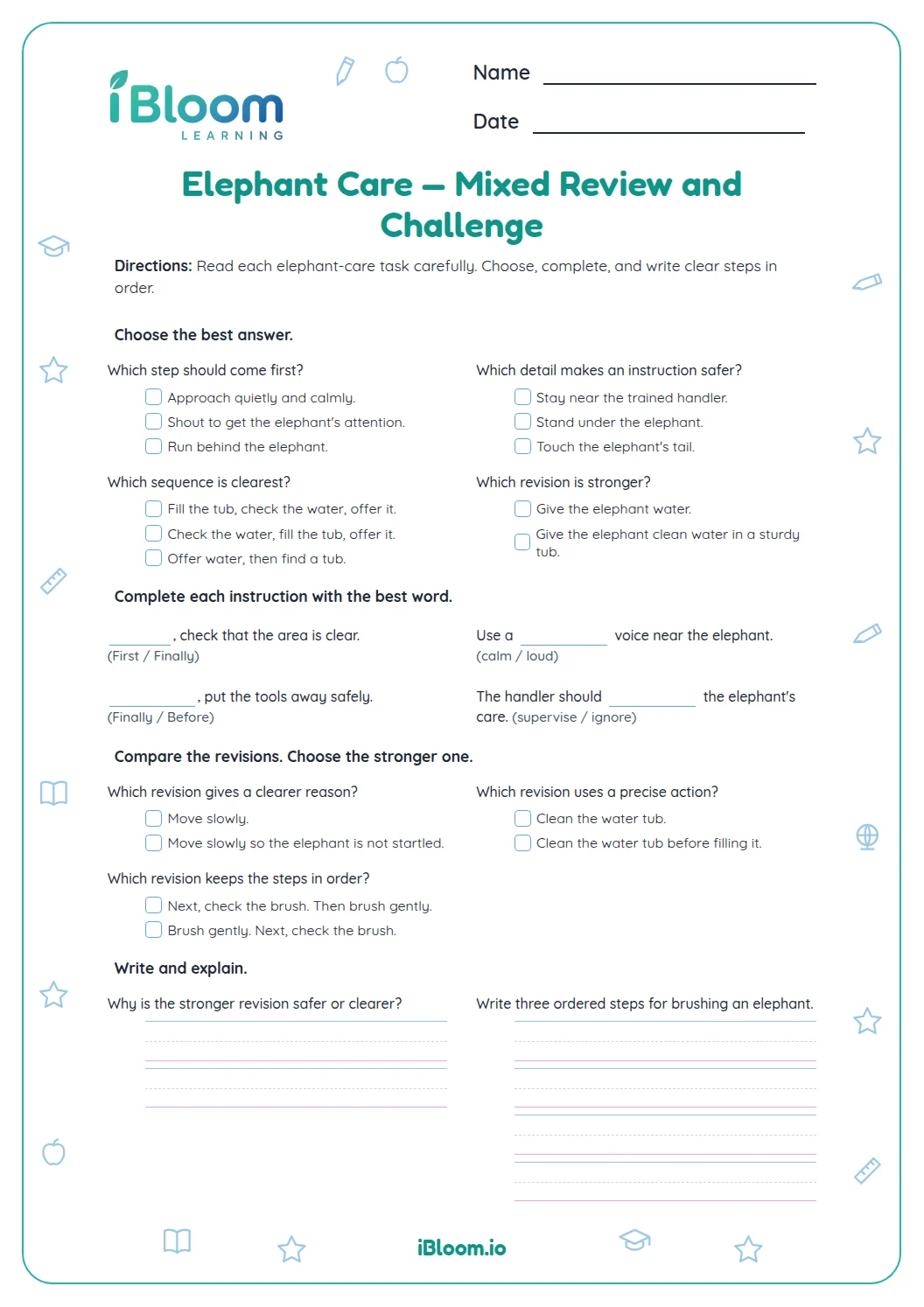
This Grade 4 worksheet uses elephant-care sentences to practice complete thoughts and clear instructions. Students choose complete sentences, fill four sentence gaps, identify a sentence that fixes a fragment, combine two ideas, and choose an instruction order. The 14 questions build from recognition to revision, with a separate answer key. The sentence work aligns with CCSS L.4.1.f.
Aligned to L.4.1.f
What makes an instruction a complete sentence?
A complete sentence communicates a finished idea. It may name who acts, as in “The keeper checks the water,” or give a direct command, as in “Check the water.”
In question 1, “Keep the gate closed” is a complete instruction. “The gate near” does not tell a complete thought.
- 1Keep the gate closed.
- 2This is a complete command with an action.
How can students revise a sentence for clarity?
Check that the sentence has a complete idea, clear word order, and punctuation. Question 11 begins with a dependent “After” phrase. Add an independent thought to finish it: “After the keeper rinses the bowl, it is clean.”
What is included in the practice?
The sheet has 14 questions in three parts. Students recognize complete sentences, fill sentence gaps, then revise, combine, and order clear instructions. The separate key gives the correct choice or word for every item.
- Part A: recognize complete sentences (6 choices)
- Part B: complete sentence parts (4 fill-ins)
- Part C: revise, combine, and order (4 choices)
How to use this worksheet
- 1Read the whole sentence and ask whether the thought is finished.
- 2For a command, check for a clear action word.
- 3Add the missing subject or verb where requested.
- 4Join ideas with a conjunction and punctuation.
- 5Reread your own directions in the order someone would follow them.
Common mistakes and quick fixes
The mistake
Leaving a dependent opening as a whole sentence, such as “After the keeper rinses the bowl.”
The fix
Add a complete thought after the opening phrase.
The mistake
Writing a command without an action, such as “The clean bucket.”
The fix
Use an action verb: “Rinse the clean bucket.”
The mistake
Joining two sentences with only a comma.
The fix
Use a conjunction such as and, or make two sentences.
Common Core alignment
Sentence editing and composition support clear, standard English writing.
Write complete sentences and recognize or correct inappropriate fragments and run-ons.
On this sheet: Students identify fragments, complete sentence parts, combine ideas, and draft complete directions.
Show the official wordingHide the official wording
Produce complete sentences, recognizing and correcting inappropriate fragments and run-ons.
What to practice next
Make more practice
Further reading
Questions parents and teachers ask
What is a sentence fragment?
A fragment is a group of words that does not express a complete thought by itself. “After rinsing the bowl” leaves the reader waiting for another idea. Part C asks students to recognize a complete sentence that can stand on its own.
Can an instruction be complete without naming a person?
Yes. A command has an understood subject, “you.” “Rinse the tub” gives a complete action even though it does not name the person doing it. On this sheet, students also choose directions that include a clear subject and verb.
What kinds of questions are on this page?
The 14 prompts include six sentence choices, four fill-ins, and four choices about revision, combining ideas, or ordering instructions. Students first recognize complete sentences, then apply the same idea to elephant-care directions and sentence edits. These task types match the three parts on the sheet.
How does the worksheet practice fixing a fragment?
One question asks students to identify a complete sentence rather than a dependent phrase. “The bowl is clean” can stand alone, while “After rinsing the bowl” needs a main idea. The answer key shows the correct choice. This gives learners a clear example of the difference.
How should a child order instructions?
Use sequence clues to decide what should happen first. In Part C, students choose to check the path before latching the gate. This order helps a keeper confirm the path is clear before closing the enclosure. The other choice puts the steps in reverse order.
Does the key give an answer for every question?
Yes. The separate answer key gives the correct sentence choice or missing word for all 14 questions. Several items ask students to recognize a complete idea or a safe sequence, so the key also makes it easy to review why that choice fits.