
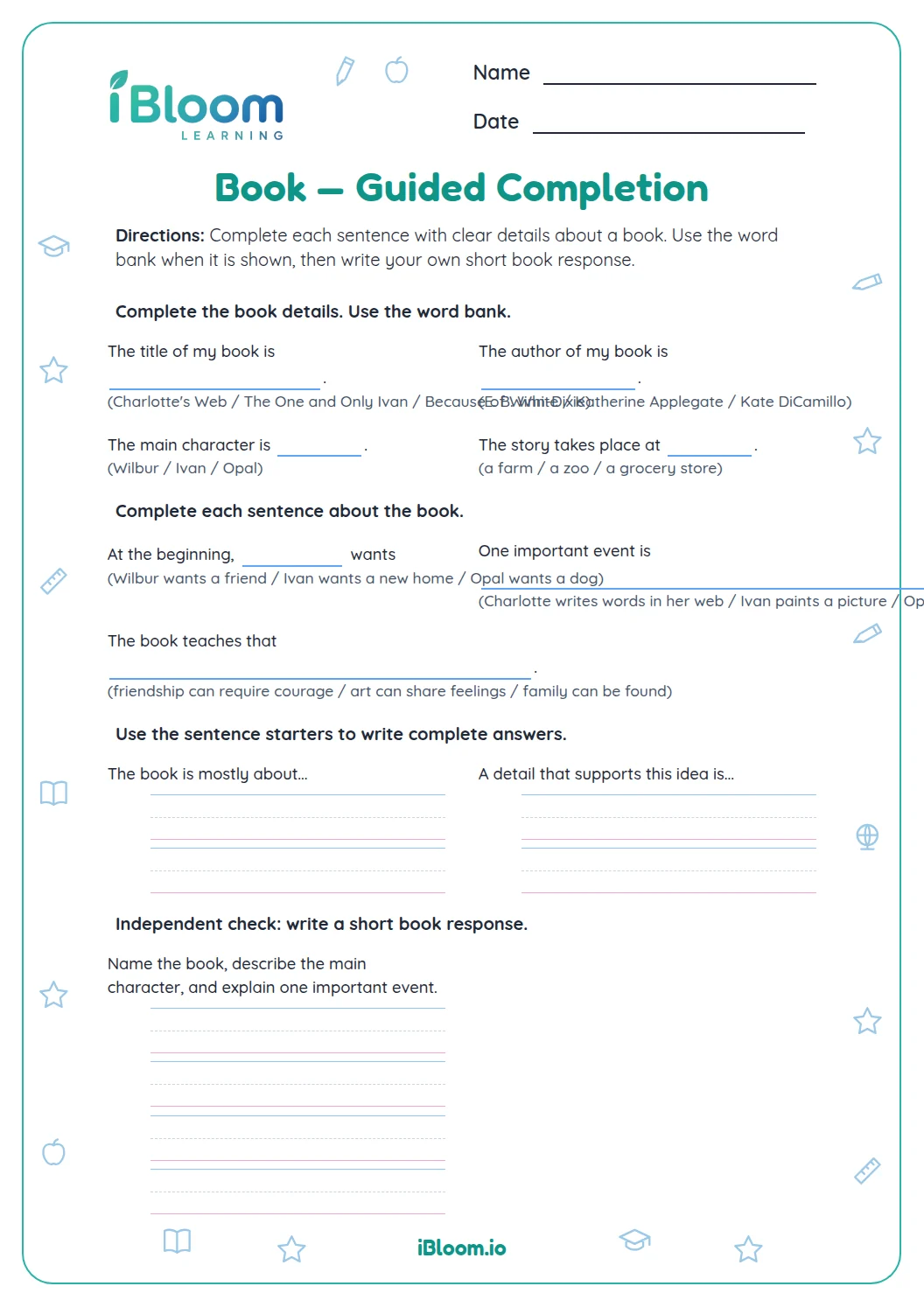
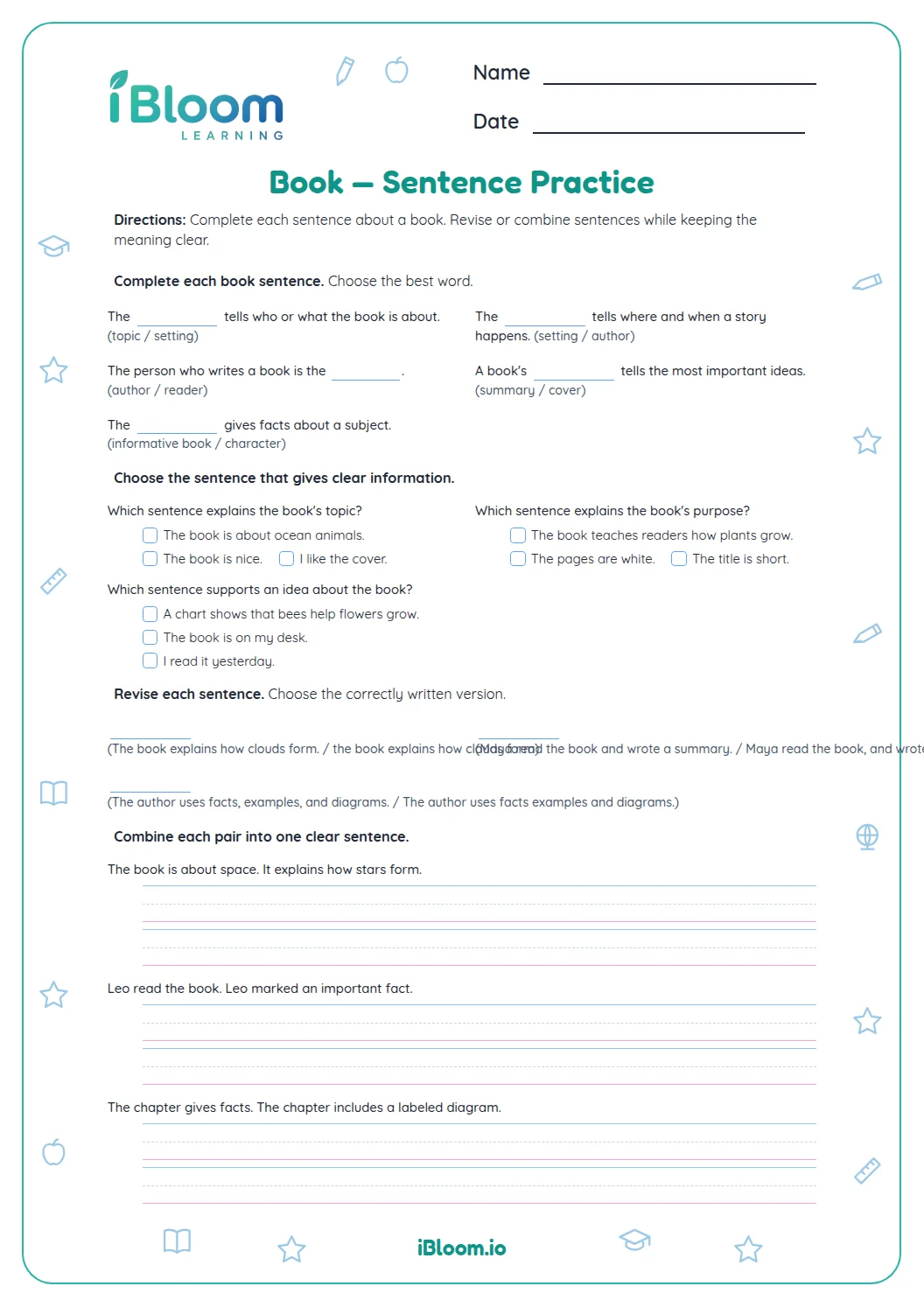
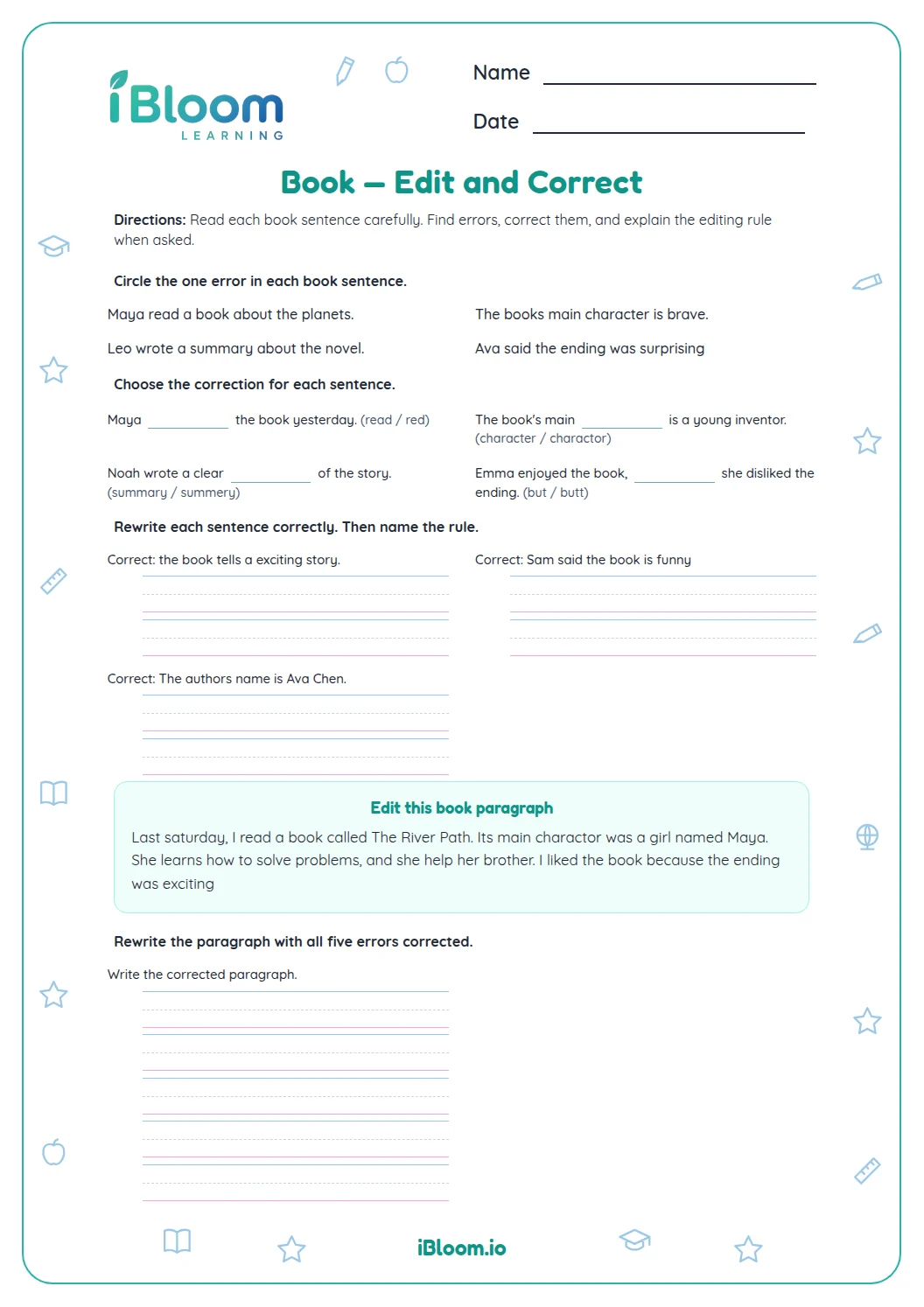
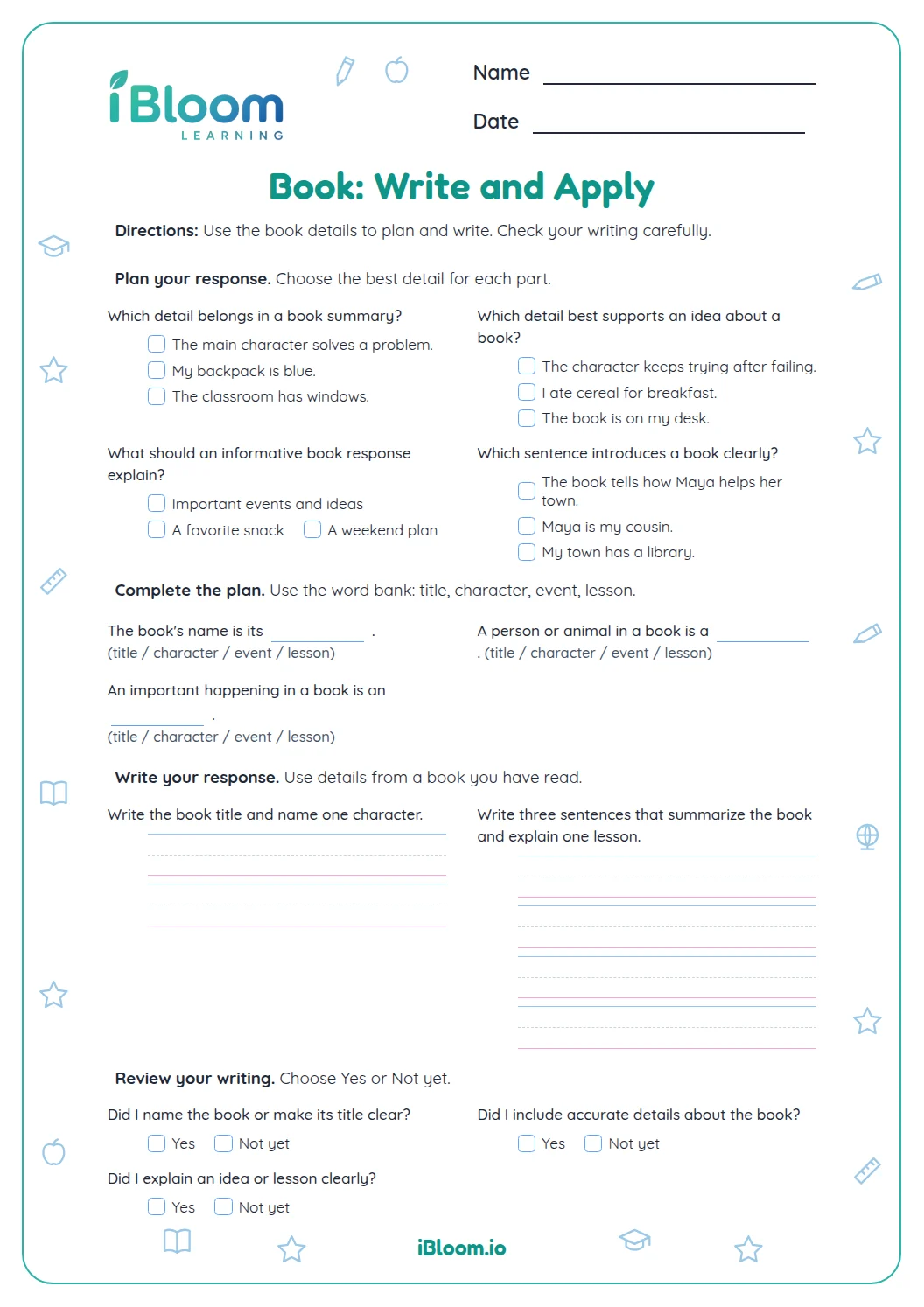
About this worksheet
This Grade 5 worksheet uses Charlotte’s Web to help students recognize information that belongs in a book response or report. In 16 short-response questions, students identify accurate story and author facts, choose details relevant to a character or setting, and spot unsupported opinions. The question style follows the source sheet’s book-detail practice. A separate answer key gives the correct choice for every item. The work connects to Common Core W.5.2, which calls for clear informative writing.
Aligned to W.5.2
How is a fact different from an opinion?
Part A asks students to label statements about Charlotte’s Web as facts or opinions. Part B asks them to choose details relevant to a character, setting, summary, or theme, following the source sheet’s fact-and-detail method.
- 1It is the best book ever.
- 2Opinion: “best” expresses a reader’s judgment, not a verifiable fact.
What makes a detail useful in a response?
A useful detail supports the point or heading. A note about a cover color does not explain a character, and the book’s chapter count does not describe its setting. Students check whether each detail fits the purpose named in the question.
How can a detail support an idea about a character?
Look for an event or action that supports the idea. Charlotte’s web writing helps Wilbur, so it supports a point about her cleverness and her help. A detail that merely names a character does not show how that character acts.
How to work through the questions
- 1Read the prompt and identify what kind of detail it asks for.
- 2Check each choice for an accurate, verifiable statement.
- 3For a report heading, choose a detail that belongs under that heading.
- 4For an opinion question, look for a personal judgment rather than a book fact.
- 5Use the answer key to review why the other choices do not fit.
Common book-detail mistakes
The mistake
Choosing a sentence because it sounds positive.
The fix
Ask whether the statement can be checked in the story or book information.
The mistake
Picking a true fact that does not support the response.
The fix
Match the detail to the specific character, setting, or idea named in the question.
The mistake
Treating “best” or “wonderful” as a fact.
The fix
Notice judgment words; they express a reader’s opinion, not verifiable information.
Common Core alignment
Students identify accurate information and relevant details used to develop an informative response about a book.
Develop a topic and convey information clearly in informative writing.
On this sheet: The questions distinguish accurate facts and relevant details from unsupported opinions, a planning step for an informative book response.
Show the official wordingHide the official wording
Write informative/explanatory texts to examine a topic and convey ideas and information clearly.
What to practice next
Make more practice
Further reading
Questions parents and teachers ask
How many questions are included?
The worksheet has 16 multiple-choice questions in two parts. The first part focuses on accurate facts and useful book details. The second asks students to match details to a report purpose, recognize opinions, and choose information that supports a point.
Does the worksheet use Charlotte’s Web?
Yes. Questions use the story’s author, characters, setting, and events as examples. Students do not need to write a full report; they practice identifying which details are factual and which ones would help explain a point about the book. based on this familiar novel
How can students tell a fact from an opinion?
A fact can be checked against the story or book information. An opinion expresses a judgment, often using words such as “best” or “wonderful.” For example, the author’s name is verifiable, while calling a book the best is a reader’s view.
What does “relevant detail” mean here?
A relevant detail fits the question’s purpose. A fact about Wilbur belongs in a character response, while the book’s page count does not explain his role. Students should read the heading or claim first, then choose the detail that helps develop it.
Is an answer key included?
Yes. The separate key lists the correct choice for all 16 questions. After checking, ask the student to explain why the selected fact or detail fits and why another choice is an opinion or belongs to a different topic. for this book response