


About this worksheet
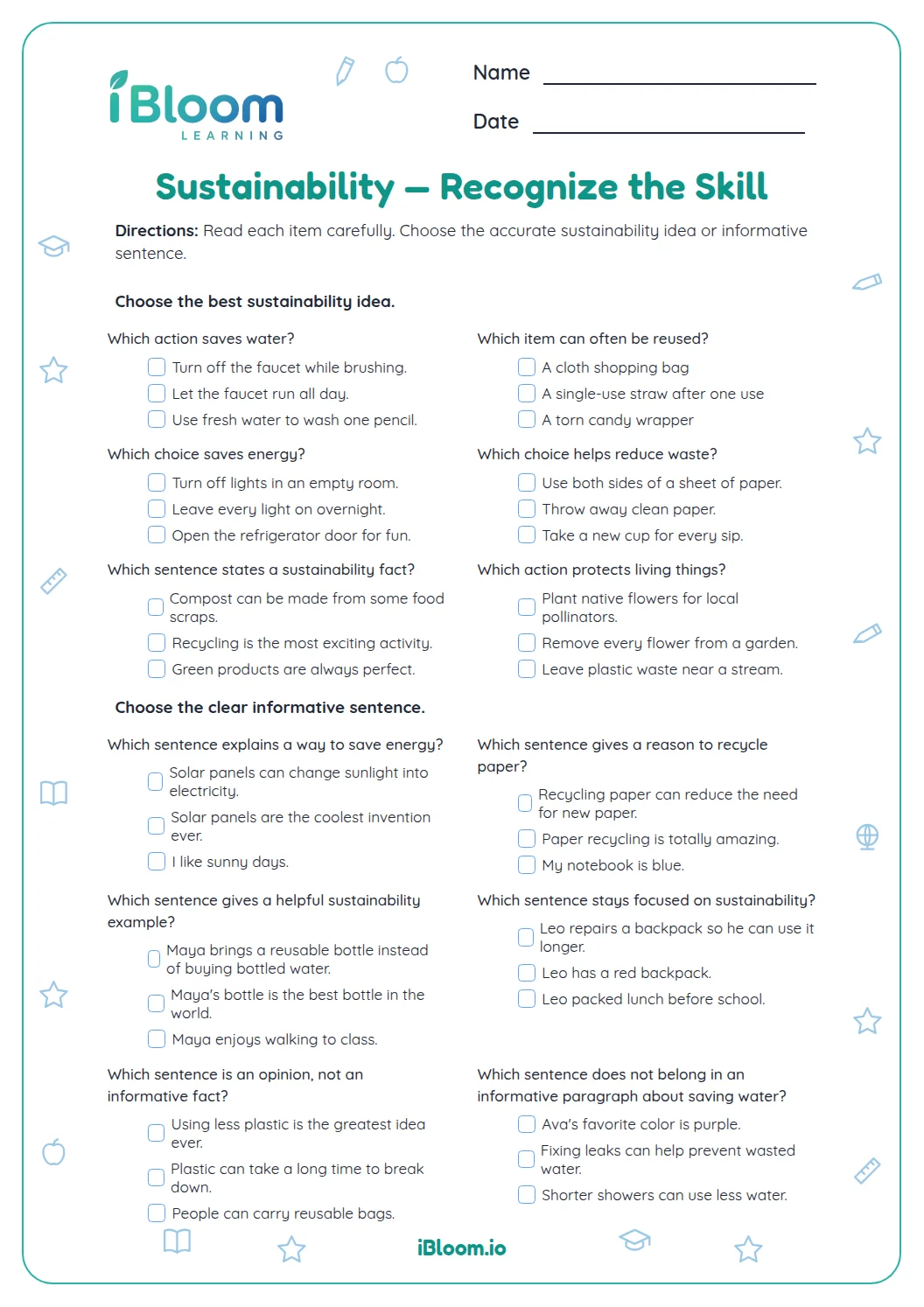
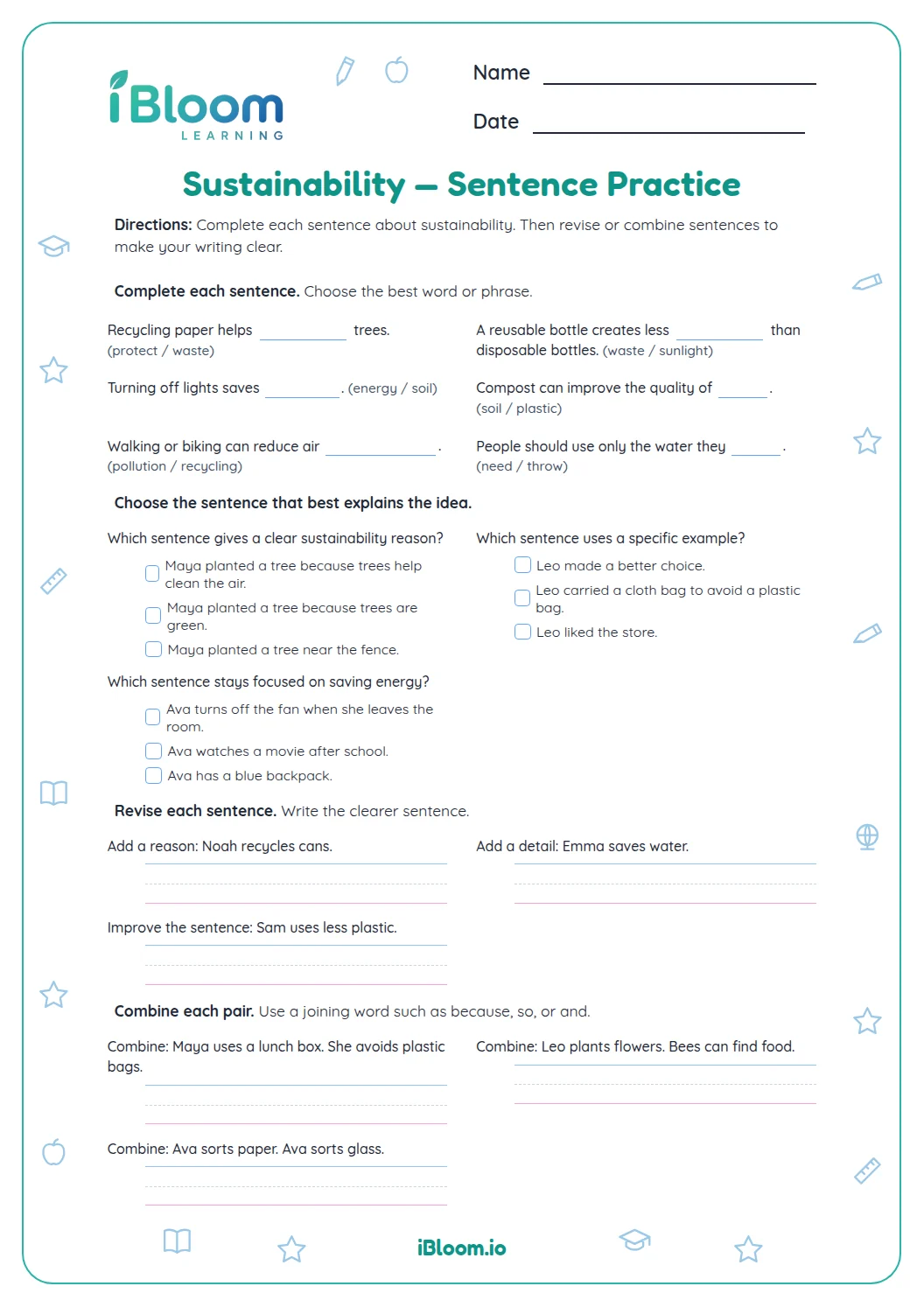
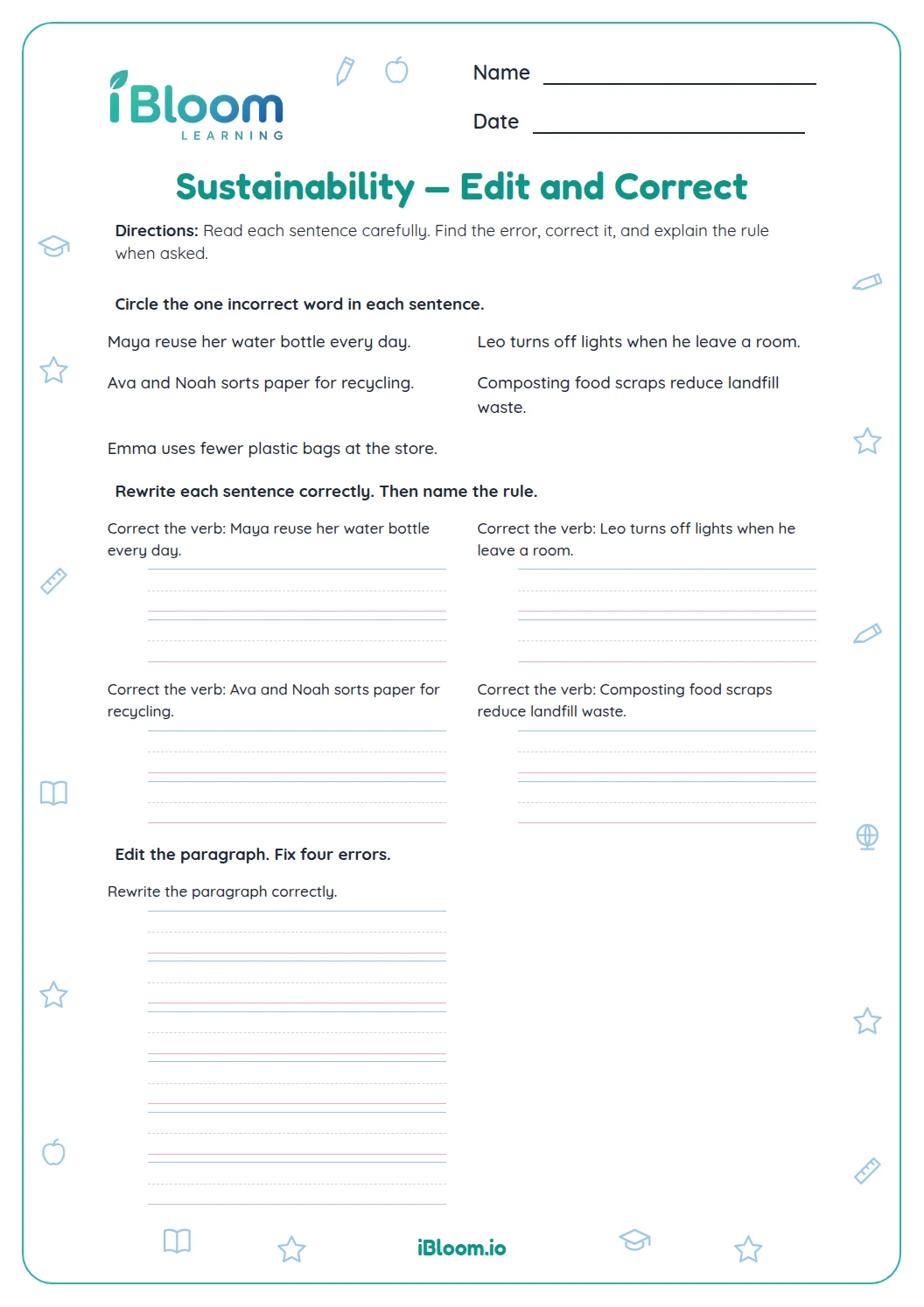
This Grade 5 worksheet reviews informative writing about sustainability. Students choose focused openings and relevant details, complete five factual statements, and check sequence, reasons, and transitions.
Aligned to W.5.2
What makes a sentence informative?
An informative sentence teaches the reader something about a topic. It names a clear idea and adds accurate details. In Part A, “Saving water protects a limited natural resource” introduces a focused idea instead of stating something general.
- 1Topic: saving water
- 2Broad: Water is something people use.
- 3Specific: Saving water protects a limited natural resource.
How do details and transitions help?
A supporting detail explains or illustrates the main idea. A transition such as “For example” signals that an example is coming. Five fill-in items ask students to complete factual statements with relevant words.
How can you revise a broad sentence?
Replace general words with a precise fact or example. “Sustainability is good” does not tell the reader why. A stronger sentence might explain how repairing an item keeps it useful and reduces waste.
How to use this worksheet
- 1Read each choice for relevance to the topic.
- 2Select details that explain the main idea.
- 3Complete Part B sentences with accurate words.
- 4Compare specific and broad statements in Part C.
- 5Check each response for focus and clarity.
Common mistakes and quick fixes
The mistake
Choosing a true sentence that does not support the topic.
The fix
Ask whether the sentence helps explain the paragraph’s main idea.
The mistake
Using a broad claim without evidence.
The fix
Add a specific example or a reason that can be checked.
The mistake
Adding a transition that signals the wrong relationship.
The fix
Use “for instance” to introduce an example and “finally” for the last step.
Common Core alignment
This worksheet gives focused practice with the standard below.
Write informative text that develops a topic with facts, details, and clear organization.
On this sheet: Write informative text that develops a topic with facts, details, and clear organization.
Show the official wordingHide the official wording
Write informative/explanatory texts to examine a topic and convey ideas and information clearly.
What to practice next
Make more practice
Further reading
Questions parents and teachers ask
What is informative writing?
Informative writing explains a topic with accurate facts, examples, and a clear order. This worksheet uses sustainability examples such as composting, refilling bottles, and reducing school waste. Students choose relevant details and revise vague statements so readers can understand specific benefits.
Can a personal example belong in informative writing?
Yes, when it clearly explains the topic and remains accurate. The worksheet’s examples focus on familiar sustainability choices, such as reducing packaging or saving electricity. A response should connect its example to the point being explained. Use the answer key to check the result and revisit the matching item if needed.
How can I make a broad sentence more specific?
Name an action and explain its effect. Instead of saying “Sustainability matters,” a writer could note that repairing an item keeps it useful and reduces waste. Question 13 asks students to choose a fact that adds a concrete detail. The best choice is specific and relevant.
What does the worksheet include?
There are 14 questions in three parts: five choices about openings and supporting details, five factual sentence completions, and four review choices about reasons, waste reduction, and transitions. The answer key lists the correct option for each question.
What should I look for when checking a response?
Check that a selected detail is accurate and supports the topic. Question 12 asks which change reduces lunchroom waste; reusable trays are the practical choice. Other items test focused openings, supporting facts, order, sentence completion, and transitions. The key gives the best answer for each.