






About this worksheet
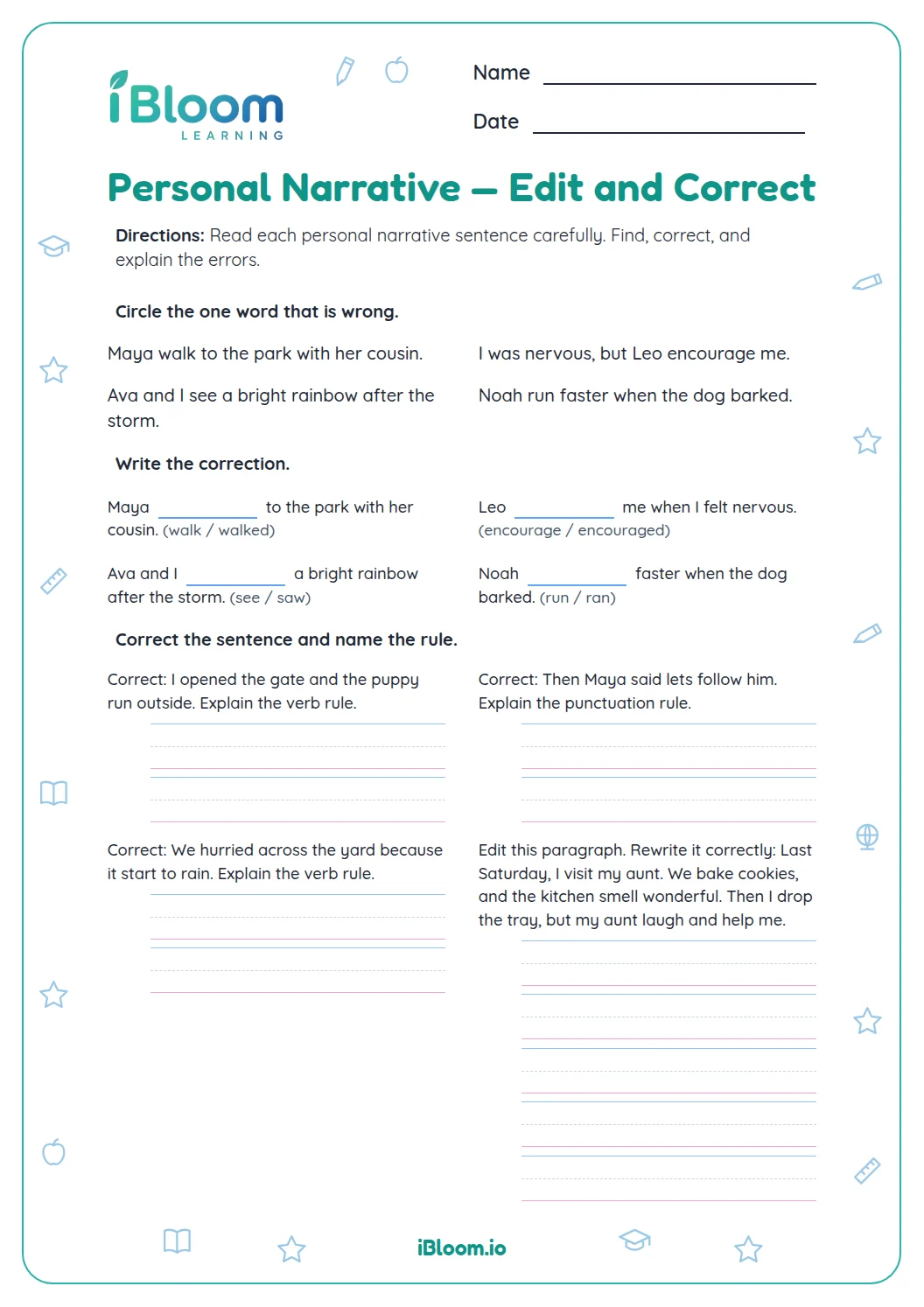
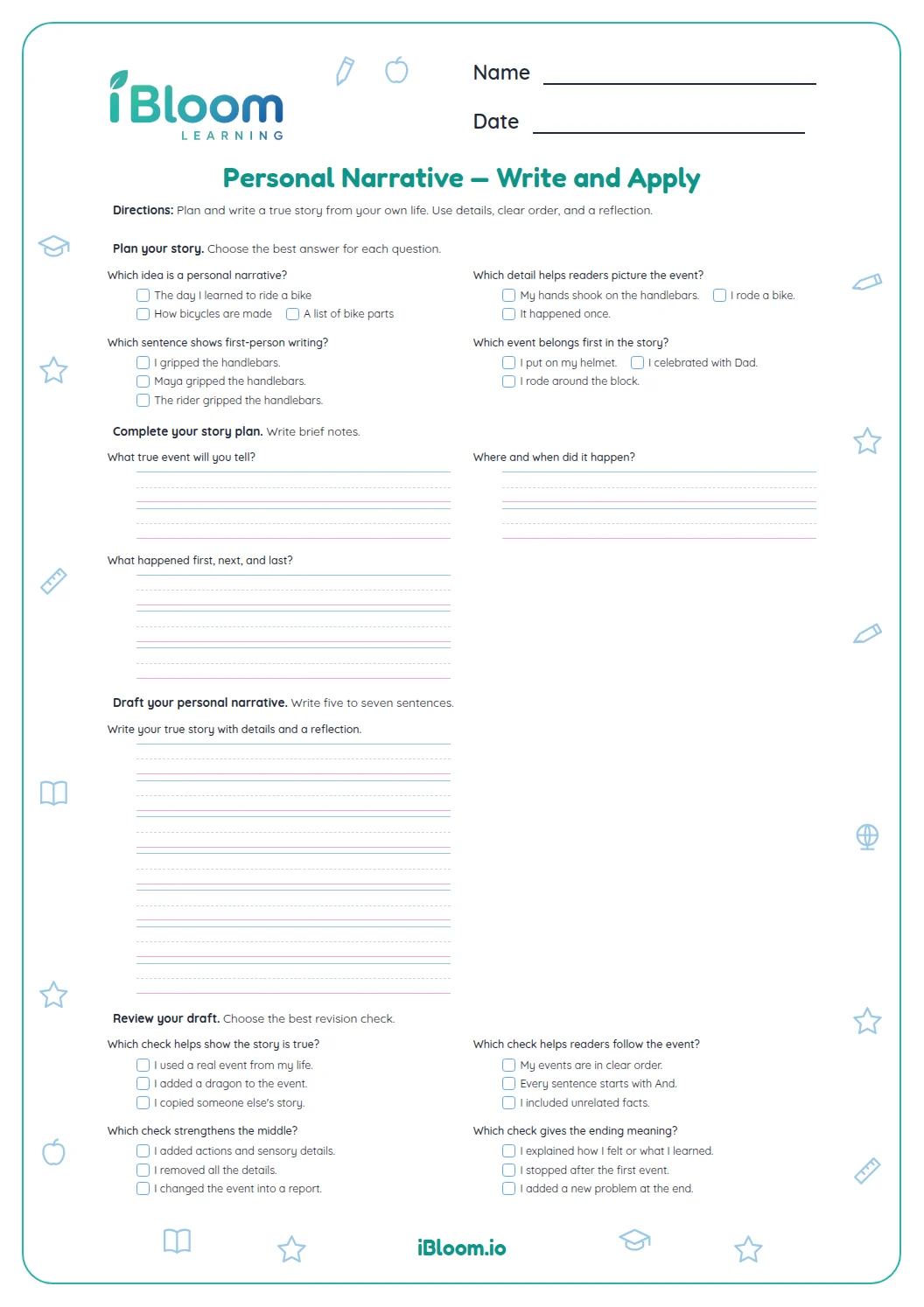
This Grade 5 writing worksheet helps students recognize features of a personal narrative. The examples follow one afternoon when a narrator helps paint a garden fence, including a small mishap and its resolution. Across 16 items, students identify first-person point of view, events, dialogue, sensory details, feelings, and reflection. The activity emphasizes narrative techniques and clear event sequence in CCSS W.5.3. A separate answer key gives the best label for each item.
Aligned to W.5.3
What makes an account a personal narrative?
A personal narrative recounts an experience from the writer’s point of view. The details make the events clear and show what the writer noticed, felt, or learned.
- 1“My hands shook before I gave my speech.” The word “my” signals first-person point of view.
How do details build the account?
Events move the experience forward. Dialogue gives spoken words, sensory details help readers imagine a moment, feelings show a reaction, and reflection shares what the writer thinks afterward.
- 1Uncle’s quoted joke is dialogue because it gives his spoken words.
How to use this worksheet
- 1Read the whole sentence before choosing.
- 2Ask whether the sentence tells what happened, gives spoken words, or describes a sense.
- 3For a reflection, look for a thought or lesson about the experience.
- 4Choose the label that best fits the sentence’s main job.
- 5Use the key to discuss any sentence that seems to fit more than one label.
Common mistakes and quick fixes
The mistake
Calling any sentence with “I” a reflection.
The fix
First person shows who tells the story; then decide whether the sentence is an event, detail, or thought.
The mistake
Treating dialogue as an event label.
The fix
Quotation marks show spoken words, so choose dialogue when the sentence mainly tells what a person said.
The mistake
Confusing a feeling with reflection.
The fix
A feeling names an emotion in the moment; reflection looks back or explains what the experience taught the writer.
Common Core alignment
The sentences ask students to notice narrative techniques and descriptive details.
Use description, dialogue and clear event sequences to develop a narrative.
On this sheet: Students identify narrative events, dialogue, descriptive details, and reflection in a first-person account.
Show the official wordingHide the official wording
Write narratives to develop real or imagined experiences or events using effective technique, descriptive details, and clear event sequences.
What to practice next
Make more practice
Further reading
Questions parents and teachers ask
What is a personal narrative?
A personal narrative recounts an experience from the writer’s point of view, using events and details to show what happened. The worksheet follows one afternoon painting a garden fence, from a paint mishap to finishing the gate together.
What does first person mean?
First person tells an experience from the narrator’s perspective, often using I, me, or my. Question 2 begins “Last Saturday, I helped,” which places the narrator inside the event. That point of view helps readers follow the writer’s own experience.
How can students recognize dialogue?
Dialogue gives a character’s spoken words, often inside quotation marks. In question 5, Uncle jokes about the painted sneaker. The quotation marks and the spoken sentence make dialogue the best label for that example. This gives students a concrete example to revisit while checking their work.
What is the difference between a sensory detail and reflection?
A sensory detail helps a reader imagine a moment, such as paint smelling sharp or the fence looking bright. Reflection shares a thought or lesson about the experience, such as learning to slow down and watch the brush. This gives students a concrete example to revisit while checking their work.
Do all sentences in a personal narrative describe an action?
No. A narrative can include action, speech, description, feelings, and thoughts about what happened. This worksheet asks students to recognize those different features in short examples from one connected first-person account. This gives students a concrete example to revisit while checking their work.