

About this worksheet
A narrative conflict is the central problem that stands between a character and a goal. This guided page moves from naming goals and obstacles to choosing developments and writing a believable resolution.
Aligned to W.5.3.a
How does this practice build narrative conflict?
A narrative conflict is the central problem that stands between a character and a goal. This guided page moves from naming goals and obstacles to choosing developments and writing a believable resolution.
Use this sheet in order: the first part focuses on one skill, and later parts ask learners to apply it in a different way. Check the separate key after the learner has tried each item.
What is on the worksheet?
Identify a story conflict, choose details that develop it, and write a short resolution. Guided prompts and a separate answer key support narrative practice.
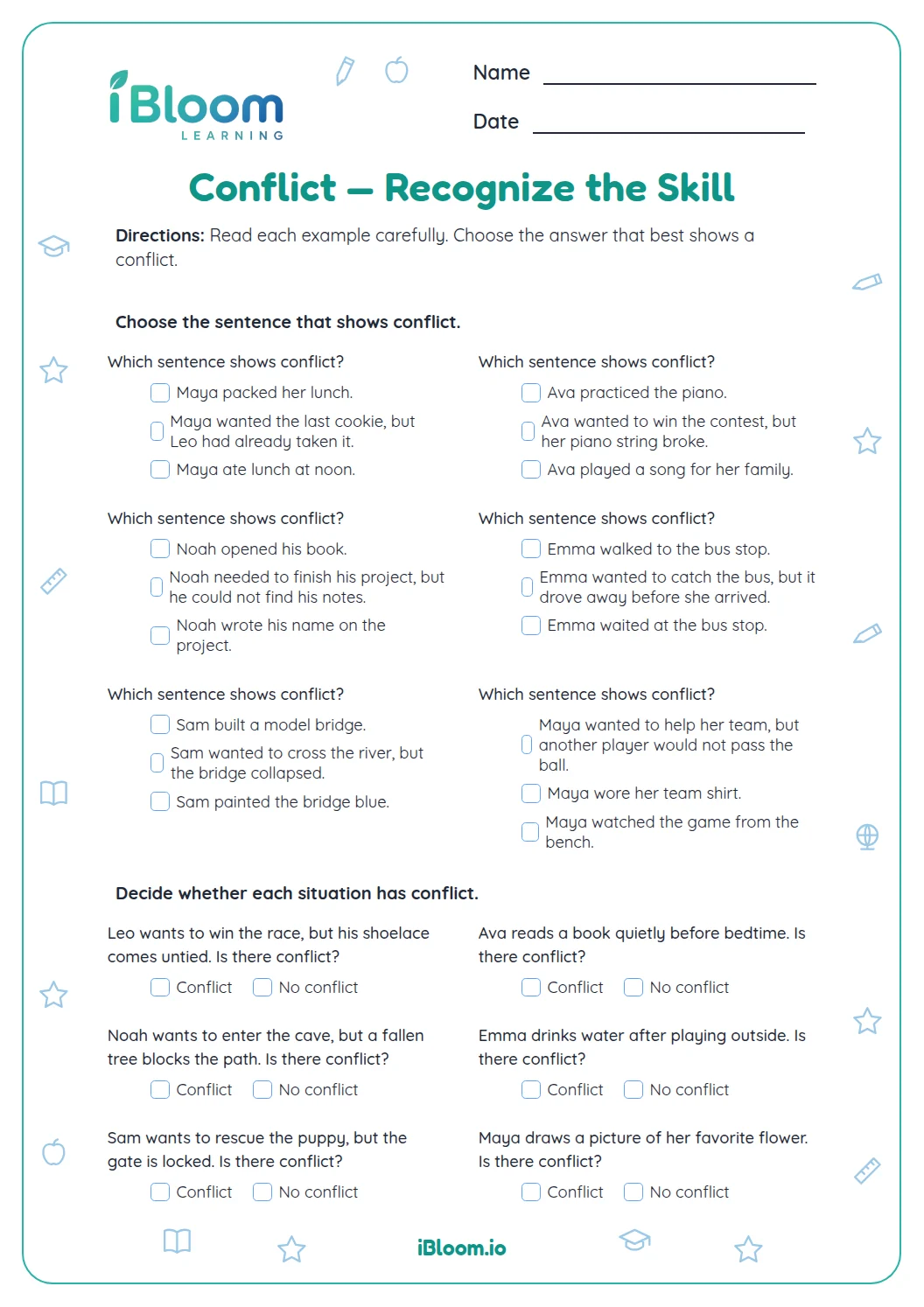
- Part A: Name the conflict
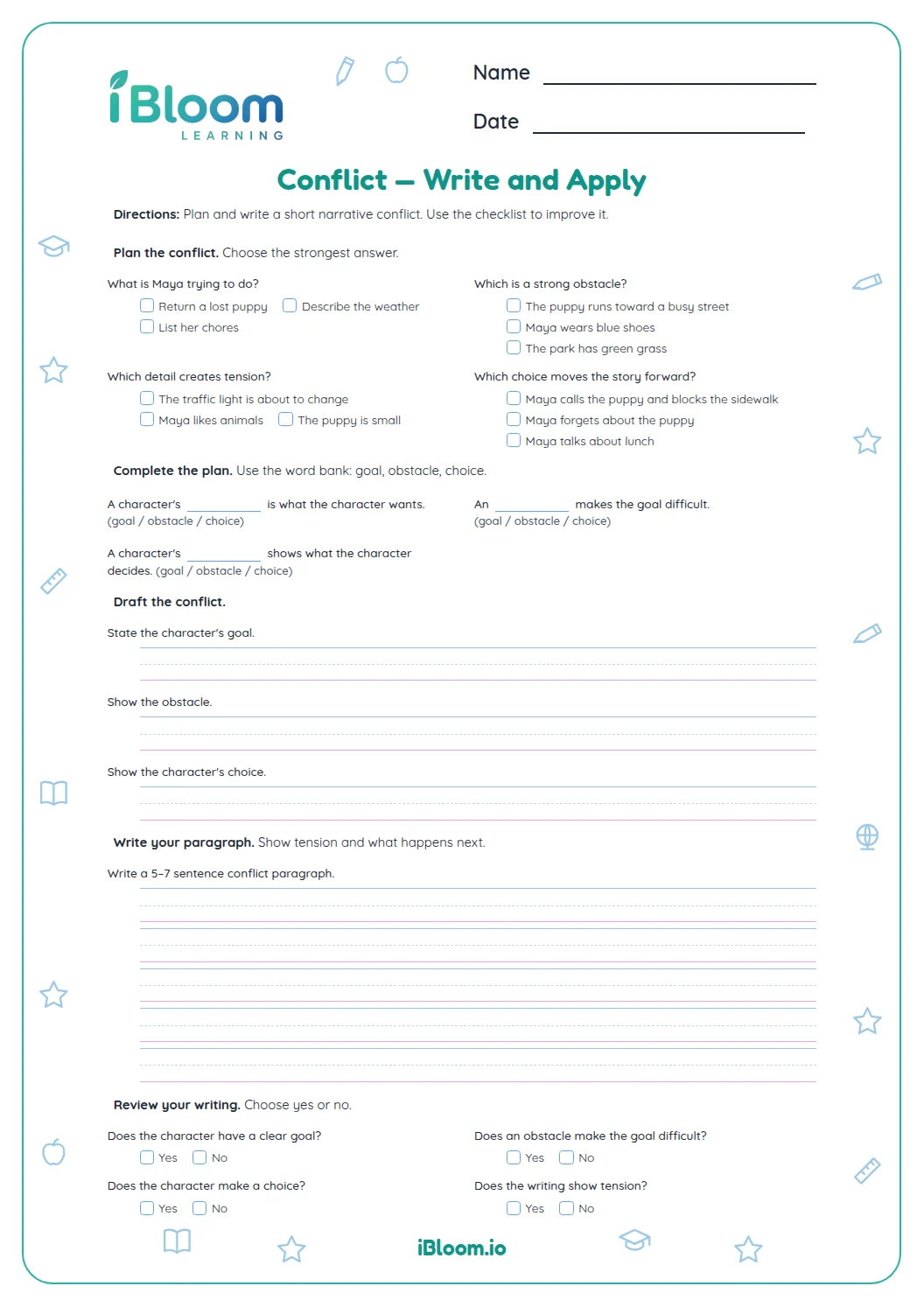
- Part B: Develop the problem
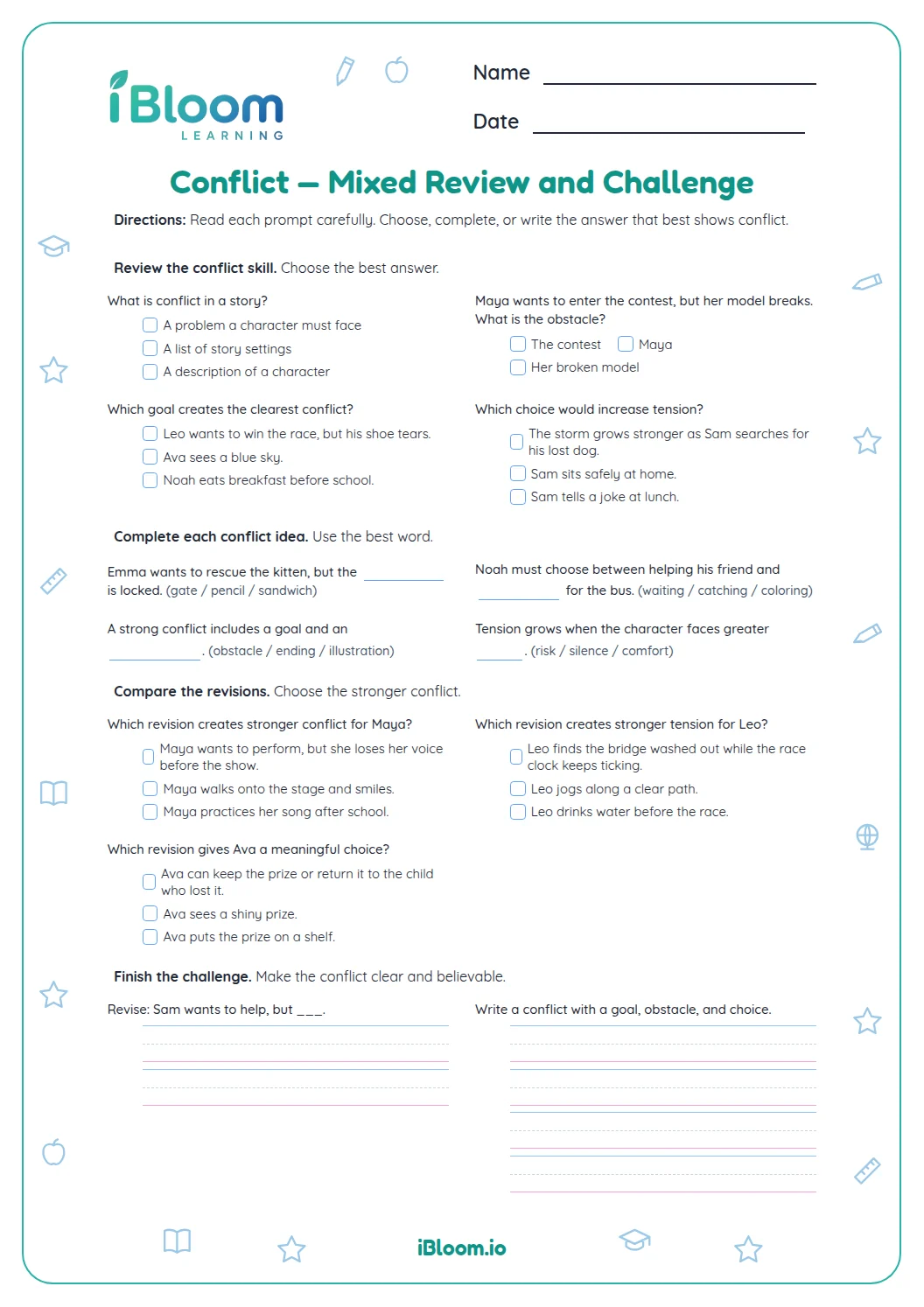
- Part C: Complete a narrative
How to use the worksheet
- 1Read the direction for the part before starting.
- 2Complete each item and use the provided response space.
- 3For reading or vocabulary items, return to the passage, clue, or word list.
- 4Check the separate answer key after finishing and revisit any missed item.
Check your work
The mistake
Naming a character’s goal but not the obstacle that blocks it.
The fix
State what the character wants, then identify what prevents it.
The mistake
Writing an event that does not make the character’s problem harder or clearer.
The fix
Check that the event connects to the same goal and obstacle.
The mistake
Ending a scene without showing an attempt to solve the conflict.
The fix
Include one character action that addresses the obstacle.
Curriculum alignment
This practice supports the grade-level skill named below.
Identify narrative goals, obstacles, and events, then write a scene that develops a conflict.
On this sheet:
Show the official wordingHide the official wording
Orient the reader by establishing a situation and introducing a narrator and/or characters; organize an event sequence that unfolds naturally.
What to practice next
Further reading
Questions parents and teachers ask
What is a story conflict?
A conflict is the problem that interrupts what a character wants to do. Part A asks learners to distinguish a goal from an obstacle and to recognize internal and external conflicts. Part B considers events that develop a problem, and Part C asks learners to write possible narrative responses.
How does the worksheet guide narrative writing?
The first two parts identify a character’s goal, obstacle, and a believable next event. The final part moves into writing: learners draft an ending, name a feeling, suggest a fair solution, explain what an ending shows, and create a brief scene with a goal, obstacle, and attempt.
How should open-ended answers be checked?
The answer key gives sample responses, not the only acceptable wording. Check that a response fits the situation, makes sense for the character, and addresses the stated conflict. For the final scene, look for all three requested pieces: a goal, an obstacle, and an attempt to solve it.
How many items are on the worksheet?
There are 15 questions in three parts: five conflict-identification items, five problem-development items, and five narrative responses. The written prompts are grouped on the final practice page, and the answer key follows the practice sheet. Each part increases the work from naming a problem to shaping a short scene.
Can learners use their own story ideas?
Yes. The last item invites a brief original scene, and other written questions accept different sensible responses. Learners can use a familiar character or situation as long as the scene clearly shows what the character wants, what gets in the way, and one attempt to address the obstacle.