




About this worksheet
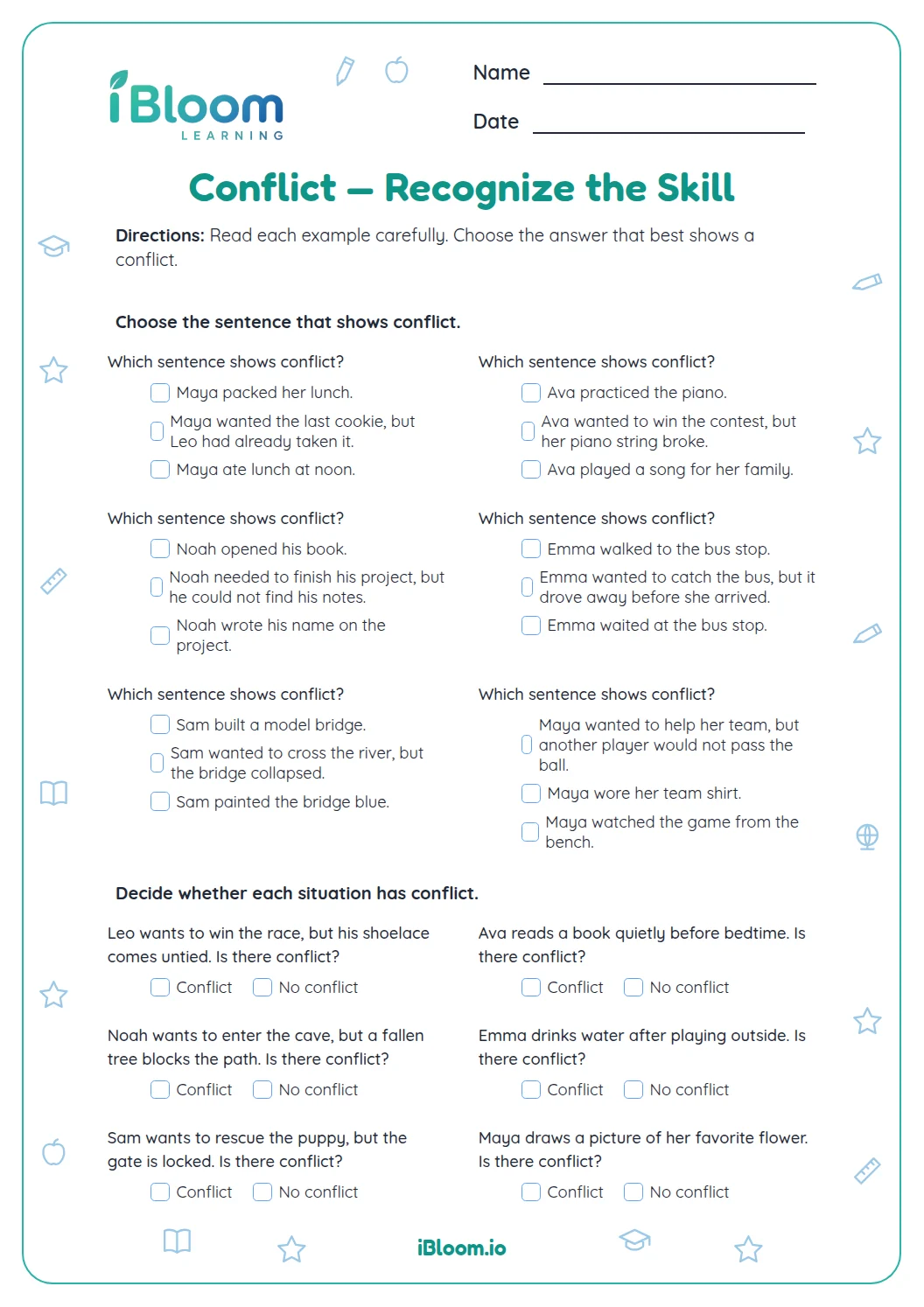
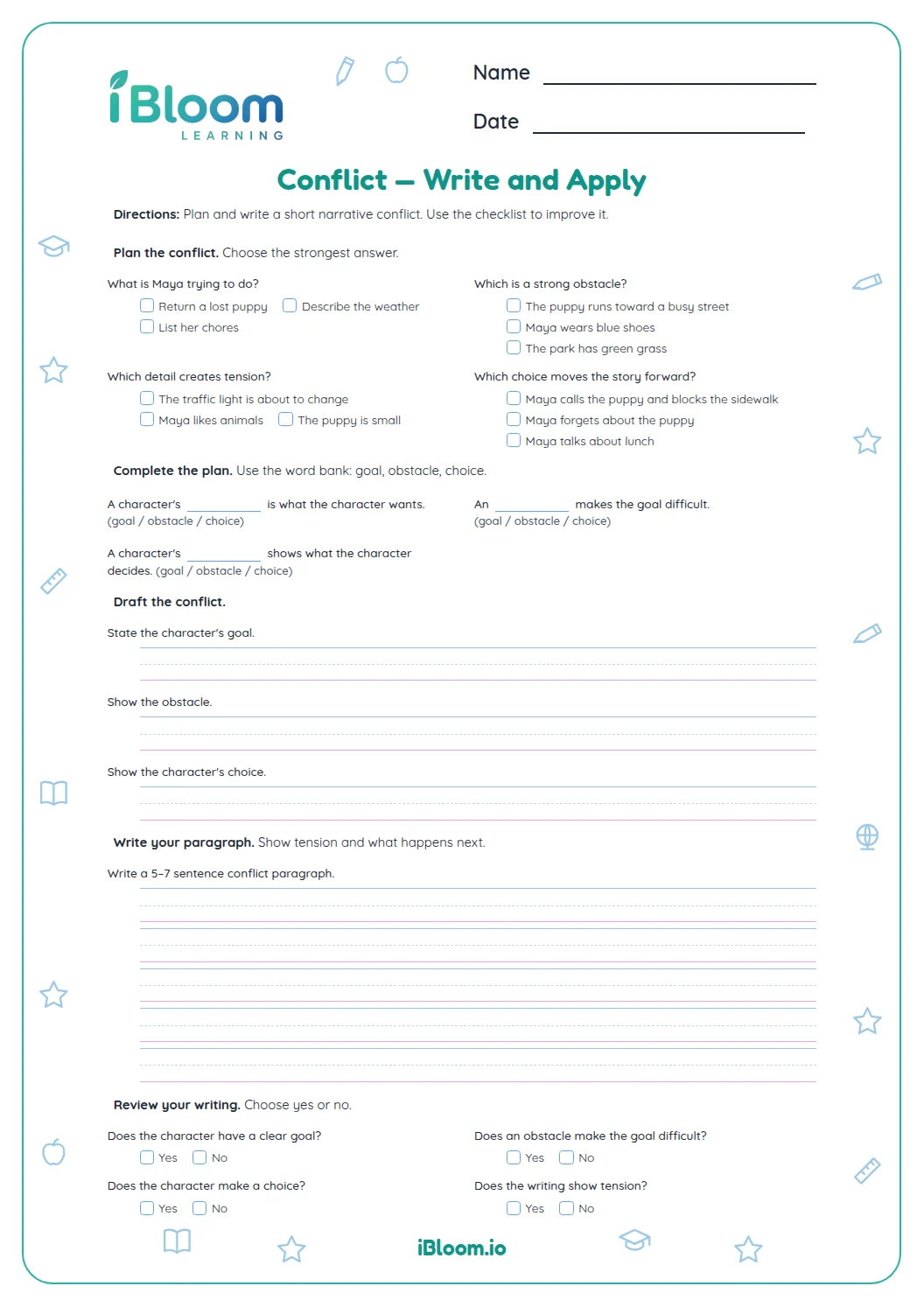
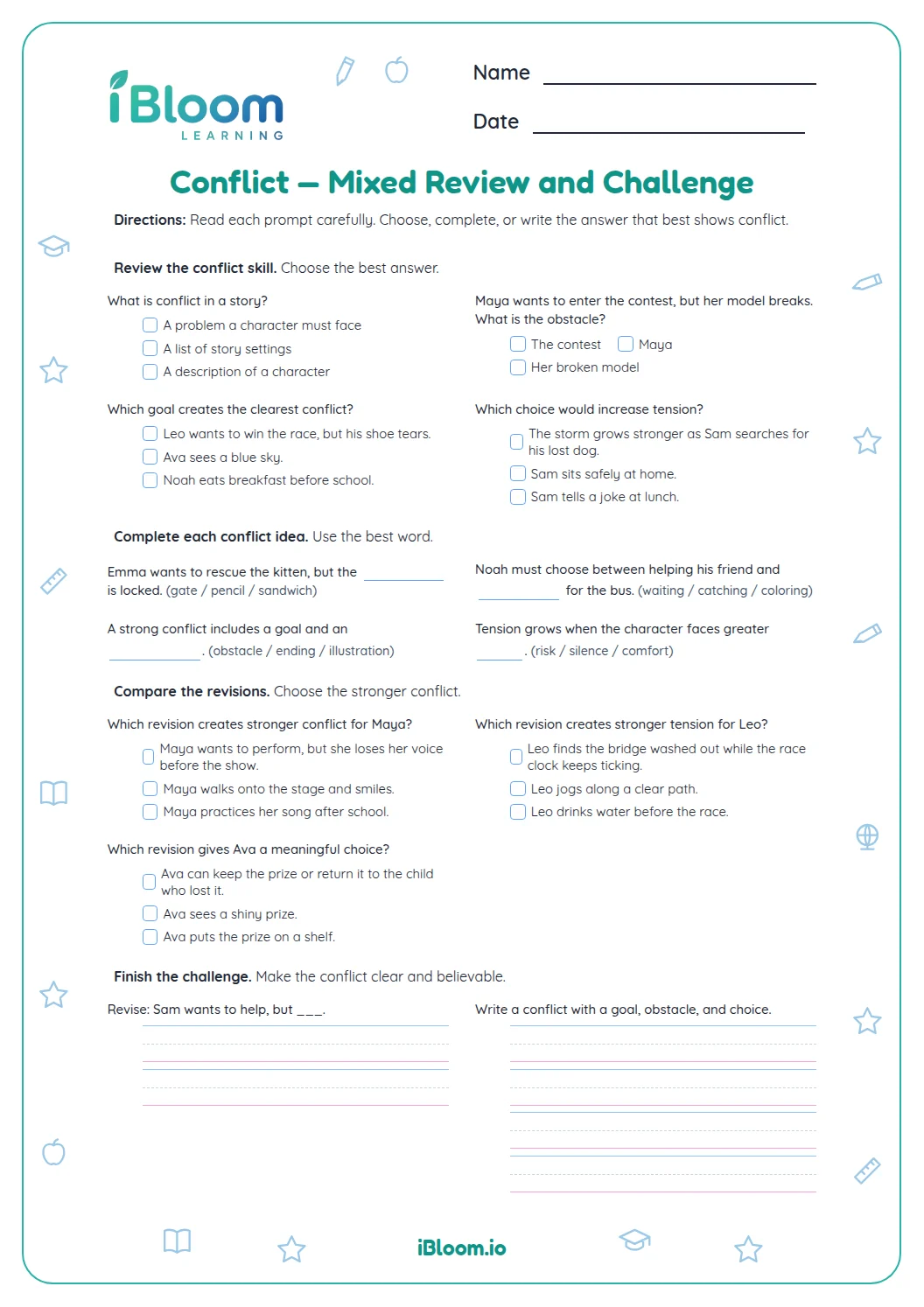
This Grade 5 narrative writing worksheet helps students create clear conflict in sentences and short scenes. Children identify sentences that show an obstacle or internal struggle, add complications, and write believable responses through action, thought or dialogue. The sequence moves from recognition to original sentence writing. The answer key gives sample responses while leaving room for students’ own story ideas.
Aligned to 5.W.3
What makes a sentence show conflict?
Conflict is a problem or struggle a character must face. A specific sentence gives the reader something that can get in the character’s way. In question 1, the kite snagging in a tree creates an obstacle; the color of the kite alone does not.
- 1The kite snagged in a tall tree.
- 2Character: the kite flyer
- 3Problem: the kite is stuck
How can one detail raise the stakes?
A detail can make an existing problem more urgent or difficult. In question 2, the wind tugging the kite higher makes retrieving it harder. A useful sentence changes what the character must do next.
How can a response move the scene forward?
A character can ask for help, make a plan, disagree or try a solution. Questions 11–15 ask you to add a believable response or build a brief scene with both a problem and an action.
How to use this worksheet
- 1Name the character and the problem in the prompt.
- 2For choices, select the sentence that introduces or changes the problem.
- 3For writing, make the conflict concrete and easy to picture.
- 4Give the character a believable response or thought.
- 5Reread the sentences in order to see whether the scene makes sense.
Common mistakes and quick fixes
The mistake
Writing a setting detail without a problem.
The fix
Add an obstacle that changes what the character can do.
The mistake
Making a problem vague.
The fix
Name what went wrong and how it affects the character.
The mistake
Solving the conflict instantly without showing a response.
The fix
Give the character one action, thought or line of dialogue that moves the scene forward.
Common Core alignment
This worksheet practices the standard through its printed questions.
Write a narrative with clear events, details and effective techniques.
On this sheet: Write narratives to develop real or imagined experiences or events using effective technique, descriptive details, and clear event sequences. (5.W.3)
Show the official wordingHide the official wording
Write narratives to develop real or imagined experiences or events using effective technique, descriptive details, and clear event sequences.
What to practice next
Make more practice
Further reading
Questions parents and teachers ask
What does conflict mean in narrative writing?
Conflict is a problem or struggle that affects a character. It may be an outside obstacle, such as a lost map, or an internal struggle, such as wanting to speak but feeling afraid. This worksheet asks children to identify conflict and make it clearer in sentences.
How can I make a conflict sentence specific?
Name the obstacle and show what it changes for the character. Instead of “Something was wrong,” write “Rain began to soak the paper signs.” The second sentence gives a concrete problem and hints at what the character may need to do.
Can my child write a different answer from the key?
Yes. Writing prompts can have many reasonable responses. The key gives sample sentences, and a different answer is suitable when it fits the scene, makes the conflict understandable, and follows the prompt. The writer can reread it to check that the scene is clear.
Should a conflict sentence include dialogue?
It can. Dialogue is one way to reveal a disagreement or a character’s worry. Action and thoughts can work too. The main goal is for the sentence to help the reader understand a problem and its effect on the character.
How long should the written responses be?
Most prompts ask for one sentence, and the last asks for a two-sentence mini-scene. Keeping the response short makes it easier to focus on a clear problem and a believable action, thought or piece of dialogue. The writer can reread it to check that the scene is clear.
Is there an answer key?
Yes. A separate answer key lists the correct choices and sample writing responses. Because students can create different conflicts and solutions, check that each original sentence follows the prompt and makes sense in its scene. The writer can reread it to check that the scene is clear.