






About this worksheet
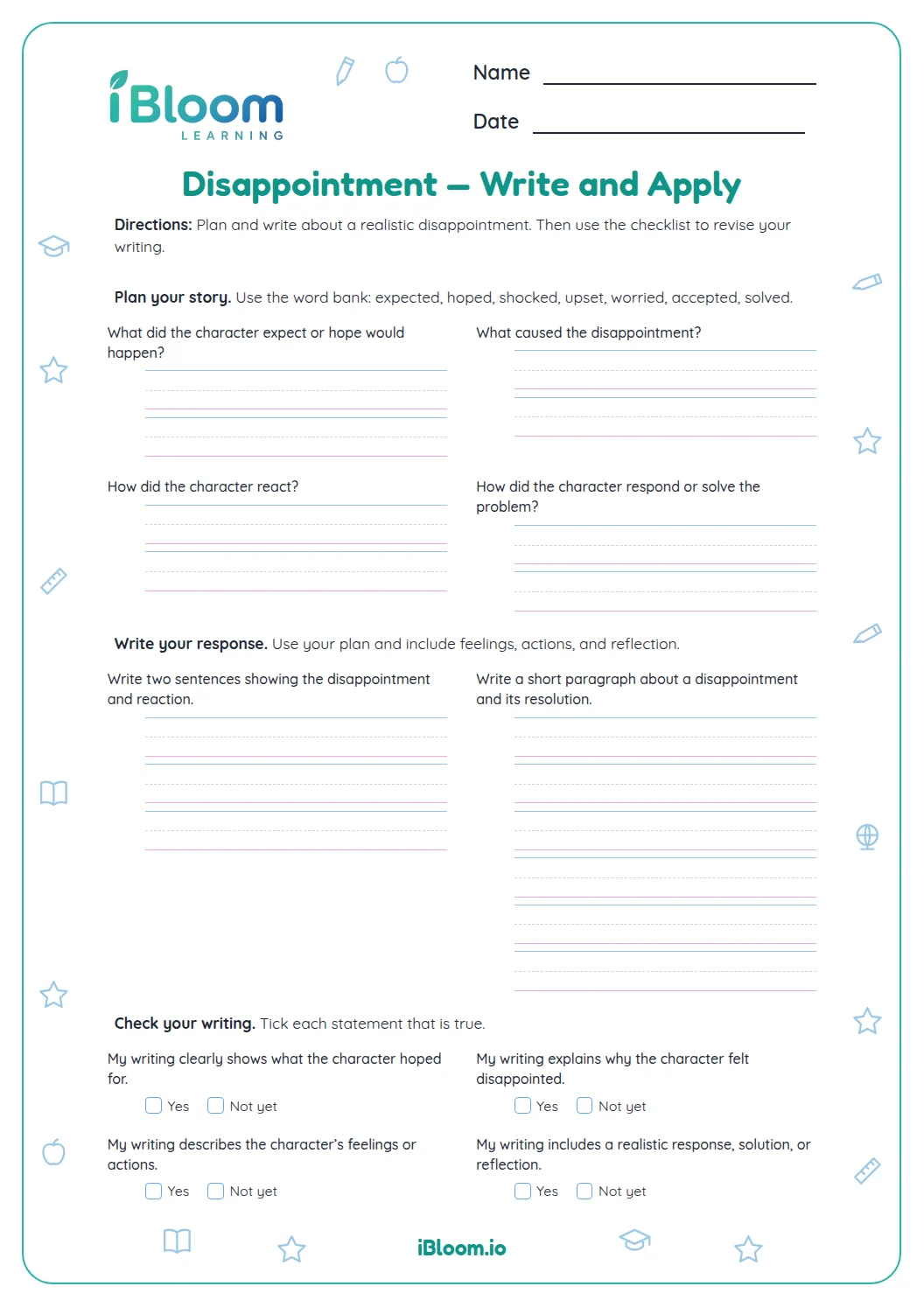
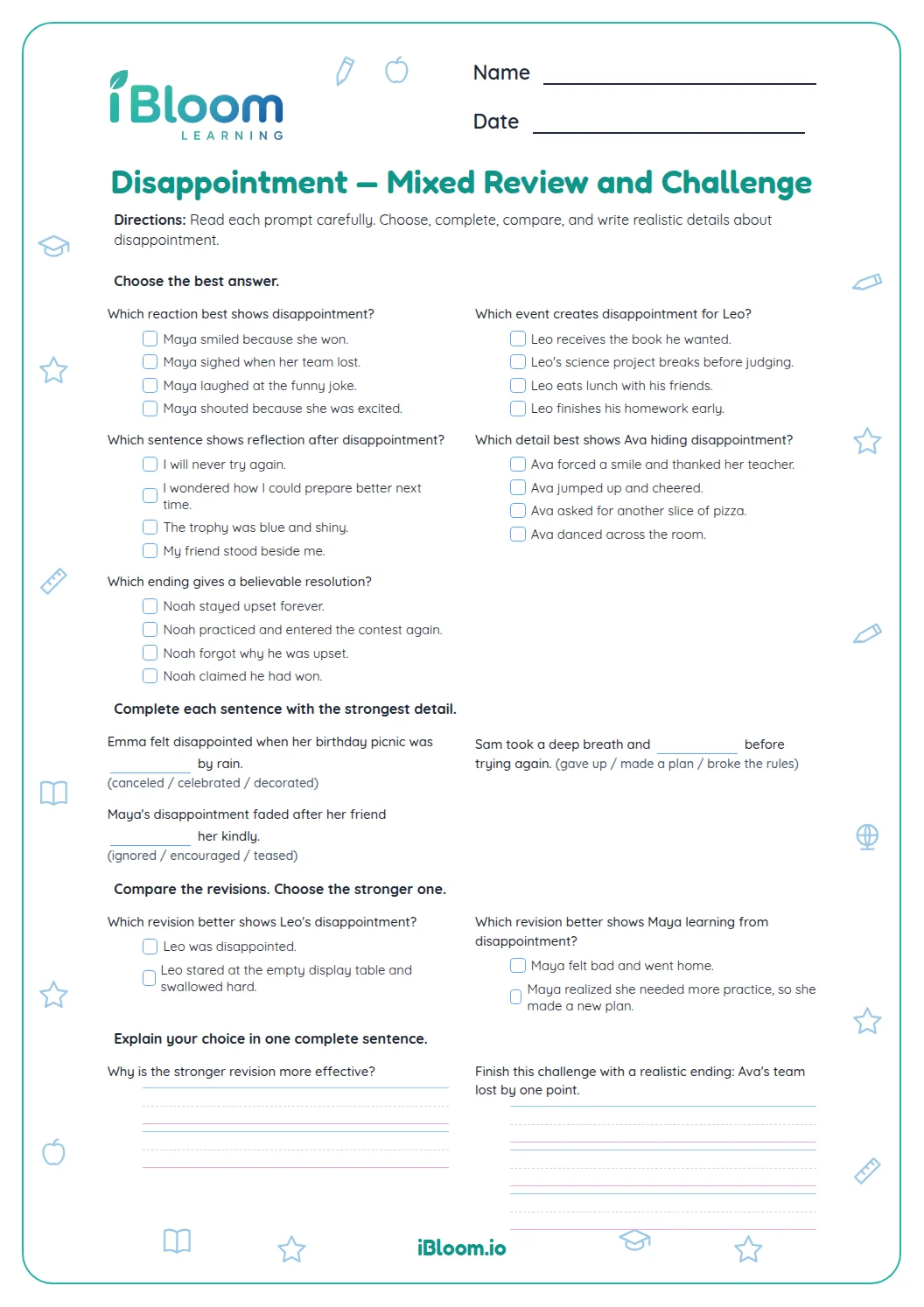
This Grade 5 worksheet helps writers express disappointment clearly in narrative sentences. Students identify sentences that show the feeling, choose precise words and cause-and-effect language, then revise or combine ideas. The final prompts add a time word, an observable detail, or what a character does next. These short exercises support clear event sequences and descriptive detail in narrative writing. The key gives models for open responses.
Aligned to W.5.3
How to use this worksheet
- 1In Part A, look for words or actions that signal disappointment.
- 2In Part B, choose a word that matches the cause and reaction.
- 3When combining ideas, keep the cause and feeling easy to follow.
- 4Add a time word when the order of events matters.
- 5Reread each revision to check that it keeps the original meaning.
Common mistakes and quick fixes
The mistake
Do not confuse disappointment with excitement or pride.
The fix
Check the result the character wanted.
The mistake
Use “because” to introduce a cause, not just to join two unrelated events.
The fix
The mistake
A specific action such as “lowered her head” helps readers picture a reaction.
The fix
Revise narrative sentences to make events and reactions clearer.
On this sheet:
Show the official wordingHide the official wording
Write narratives to develop real or imagined experiences or events using effective technique, descriptive details, and clear event sequences.
What to practice next
Make more practice
Further reading
Questions parents and teachers ask
What does this worksheet mean by disappointment?
Disappointment is a feeling that can follow an unwanted result or an unmet hope. The worksheet uses clear situations such as losing a game, a canceled trip, or a broken project. Children identify the feeling and make its cause or reaction clear in a sentence.
Are there open-ended writing questions?
Yes. Questions 9 through 16 ask students to revise, combine or complete sentences and to write about a character’s next action. The answer key gives one sample for each. A different sentence is fine when it is clear, fits the prompt and preserves the intended event.
How can I make a disappointment sentence more vivid?
Add a concrete response that a reader could picture, such as a character lowering their head, sighing or taking a breath. Pair the action with the cause so the reader knows what happened. A detail should clarify the moment rather than add an unrelated event.
Why use “because” in a narrative sentence?
“Because” can connect a character’s feeling to the event that caused it: “Leo was disappointed because he missed the final goal.” The relationship becomes explicit. In another prompt, “although” would signal contrast, so it would not fit the intended cause.
How do time words improve a story?
Words such as “then” and “after” help readers follow which event happened first and what followed. The final questions invite students to place the disappointing event in sequence and show what a character does next, keeping the narrative easy to follow.