






About this worksheet
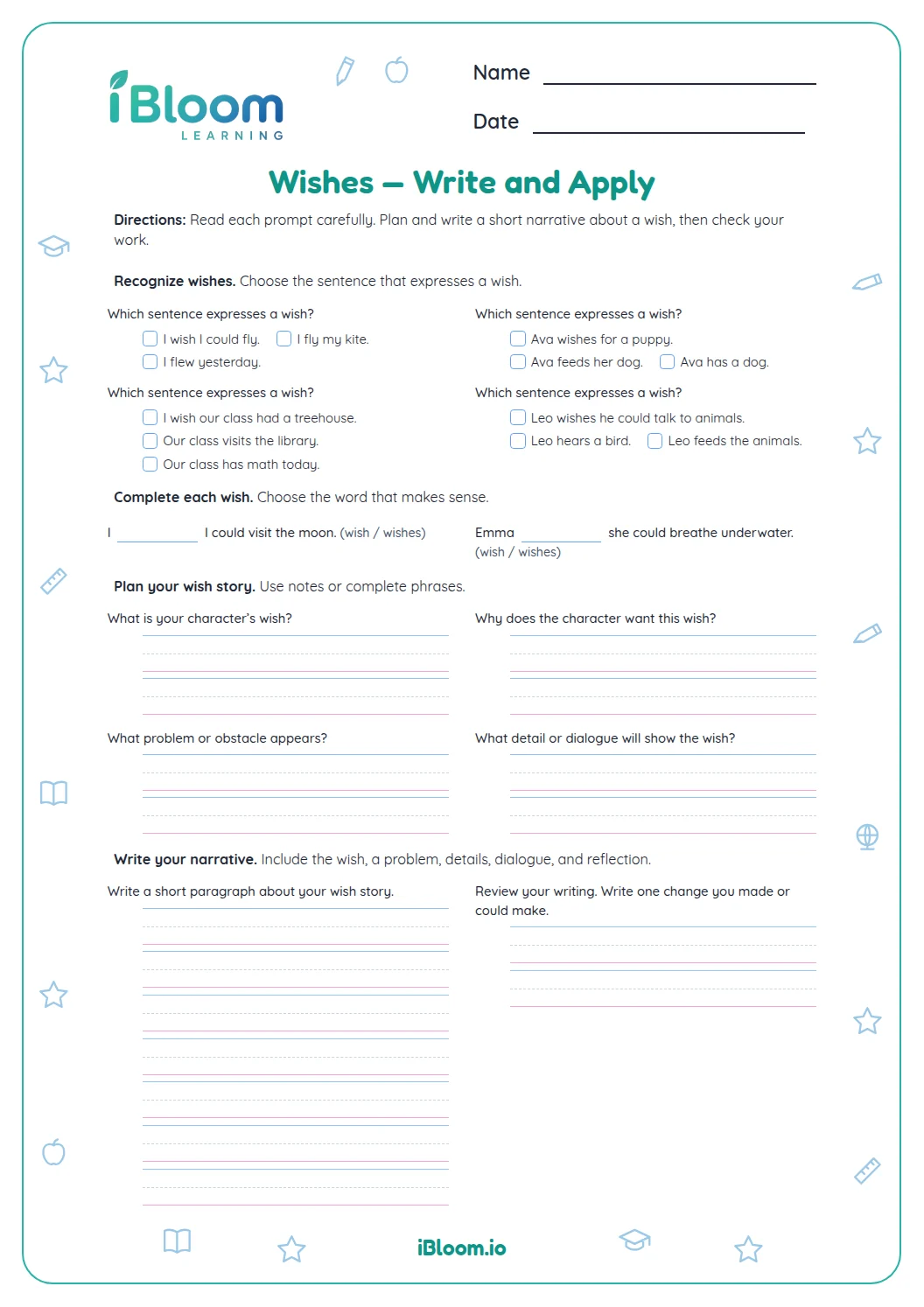
This Grade 5 worksheet guides students through planning a wish-based narrative. Fourteen prompts follow Maya’s wish to see the moon through a telescope: students establish a setting, add a problem, connect actions, and choose details for dialogue and an ending. The answer key offers one possible response for each blank; students can suggest other details that keep the story coherent.
Aligned to W.5.3
How does the wish start the story?
A character’s wish gives the narrative a goal. Maya wants to see the moon through a telescope, so the hilltop observatory and folded map support that goal.
How can events connect to the problem?
A locked observatory door creates an obstacle. Maya searches for a key, finds a spare with help, and can then reach her goal. Each event should help move the character toward the wish.
What makes the ending feel complete?
Show that Maya reaches her goal and include a fitting feeling or detail. Question 10 uses “reached” to show that the goal is met.
- 1A satisfying ending shows Maya’s goal is ___.
- 2Answer: reached
How to use this worksheet
- 1Read the directions and example aloud.
- 2Complete the first part together, naming the clue or rule.
- 3Let the student try the next part independently.
- 4Use the answer key to check each response.
- 5Review one missed item by explaining the correct choice.
Story-planning slips and fixes
The mistake
Adding a detail that does not connect to the character’s wish.
The fix
Check that the setting and events help Maya reach the observatory.
The mistake
Introducing a problem without showing an action to address it.
The fix
Use the search and spare-key prompts to connect the obstacle to the solution.
The mistake
Ending before the character reaches the goal.
The fix
Show that Maya sees the moon through the telescope and name how she feels.
Common Core alignment
This sheet gives students focused practice with a Common Core writing skill.
Write narratives with organized events, details, dialogue, and a conclusion.
On this sheet: Students plan a wish-based narrative with a character, problem, event sequence, details, and ending.
Show the official wordingHide the official wording
Write narratives to develop real or imagined experiences or events using effective technique, descriptive details, and clear event sequences.
What to practice next
Make more practice
Further reading
Questions parents and teachers ask
How does a wish become a narrative?
A wish gives the character a goal. Add a setting, a problem that blocks the goal, and actions that help solve it. These prompts follow Maya’s plan to see the moon through a telescope, from packing a map to reaching the observatory.
Do students need to write full paragraphs?
No full paragraphs are required. Students complete 14 short blanks to build Maya’s story from her wish through the problem and ending. They can expand the finished plan into a paragraph afterward if they want to develop the narrative further.
What makes a useful story problem?
A useful problem makes the character’s goal harder to reach and leads to an action. Maya finds the observatory door locked, so she searches for a key and asks the caretaker for help. Those events connect the obstacle to the solution.
Why include dialogue and descriptive details?
Dialogue lets readers hear what a character says, and a descriptive detail helps them picture the setting. Choose details that fit the scene. The bell and stars in this story add sound and visual information around Maya’s trip.
Can students use different answers from the key?
Yes. The key gives one possible response for each blank, but a different answer may work if it fits the sentence and keeps the story coherent. Ask the student to explain how the detail connects to Maya’s wish and events.