






About this worksheet
This Grade 5 worksheet helps students recognize how an opinion piece works by sorting weekend-themed statements into opinions, reasons, evidence, facts, and conclusions. Fourteen multiple-choice questions move from identifying a writer’s position to noticing details that support it. The answer key gives a label for each example. Students practice distinguishing a checkable detail from a judgment or a reason.
How can a reader spot an opinion?
An opinion states what someone thinks should happen or what choice is best. Question 5 says libraries should stay open later; that is a position a writer could support.
- 1“Libraries should stay open later on Saturdays.” → Opinion
- 2It recommends a choice, rather than reporting a schedule.
What makes a reason useful?
A reason explains why the writer holds an opinion. Look for a cause or benefit that connects directly to the position, as in question 2.
How does evidence help a reason?
A specific detail gives a reader something concrete to check. Question 3 uses a trail map and its listed paths as a detail, rather than a broad preference.
How to use this worksheet
- 1Read the question first and identify the job it names.
- 2Underline opinion words such as should, best, or I think.
- 3Check that a reason explains why someone holds the opinion.
- 4Choose evidence that is specific and checkable.
- 5Use the answer key to discuss one choice that was close.
Common mistakes and quick fixes
The mistake
Choosing a personal preference as evidence.
The fix
Evidence is a specific detail a reader could check; “the best” signals a judgment.
The mistake
Calling a schedule fact a reason.
The fix
Ask whether the sentence explains why the writer believes the opinion.
The mistake
Mistaking a final recommendation for a new reason.
The fix
A conclusion gathers the argument and signals that the writer is wrapping up.
What to practice next
Make more practice
Further reading
Questions parents and teachers ask
How many questions are on the worksheet?
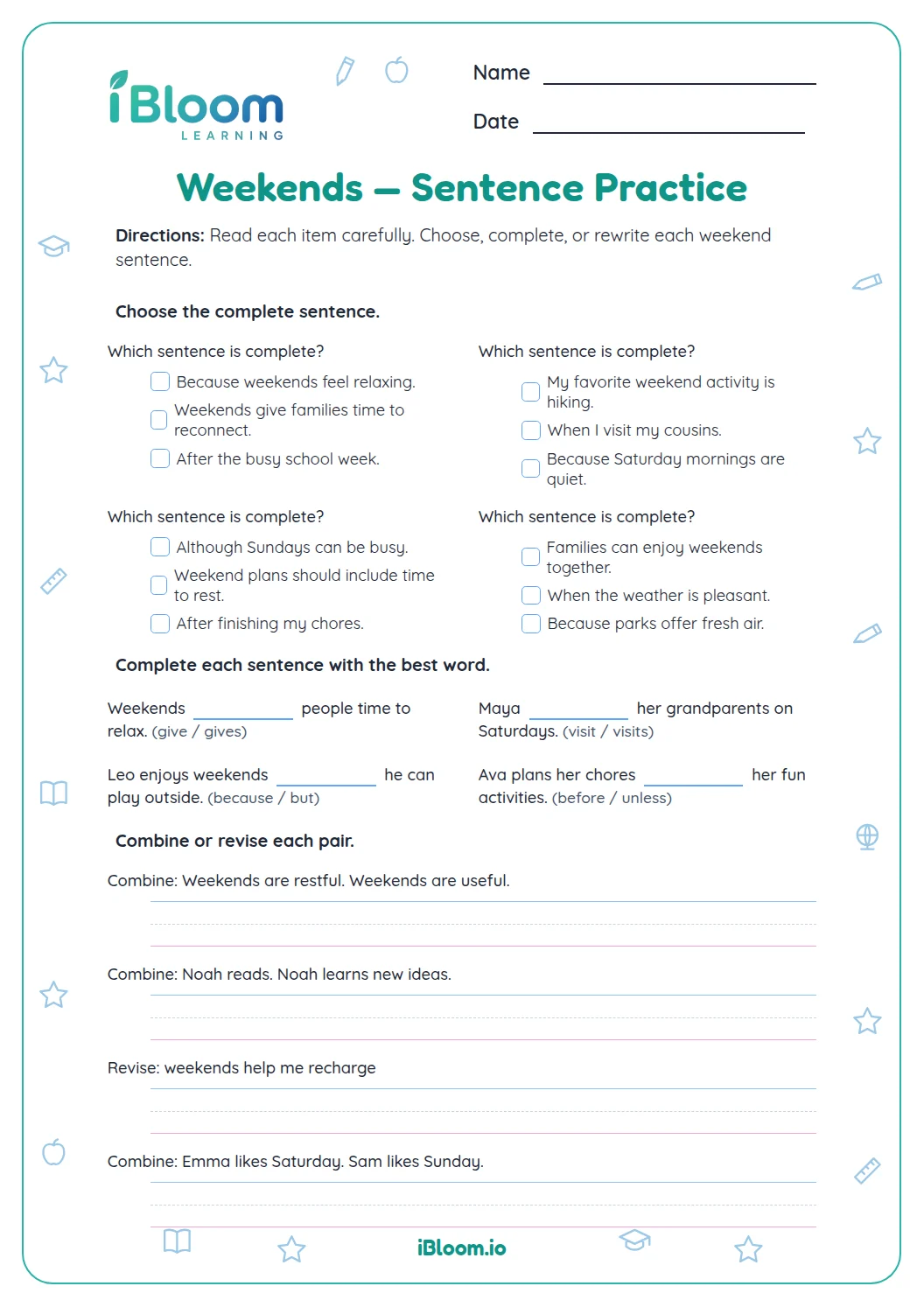
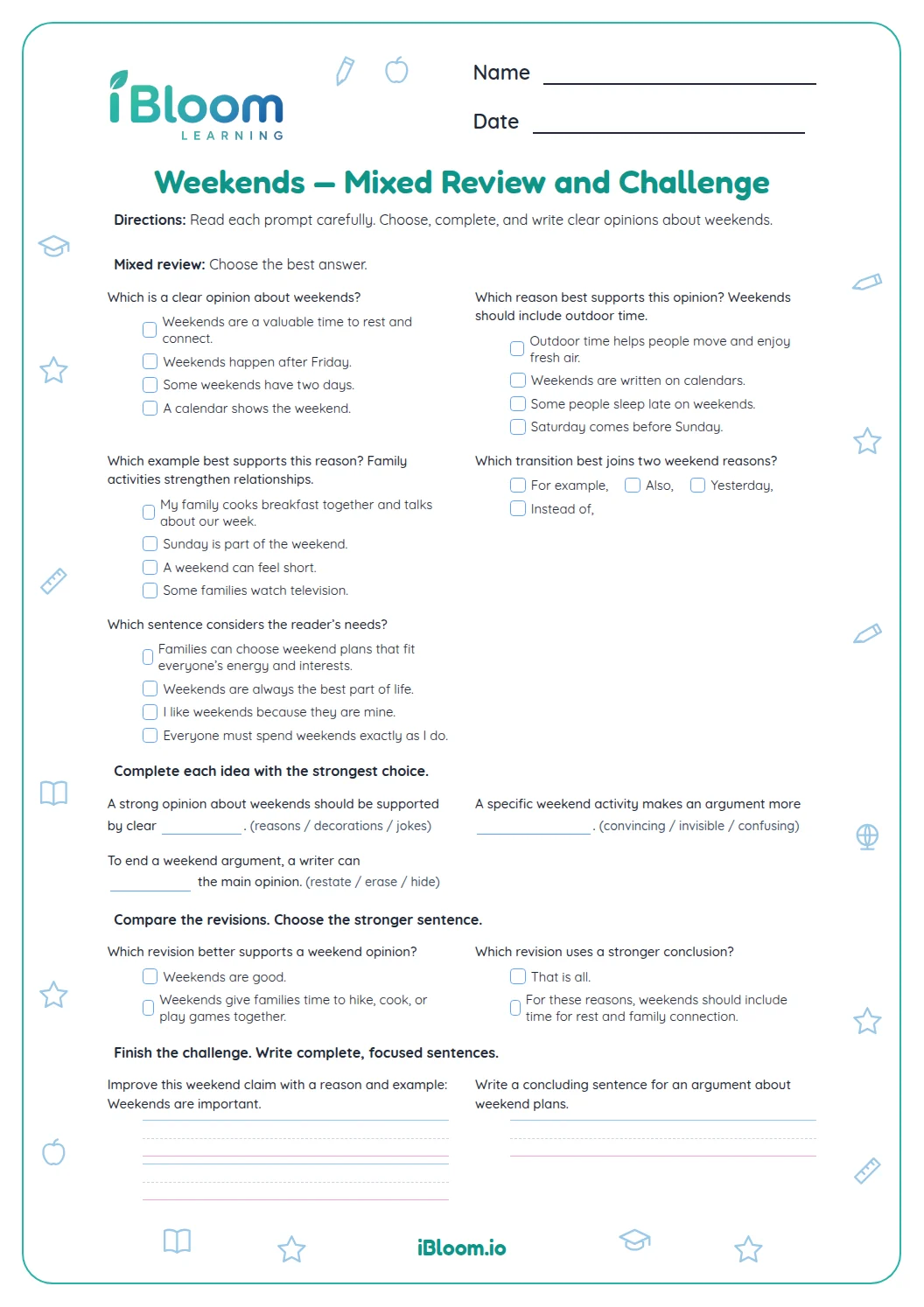
There are 14 multiple-choice questions across two worksheet pages, followed by a two-page answer key. Each item asks students to identify a statement’s role in opinion writing. The weekend examples keep the topic familiar while students focus on the sentence and the clue that supports its label.
What kinds of statements do students identify?
Students distinguish opinions, reasons, evidence, facts, and concluding statements. The questions use familiar weekend topics such as a library visit, a hike, or a neighborhood activity. Each item offers two choices. Ask the student to point to a word or detail that supports the selected label.
Does the page ask students to write an essay?
No. This particular page builds recognition by asking students to select the sentence that fits each role. After checking the key, invite your child to turn one selected opinion into a short paragraph with a reason and a detail. Students can explain the label by pointing to the words that signal a judgment, a reason, or a checkable detail.
How can I explain evidence to my child?
Evidence is a concrete detail that can support a reason. For instance, a trail map listing two miles of paths is checkable information; saying a hike is the best activity is a personal judgment. Ask whether someone could verify the detail.
Is there an answer key?
Yes. A separate two-page key lists the correct choice for each of the 14 questions. Use it after the student finishes, then ask them to explain why one statement fits its label. For evidence, a useful clue is whether the detail is specific enough for a reader to check.
What should students practice next?
After recognizing the parts, students can write an opinion about a weekend activity, add reasons, and connect those reasons with linking words. The linked writing prompts, linking words, and supporting-reasons practice pages offer a sensible next step. Students can explain the label by pointing to the words that signal a judgment, a reason, or a checkable detail.