






About this worksheet
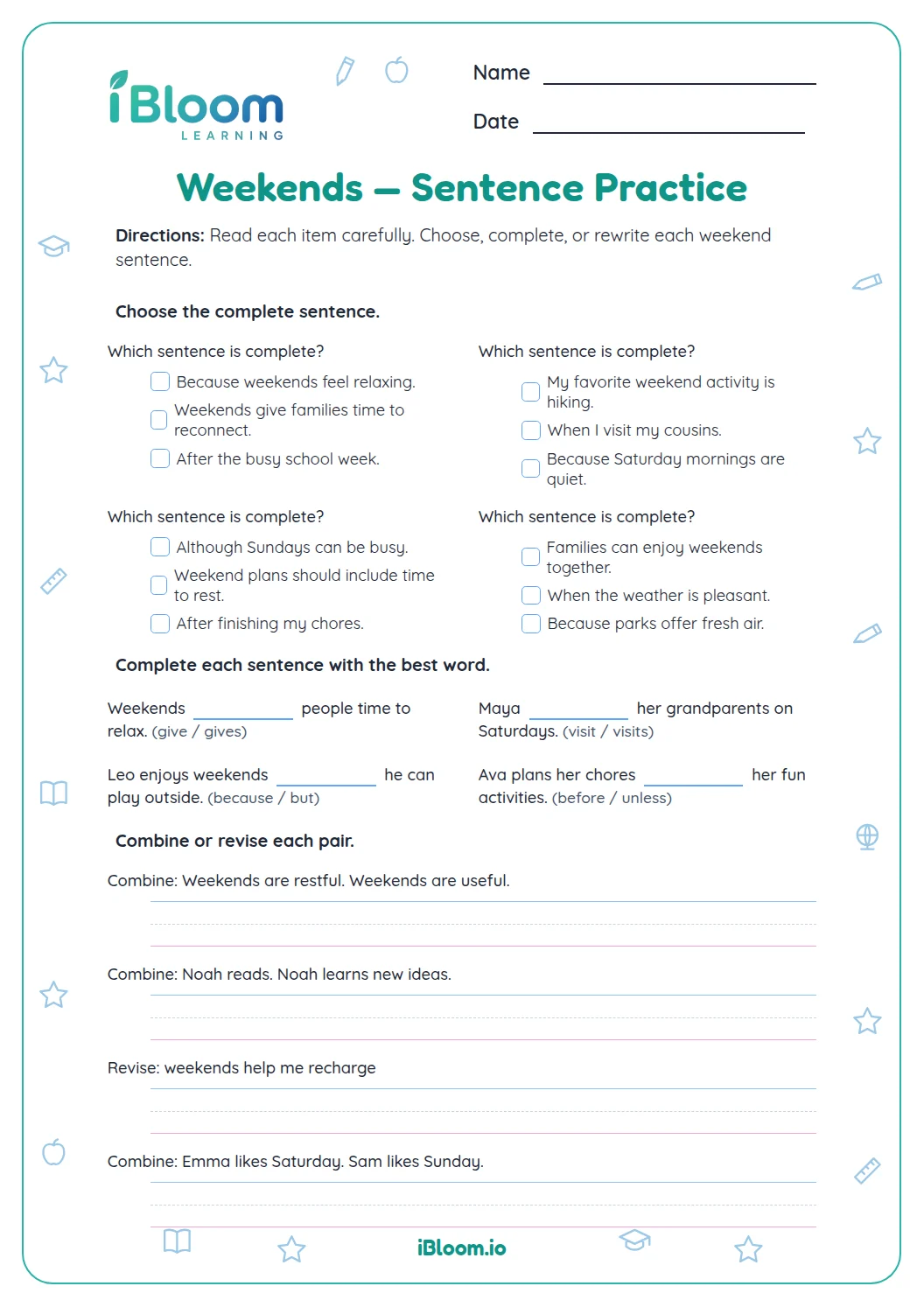
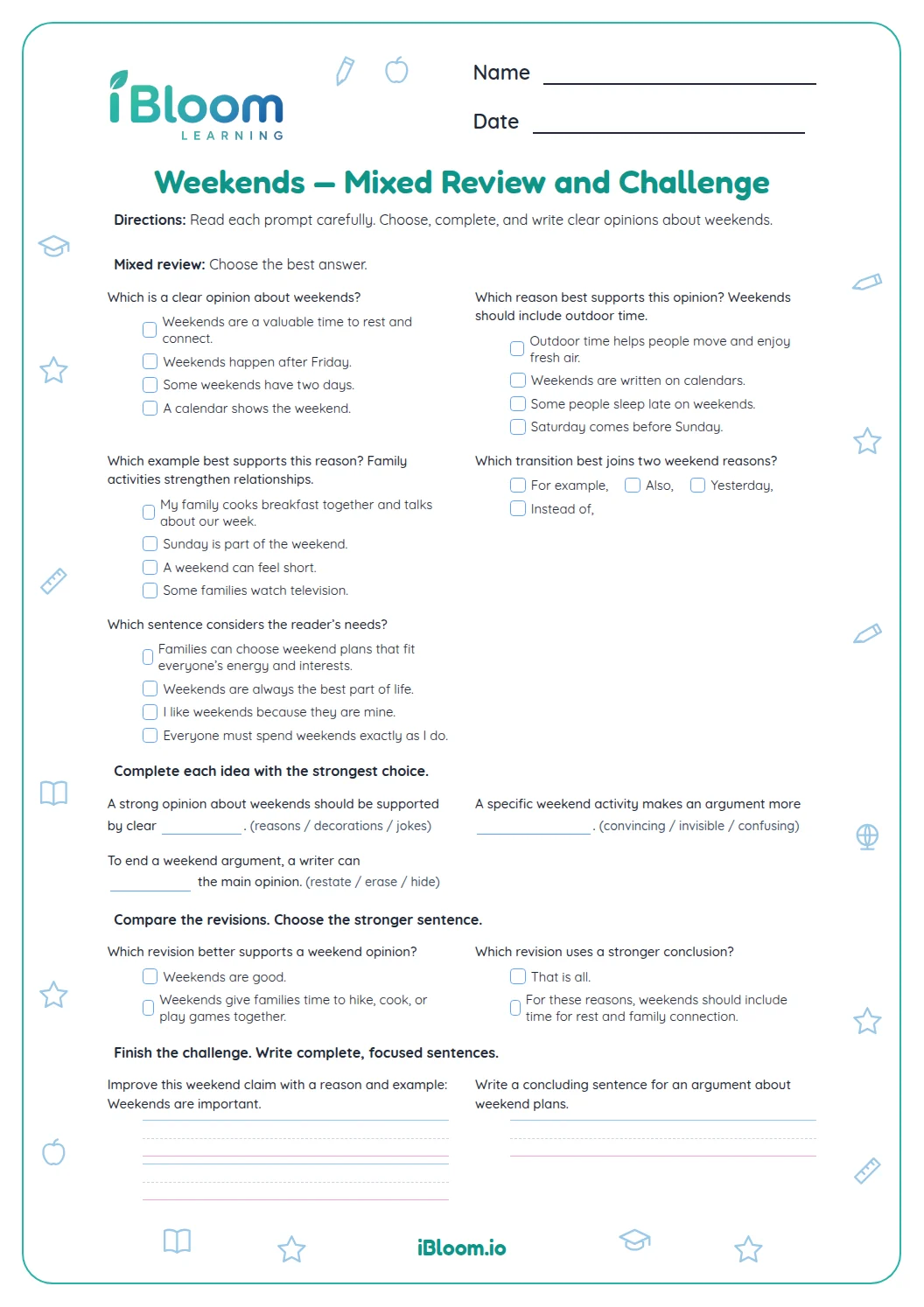
This Grade 5 worksheet uses weekend topics to practice persuasive opinion writing. Students choose claims and support, check argument ideas, and connect reasons with linking words, then write one sentence stating an opinion with a reason. The work supports the argument structure in CCSS W.5.1.
Aligned to W.5.1
What makes a reason support an opinion?
A reason explains why someone might agree with a claim. A useful detail makes that reason clearer, such as a survey count or an example of who would benefit. A fact that merely mentions the topic may not support the claim.
- 1Claim: Add a Saturday art class.
- 2Reason: Kids can make projects.
How do linking words connect ideas?
A reason explains why a position makes sense. Evidence adds a fact or example that supports that reason. Linking words such as “for example” and “in addition” show how ideas connect.
How can a conclusion strengthen an opinion?
A written response applies opinion writing to a weekend craft table. Students state a position and give a reason that supports it.
How to use this worksheet
- 1Read the weekend topic and identify the position.
- 2Choose a reason that directly supports it.
- 3Add a relevant fact or example as evidence.
- 4Use a linking word to show how ideas connect.
- 5Write one clear opinion sentence and give a reason.
Common mistakes and quick fixes
The mistake
Choosing a fact that only repeats the topic
The fix
Ask how the detail proves or explains the stated reason. A useful detail connects directly to the claim.
The mistake
Giving a reason without explaining it
The fix
Add a concrete example, survey result, or description that shows what the reason looks like.
The mistake
Ending with a new argument
The fix
Use the final sentence to reinforce the position and gather a reason already discussed.
Common Core alignment
This worksheet gives students focused practice with a grade-level skill.
State an opinion and support it with logically ordered reasons and details.
On this sheet: State an opinion and support it with logically ordered reasons and details.
Show the official wordingHide the official wording
Write opinion pieces on topics or texts, supporting a point of view with reasons and information.
What to practice next
Make more practice
Further reading
Questions parents and teachers ask
Can a student choose either side of the weekend topic?
Yes. The final prompt accepts different positions about a town craft table. The student should make the claim clear and support it with a relevant reason, an example, and a closing sentence. A different position is fine when its support matches the claim.
What is the difference between a reason and evidence?
A reason explains why the writer holds an opinion; evidence gives a fact or example that supports that reason. For instance, wanting a park cleanup is a position, and the number of families ready to help can serve as evidence.
What should the final opinion sentence include?
It should state a clear position and give a reason that supports it. The last question asks whether the town should host a weekend craft table. Students can choose yes or no, then explain their view in one sentence.
Which linking words can students use?
“In addition” can add another idea, while “for example” can introduce evidence. “So” can show a result. The worksheet asks students to judge whether linking words and argument ideas fit their purpose. Ask students to point to the linking word and explain how it connects the two sentences.
How does the sheet practice argument structure?
Students identify relevant support, check claims about reasons and evidence, and name parts such as a claim and conclusion. The final response applies that knowledge by stating an opinion about a weekend craft table and giving a reason.