






About this worksheet
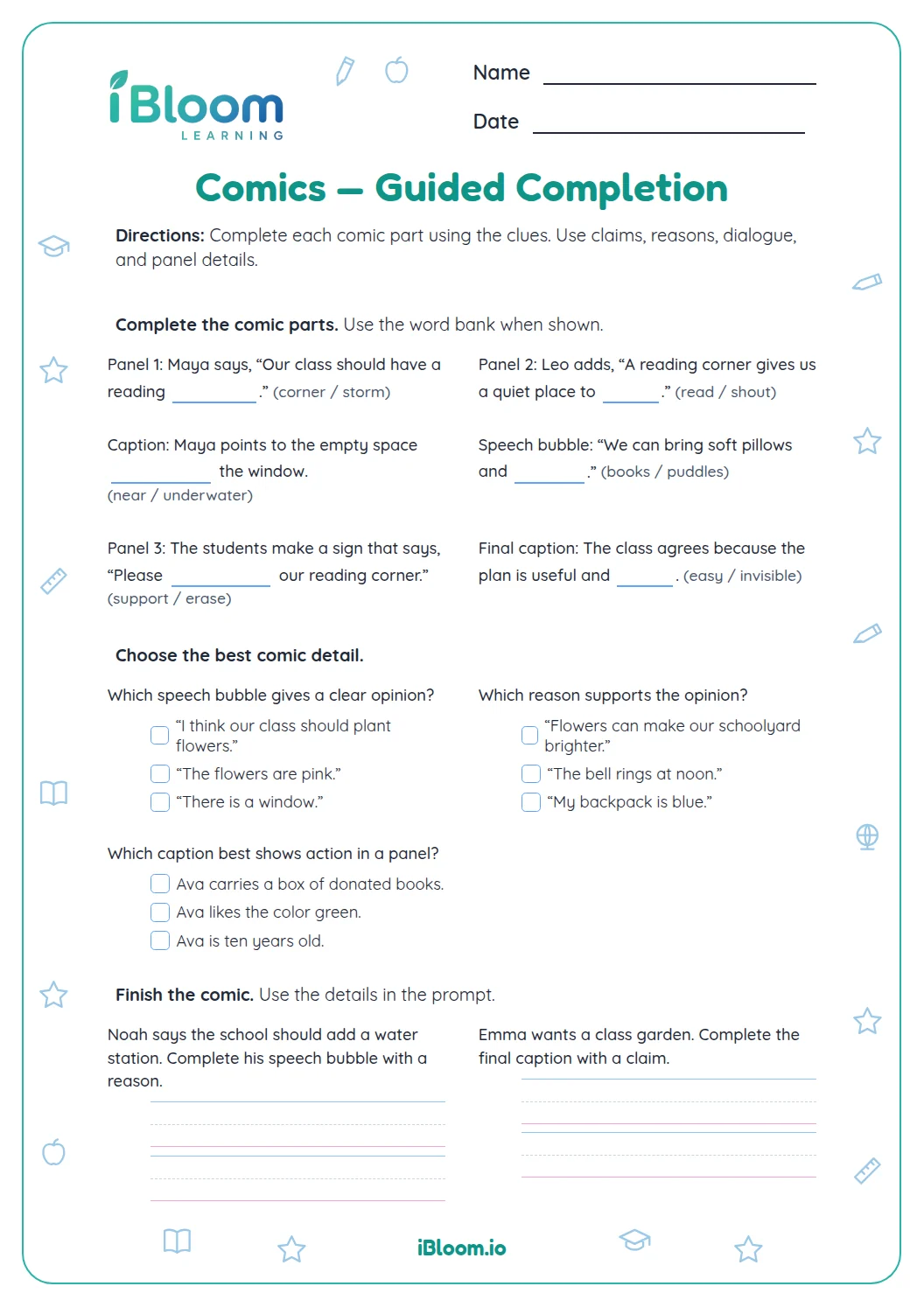
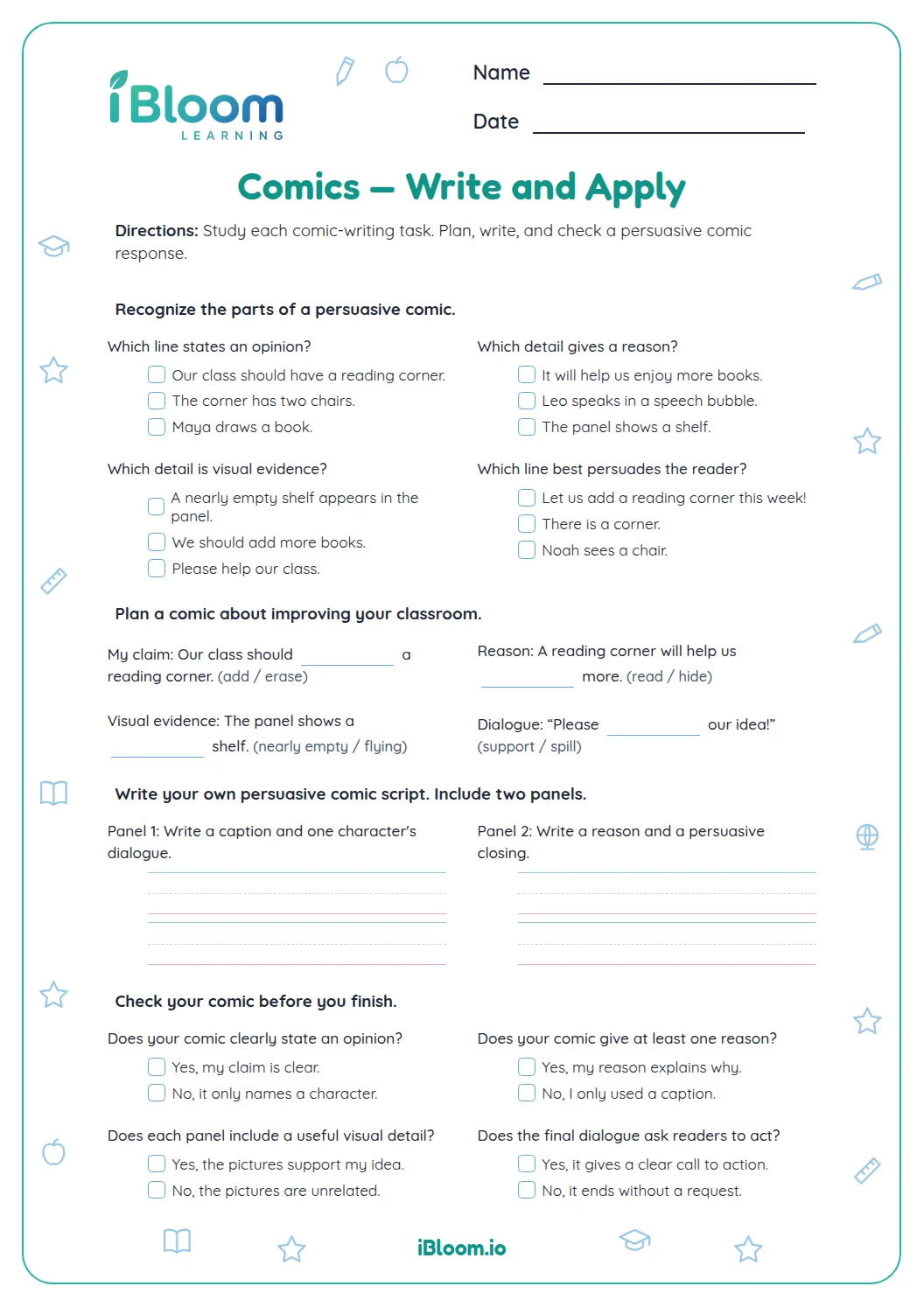
This free Grade 5 worksheet uses short descriptions of persuasive comics to help students recognize claims, reasons, supporting details, speech bubbles, and panels. Part A labels argument parts and identifies comic features. Part B sorts persuasive comic examples from other writing and matches details to reasons. The 14 multiple-choice questions practice how reasons and evidence support points in a text. An answer key identifies the correct choices.
Aligned to RI.5.8
How do claims, reasons, and details work together?
A claim states what a writer wants readers to think or do. A reason explains why, and a supporting detail makes that reason clearer. Part A asks students to label each as O (opinion), R (reason), or D (supporting detail).
For questions 1–3, the reading-corner sentence is the opinion, helping students enjoy books is the reason, and Leo pointing to the empty shelf is a detail.
What makes the example a persuasive comic?
Speech bubbles show what a character says or thinks. Panels organize events, and a caption can tell when or where a scene happens. A persuasive comic also communicates a point and gives a reason or supporting detail.
Questions 7–12 ask students to notice these features and distinguish persuasive comic examples from a paragraph or a page of panels without a point or supporting detail.
How can a panel support a reason?
A detail is relevant when it connects directly to a reason. If the reason says panels make event order clear, “Slip → fall → stand” demonstrates a sequence. A blue cover does not explain event order.
Questions 13 and 14 ask students to choose details that support stated reasons.
How to use this worksheet
- 1Read the claim, reason, or detail in each question before choosing.
- 2For comic features, look for dialogue in speech bubbles and events organized into panels.
- 3When sorting examples, check for a point of view and a reason or supporting detail.
- 4Match each reason to the detail that directly supports it.
- 5Use the key to review which feature or evidence makes the choice fit.
Mistakes to notice and how to help
The mistake
Calling a reason the claim because both relate to the same topic.
The fix
Ask which sentence states what the writer wants and which one explains why.
The mistake
Choosing a detail just because it appears in the same comic.
The fix
Check whether it directly supports the stated reason; a blue cover does not show event order.
The mistake
Treating every page with panels as a persuasive comic.
The fix
Look for the opinion or point and at least one reason or supporting detail.
Common Core alignment
Identify which comic details support a stated point or reason.
On this sheet: Students label a claim, reasons, and details, then select and explain details that support stated points.
Show the official wordingHide the official wording
Explain how an author uses reasons and evidence to support particular points in a text, identifying which reasons and evidence support which point(s).
What to practice next
Make more practice
Further reading
Questions parents and teachers ask
Does this worksheet include comic strips to draw or read?
It uses short descriptions of persuasive comics rather than full comic strips to draw. Students identify claims, reasons, details, speech bubbles, and panel sequences, then sort examples and match evidence to reasons. The examples provide the information needed to answer, so no outside comic or reading is required.
What do Opinion, Reason, and Supporting detail mean?
O means opinion, R means reason, and D means supporting detail. The opinion states what the writer wants, the reason explains why, and the detail gives a specific example or evidence. In questions 1–3, the reading-corner claim is the opinion, helping students enjoy books is the reason, and pointing to the empty shelf is a detail.
How can I tell whether a detail supports a reason?
Ask whether the detail shows or explains the reason. A turtle tangled in plastic supports the idea that plastic can harm sea animals because the panel shows an animal affected by plastic. A green title does not show that effect, even though it belongs to the same comic.
Are the classroom examples research findings?
No. They are practice scenarios written for this worksheet. For example, the empty reading-corner shelf and the comic about planting flowers are details to evaluate within the question. Students practice deciding whether information supports a point, using only what the prompt gives them.
How can I check the evidence matches?
Ask whether the detail shows or explains the reason. “Slip → fall → stand” supports the idea that panels make event order clear because it displays events in order. A blue cover does not show event order, even though it belongs to the same comic. The answer key marks the supporting details.