






About this worksheet
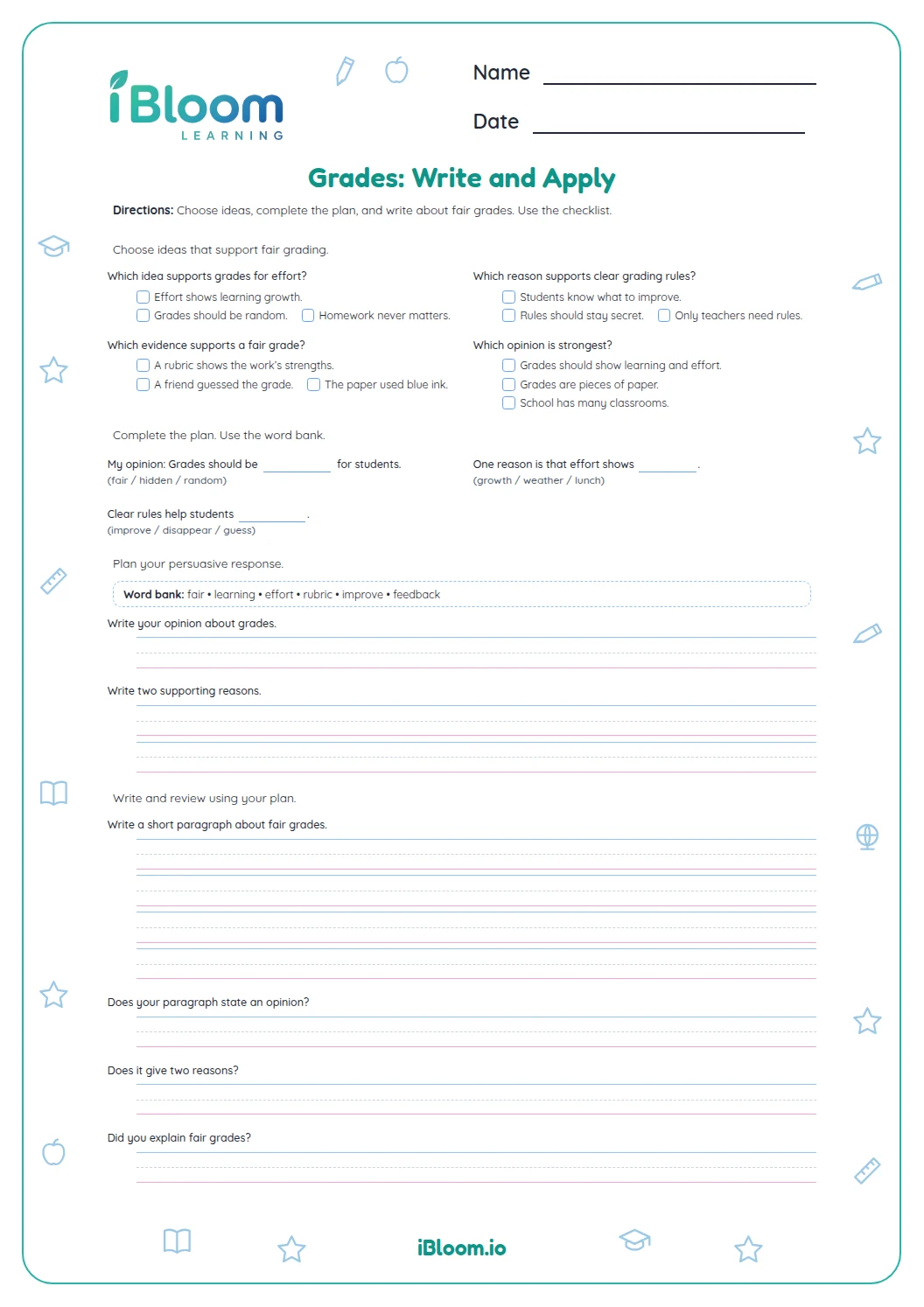
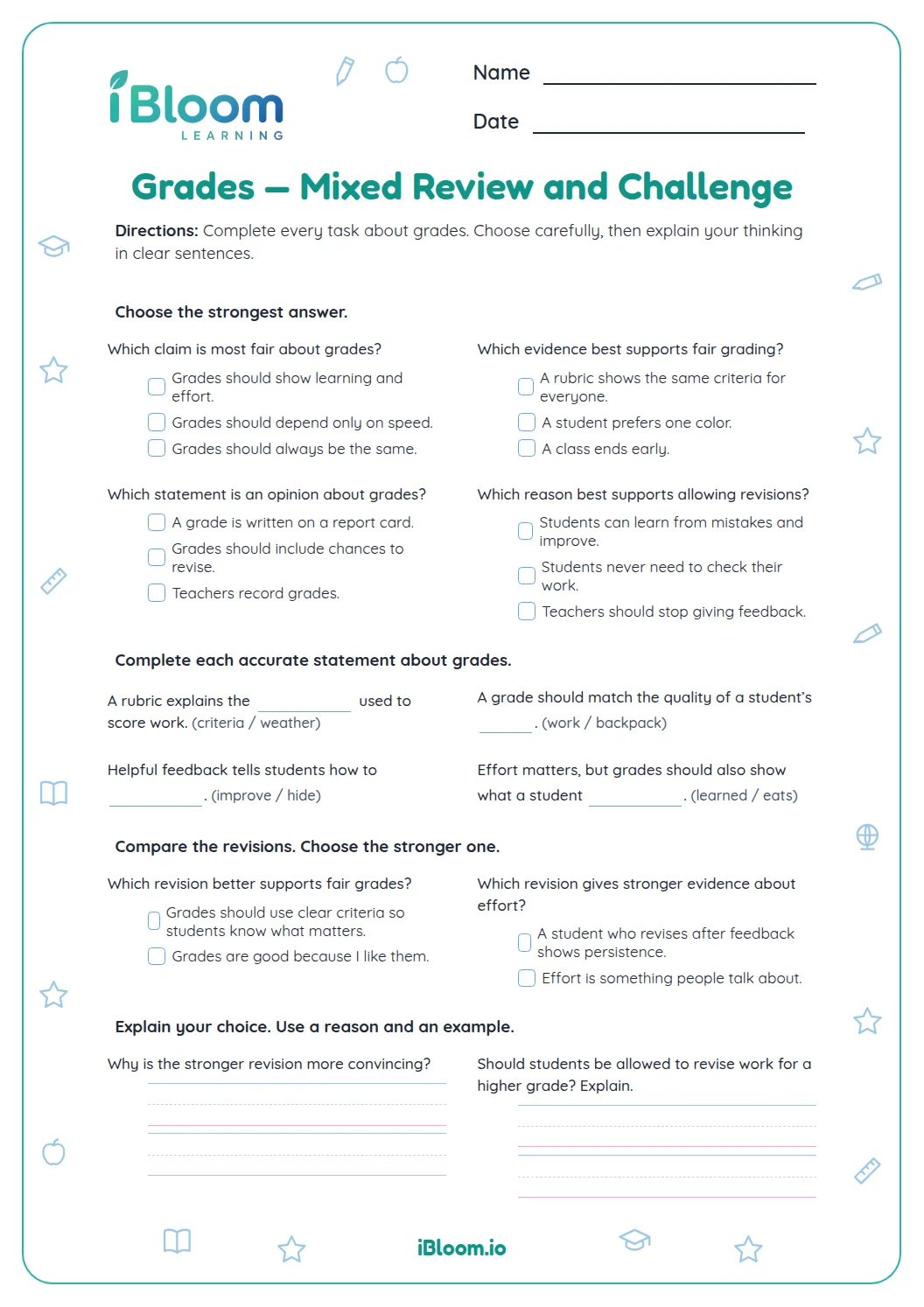
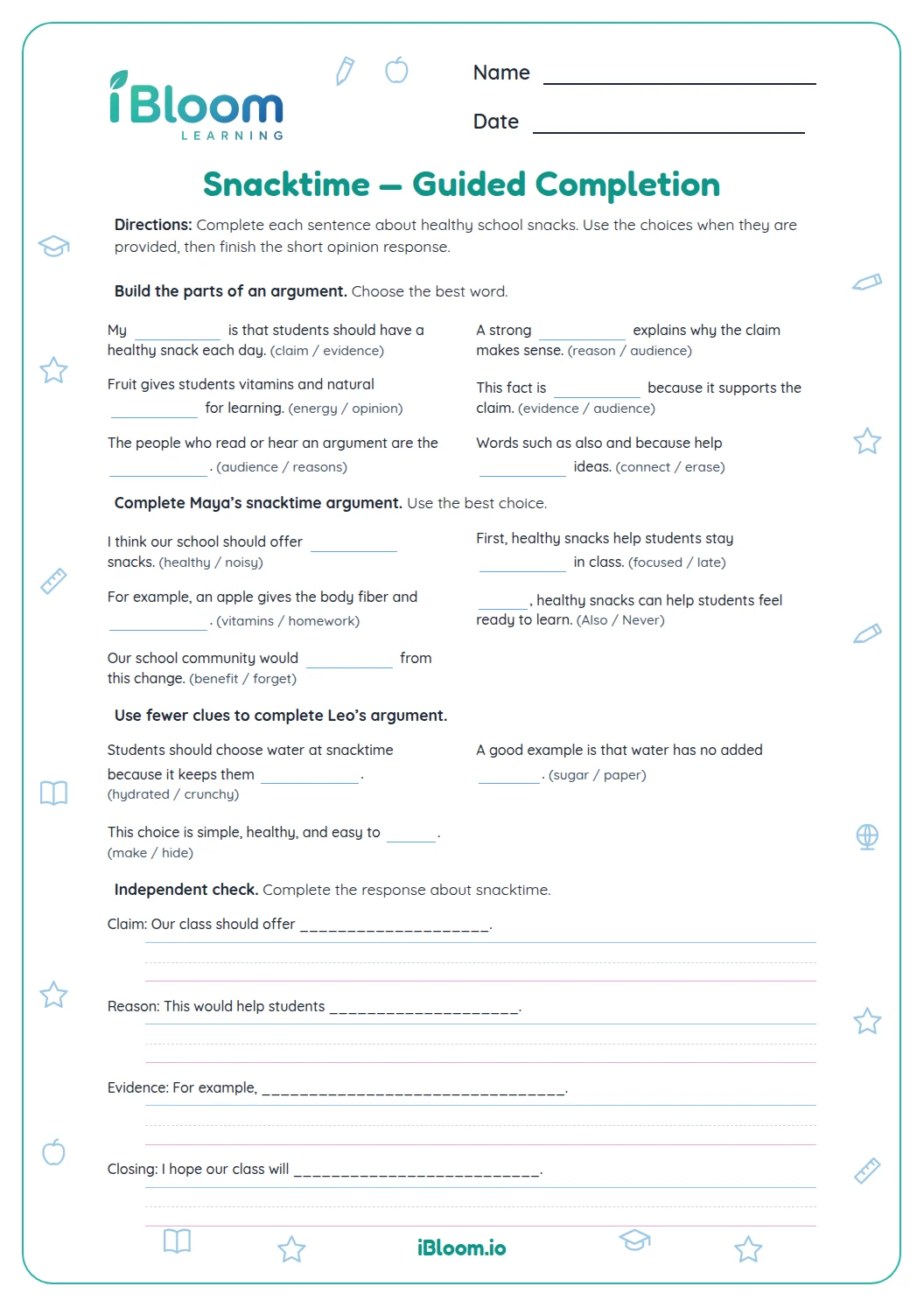
This Grade 5 opinion-writing worksheet gives students four choices and ten short sentence edits about grading. They identify a clear claim, a fitting reason, specific evidence, and a conclusion, then add missing words or punctuation to strengthen arguments about grades and feedback. The activities practice CCSS W.5.1, writing an opinion supported by reasons and information. The answer key gives the word or mark for each blank.
Aligned to W.5.1
What makes an opinion claim clear?
A clear claim tells the reader what the writer believes about grading. “Teachers should explain grades with helpful feedback” names a specific position that an argument can support.
- 1Opinion: Teachers should explain grades with helpful feedback.
- 2The claim states a position about grading.
How can a writer choose strong evidence?
Specific evidence gives readers something concrete to consider. A survey showing how many students have questions about rubric scores supports a claim more clearly than a broad statement.
- 1A class survey found that 18 of 24 students asked what a rubric score meant.
How do linking words guide a reader?
Words such as for example introduce a supporting detail. A comma after the linking phrase helps readers see where the example begins.
How to use this worksheet
- 1Underline the opinion or claim in each item.
- 2Ask whether the reason directly supports that claim.
- 3Prefer specific details over broad statements.
- 4Check that linking words show the intended relationship.
- 5Read the ending to see whether it returns to the writer’s opinion.
Common mistakes and quick fixes
The mistake
Choosing a fact that is true but does not support the opinion.
The fix
Ask how the detail helps prove the writer’s claim.
The mistake
Leaving a claim too broad to picture.
The fix
Name the exact change or position the writer supports.
The mistake
Repeating the same word instead of revising.
The fix
Replace the repeated noun with a clear pronoun or a more precise phrase.
Common Core alignment
This page practices the following Common Core skill.
Support an opinion with reasons, information, and clear organization.
On this sheet: Students choose and revise claims, reasons, evidence, linking language, and conclusions.
Show the official wordingHide the official wording
Write opinion pieces on topics or texts, supporting a point of view with reasons and information.
What to practice next
Make more practice
Further reading
Questions parents and teachers ask
Is this a full essay assignment?
No. This sheet focuses on editing and evaluating short opinion examples about grades and feedback. Students practice the decisions that help make an argument clearer before applying them in a longer piece. Discuss one example together, then let your child try the next item independently.
What counts as strong evidence about grading?
A useful detail is specific and connected to the claim. For example, a class survey showing that 18 of 24 students asked about rubric scores gives clearer support for explaining grades than a broad statement. Discuss one example together, then let your child try the next item independently.
Can students give different answers in the writing items?
Most blanks have one fitting word or punctuation mark in the sentence. The answer key provides the intended completion; a different answer is fine if it is grammatical and still supports the point about grades. Discuss one example together, then let your child try the next item independently.
Why does the worksheet mention rubrics?
A rubric explains what a task expects and how work is scored. The examples use rubrics to show how specific evidence and clear feedback can help students understand a grade. Discuss one example together, then let your child try the next item independently.
What should a student check in a conclusion?
The conclusion should bring the argument to a close and return to the opinion. In this worksheet, the sample conclusion restates why teachers should explain grades clearly. Discuss one example together, then let your child try the next item independently.