





About this worksheet
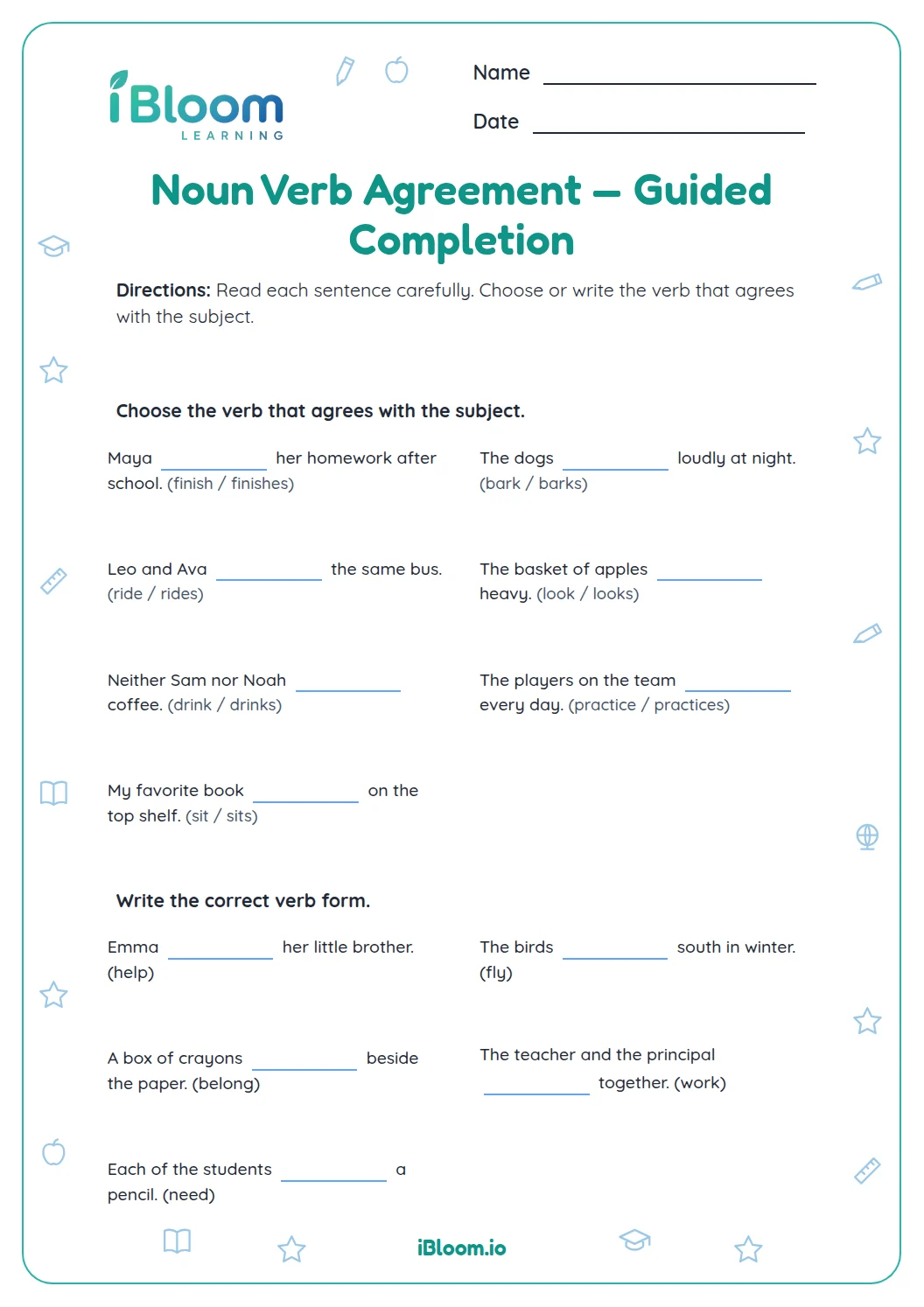
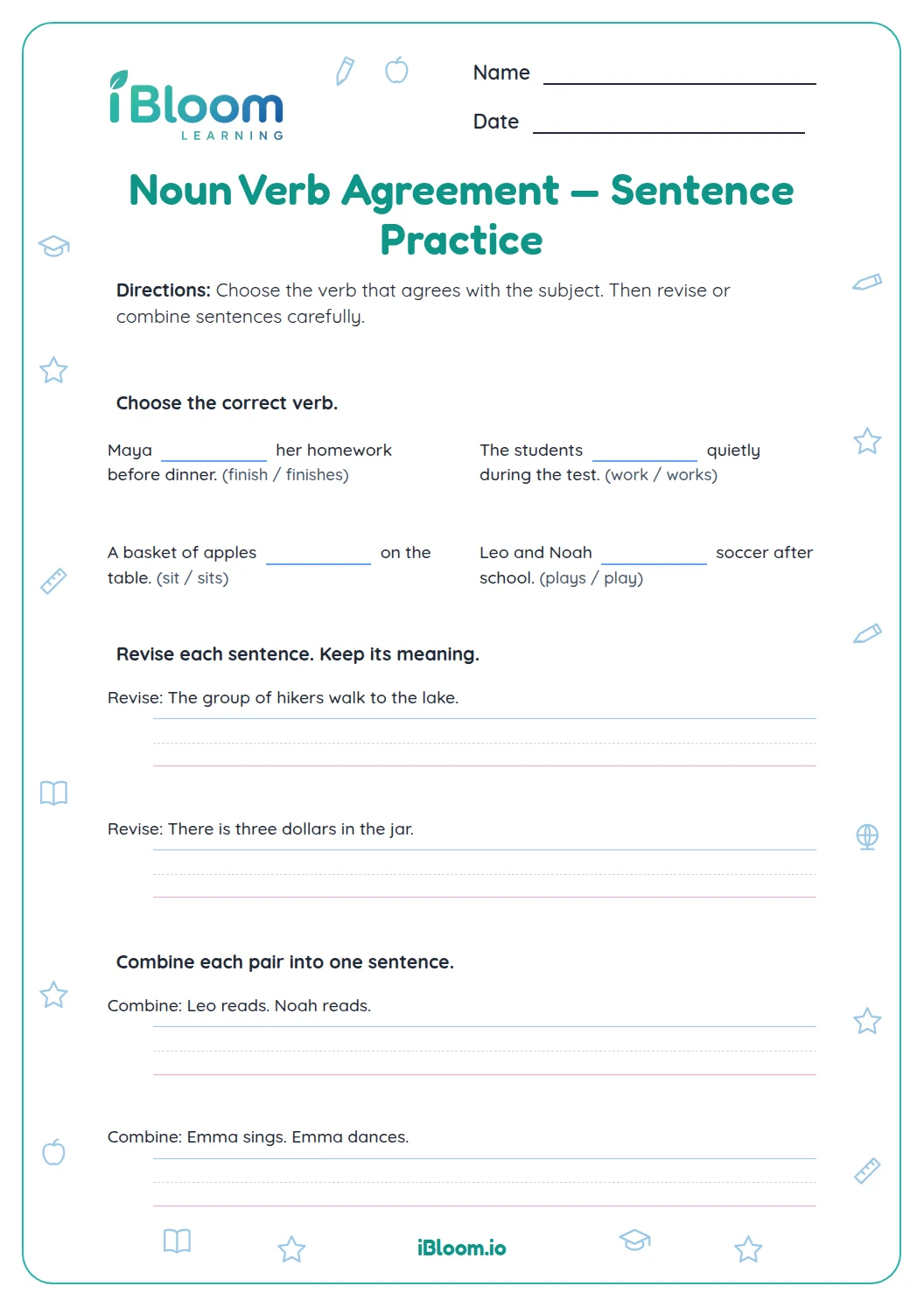
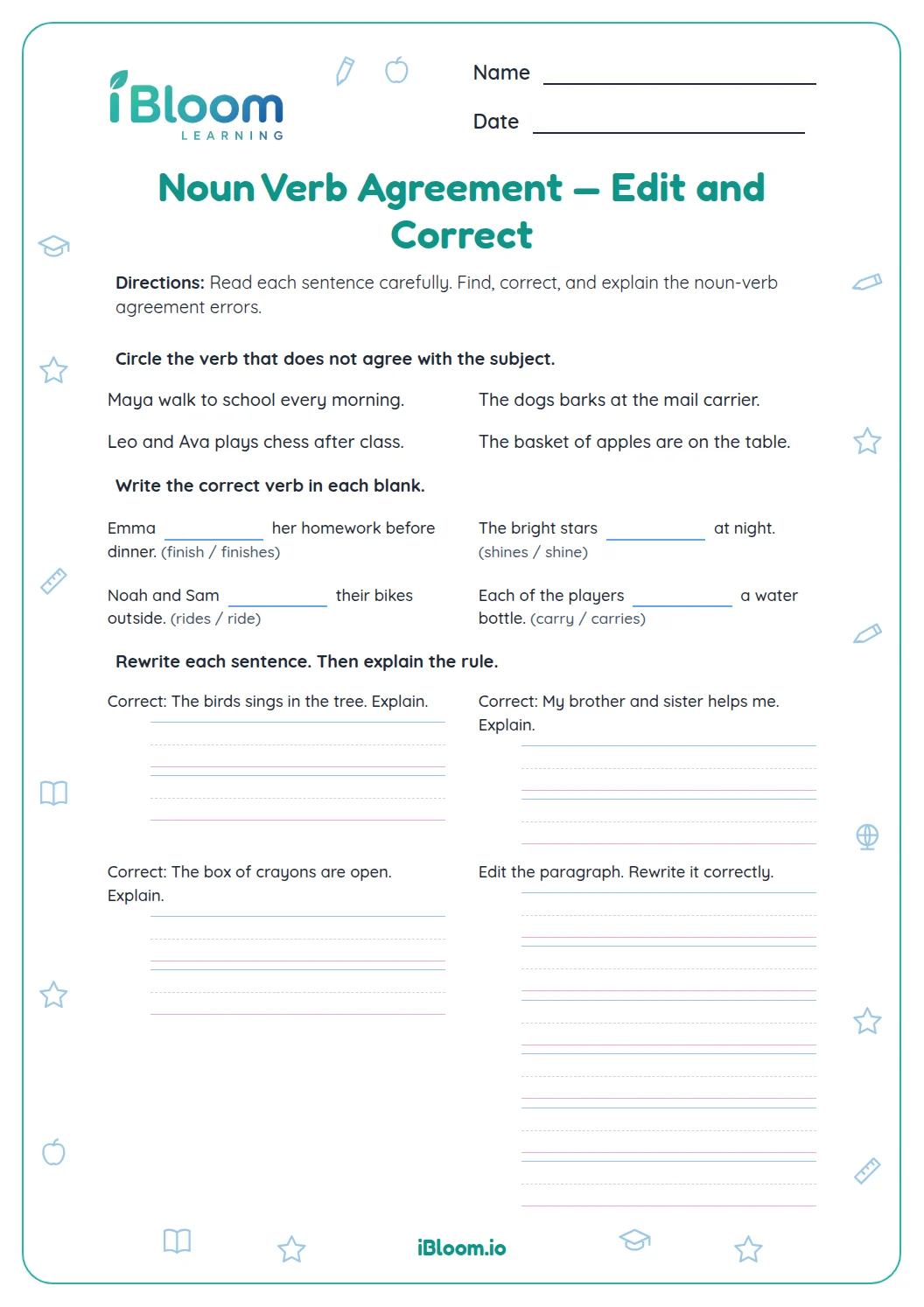
This Grade 5 worksheet has 14 multiple-choice questions on matching verbs to their subjects. Children choose agreeing forms, notice subjects inside longer phrases, and correct agreement errors. A separate answer key marks each response. The practice aligns with CCSS 3.L.1.f.
Aligned to 3.L.1.f
How can you match a verb to its subject?
The subject controls the verb. In “The basket of apples sits on the table,” basket is singular; the nearby plural word apples does not change the subject. In either/or and neither/nor sentences, match the verb to the nearer subject.
The first part practices direct subject–verb matches and sentences with intervening phrases. The second checks pronouns such as everyone and each, nearer subjects, and two agreement edits.
- 1In “The list of supplies is in my backpack,” list is the subject. Supplies is part of a phrase describing the list, so it does not control the verb.
What will children practice?
The first part practices direct subject–verb matches and sentences with intervening phrases. The second checks pronouns such as everyone and each, nearer subjects, and two agreement edits.
How can children check their answers?
Find the complete subject before looking at the verb. Temporarily set aside a describing phrase, decide whether the subject is singular or plural, and reread the sentence with the matching verb.
How to use this worksheet
- 1Underline the subject before choosing a verb.
- 2Ignore nouns inside a phrase that begins with of or near.
- 3Check whether the subject means one or more than one.
- 4For either/or or neither/nor, match the verb to the nearer subject.
- 5Read the completed sentence aloud and check its meaning.
Common mistakes and quick fixes
The mistake
Matching the verb to the nearest noun.
The fix
Find the whole subject; in “basket of apples,” basket controls the verb.
The mistake
Treating everyone or each as plural.
The fix
These indefinite pronouns take singular verbs: everyone has, each wears.
The mistake
Using a plural verb with a singular subject because extra words intervene.
The fix
Cover the describing phrase and match the verb to the main subject.
Common Core alignment
This worksheet practices subject-verb agreement through the skills named below.
Choose verbs that agree with the subject in each sentence.
On this sheet: Choose verbs that agree with the subject in each sentence.
Show the official wordingHide the official wording
Ensure subject-verb and pronoun-antecedent agreement.*
What to practice next
Make more practice
Further reading
Questions parents and teachers ask
What does subject–verb agreement mean?
The verb form must match its subject in number. A singular subject such as basket takes sits; a plural subject such as baskets takes sit. Several questions place describing phrases between subject and verb so children practice finding the true subject.
What is the subject in “The basket of apples sits”?
Basket is the subject. The words of apples describe the basket, but they do not change the subject from singular to plural. That is why the correct verb is sits. Ask children to cover the phrase of apples and read “The basket sits.”
Do words like everyone and each take singular verbs?
Yes. In standard English, everyone and each are treated as singular subjects, so use everyone has and each wears. The worksheet includes both words in sentence choices to help children notice that the subject’s meaning, rather than the nearby nouns, controls the verb.
How does either/or affect the verb?
With either/or and neither/nor, the verb usually agrees with the subject nearer the verb. In “Either the coach or the players are bringing the cones,” players is nearer and plural, so are is correct. The answer key identifies the matching subject.
What is on the answer key?
The key marks the correct verb or corrected sentence for each of the 14 questions. Children can check the subject as well as the verb, especially when a phrase such as “of apples” comes between them. No open-ended sentence response is required.
How many questions are included?
There are 14 questions in two parts. The first practices direct matches and intervening phrases; the second includes tricky subjects and two sentence edits. The answer key lists the matching verb or corrected sentence for every item, in worksheet order.