
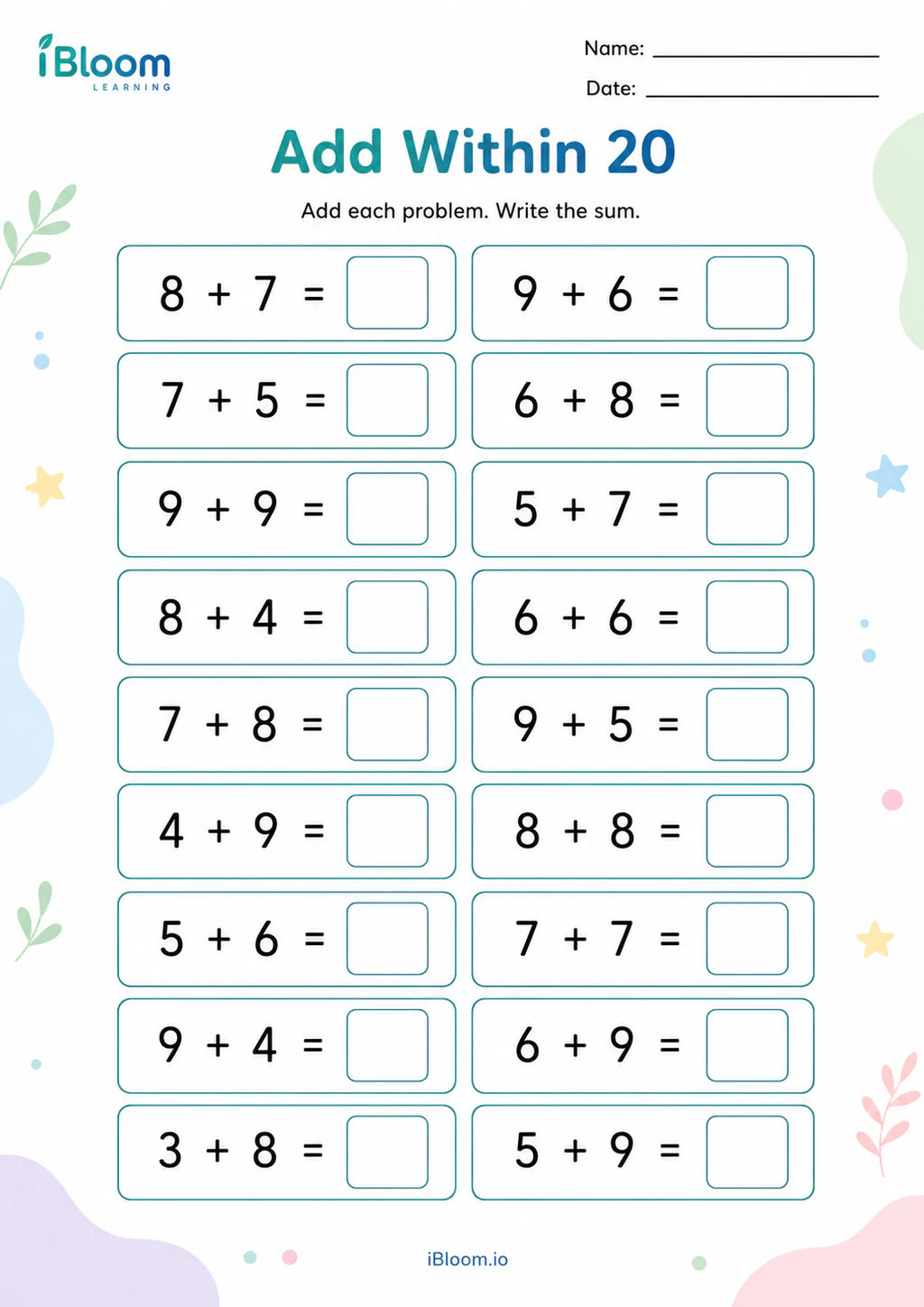
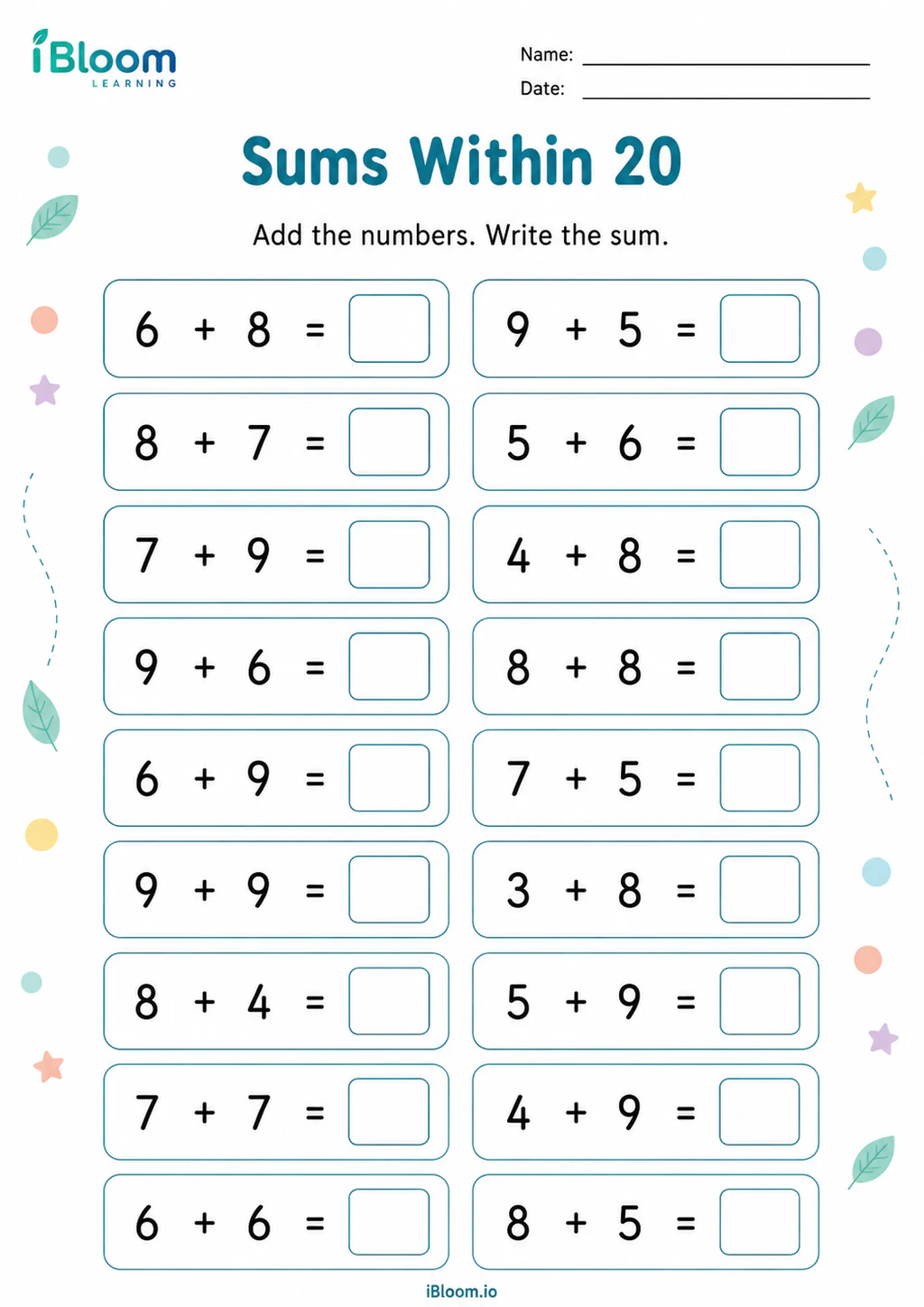
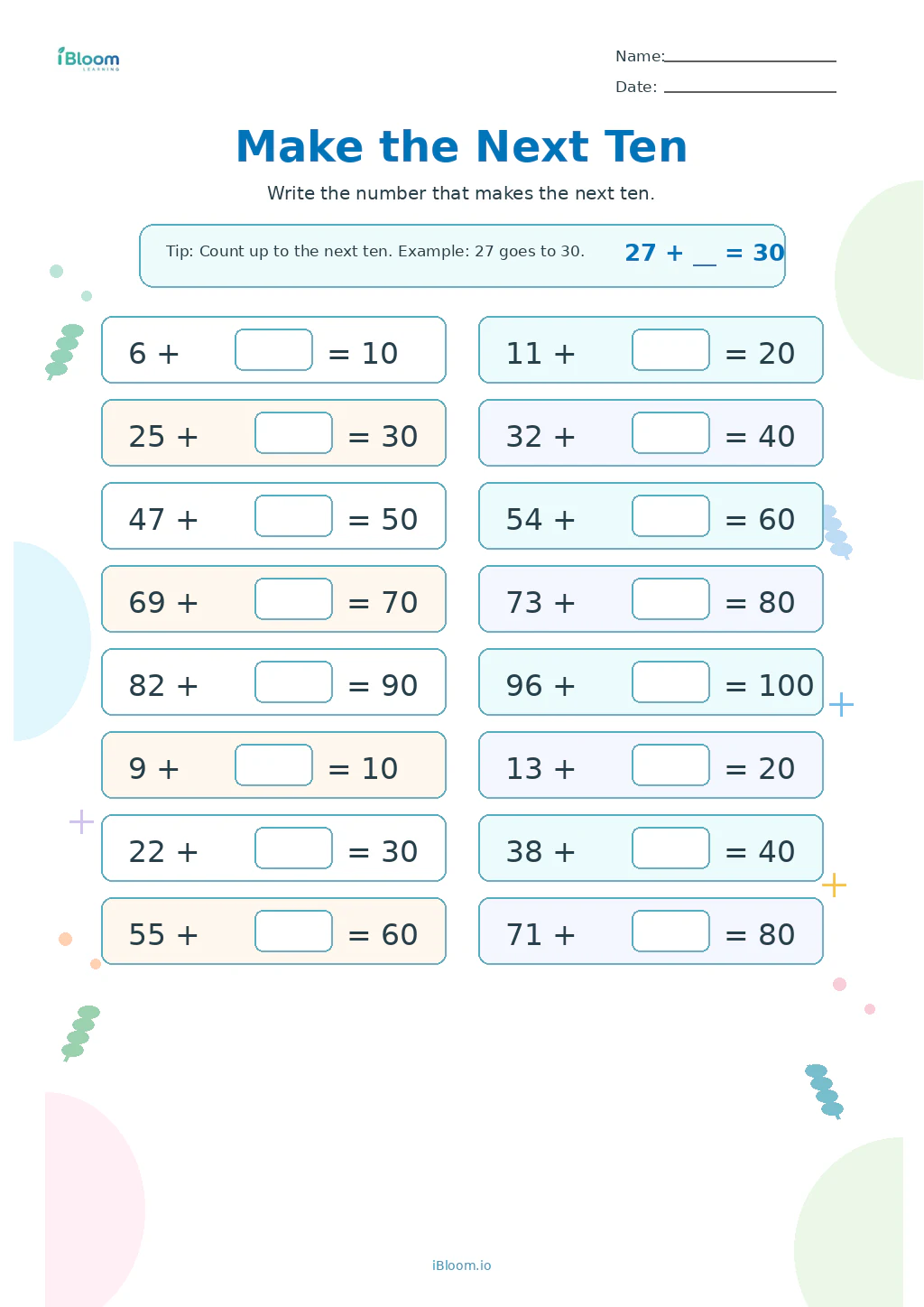
About this worksheet
This printable Grade 1 worksheet gives learners focused practice with addition on a number line. The opening problem models counting forward, and 13 more equations let children apply the same strategy to sums within 20. A separate answer key helps adults check each total.
Aligned to 1.OA.C.5
How does the number line show addition?
Begin at 2 on the line and move three ticks to the right. Each tick is one more, so the total is 5.
- 1Begin at 2.
- 2Move forward 3 one-unit jumps to 5.
- 32 + 3 = 5
How can learners check each sum?
Use the number line strategy to count on, then write the sum in the blank. The 14 equations stay within 20. Learners can make a small number line beside a problem if they need extra support.
What does this worksheet include?
The first four questions each include a number line. Learners count forward on the line for those sums, then complete ten compact equations within 20.
- Questions 1–4 each include a number line.
- Questions 5–14 give compact addition practice within 20.
- The answer key lists all 14 totals.
How to use this worksheet
- 1Read both addends before starting.
- 2Point to the first addend on the number line.
- 3Make one forward move for every count in the second addend.
- 4Say the number at each new tick.
- 5Write the endpoint as the sum and check it with the key.
Common mistakes and quick fixes
The mistake
Counting the start as the first jump
The fix
Say the start number, then count only after moving to the next tick.
The mistake
Moving backward instead of forward
The fix
Addition increases the number, so each move goes to the right.
The mistake
Skipping a tick
The fix
Touch each tick while saying the next counting number.
Common Core alignment
The number-line models connect counting forward with addition sums within 20.
Use counting forward as a strategy for addition.
On this sheet: Each problem connects counting forward by equal one-unit jumps with adding two numbers.
Show the official wordingHide the official wording
Relate counting to addition and subtraction (e.g., by counting on 2 to add 2).
What to practice next
Make more practice
Further reading
Questions parents and teachers ask
How does a number line help with addition?
A number line shows addition as moving forward. Begin at the first addend, then move one tick for each unit in the second addend. In question 1, start at 2 and count three jumps to 5. Each tick marks one more than the number before it.
Should my child count the starting number as a jump?
No. The starting number is the place to begin. Each jump moves to the next tick and counts as one. Starting at 4 and making 2 jumps lands on 6, because the moves are 4 to 5 and 5 to 6.
What numbers are included in the practice?
The first four questions each include a number line, and all 14 questions practice addition within 20. Learners count forward on the lines, then use the same strategy to solve compact equations. The separate key lists each total.
What if a learner loses track of the jumps?
Touch or mark one tick for every move, and say the number reached after each jump. This keeps the starting point separate from the count of jumps and makes the endpoint easier to check. One mark for each move can keep the count organized.
Does the worksheet include an answer key?
Yes. A separate answer key page lists the sum for each of the 14 questions. Learners can first work through the worksheet, then use the key to check the totals and revisit any missed sum. Checking begins after the learner has attempted each sum independently.
Can this activity be done without printing?
The number line appears with the first problem, so the printed page provides a clear model to study. An adult can also sketch an evenly spaced line from 0 to 20 if a learner wants another example. A hand-drawn line should have evenly spaced ticks and labels in counting order.