
About this worksheet
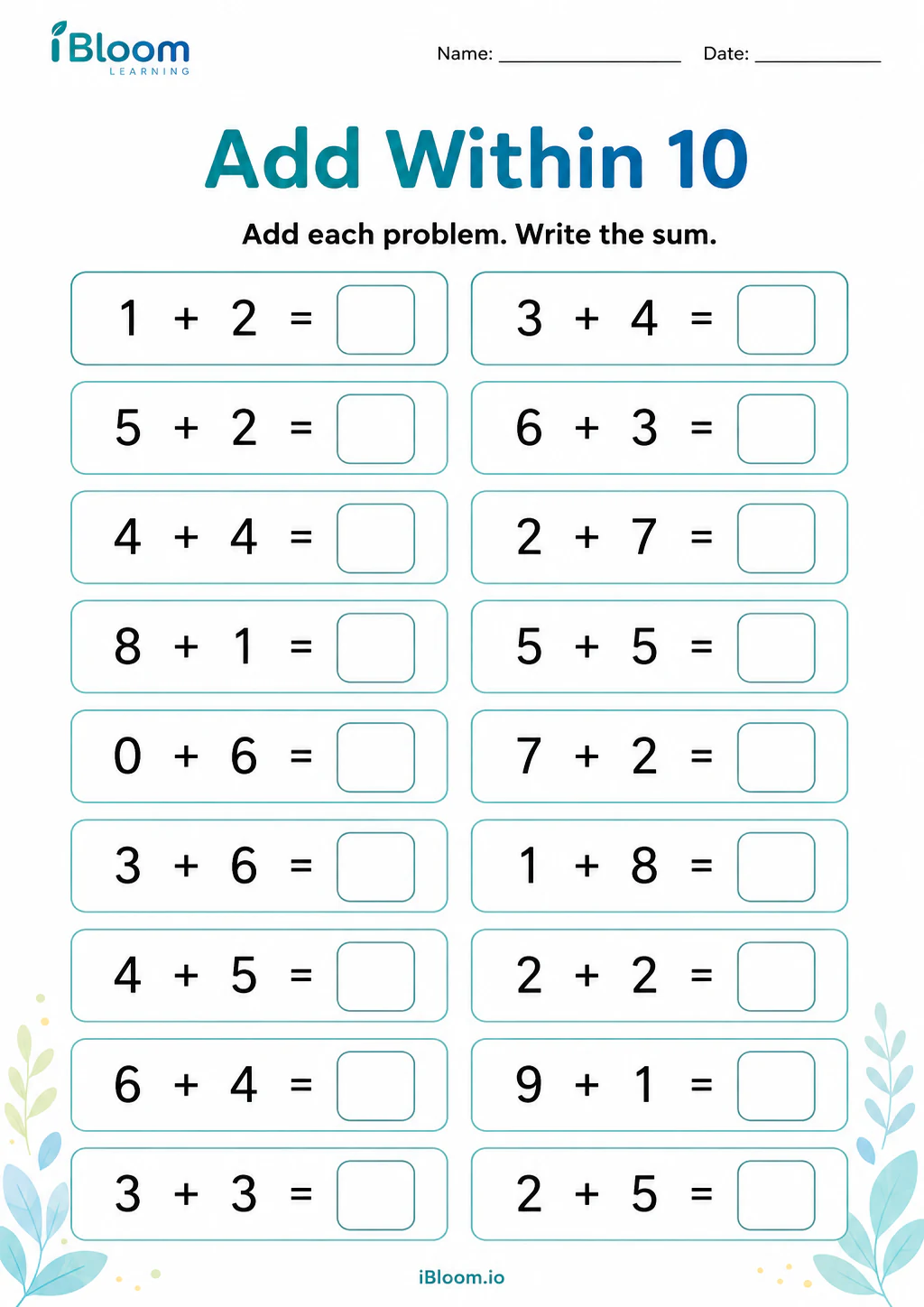
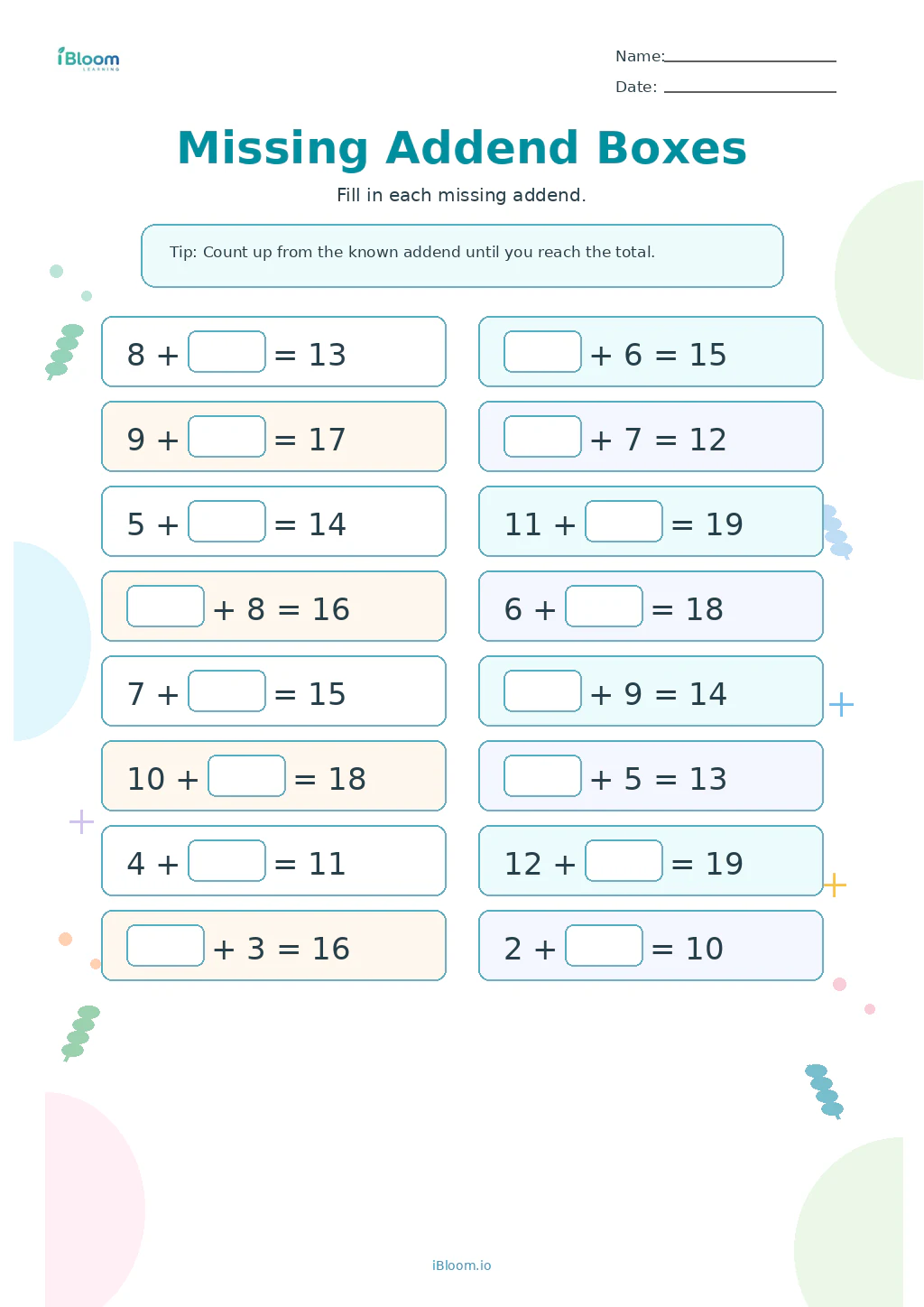
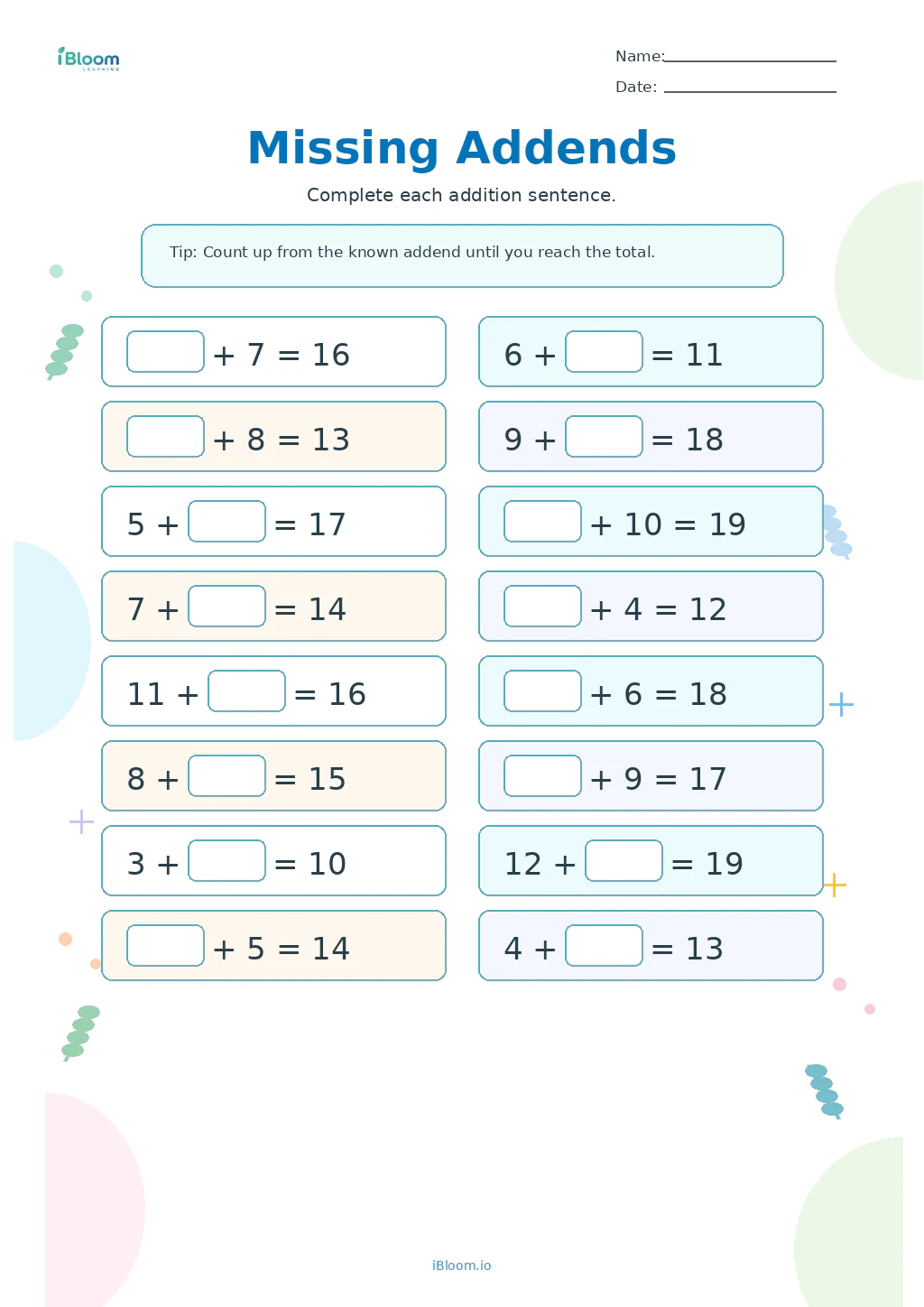
This free Grade 1 worksheet gives children fourteen addition problems and two reusable number lines. Part A keeps sums within 10, and Part B moves to sums within 20. The set includes adding zero, making ten, and counting across ten. Children begin at the first addend and make one hop to the right for each unit in the second addend. This practices Common Core 1.OA.C.5, relating counting to addition. A separate answer key gives the sums so adults can check the landing numbers and discuss any extra or missing hops.
Aligned to 1.OA.C.5
What counts as one hop?
A hop is the space from one numbered tick to the next. The number under the starting finger tells where the child begins; it does not count as a move. Have children say “start” at the first addend, then count only when the finger moves.
Children can pencil small arcs above the ticks or point as they count. Erase old arcs before reusing a line. Every tick is labeled, so children can focus on making one move for each unit in the second addend.
How do you model 2 + 3?
Use the number line above question 1. Put a finger on 2 and say “start.” Move right three times, naming the landing numbers. Write the last landing number in the blank.
- 12 + 3 = ___
- 2Start at 2.
- 3Hop 1 lands on 3; hop 2 lands on 4; hop 3 lands on 5.
- 4Write 5.
What changes in the second part?
Part A has five sums and one line from 0 to 10. Part B has nine sums and one line from 0 to 20, including 8 + 5 and 9 + 7. Children can reuse the Part B line for every sum in that part. Each hop still moves one space when crossing 10.
For 6 + 0 in Part A, no hops are needed. For 0 + 7 in Part B, zero is the starting point and seven hops are needed. Comparing those two questions helps distinguish the role of each addend.
How to use this worksheet
- 1Point to 0, 5, and 10 to check that the child can read the tick labels.
- 2Model question 1, saying “start” before counting the three hops.
- 3Let the child solve the remaining Part A sums with a finger or pencil arcs.
- 4Continue with Part B, keeping hops one space long while crossing 10.
- 5Compare landing numbers with the key and recount only the moves for any mismatch.
Mistakes to discuss and fix
The mistake
Counting the starting tick as hop one.
The fix
Say “start” at the first number; count one after moving to the next tick.
The mistake
Moving left for 2 + 3, as if the plus sign meant subtract.
The fix
Follow the plus sign by counting toward larger numbers on the right.
The mistake
Making a hop when adding zero.
The fix
For 6 + 0, keep the finger at 6 because zero asks for no moves.
Common Core alignment
Count on along number lines to solve addition facts within 20.
On this sheet: Children use equal one-unit hops to connect counting forward with addition.
Show the official wordingHide the official wording
Relate counting to addition and subtraction (e.g., by counting on 2 to add 2).
What to practice next
Make more practice
Further reading
Questions parents and teachers ask
How many number lines are printed?
The sheet has two reusable number lines for fourteen questions. Part A has one line from 0 to 10, and Part B has one from 0 to 20. Children can reuse the line for every sum in that part, pointing or marking hops as needed.
Should children start at zero every time?
They should start at the first addend written in the problem. For 2 + 3, that means starting at 2 and making three hops. Starting at zero is correct for 0 + 7 because zero is the first addend in that particular question on this sheet.
How do I explain adding zero?
Adding zero means making no moves from the starting number. In 6 + 0, the child places a finger on 6 and stays there, so the answer is 6. Compare that with 0 + 7, where the child starts at zero and then moves seven spaces.
Can children draw hops instead of pointing?
Yes, children can draw small pencil arcs between neighboring ticks. Mark the starting tick, then make exactly as many hops as the second addend requires. For a reused line, erase the earlier arcs or point with a finger instead. Write the final landing number beside each addition sentence.
What should I check if a sum is one too small?
Check whether the child counted the starting tick as the first hop. For 2 + 3, counting 2, 3, 4 produces an answer of 4 because only two moves occurred. Revisit the line, say “start” at 2, and count three actual moves to reach 5.