Free printable practice
Missing Addend Sum Under 20 Practice Activities
Grade 1 worksheets for finding the missing addend in addition equations with sums under 20 using pictures, models, and number facts.
Free printable worksheet PDFs
Preview every available page, then download the free worksheet PDF for home, homeschool, tutoring, or classroom practice.
Preview the exact activity before downloading it.
Practice that builds confidence
What the skill means
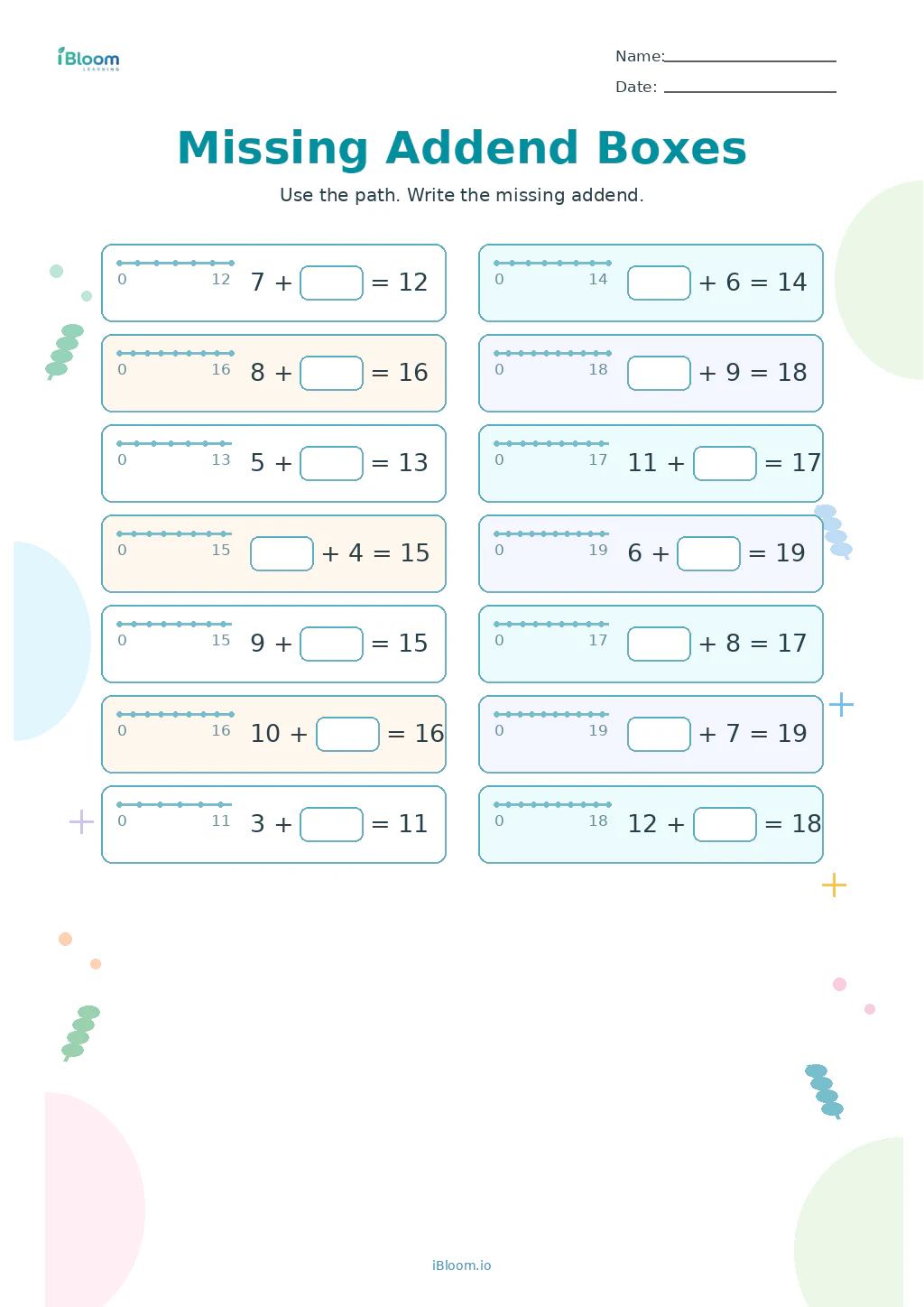
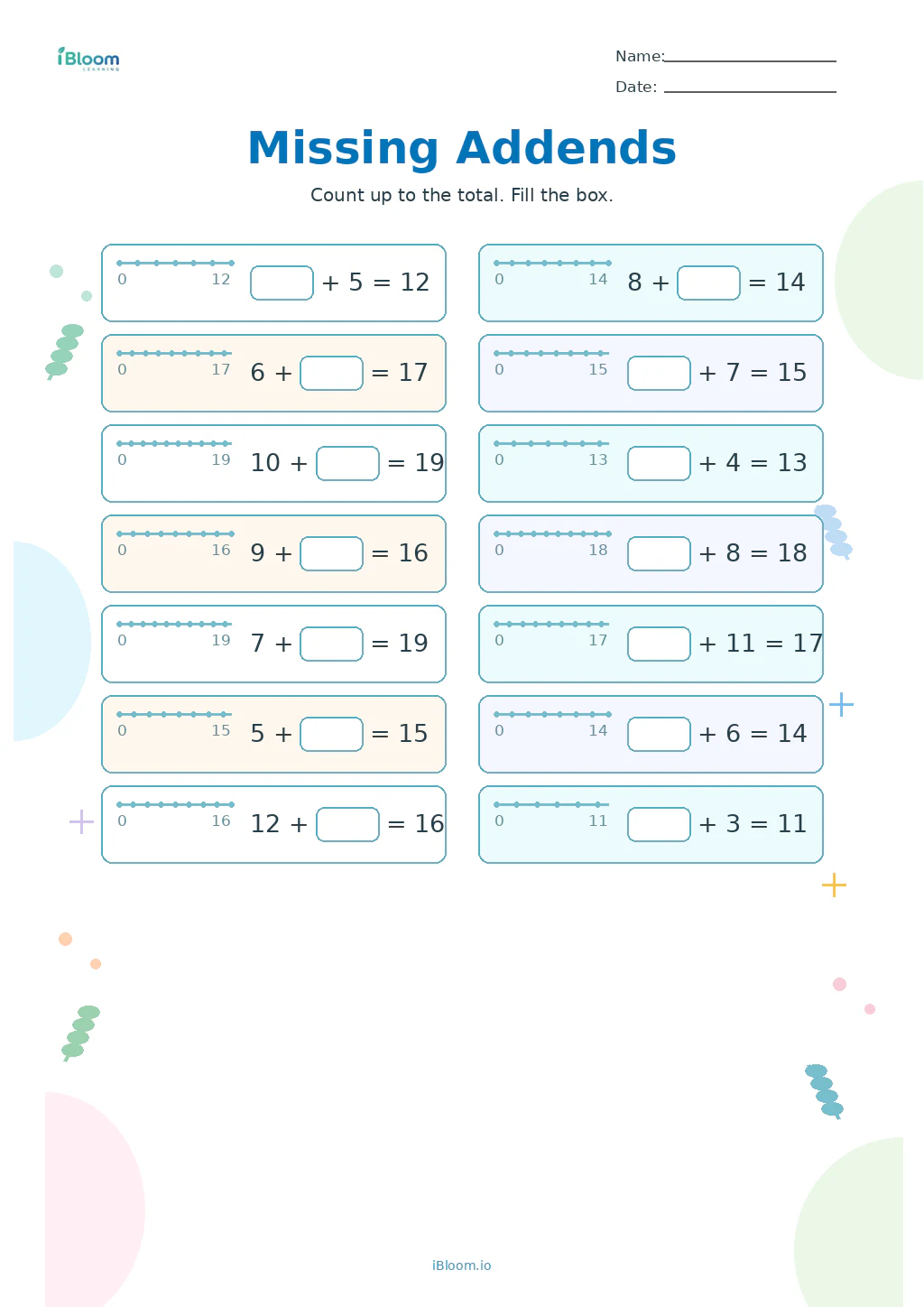
This Math > Grade 1 > Addition collection helps children find the missing addend in equations with sums under 20, such as 6 + __ = 14 or __ + 5 = 12. Students practise seeing addition as a part-part-whole relationship, not just as counting forward.
The printable activities include number lines, ten-frames, counters, bar models, and equation practice. Pages move from visual support to independent problems so children can build fluency while explaining which part is missing and how they found it.
A missing addend problem gives the total and one part, then asks for the other part. In Grade 1, this is a key step between basic addition facts and early subtraction thinking. Children learn that 9 + __ = 15 can be solved by asking, “What goes with 9 to make 15?”

How the practice progresses
The worksheets begin with visible representations, such as counters, ten-frames, or simple part-part-whole models. These supports help children connect the blank in the equation to an actual quantity. Later pages use more symbolic equations with sums under 20, encouraging students to use known facts, make ten, count on, or think of related subtraction.
Parent routine at home
Choose one page and sit beside your child with small objects such as buttons, cereal pieces, or coins. Read each equation aloud: “Seven plus something equals twelve.” Build 7, then add objects one at a time until the total is 12. Have your child say the full equation: “7 plus 5 equals 12.” After a few problems, ask, “Can you solve the next one in your head before building it?”

Classroom uses
Teachers can use these printables for addition centers, morning work, small-group reteaching, or quick checks after a lesson on part-part-whole addition. Visual pages work well for students who still need concrete support, while equation-only pages are useful for independent practice or math journals.

Errors to watch for
Some children put the total in the blank, so 8 + __ = 13 becomes 8 + 13. Others count both the known addend and the total again, which gives an answer that is too large. Encourage students to point to the total, circle the known part, and ask what missing part completes the whole.
Free printable PDF download
Use this missing addend worksheets sum under 20 page to preview the activity, print it, or download it as a PDF for quick practice. It works well for homework, homeschool lessons, tutoring, morning work, revision, and classroom centers.
Answers and answer key support
After the child completes the worksheet independently, parents and teachers can use the answer support or answer key information to check the work, review mistakes, and choose the next practice step.
Why iBloom worksheets help
These worksheets keep the number range focused on sums under 20, so children can strengthen reasoning without being overwhelmed. A helpful child-friendly strategy is: “Start with the part you know, count up to the total, and the jumps you count are the missing number.”
Helpful answers
Frequently asked questions
What is a missing addend in Grade 1 addition?
A missing addend is the unknown part in an addition equation. For example, in 6 + __ = 11, the child knows one part is 6 and the total is 11, so the missing addend is 5.
Are these worksheets only for sums up to 10?
No. This collection focuses on sums under 20, so children practise equations such as 9 + __ = 16 and __ + 7 = 14, while still using Grade 1-friendly models and strategies.
How can my child solve missing addend problems without guessing?
Teach your child to start with the known addend and count up to the total. The number of counts or jumps is the missing addend. Ten-frames and number lines make this strategy easier to see.
Do missing addend worksheets help with subtraction?
Yes. Missing addend problems build the idea that addition and subtraction are related. A problem like 8 + __ = 13 connects naturally to 13 - 8 = 5.
What should I do if my child writes the total in the blank?
Have your child label the equation first: known part, missing part, and total. Then use objects or a drawing to show that the blank must be the other part, not the whole number.
Is this missing addend worksheets sum under 20 free?
Yes. You can preview it for free and use the printable worksheet for home or classroom practice.
Can I download this missing addend worksheets sum under 20 as a PDF?
Yes. Use the worksheet download option to save a printable PDF, or print the worksheet directly from the page.
Does this missing addend worksheets sum under 20 include answers or an answer key?
When the activity has fixed answers, iBloom includes answer support so parents and teachers can check the completed worksheet.