Free printable practice
Adding Doubles Practice Activities
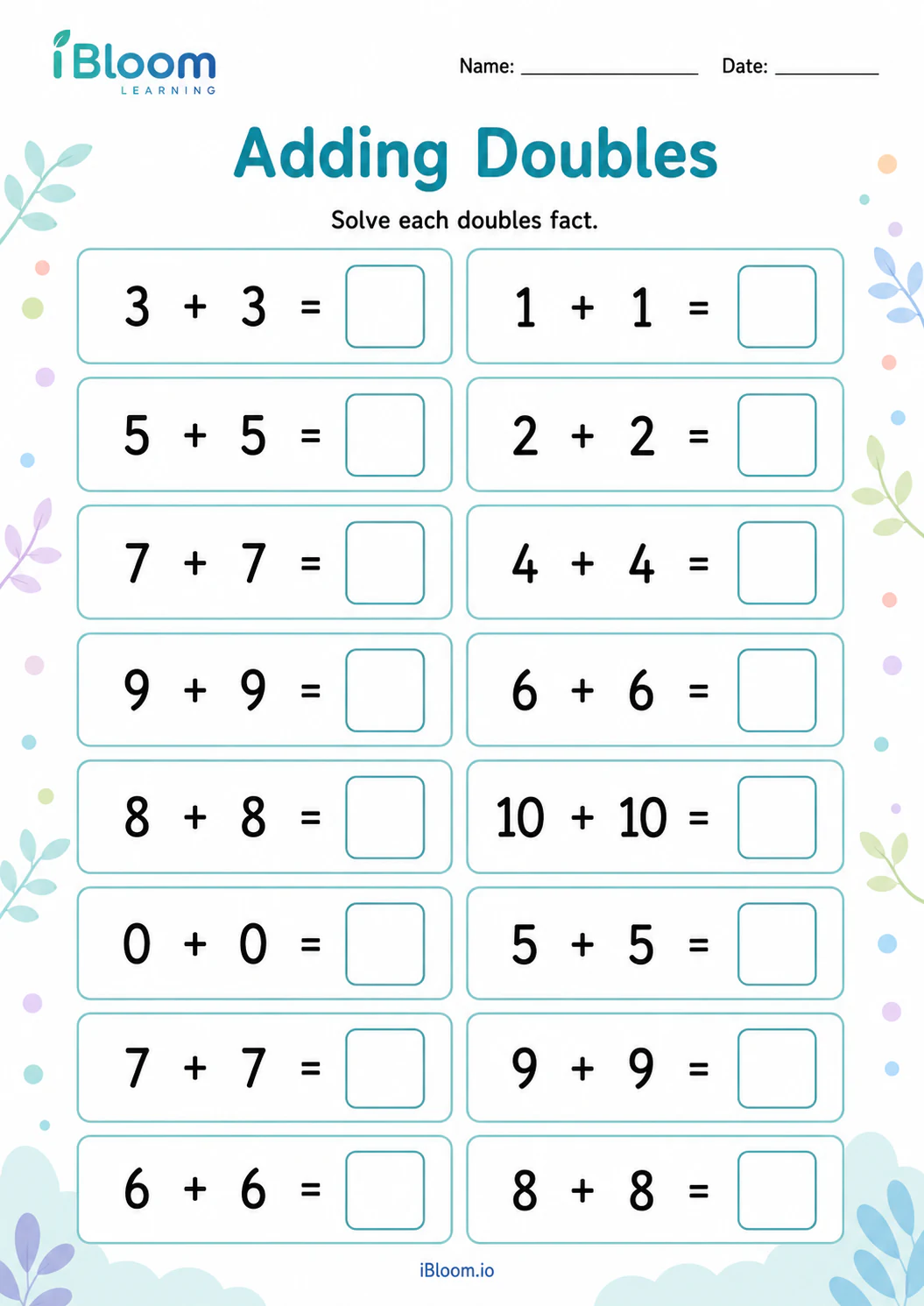
Grade 1 addition worksheets that help children learn and recall doubles facts such as 3 + 3, 6 + 6, and 10 + 10.
Free printable worksheet PDFs
Preview every available page, then download the free worksheet PDF for home, homeschool, tutoring, or classroom practice.
Preview the exact activity before downloading it.
Practice that builds confidence
What children learn
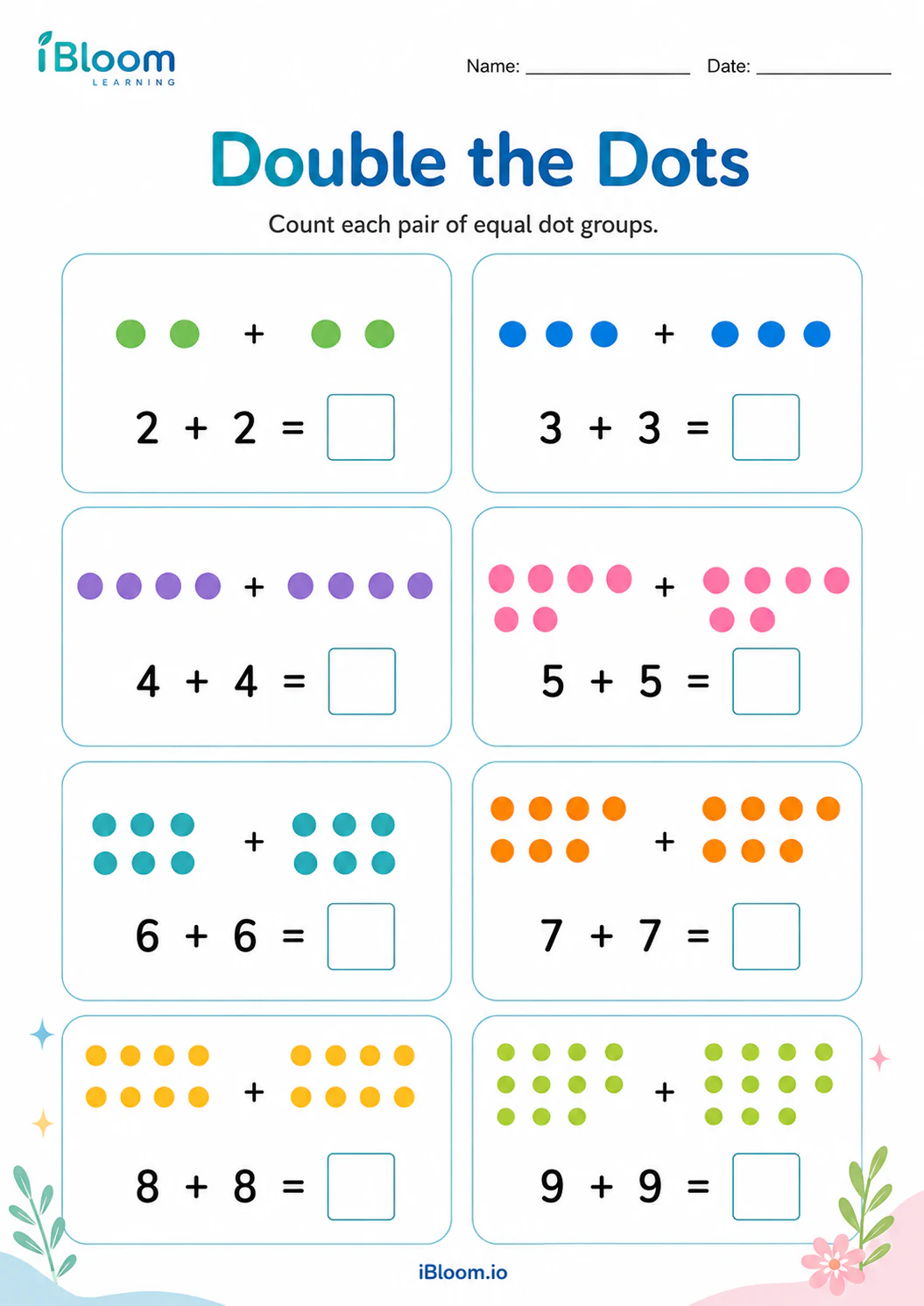
Adding doubles helps Grade 1 children see addition as joining two equal groups. These printable activities give repeated practice with facts such as 1 + 1, 4 + 4, and 9 + 9 so children can build quick recall with understanding.
The worksheets include clear number sentences and visual-style practice that encourages children to notice equal addends, say the fact aloud, and connect the sum to a familiar pattern. They are useful for review, math centers, homework, or short fluency practice.
Doubles facts are addition facts with the same number on both sides of the plus sign, such as 2 + 2 or 8 + 8. In Grade 1, children use these facts to strengthen number sense, count by 2s, and prepare for near doubles like 5 + 6. The focus is not just speed; children should understand that both addends are equal and that the total is two matching groups combined.

How the practice progresses
Children begin by recognizing the structure of a double: same number, plus sign, same number. They then solve facts within the Grade 1 range, often up to 10 + 10, using counting, fingers, drawings, or known patterns. As confidence grows, they move toward remembering sums automatically, especially common facts like 5 + 5 = 10 and 10 + 10 = 20.
Parent routine for home practice
Choose one page and sit beside your child with a small set of counters, coins, or cereal pieces. Build one fact, such as 6 + 6, by making two equal rows. Ask, “How many in each group? How many altogether?” Then have your child write or read the matching number sentence. End by asking them to name one double they now know without counting.

Classroom uses for teachers
Use these pages as morning work, addition centers, small-group fluency checks, or follow-up after a doubles lesson. Teachers can pair worksheets with ten-frames, cubes, dominoes, or number lines so children move between concrete objects, pictures, and equations. The pages also work well for quick reteaching when students confuse doubles with random addition facts.

Common errors to watch for
Some children read 7 + 7 as 7 + 1 because they rush past the second addend. Others count all from 1 every time and do not notice the equal-group pattern. Watch for reversed numerals, skipped sums, or answers that are one more or one less than the correct total. Encourage children to check that the two addends match before solving.
Free printable PDF download
Use this adding doubles worksheets grade 1 page to preview the activity, print it, or download it as a PDF for quick practice. It works well for homework, homeschool lessons, tutoring, morning work, revision, and classroom centers.
Answers and answer key support
After the child completes the worksheet independently, parents and teachers can use the answer support or answer key information to check the work, review mistakes, and choose the next practice step.
Why iBloom worksheets help
The practice is focused on one powerful addition idea at a time, so children are not overloaded by mixed strategies. A helpful child-friendly strategy is: “Same and same? Double the name.” If the numbers match, say the double fact, picture two equal groups, and check whether the answer makes sense.
Helpful answers
Frequently asked questions
What are adding doubles facts?
Adding doubles facts are addition facts where both addends are the same, such as 3 + 3, 6 + 6, or 10 + 10.
Why are doubles important in Grade 1 math?
Doubles help children recognize equal groups, build addition fluency, count by 2s, and later solve near-doubles facts such as 4 + 5 or 8 + 9.
Should my child memorize doubles or use objects?
Both are useful. Start with objects or drawings so your child understands the equal groups, then practise saying and recalling the facts more quickly.
What doubles facts should a first grader practise?
Most Grade 1 children practise doubles from 1 + 1 through 10 + 10, with extra attention to common anchor facts like 5 + 5 and 10 + 10.
How can I help if my child keeps miscounting doubles?
Have your child build two equal rows with counters, touch each group while reading the equation, and check that the two addends match before finding the total.
Is this adding doubles worksheets grade 1 free?
Yes. You can preview it for free and use the printable worksheet for home or classroom practice.
Can I download this adding doubles worksheets grade 1 as a PDF?
Yes. Use the worksheet download option to save a printable PDF, or print the worksheet directly from the page.
Does this adding doubles worksheets grade 1 include answers or an answer key?
When the activity has fixed answers, iBloom includes answer support so parents and teachers can check the completed worksheet.