

About this worksheet
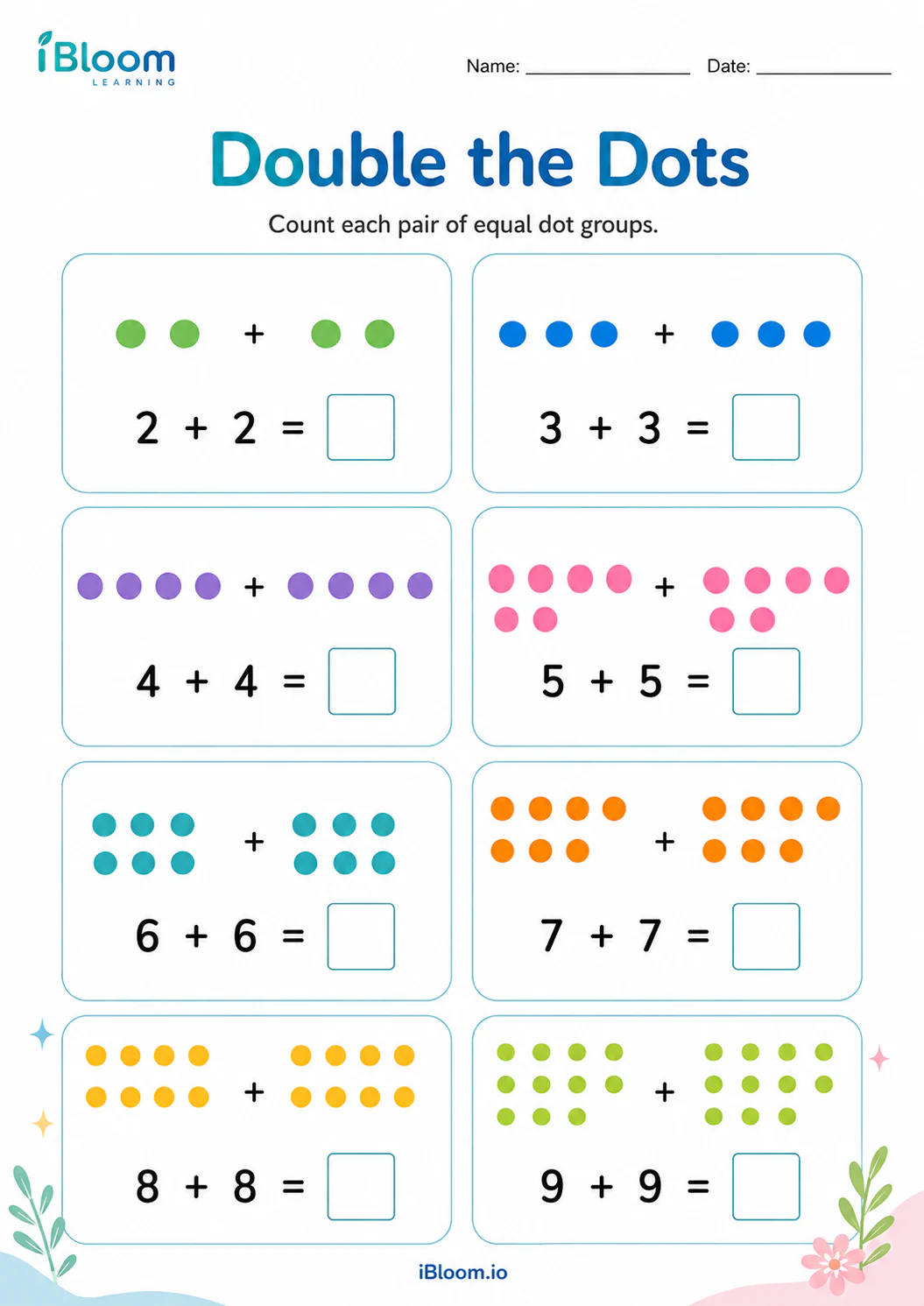
This free Grade 1 addition worksheet builds fluency with doubles facts. Children count equal rows of stars, solve doubles equations from 7 + 7 through 10 + 10, select sums for familiar facts, and use doubles in two short stories. The practice supports Common Core 1.OA.C.6, which asks students to add and subtract within 20 while building fluency within 10. A separate key shows each sum and story equation.
Aligned to 1.OA.C.6
What does a doubles model show?
Part A uses two equal rows of stars for each sum. The picture supports the idea that both addends have the same value.
- 1Two rows show 3 stars each.
- 23 + 3 = 6 stars.
What changes in each part?
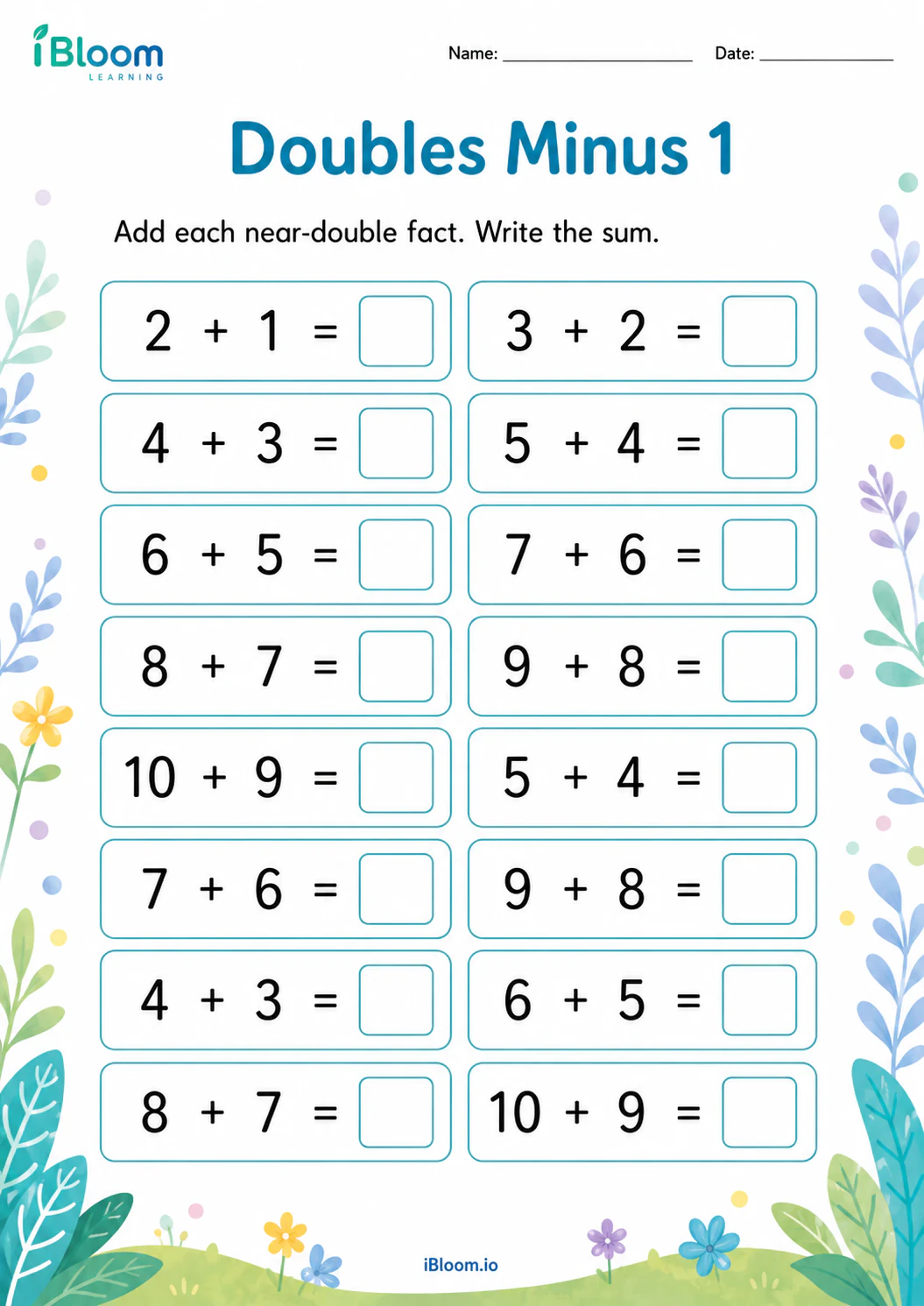
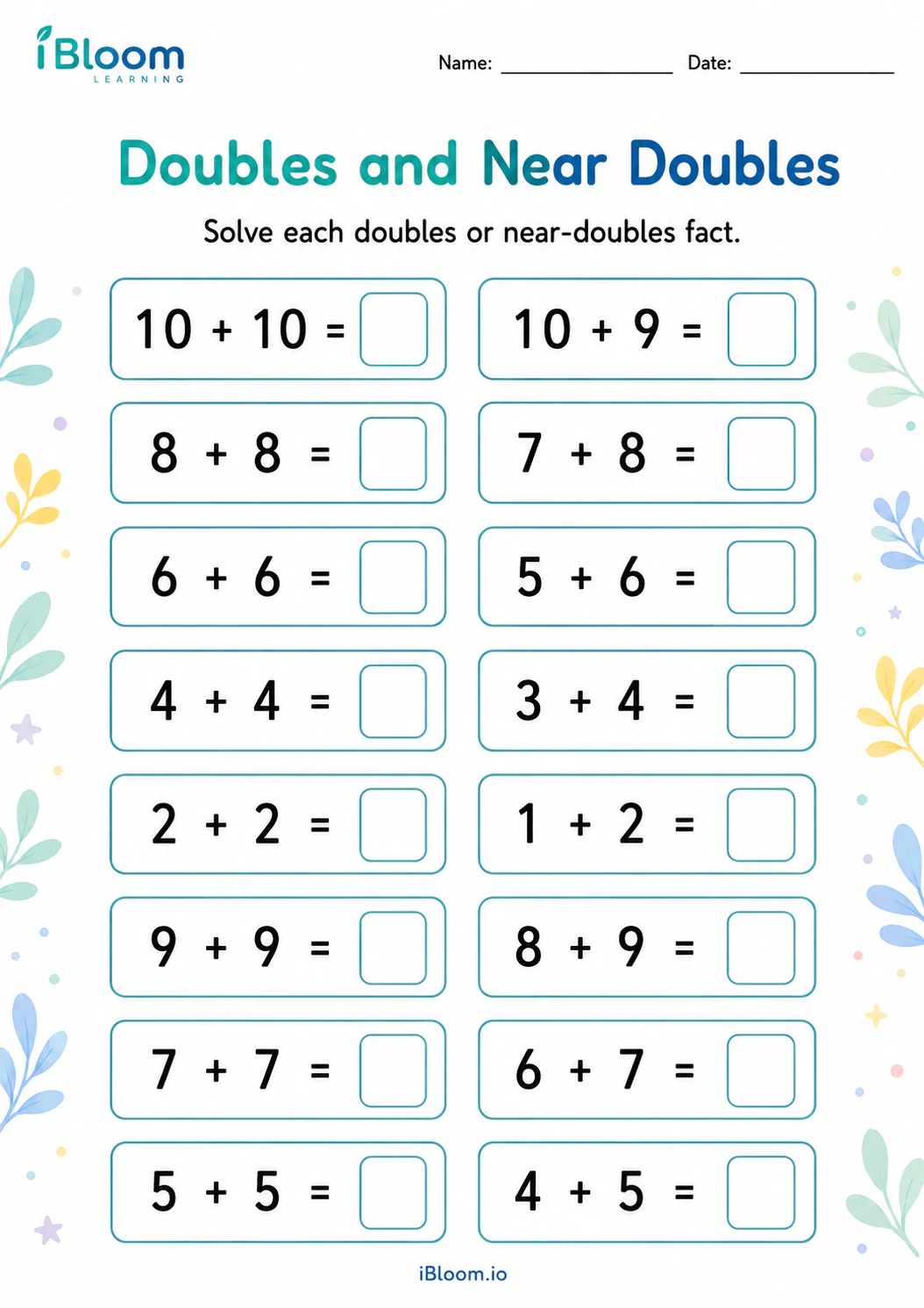
Part A counts stars; Part B completes number sentences; Part C selects a sum; Part D uses doubles in short stories.
How can children remember a doubles fact?
A child may count by twos, picture two equal groups, or use a related fact. For 9 + 9, double 10 and subtract 2 to find 18.
How to use this worksheet
- 1For each picture, count the first row and confirm the second row matches.
- 2Say the doubles fact aloud before writing its sum.
- 3For an answer choice, compute the fact first and then scan the options.
- 4In a story, identify the two equal groups and write an addition equation.
- 5Check the answer key after completing the page.
Common mistakes and quick fixes
The mistake
Treating the two addends as different numbers.
The fix
Pause and check the sentence or calculation against the clue: treating the two addends as different numbers.
The mistake
Counting every picture from one instead of counting the equal groups.
The fix
Pause and check the sentence or calculation against the clue: counting every picture from one instead of counting the equal groups.
The mistake
Choosing an answer before working out the doubles sum.
The fix
Pause and check the sentence or calculation against the clue: choosing an answer before working out the doubles sum.
Common Core alignment
Add and subtract within 20, building fluency with facts to 10.
On this sheet: The questions ask students to practice add and subtract within 20, building fluency with facts to 10..
Show the official wordingHide the official wording
Add and subtract within 20, demonstrating fluency for addition and subtraction within 10. Use strategies such as counting on; making ten (e.g., 8 + 6 = 8 + 2 + 4 = 10 + 4 = 14); decomposing a number leading to a ten (e.g., 13 - 4 = 13 - 3 - 1 = 10 - 1 = 9); using the relationship between addition and subtraction (e.g., knowing that 8 + 4 = 12, one knows 12 - 8 = 4); and creating equivalent but easier or known sums (e.g., adding 6 + 7 by creating the known equivalent 6 + 6 + 1 = 12 + 1 = 13).
What to practice next
Make more practice
Further reading
Questions parents and teachers ask
What is an adding doubles fact?
A doubles fact adds the same number twice, such as 6 + 6. The sum is two equal groups, so children can use a known fact or count the matching groups in Part A. Naming both equal groups aloud can help a child check whether the total makes sense.
How does the worksheet build practice?
It begins with six star-array models, then moves to equations, answer choices, and two short story problems. This keeps the focus on the same idea while changing how children meet it. Naming both equal groups aloud can help a child check whether the total makes sense.
Which sums are in the worksheet?
The equation section includes doubles from 7 + 7 through 10 + 10. The model and choice sections revisit facts through 9 + 9, and the story problems use 4 + 4 and two groups of 7. Naming both equal groups aloud can help a child check whether the total makes sense.
How can I help with a tricky fact?
Ask the child to name the equal groups first. For 8 + 8, they might use 8 + 2 = 10 and add the remaining 6 to reach 16, or count two rows of eight. Naming both equal groups aloud can help a child check whether the total makes sense.
Does the worksheet include an answer key?
Yes. The key gives all 16 answers, including each doubles sum and the equation and total for both stories. Children can use it to check after they finish. Naming both equal groups aloud can help a child check whether the total makes sense.