

About this worksheet
This printable Grade 1 worksheet helps children use a known double to solve a neighboring addition fact. It starts with 12 number sentences such as 5 + 6, then applies the same strategy to four short stories. Every sum stays within 20, and the practice supports CCSS 1.OA.C.6 strategies for addition. A separate answer key gives each sum and story answer.
How does doubles plus one help?
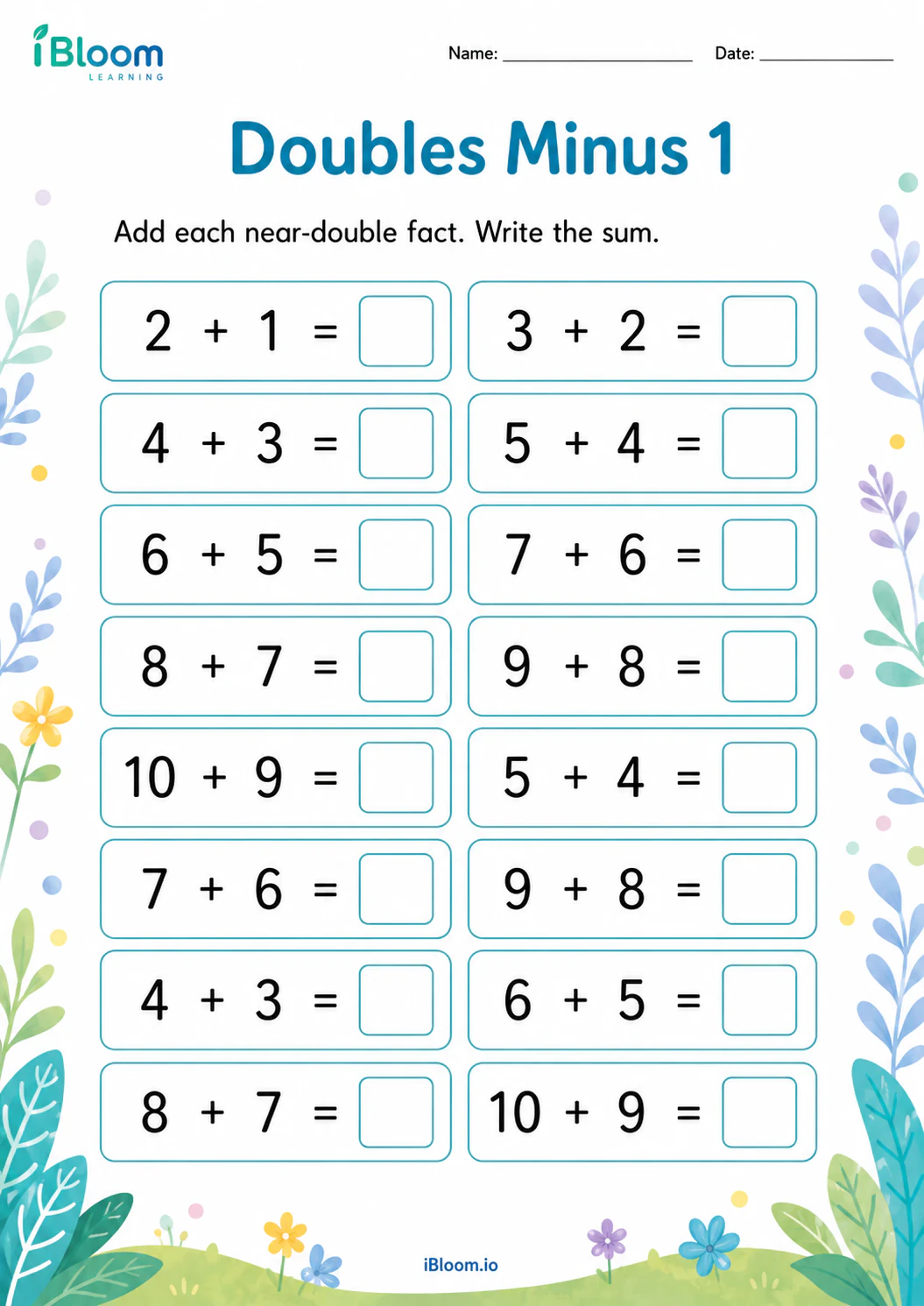
A doubles-plus-one fact has two numbers next to each other, such as 6 + 7. Think of the nearby double, 6 + 6 = 12, then add 1 more to get 13.
For question 3, 5 + 6 is one more than 5 + 5. The sum is 11.
- 15 + 5 = 10
- 25 + 6 is one more
- 35 + 6 = 11
How can you solve the larger facts?
For 9 + 10, use the double 9 + 9 = 18 and add one more to make 19. For 10 + 9, reverse the addends and use the same idea.
Where can this strategy help?
The last four problems use short stories. Identify the two amounts, write an addition equation, then use a nearby double to find the total.
How to use this worksheet
- 1Read each number sentence from left to right.
- 2Find the nearby double fact.
- 3Add one more to the known double.
- 4For story problems, write an addition equation first.
- 5Check each total with the answer key.
Common slips and helpful fixes
The mistake
Adding the same number twice by mistake
The fix
Check whether the addends are neighbors; one is exactly one greater.
The mistake
Forgetting the extra one
The fix
Say the double aloud, then count one more.
The mistake
Writing only a number for a story problem
The fix
Write an addition equation using both amounts before finding the sum.
What to practice next
Make more practice
Questions parents and teachers ask
What is a doubles-plus-one fact?
It adds two neighboring numbers, such as 6 + 7. You can use the nearby double, 6 + 6, and add one more to find the sum. An adult can invite the learner to explain one answer aloud and point back to the matching prompt. This makes it easy to check the strategy as well as the final response.
How many questions are on the sheet?
There are 16 questions: 12 number sentences and four short story problems. A separate answer key gives the sums and story answers. An adult can invite the learner to explain one answer aloud and point back to the matching prompt. This makes it easy to check the strategy as well as the final response.
How can my child use a doubles fact?
For 7 + 8, start with 7 + 7 = 14, then add one more to get 15. Children can also double the larger addend and take away one. The adult can ask the learner to point to the related item and explain the answer in their own words.
Are the answers within 20?
Yes. Every sum on the worksheet is 20 or less, keeping the computation appropriate for Grade 1 addition practice. An adult can invite the learner to explain one answer aloud and point back to the matching prompt. This makes it easy to check the strategy as well as the final response.
Should children write an equation for the stories?
Yes. The story problems provide room to write an addition equation before solving. This helps connect the two quantities in the story to the number sentence. An adult can invite the learner to explain one answer aloud and point back to the matching prompt. This makes it easy to check the strategy as well as the final response.
How long will practice take?
About 15 minutes is a useful starting point for 12 facts and four short stories. Let your child explain one doubles strategy aloud before working independently. An adult can invite the learner to explain one answer aloud and point back to the matching prompt. This makes it easy to check the strategy as well as the final response.