

About this worksheet
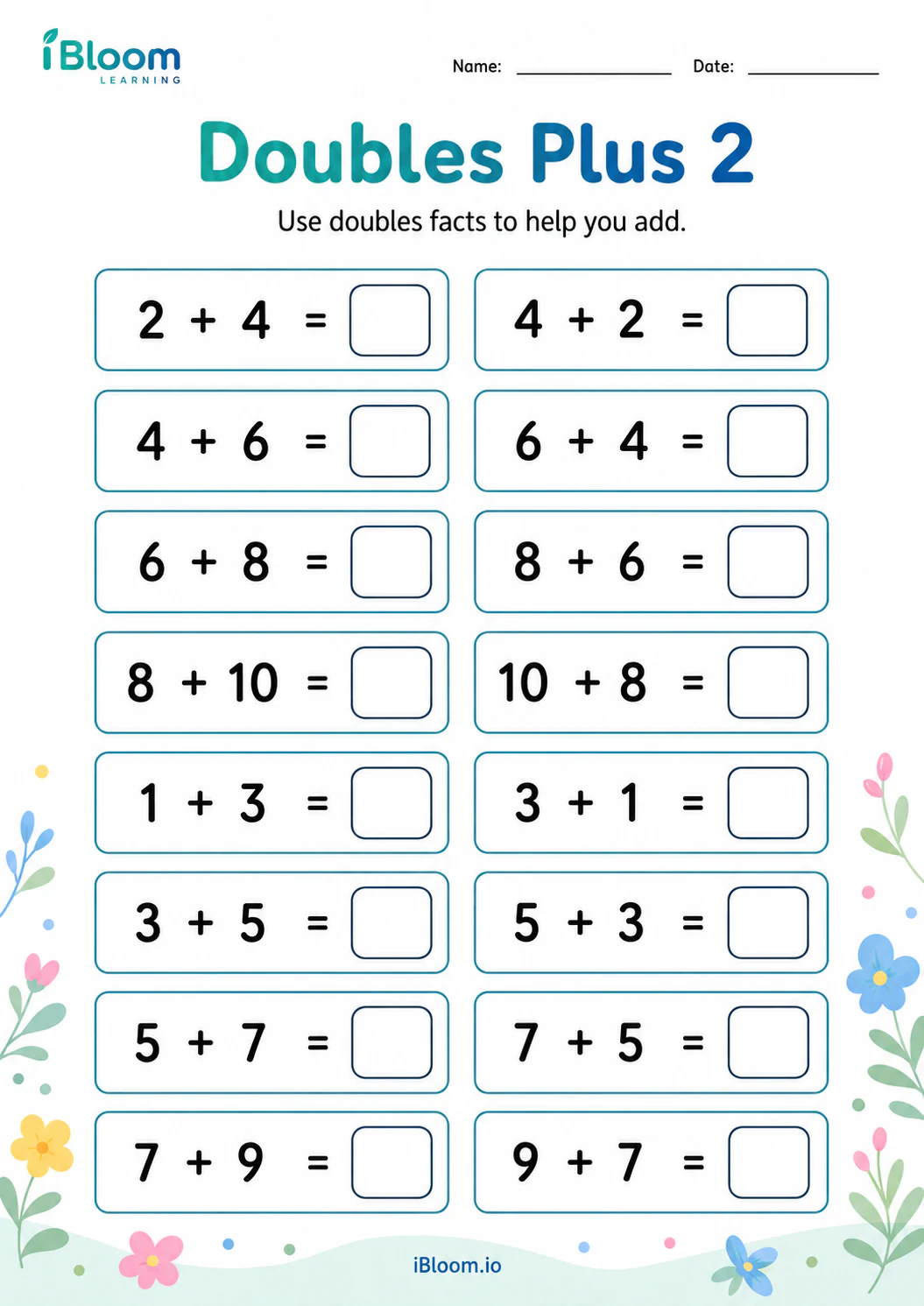
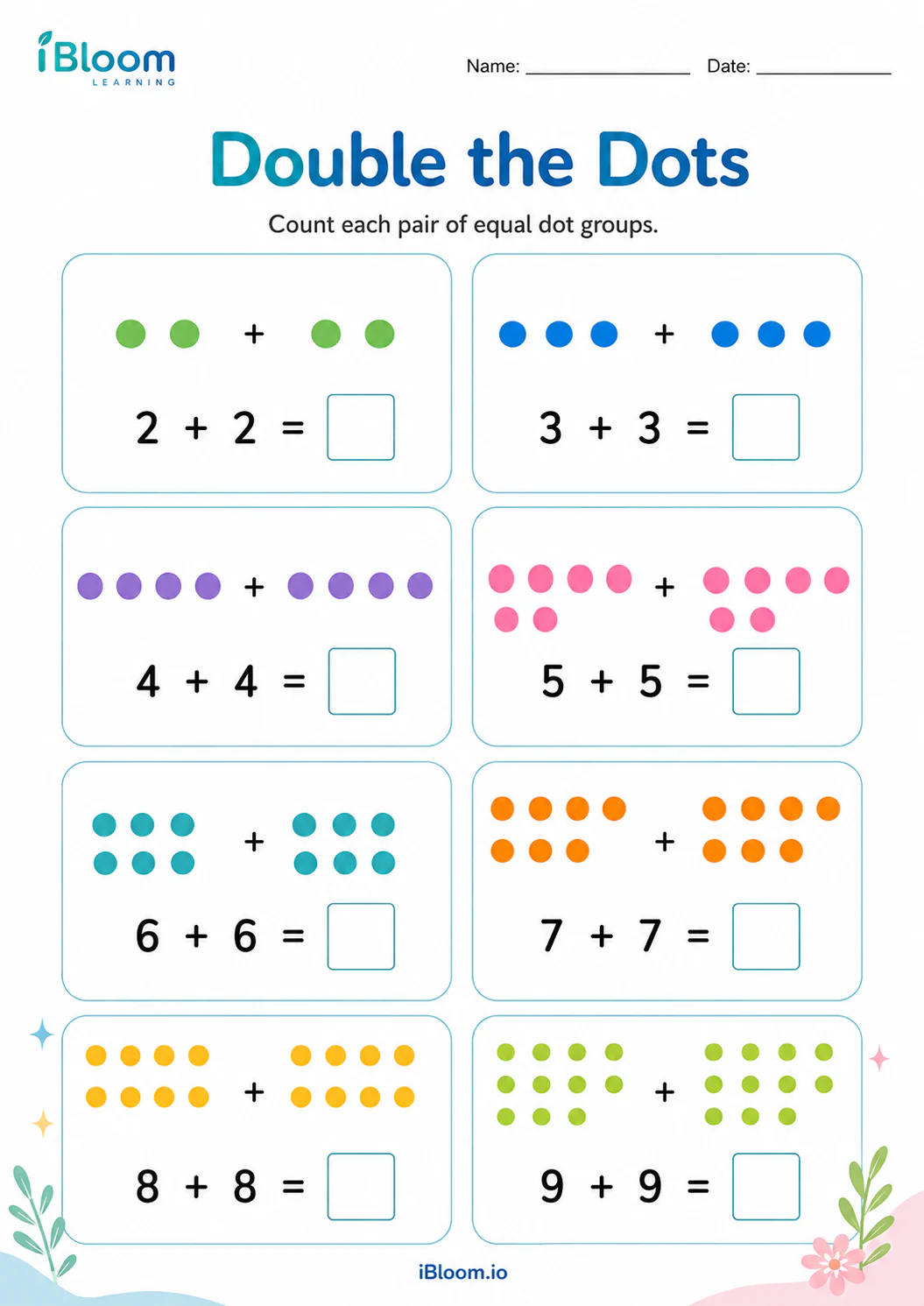
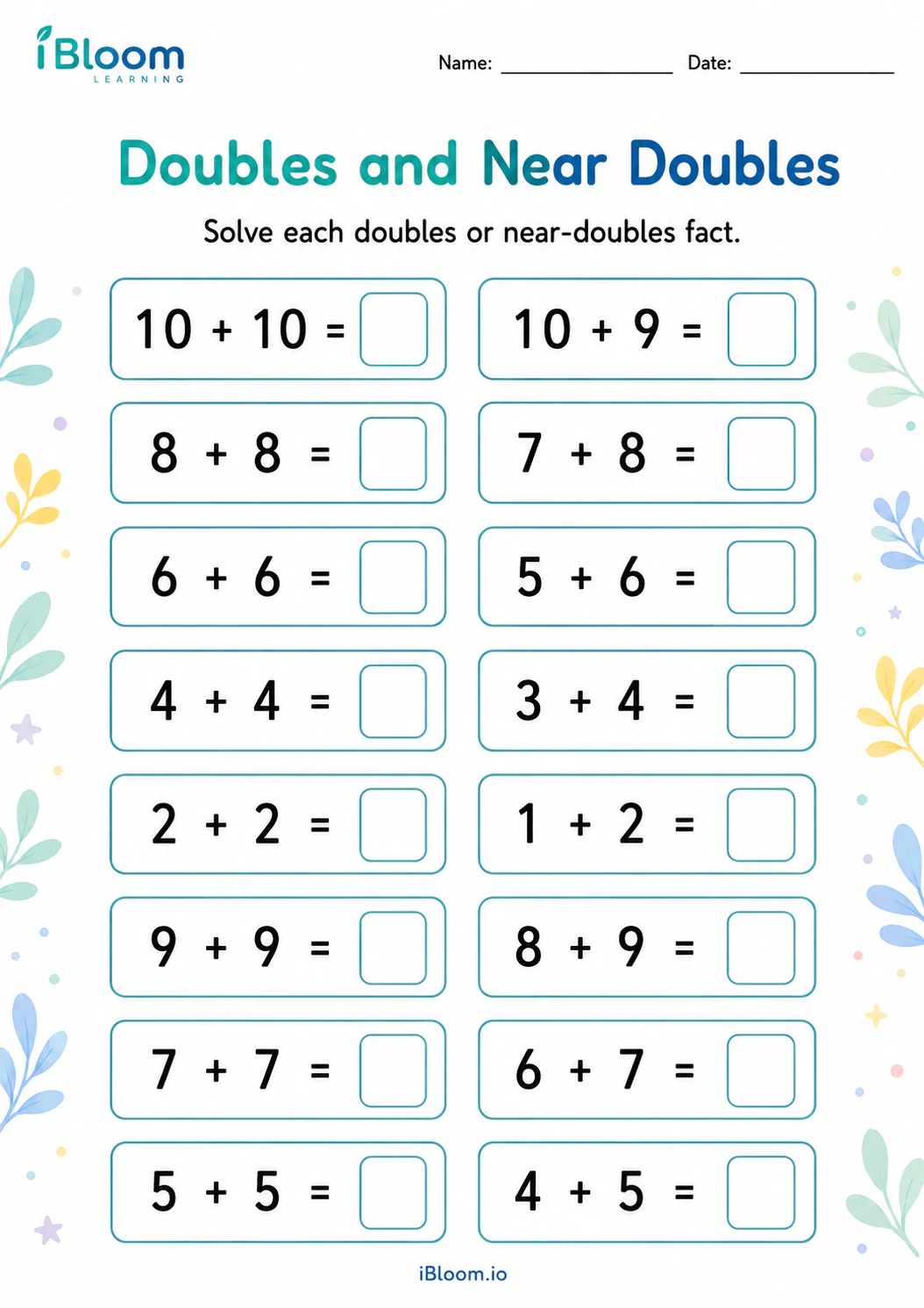
This free printable Grade 1 math worksheet builds fluency with near doubles, addition facts whose addends differ by 2. Children solve 20 equations in four parts: an ascending set, reversed addends, mixed facts, and a short review. For example, 3 + 5 can be seen as 4 + 4. The separate answer key lists every sum, and the facts stay within 20.
Aligned to 1.OA.C.6
How can a double help solve a nearby sum?
A near double has addends that are two apart. For 3 + 5, use the known double 4 + 4 = 8; one addend is one less than 4 and the other is one more, so the sum stays 8.
The facts use addends two apart and sums from 4 through 18. Reversed addends still make the same sum.
- 13 + 5 = ___
- 2Think of 4 + 4 = 8
- 3One addend is 1 less, the other 1 more
- 43 + 5 = 8
What will children practice on the page?
Part A practices near doubles in both orders. Part B asks for the matching midpoint double, a strategy for finding each sum.
How can the answer key help?
The key lists each sum and midpoint double. For 7 + 9, the midpoint is 8, so the helpful double is 8 + 8.
How to use this worksheet
- 1Read both addends and notice how far apart they are.
- 2Find the number halfway between them.
- 3Double that middle number.
- 4Write the sum and check by counting on if needed.
- 5Use the key to revisit facts that were not automatic yet.
Common mistakes and quick fixes
The mistake
Adding only the smaller addend twice.
The fix
Use the middle number as the double; for 3 + 5, double 4.
The mistake
Changing the answer when the addends switch places.
The fix
The same two addends have the same total in either order.
The mistake
Counting on from zero for every fact.
The fix
Try the nearby double first, then confirm with counting if needed.
Common Core alignment
The questions below practice the stated Common Core skill.
Use known addition facts to solve sums within 20, including near doubles.
On this sheet: Use doubles facts to work out addition facts with addends two apart.
Show the official wordingHide the official wording
Add and subtract within 20, demonstrating fluency for addition and subtraction within 10. Use strategies such as counting on; making ten (e.g., 8 + 6 = 8 + 2 + 4 = 10 + 4 = 14); decomposing a number leading to a ten (e.g., 13 - 4 = 13 - 3 - 1 = 10 - 1 = 9); using the relationship between addition and subtraction (e.g., knowing that 8 + 4 = 12, one knows 12 - 8 = 4); and creating equivalent but easier or known sums (e.g., adding 6 + 7 by creating the known equivalent 6 + 6 + 1 = 12 + 1 = 13).
What to practice next
Make more practice
Further reading
Questions parents and teachers ask
What does “doubles plus 2” mean?
It means the addends differ by two, such as 3 and 5. The number halfway between them makes a double: 4 + 4. One addend is one less and the other one more, so the total matches that nearby double.
How many addition facts are on the page?
There are 20 addition facts in four parts. Eight are listed in order, four reverse the addends, four mix the facts, and four make up a review. Every pair of addends differs by two, and the sums range from 4 through 20.
How can a double help with 3 + 5?
Think of 4 + 4 = 8. The 3 is one less than 4 and the 5 is one more, so one addend loses what the other gains. The total remains 8. This nearby-double strategy works across the facts on this worksheet.
Do all the sums stay within 20?
Yes. The facts on the worksheet have sums from 4 to 20. Children can use a known double, count on, or another accurate strategy to check their work. The answer key gives each total for a quick review after the child has tried the page.
Why are some facts written backward?
Switching the order helps children notice that 10 + 8 and 8 + 10 use the same addends and have the same total. The reversed facts provide a second way to see the same near-double relationship and keep practice from following only one memorized order.
Is there an answer key?
Yes. The separate answer key lists all 20 sums. After checking, ask your child to show a missed answer with its nearby double; for example, 7 + 9 can be rewritten as 8 + 8. That explanation reinforces the strategy behind the answer.