

About this worksheet
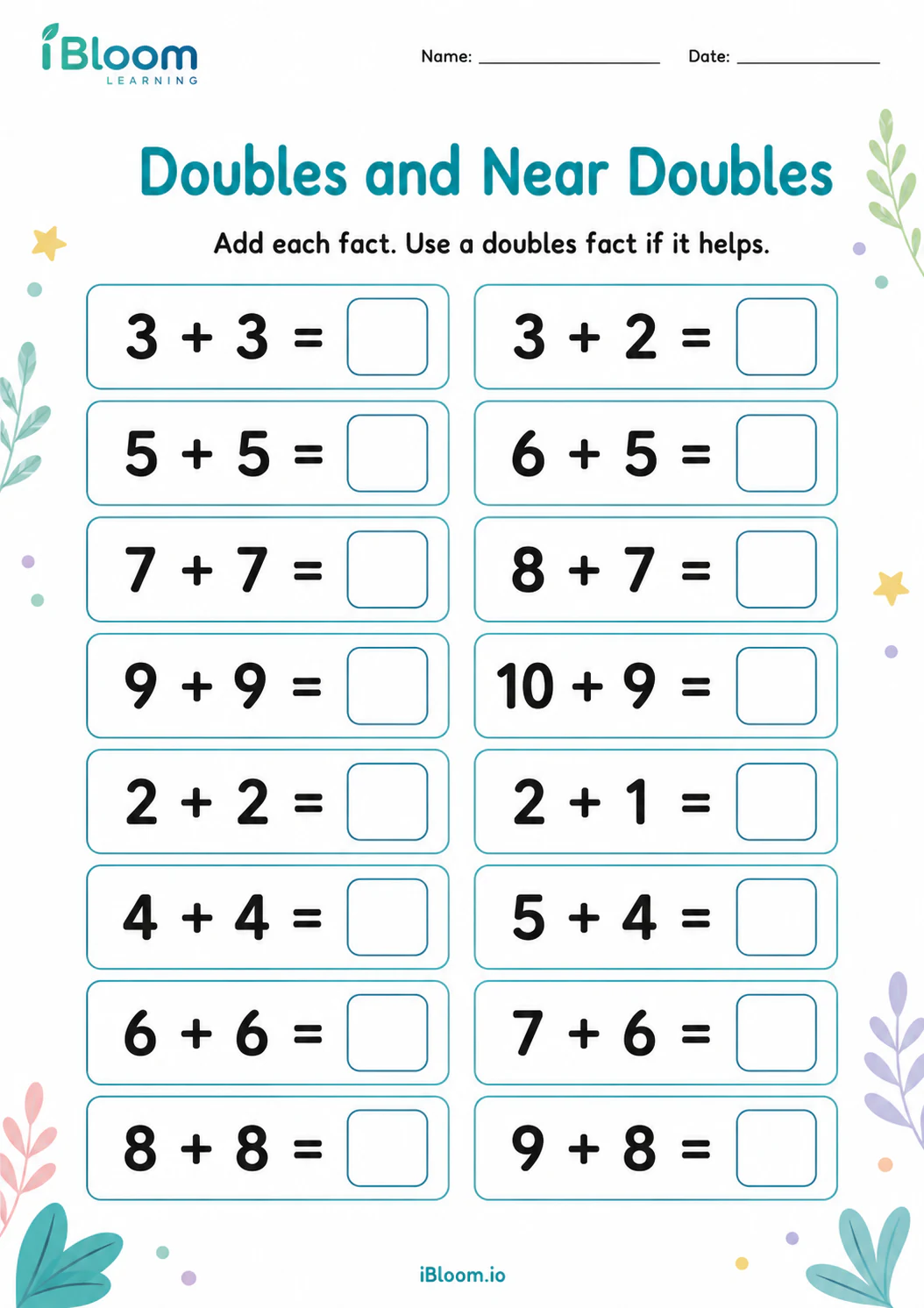
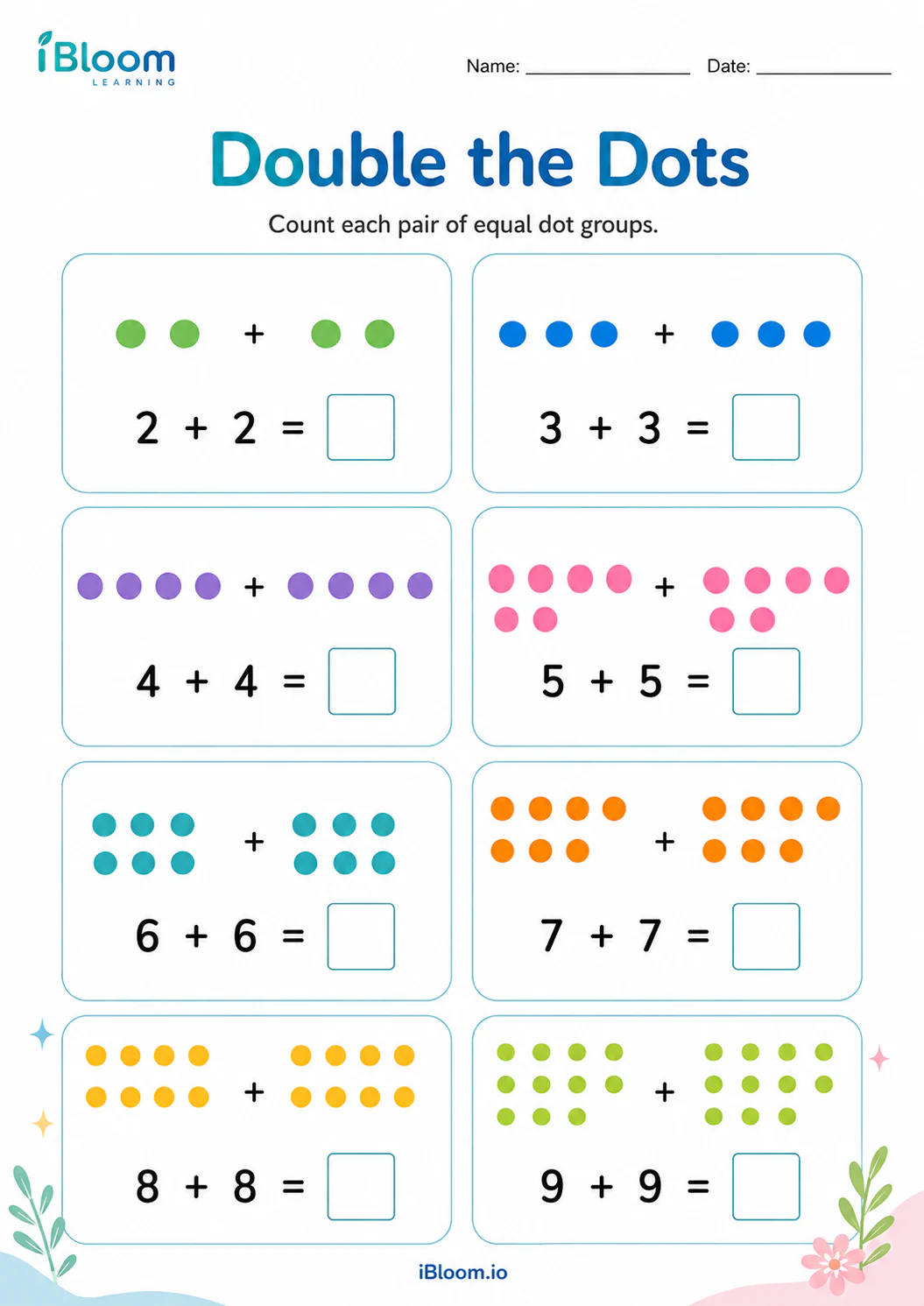
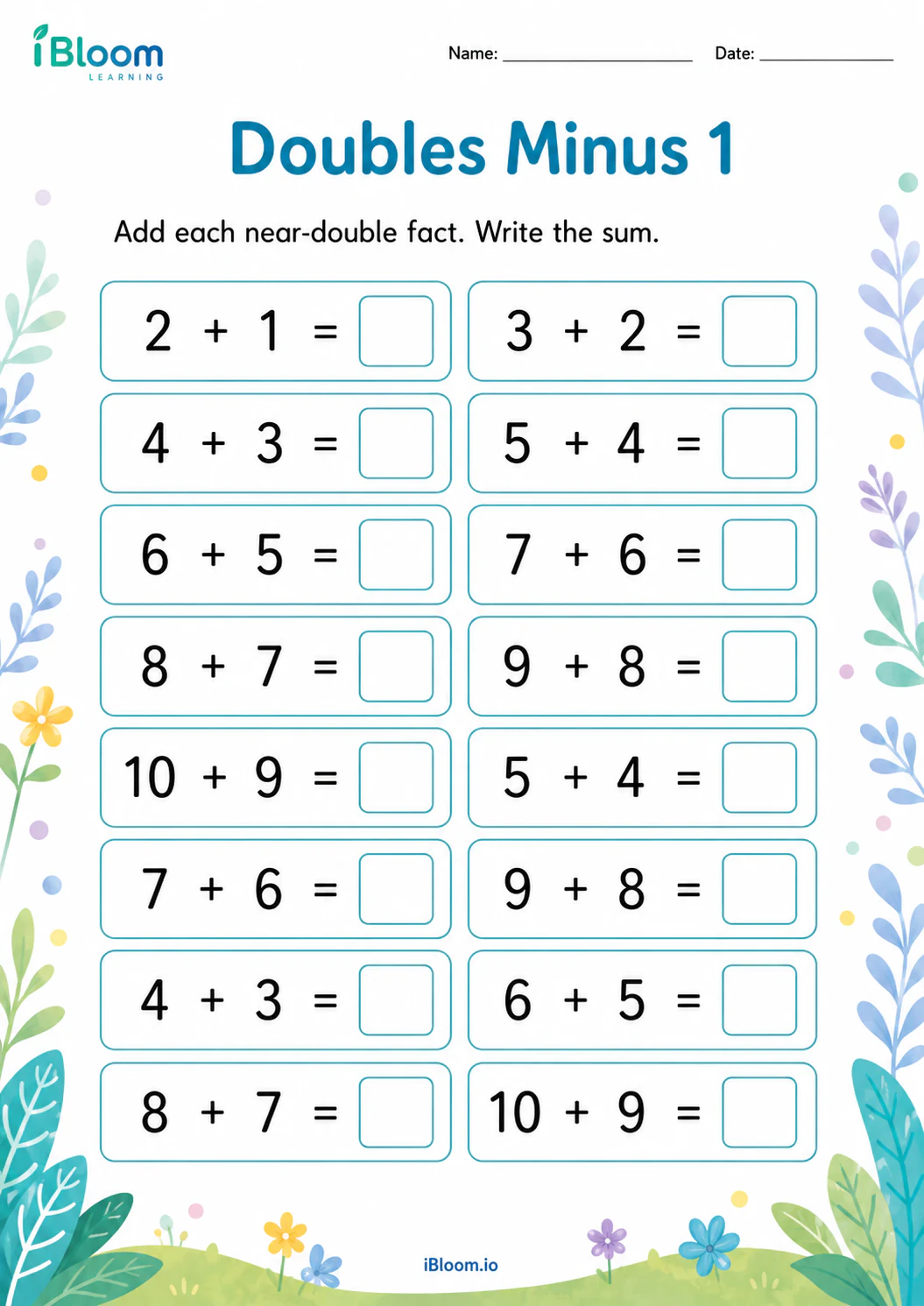
This Grade 1 worksheet gives practice with nine doubles facts and nine near doubles, all with sums within 20. Learners use a known equal-addend sum to find a total one apart. The answer key lists all 18 answers.
Aligned to 1.OA.C.6
How can a doubles fact help you add?
A doubles fact has two equal addends. In question 1, 3 + 3 = 6. Remembering that known sum gives you a starting point for the near doubles in the next part.
- 13 + 3 has equal addends.
- 23 + 3 = 6.
How do you solve a near double?
Near doubles have addends one apart. For 4 + 5, use 4 + 4 = 8, then add one more to get 9. Check which addend is repeated and whether the extra amount is one.
How can you check the adjusted sum?
Count on from one addend or compare with the closest double. For 8 + 9, 8 + 8 = 16, then one more is 17. Be sure to include the extra one after finding the double.
How to use doubles facts
- 1Solve the equal-addend facts in the first part.
- 2For each near double, identify the addend that can be doubled.
- 3Find that known double.
- 4Add one to the double for the nearby sum.
- 5Check each answer with the answer key.
Common near-double mistakes
The mistake
Treating two addends one apart as a double.
The fix
Double the smaller addend, then add one.
The mistake
Finding the double but forgetting the extra one.
The fix
Compare both addends before writing the total.
The mistake
Changing the wrong addend when checking.
The fix
Keep the smaller addend as the double and count one more for the larger addend.
Common Core alignment
The questions practice 1.OA.C.6 by applying the target skill in each item.
Add within 20 using known sums and strategies.
On this sheet: Doubles provide known sums that learners use to find sums within 20.
Show the official wordingHide the official wording
Add and subtract within 20, demonstrating fluency for addition and subtraction within 10. Use strategies such as counting on; making ten (e.g., 8 + 6 = 8 + 2 + 4 = 10 + 4 = 14); decomposing a number leading to a ten (e.g., 13 - 4 = 13 - 3 - 1 = 10 - 1 = 9); using the relationship between addition and subtraction (e.g., knowing that 8 + 4 = 12, one knows 12 - 8 = 4); and creating equivalent but easier or known sums (e.g., adding 6 + 7 by creating the known equivalent 6 + 6 + 1 = 12 + 1 = 13).
What to practice next
Make more practice
Further reading
Questions parents and teachers ask
How many doubles and near doubles are included?
There are 18 questions: nine doubles followed by nine near doubles. All sums are within 20. The answer key gives each total, so learners can check the known doubles and practice sums one apart with a familiar strategy.
What is a doubles fact?
A doubles fact adds the same number twice, such as 6 + 6 = 12. The first section practices these equal-addend sums. A familiar double can act as an anchor when solving an addition fact with nearby addends.
What is a near double?
A near double has addends that differ by one, such as 6 + 7. Think of the nearby double 6 + 6 = 12, then add one more to get 13. The second section practices this adjustment with sums within 20.
Does the printable include an answer key?
Yes. The key follows the worksheet and lists all 18 sums. For a missed near double, return to the closest double and add or subtract one. This helps learners check the adjustment instead of recounting the entire sum.
How can I help a learner who forgets the adjustment?
Ask which addend can be doubled, then compare it with the other addend. If the second addend is one greater, add one to the double; if it were one less, subtract one. The near-double questions here are one apart with the larger addend second.