
About this worksheet
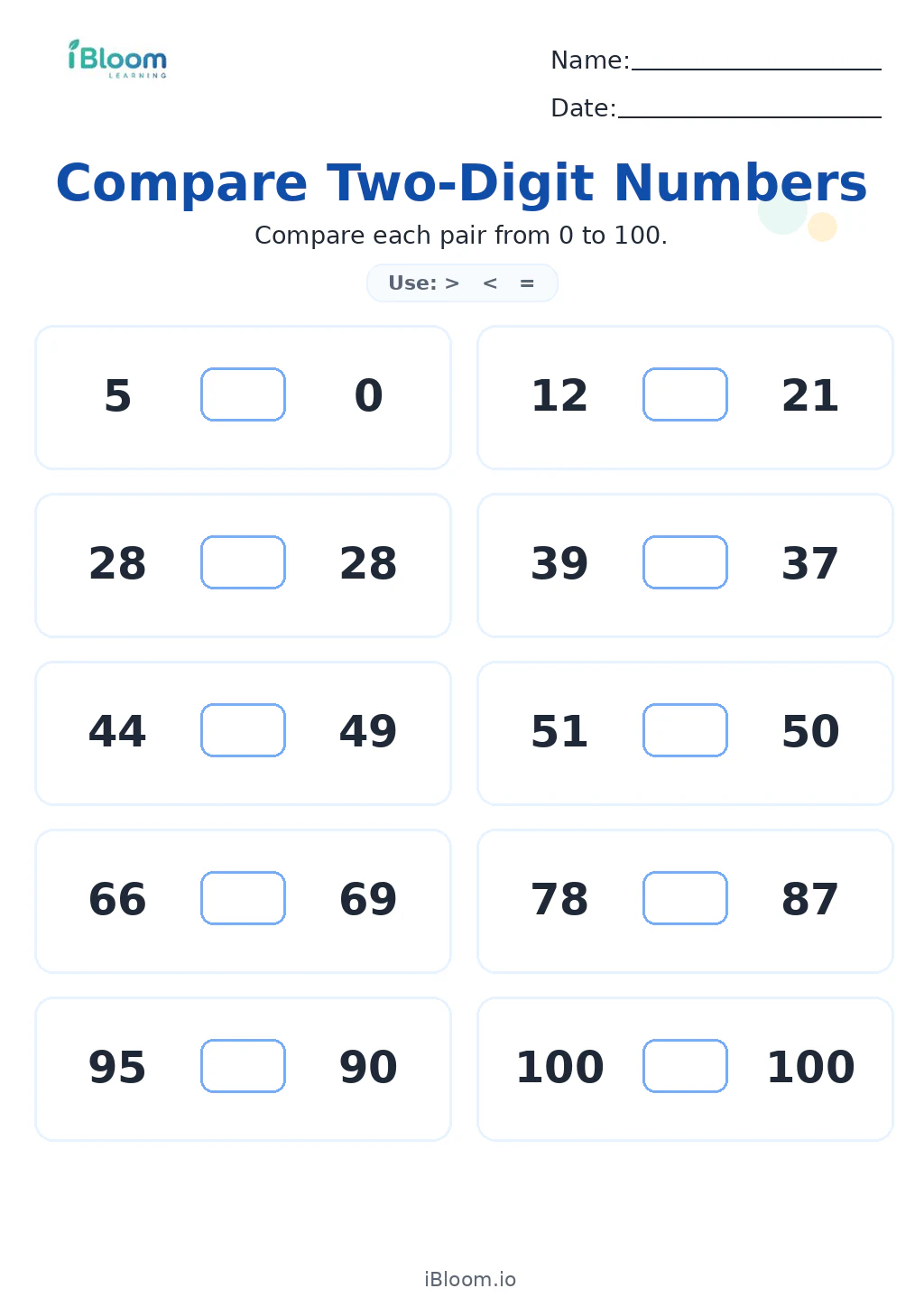
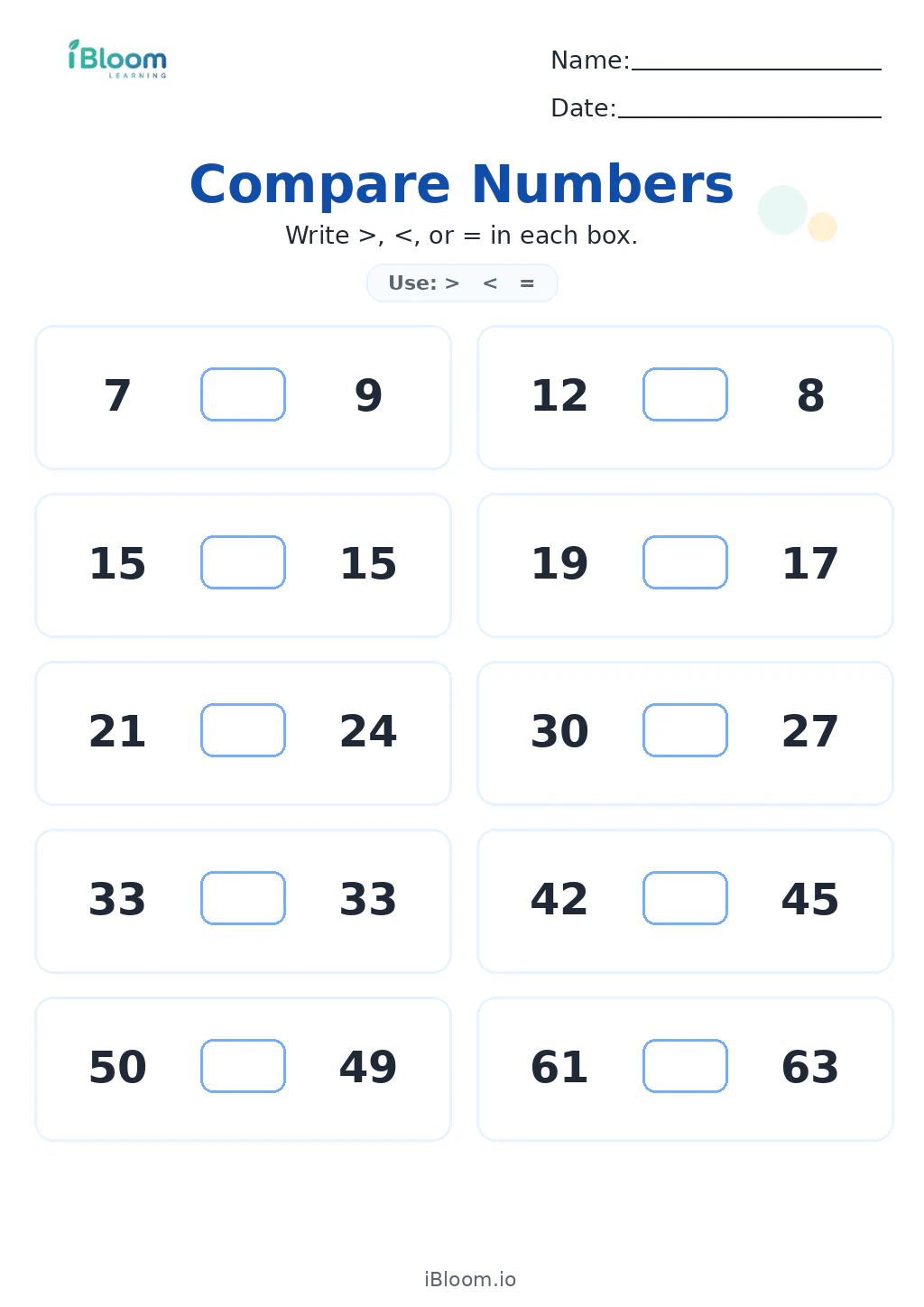
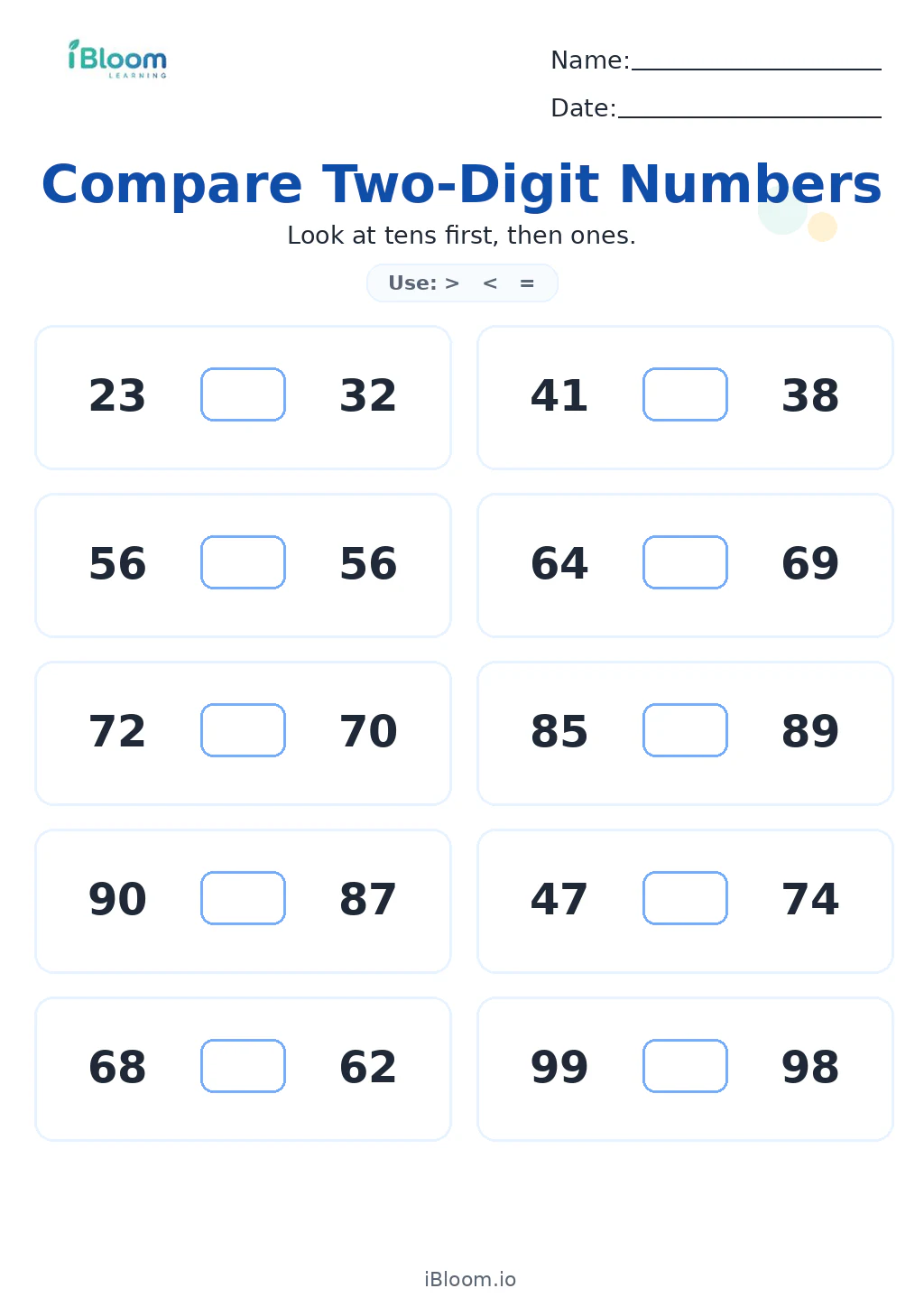
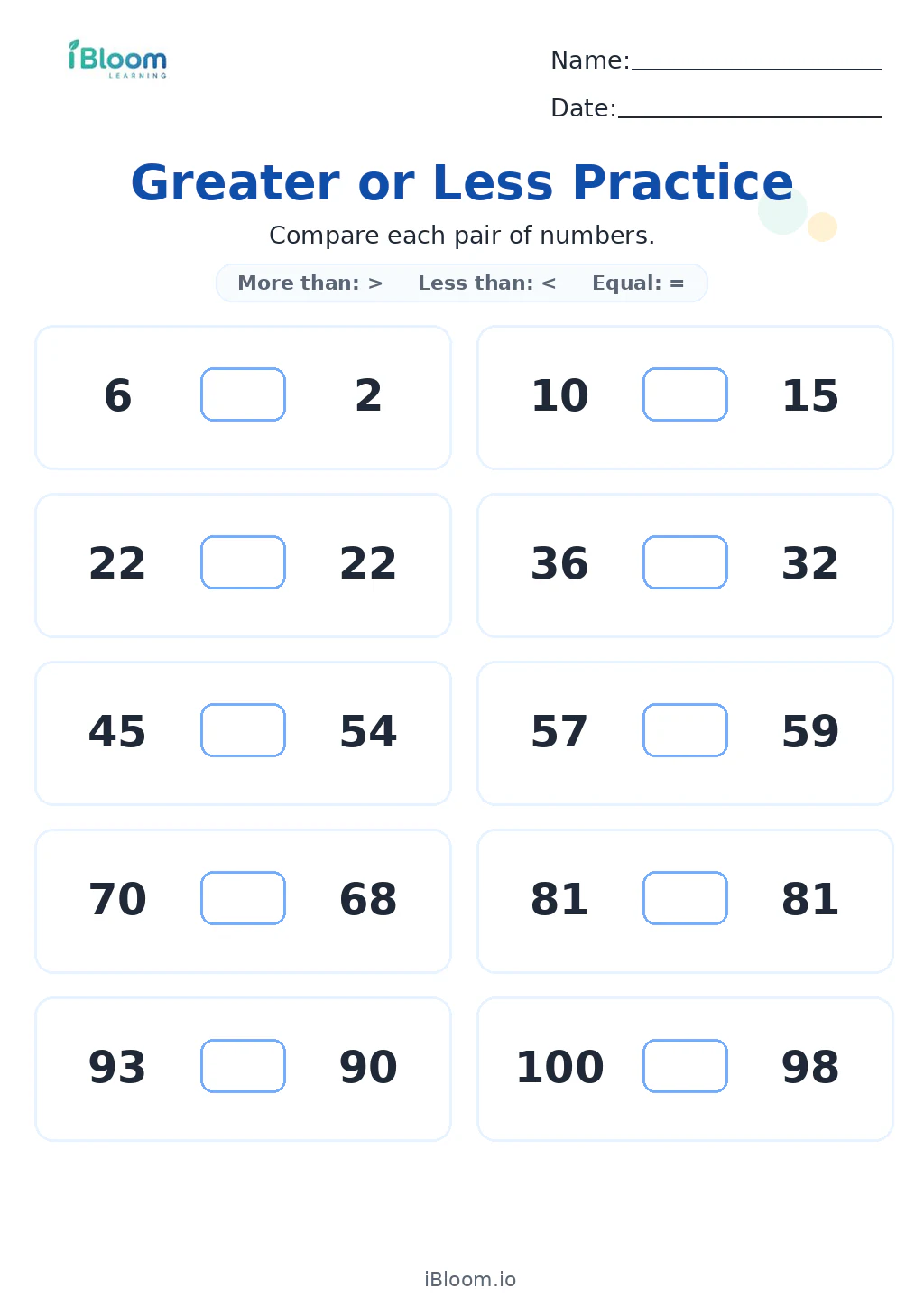
This free Grade 1 printable gives children 20 number comparisons from 0 through 100. They write <, >, or =, first comparing tens and then ones when needed. Items include equal numbers, matching tens, and the endpoints 0 and 100; eight prompts include a base-ten model for the first number. The page practices CCSS 1.NBT.B.3, and the key lets adults check every symbol.
Aligned to 1.NBT.B.3
What number comparisons are included?
All 20 prompts ask children to fill in a comparison symbol. The set moves from easy contrasts to matching tens, equal numbers, and comparisons that include 0 or 100.
- Compare different tens digits
- Compare ones when tens match
- Practice equality and range endpoints
Why look at tens first?
The tens digit tells how many groups of ten a number has. For 58 and 52, both numbers have five tens, so compare the ones: eight is greater than two.
- 158 ___ 52
- 2Both numbers have 5 tens.
- 3Compare the ones: 8 is greater than 2.
- 4So 58 > 52.
How do I choose the comparison sign?
Read the sign as a statement about the numbers: 14 < 41 means 14 is less than 41. For equal values, use =. Say the comparison aloud after writing the sign.
How do 0 and 100 fit the range?
The range includes both ends. Zero is less than any positive number in this set, and 100 is greater than every number below it. Compare by place value, including when one number is 100.
How to use this worksheet
- 1Read both numbers aloud.
- 2Compare the tens digits before the ones digits.
- 3When the tens are the same, compare the ones.
- 4Choose the sign that makes a true statement.
- 5Read the full comparison back to check it.
- 6Use the answer key to review any missed comparisons.
Common mistakes and quick fixes
The mistake
Comparing the ones first even when tens differ.
The fix
Compare tens first because each ten is a group of ten ones.
The mistake
Using = because two numbers look similar.
The fix
Use = only when the complete values match.
The mistake
Thinking 100 is outside the range.
The fix
The title range includes both 0 and 100.
Common Core alignment
This page records comparisons by using place value and standard comparison symbols.
Compare two-digit values using tens and ones, then record a symbol.
On this sheet: Every problem compares two values and asks for one of the standard symbols.
Show the official wordingHide the official wording
Compare two two-digit numbers based on meanings of the tens and ones digits, recording the results of comparisons with the symbols >, =, and <.
What to practice next
Make more practice
Further reading
Questions parents and teachers ask
What signs does this worksheet use?
Each of the 16 questions has a blank for <, >, or =. Children compare the two values and choose the symbol that makes the statement true. The answer key gives the correct symbol for every comparison, including equal values and the endpoints 0 and 100.
How should a child compare two two-digit numbers?
There are 20 comparisons, each asking children to write <, >, or =. Eight prompts also show a base-ten model for the first number. The answer key lists every symbol, including equal pairs and comparisons that use 0 or 100.
Does the range include 0 and 100?
Yes. The practice includes numbers at the ends of the stated range. Children can compare 0 with a positive number and 100 with a number below it by using the same place-value reasoning they use for other comparisons. These endpoint items reinforce that both limits belong to the range.
What does the equal sign mean here?
The equal sign means the number on the left and the number on the right have the same value. A child should use it only when both numbers match, as in 70 and 70. Similar-looking digits do not make numbers equal.
How long will the worksheet take?
Most children can work through the 20 comparisons in about 15 minutes. Encourage them to say “less than,” “greater than,” or “equal to” after choosing a symbol so they connect the written mark to its meaning. If a symbol is reversed, cover the page and practice reading the open side toward the greater number.