
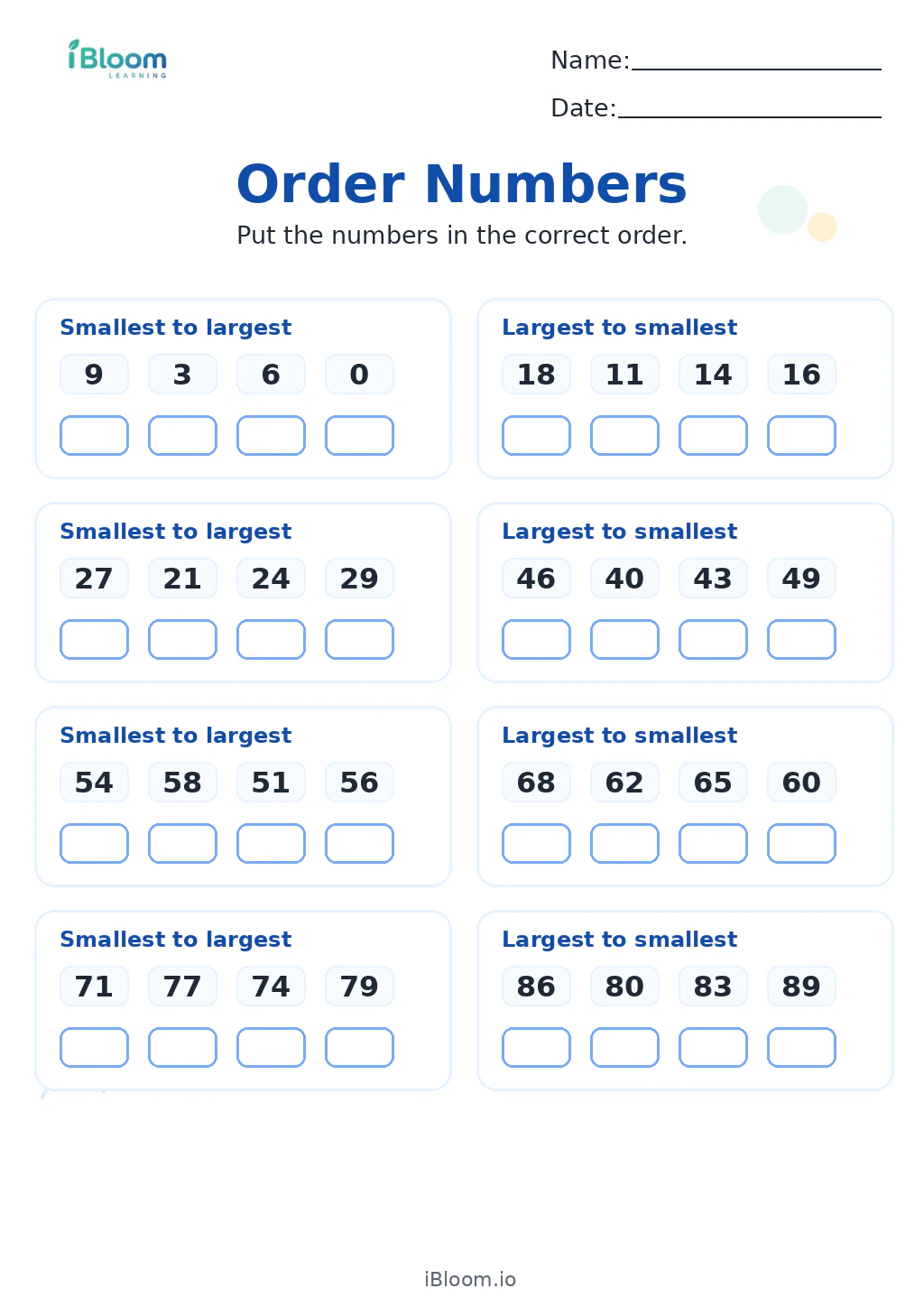
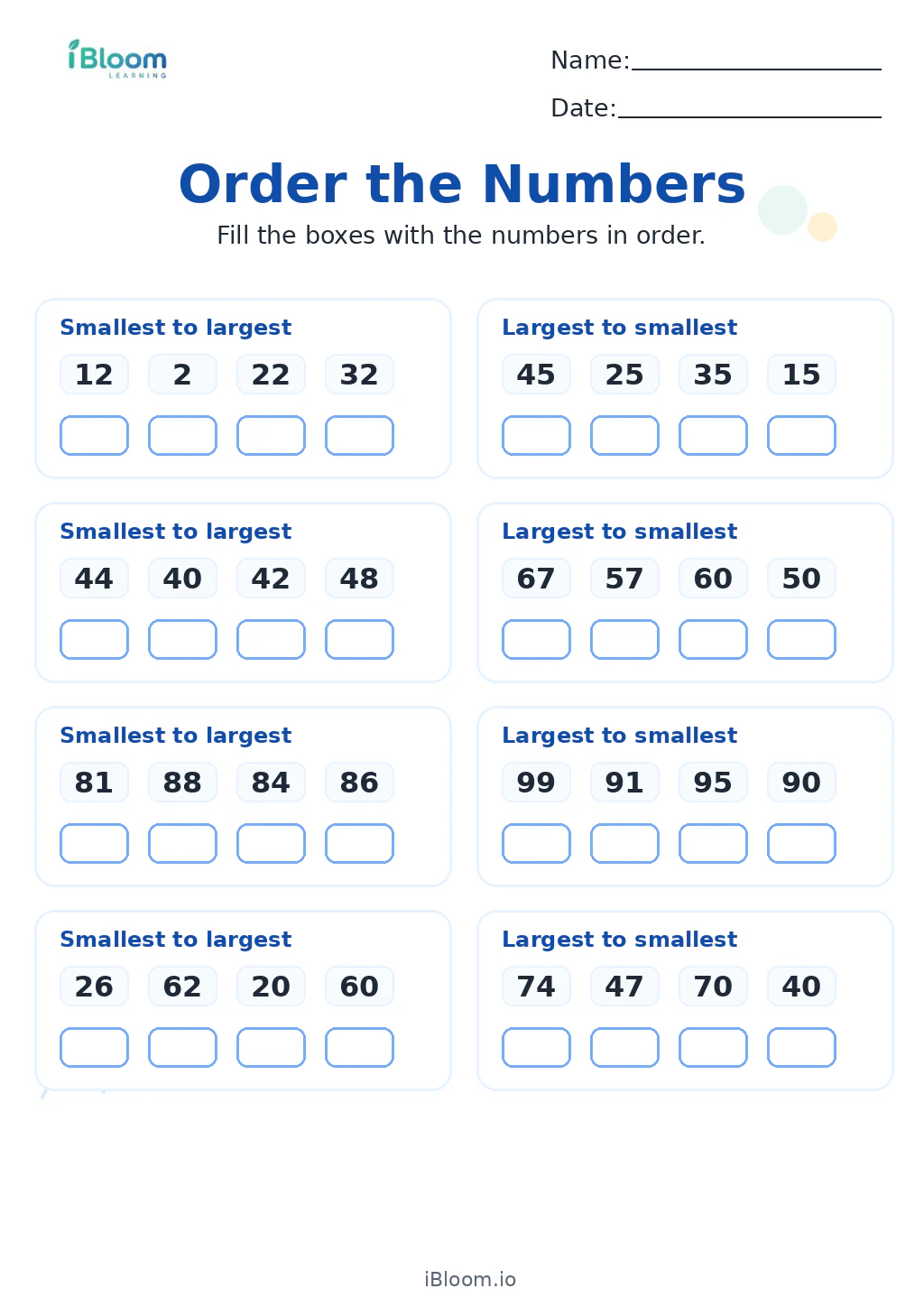
About this worksheet
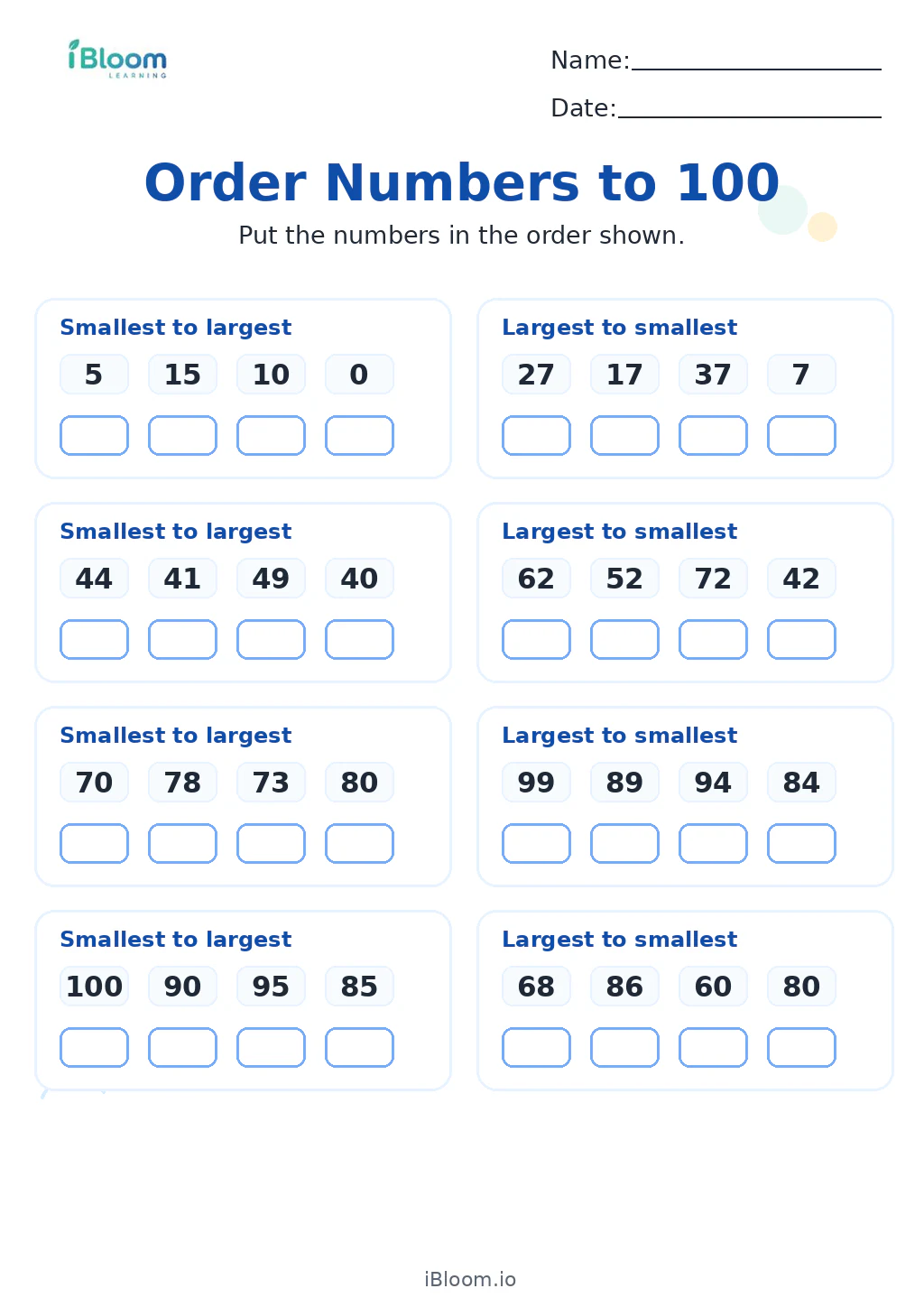
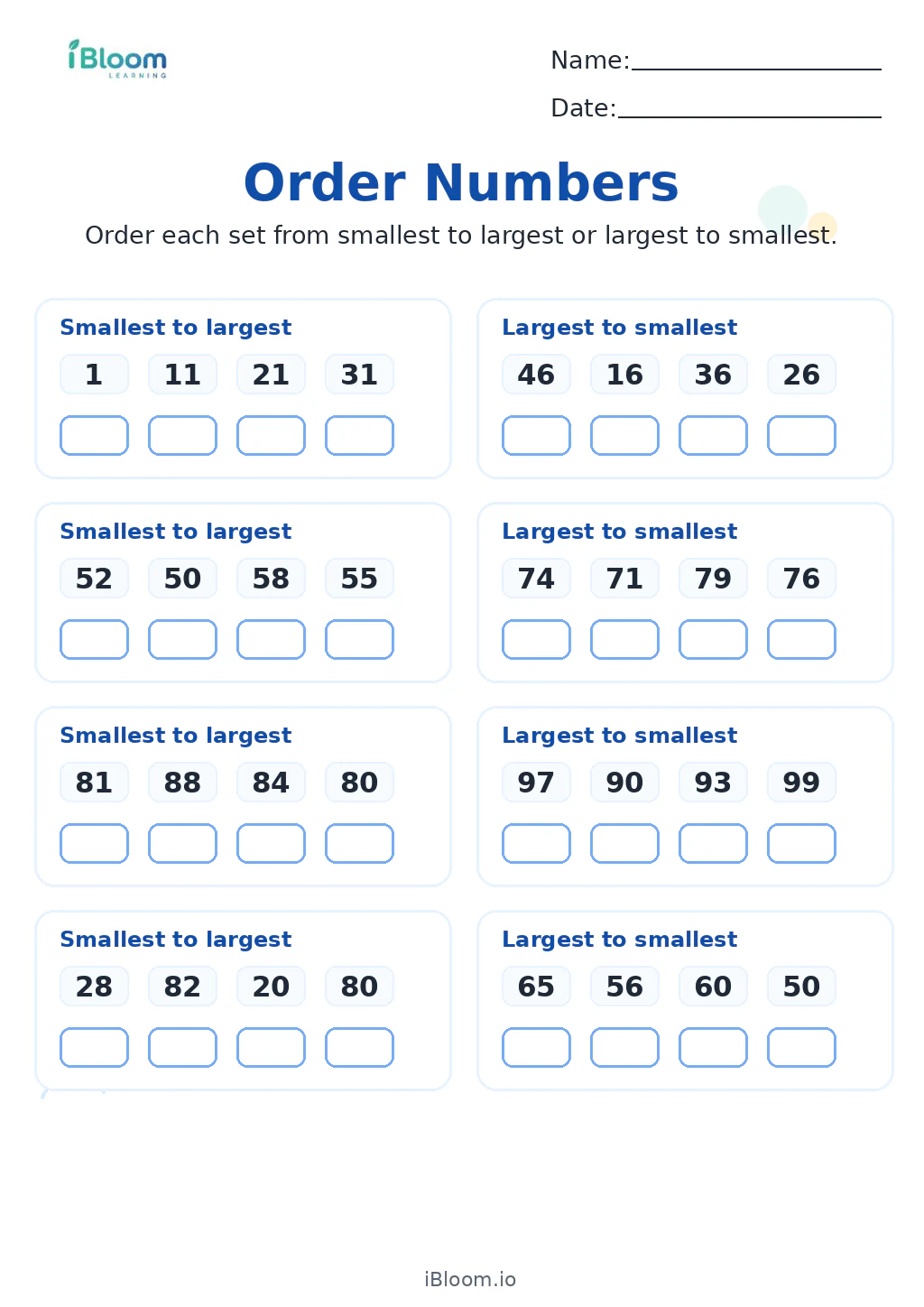
This Grade 1 worksheet practices putting three-number sets in ascending order (least to greatest) and descending order (greatest to least). It includes 14 multiple-choice questions, split evenly between the two directions. The largest number is 94, and the answer key identifies the correctly ordered sequence for each set.
What does this worksheet include?
The worksheet has 14 multiple-choice questions. Seven ask for least-to-greatest order and seven ask for greatest-to-least order. Each item gives three numbers.
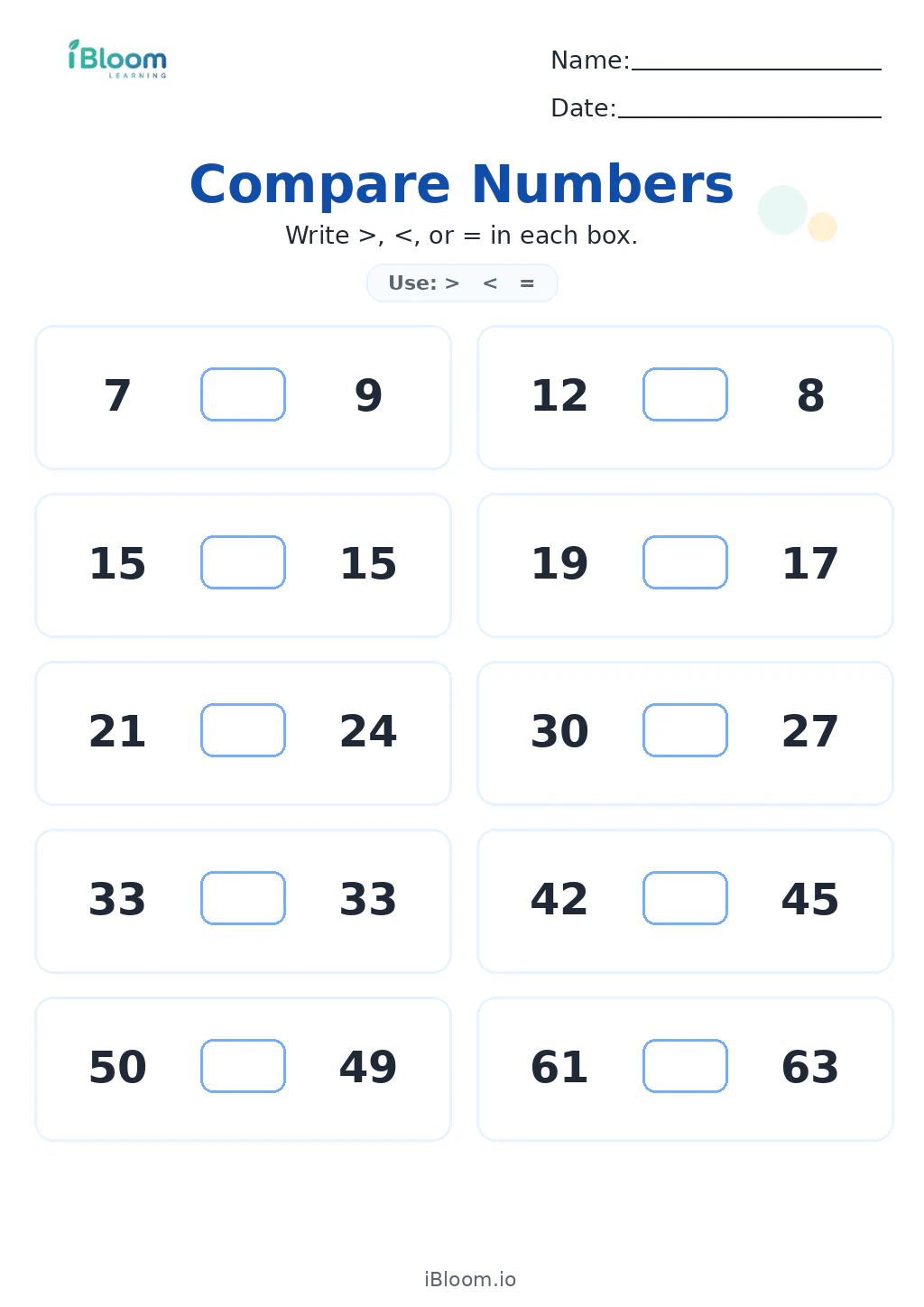
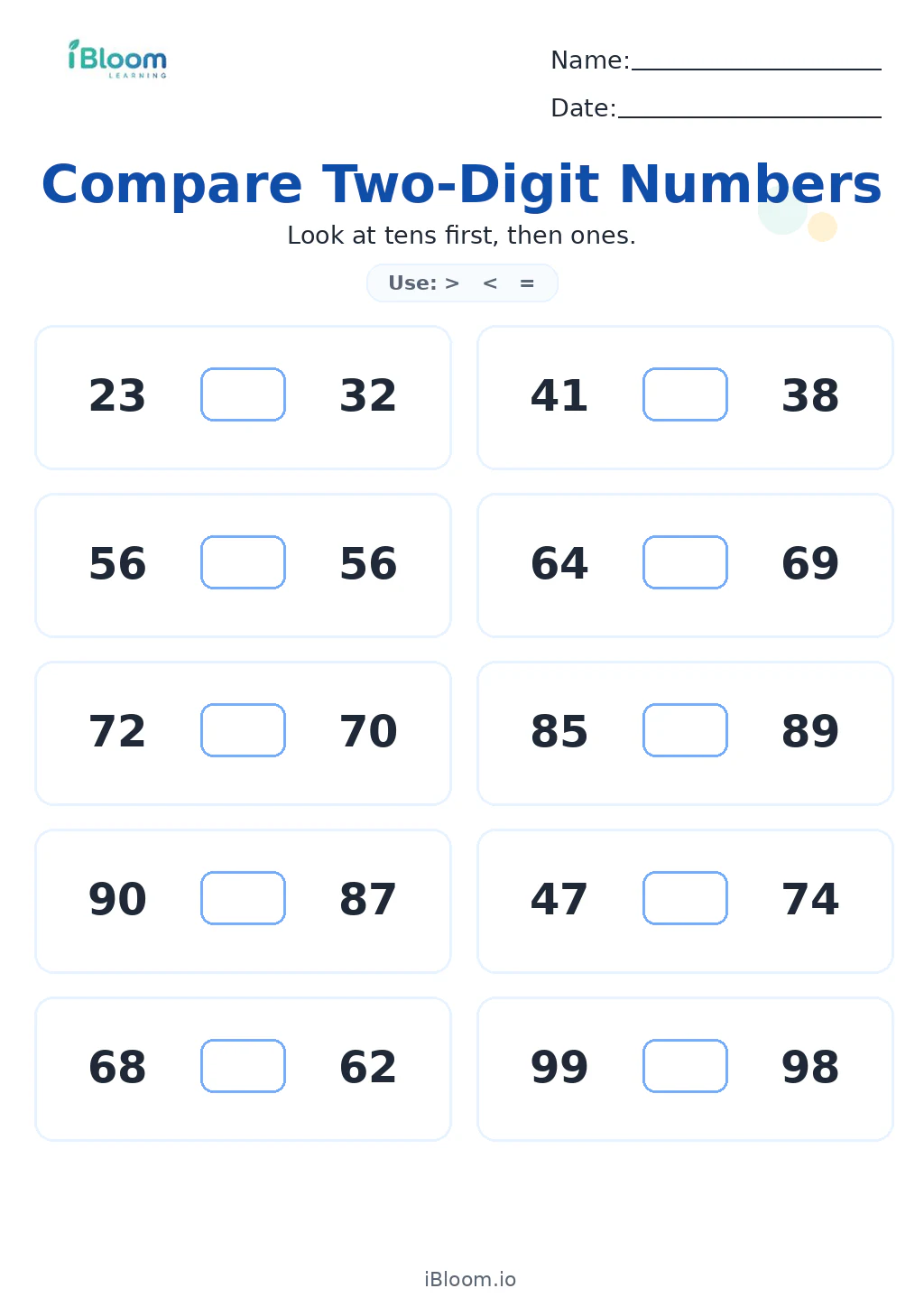
Compare two-digit numbers by tens first. If the tens match, compare the ones to decide which number is smaller or larger.
- 14 questions
- Two ordered practice parts
- Separate answer key
How can students work through an example?
For example, 18, 12, 15 in least-to-greatest order is 12, 15, 18: 12 is smallest, 15 is next, and 18 is greatest.
- 1Numbers: 18, 12, 15
- 2Least to greatest: 12, 15, 18.
How can students check their work?
Check the direction in each prompt, then read every number in the chosen sequence. The key lists the correct sequence for all 14 items.
How can practice build accuracy?
Use the answer key after attempting the questions. For any missed item, redo the comparison, place-value step, sentence clue, or equation check that applies.
How to use this worksheet
- 1Notice whether the question asks for least-to-greatest or greatest-to-least.
- 2Compare the numbers by tens, then by ones.
- 3Find the smallest or largest value first.
- 4Check the other two numbers in order.
- 5Read the full choice once more before marking it.
Common mistakes and quick fixes
The mistake
Reversing ascending and descending.
The fix
Use the direction words: least-to-greatest increases.
The mistake
Comparing only the ones digits.
The fix
Compare the tens first, then compare ones if needed.
The mistake
Checking only the first number in a choice.
The fix
Verify all three numbers follow the requested order.
What to practice next
Make more practice
Questions parents and teachers ask
What is ascending order?
Ascending order goes from least to greatest, so each number is larger than the one before it. For example, 12, 15, 18 is ascending. The first seven questions ask students to choose the ascending sequence from three numbers. All values are within 100.
What is descending order?
Descending order goes from greatest to least, so each number is smaller than the one before it. The last seven questions ask students to choose descending sequences. Have students point out the direction word before comparing the choices. Each set has three values.
How many numbers are in each set?
Each question gives three numbers to put in order. There are 14 questions total, with seven ascending and seven descending. Every item has three answer choices, and only one choice lists all three numbers in the requested order. The highest value is 94.
What is the largest number on the page?
The largest number used is 94. All numbers are within 100. Students compare two-digit numbers by checking tens first and then ones when the tens digits match. This comparison helps them decide which value belongs earlier in the sequence. The separate key lets students review the result after completing the question independently.
How can a student check a sequence?
Read the sequence from left to right and compare each neighboring pair. In ascending order, each next number must be greater; in descending order, each next number must be smaller. Checking all three positions helps catch a choice with only the first value correct.