
About this worksheet
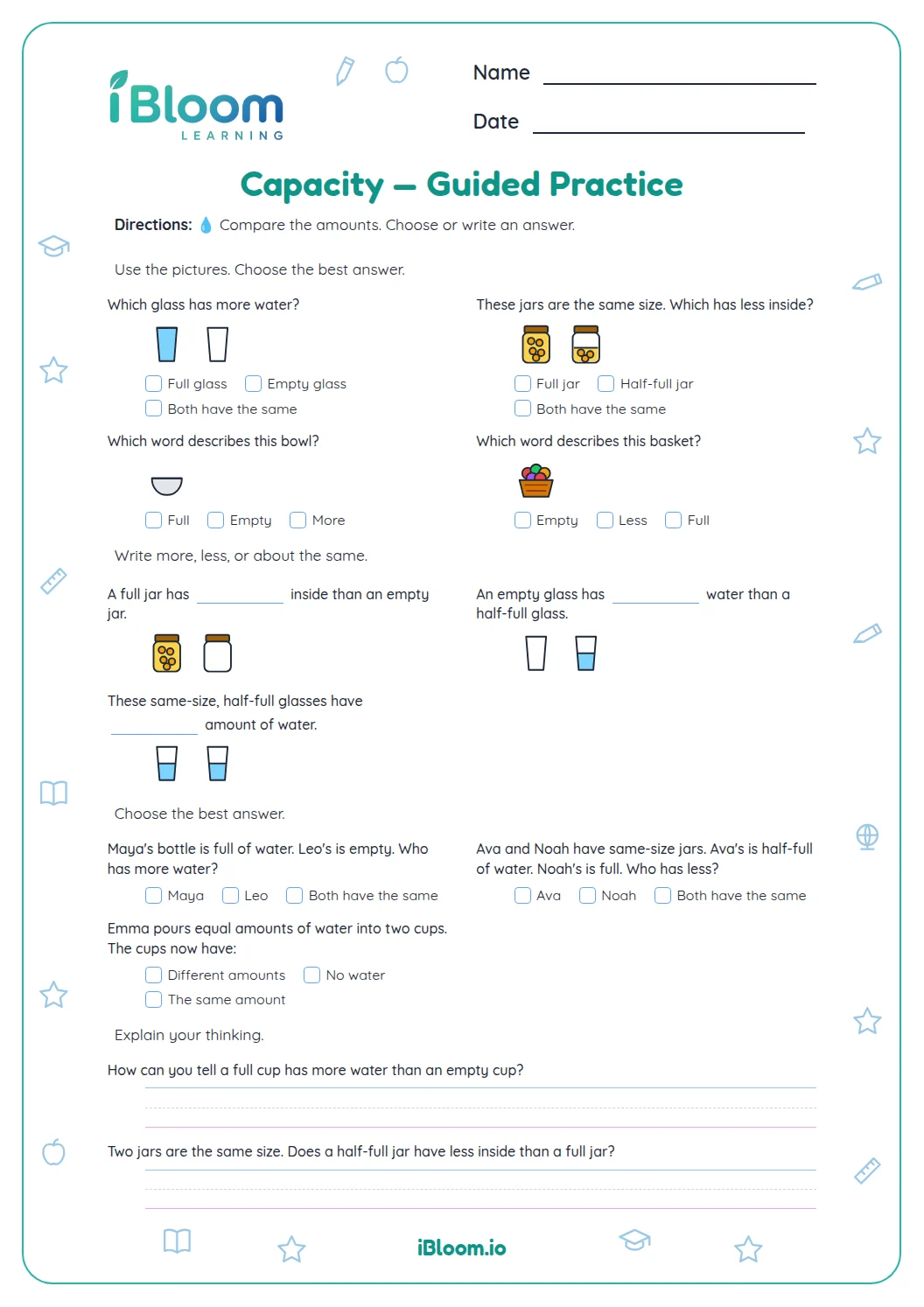
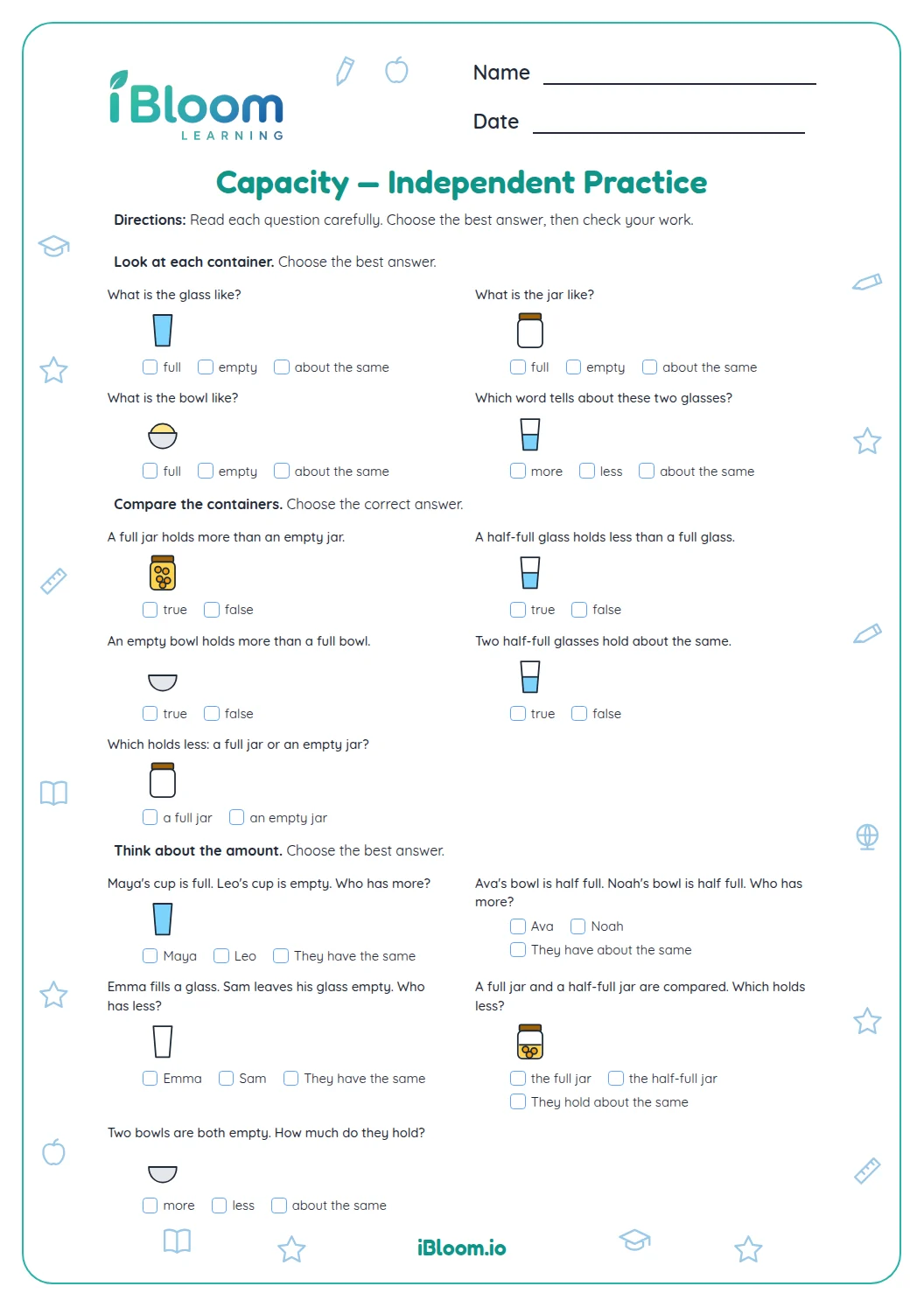
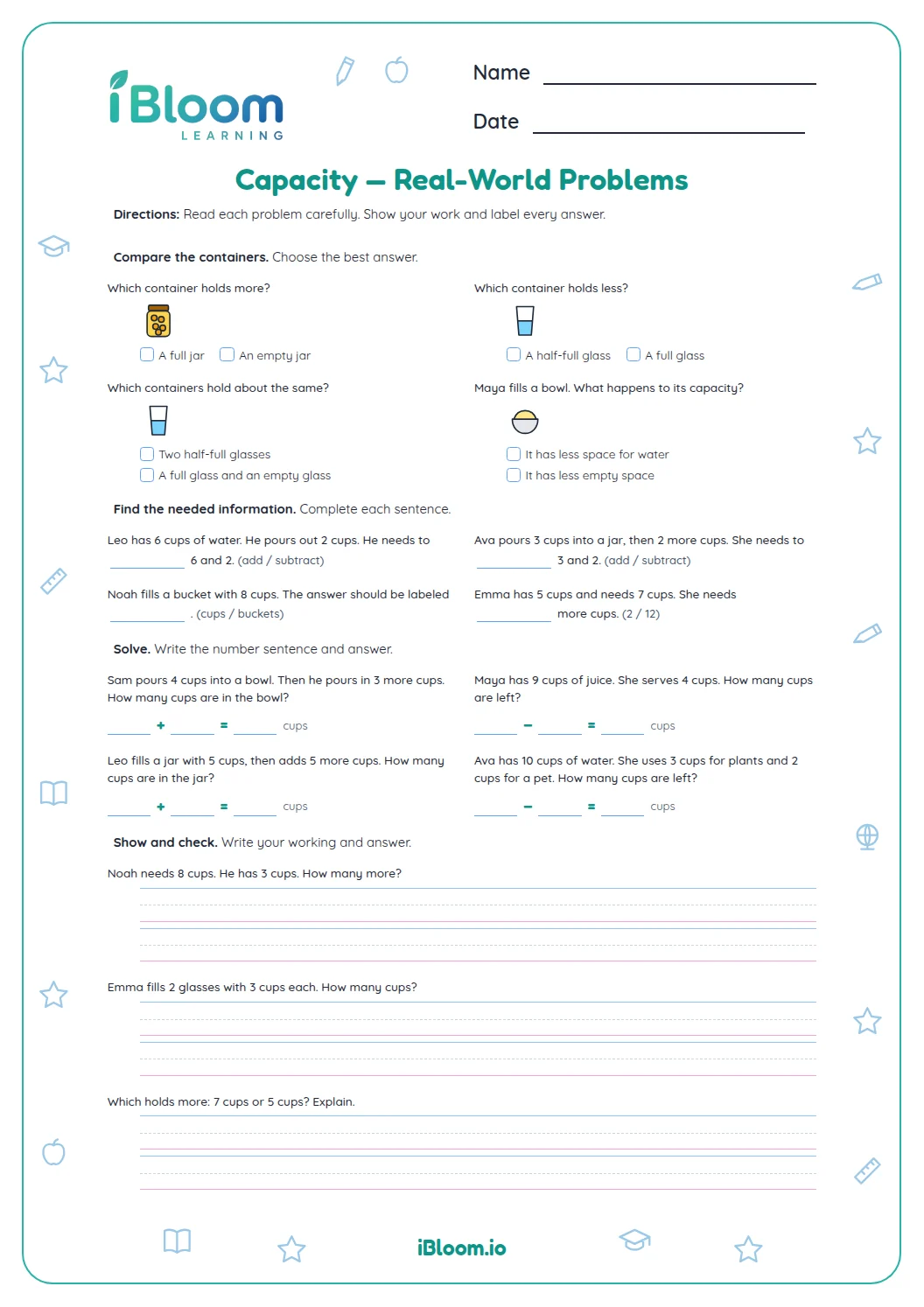
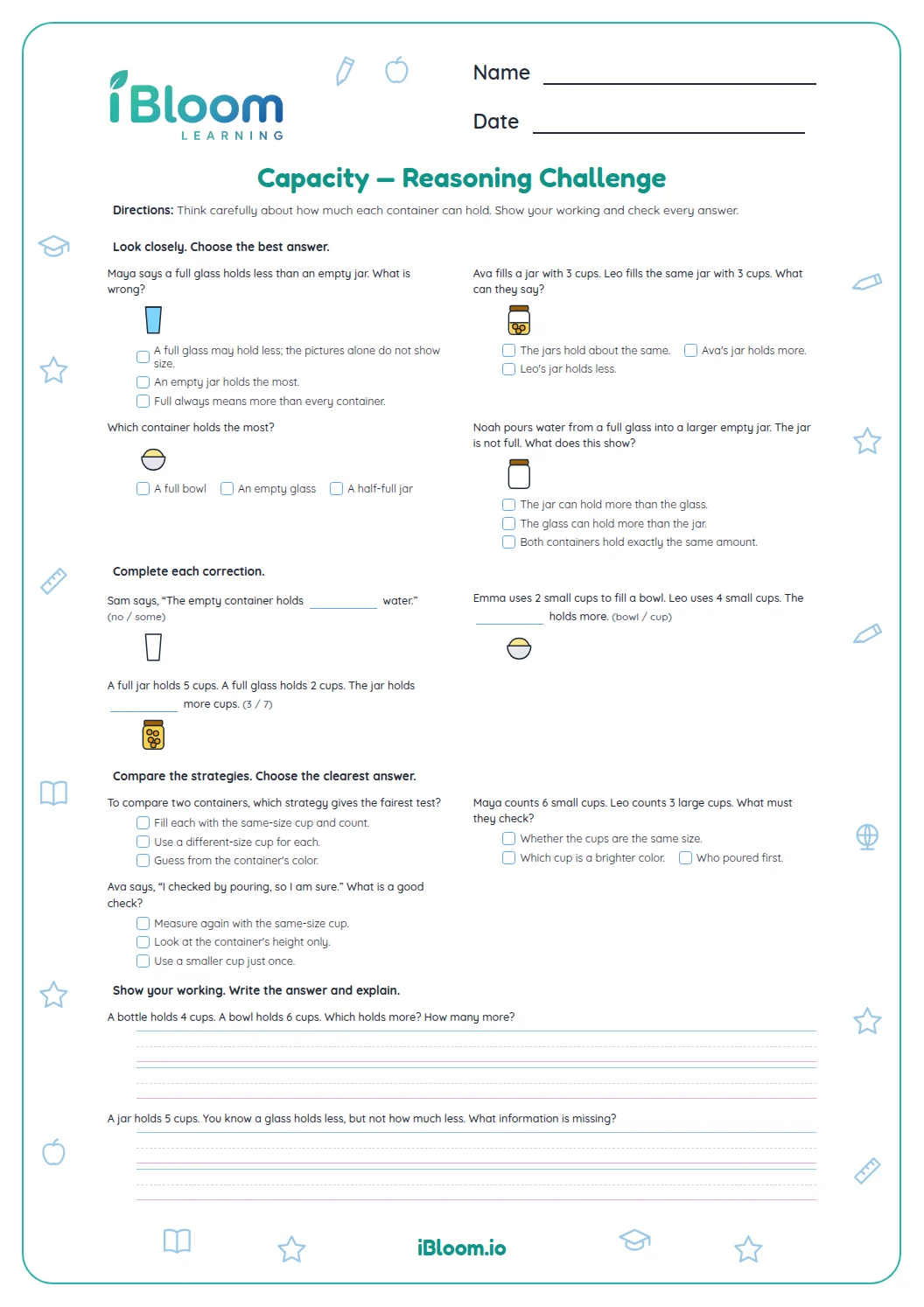
This free printable worksheet is for Grade 1 learners practicing capacity visual models. It moves from reading a visual model to solving a short application, with 15 questions across three parts and a separate answer key. The page explains how to notice the key features, record an answer, and check it. It aligns with K.MD.A.2, which calls for learners to directly compare two objects with a measurable attribute in common..
Aligned to K.MD.A.2
How can children compare capacity?
Capacity describes how much a container can hold. Compare the visible fill levels: a higher fill means more is in that container when the containers are alike. This sheet uses clear fill models so children can practice the comparison directly.
- 1Look at A and B.
- 2A is filled to 20%.
- 3B is filled to 80%.
- 4B holds more.
Which ideas appear on the page?
Children compare pairs, find the fullest of three, and match everyday words such as half full and nearly full to a model.
How to use this worksheet
- 1Point to the bottom and top of each fill.
- 2For two containers, identify which fill reaches higher.
- 3For three, compare each level before choosing.
- 4Use “half,” “nearly full,” and “small amount” as clues.
- 5Check the answer letter against the model.
Common mistakes and quick fixes
The mistake
Choosing the container with less fill; compare the heights again.
The fix
Read the directions again, mark the important information, and check the answer against the model or operation.
The mistake
Calling a container empty when it has a small fill; look for the zero mark.
The fix
Read the directions again, mark the important information, and check the answer against the model or operation.
The mistake
Mixing up fullest and least; say “more” or “less” before choosing.
The fix
Read the directions again, mark the important information, and check the answer against the model or operation.
Common Core alignment
This worksheet practices the following Common Core skill.
Directly compare two objects with a measurable attribute in common.
On this sheet: The questions ask learners to directly compare two objects with a measurable attribute in common..
Show the official wordingHide the official wording
Directly compare two objects with a measurable attribute in common, to see which object has “more of”/“less of” the attribute, and describe the difference.
What to practice next
Make more practice
Further reading
Questions parents and teachers ask
What does capacity mean here?
Capacity is how much a container can hold. The drawings show different fill amounts so children can compare which matching container holds more or less. This worksheet focuses on direct visual comparison. Children can point to the fill line and use it as evidence for their choice.
How do I explain half full?
Half full means the liquid reaches about halfway from the bottom to the top. In the model, compare the fill with the container’s midpoint. It is a useful everyday description that connects a familiar word to a visible amount. Ask the learner to explain the clue they used so the answer connects back to the skill.
Why compare the fill heights?
The containers in each question are drawn with the same scale and shape, so a higher fill shows more capacity currently held. Children should compare the liquid level from the bottom rather than the empty space above it. Ask the learner to explain the clue they used so the answer connects back to the skill.
Can the same container be both full and have capacity?
Capacity is the total amount the container can hold, while the fill level shows how much is inside now. A nearly full container has little empty space left. This worksheet asks children to compare the visible amount inside. Ask the learner to explain the clue they used so the answer connects back to the skill.
How can children check their choice?
Have them point to the fill line in each container and explain which one is higher. For fullest or least, compare all the levels in order. A clear explanation of the visual evidence is a good check alongside the answer key.