



About this worksheet
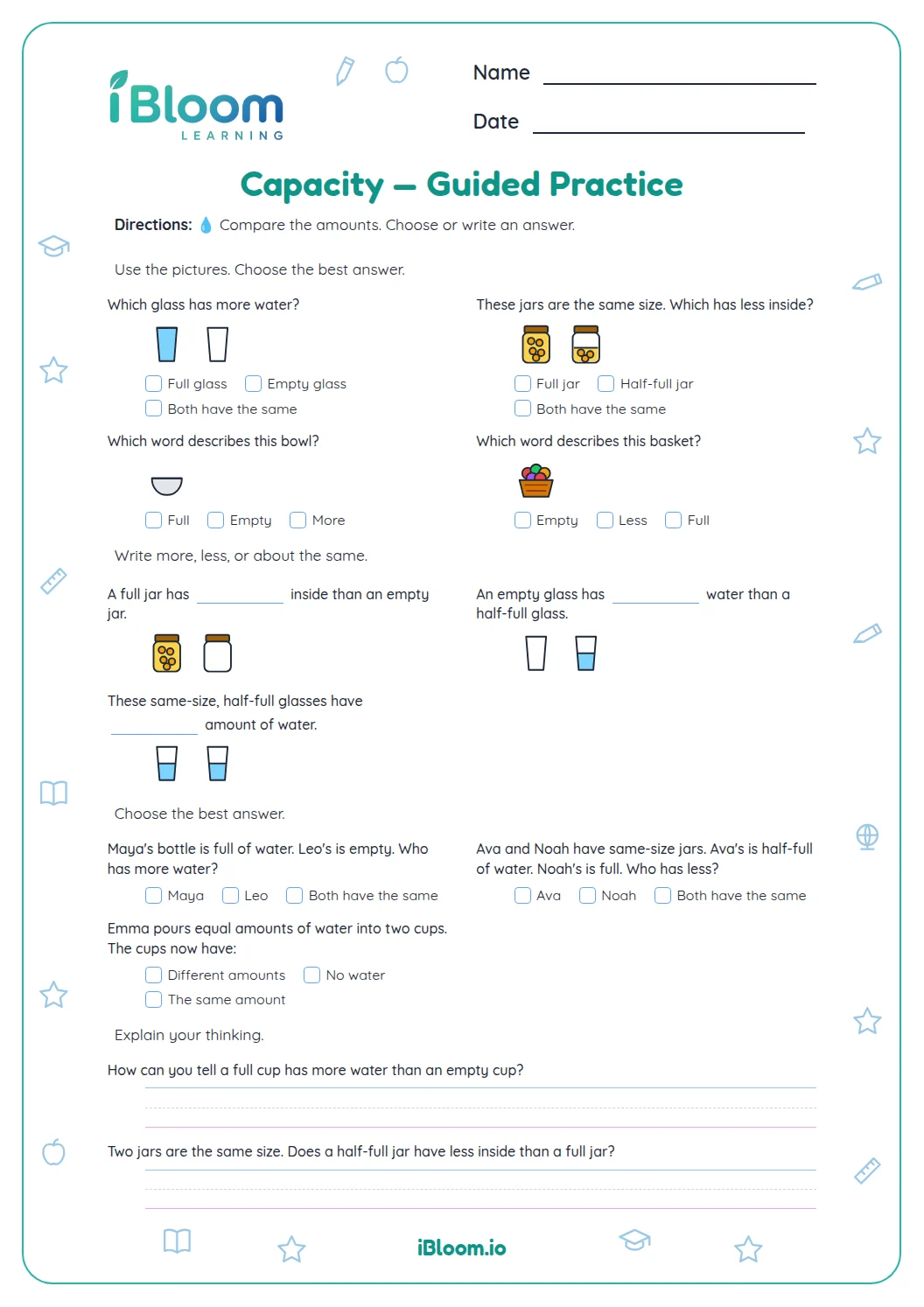
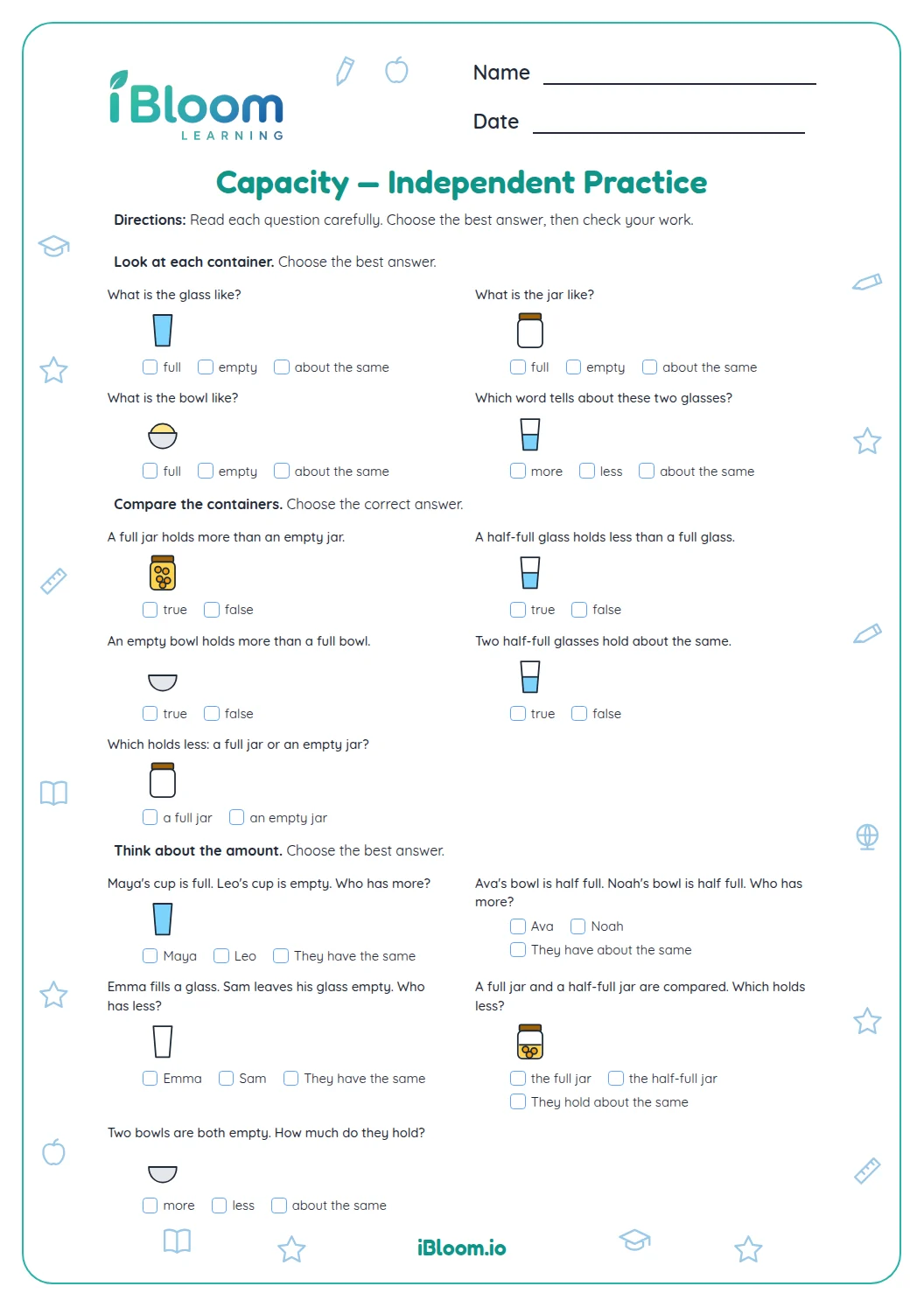
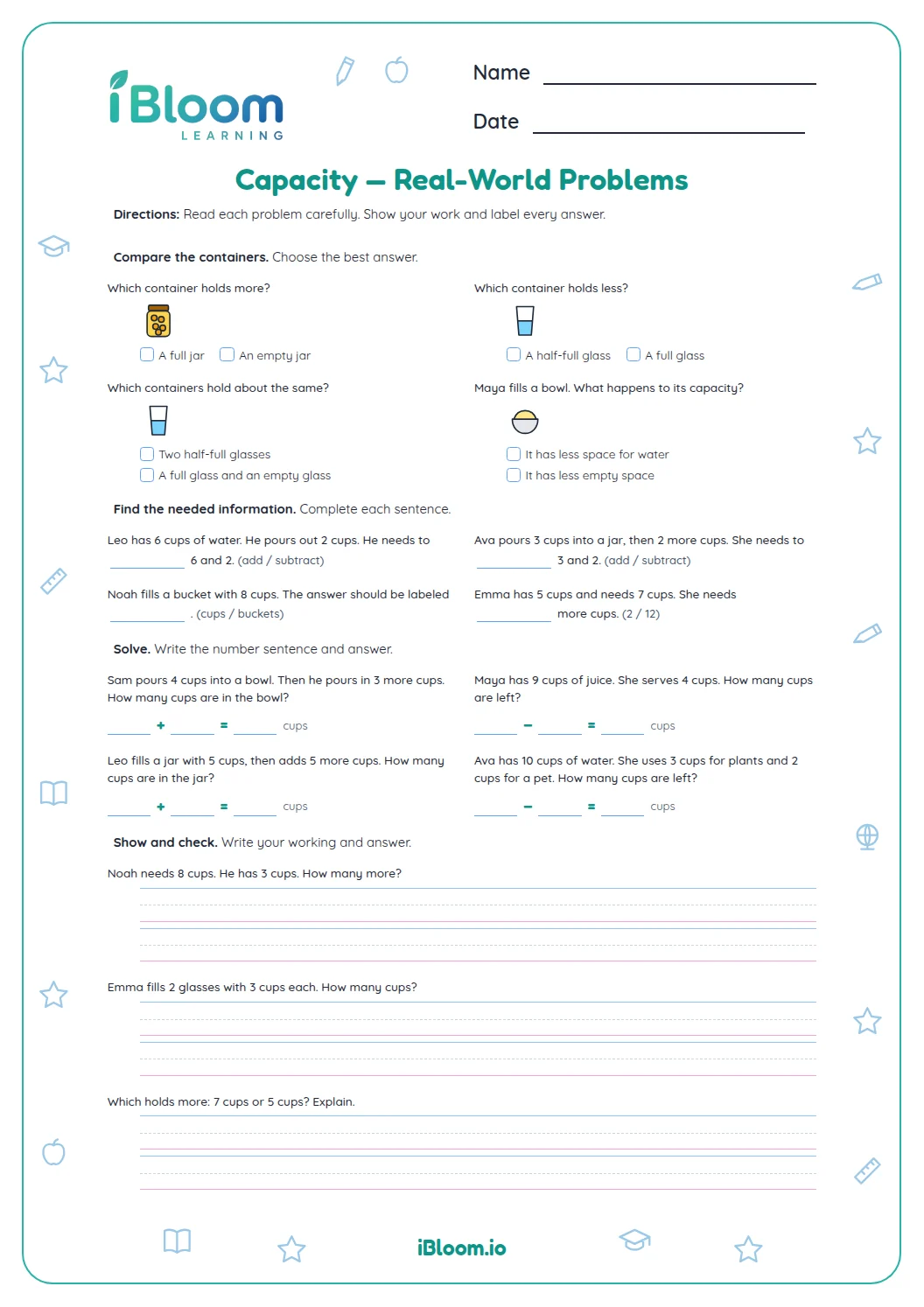
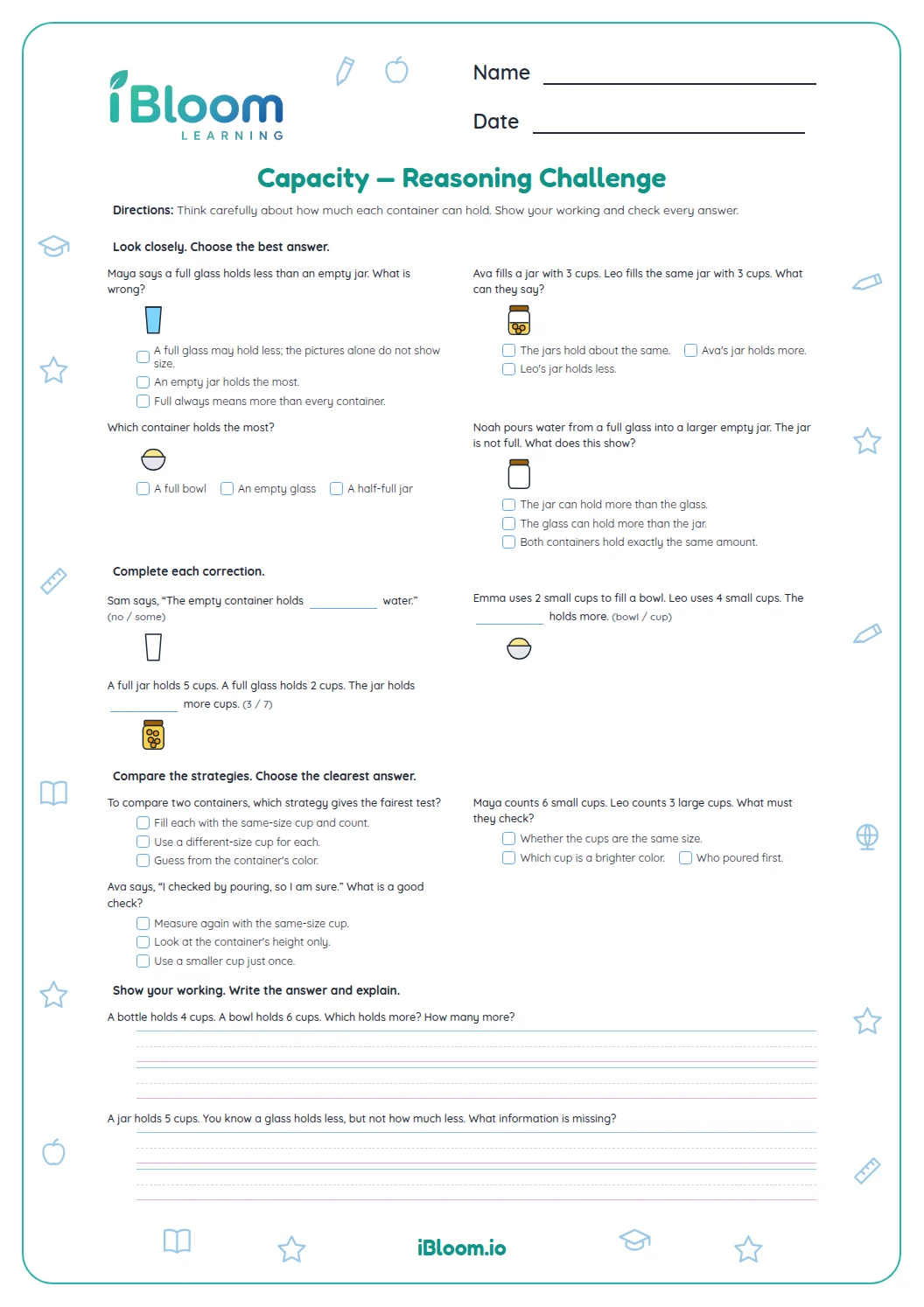
This free printable Grade 1 worksheet uses container drawings and short sentences to practice capacity words. Part A identifies empty, full and half-full containers. Parts B and C use full, empty, more, less and about the same to describe liquid amounts, including direct comparisons of same-size containers. The 16 questions move from naming a fill level to comparing amounts in familiar contexts. The worksheet practices Common Core K.MD.A.2 by comparing the measurable attribute of capacity. A separate answer key is included.
Aligned to K.MD.A.2
Which capacity words appear on the sheet?
Children choose or write full, empty, more, less and about the same. The Learn section introduces full cups and empty jars. Complete each idea asks children to supply words from two choices printed beside each blank.
The final section returns to these words in sentences about bottles, cups and glasses. Read the whole sentence after filling a blank so children hear how the comparison word fits.
How can an adult explain full and empty?
Empty means there is no liquid inside. Full means the liquid reaches the container’s usable top. Ask the child to point to the inside of the container while saying the word, rather than judging its outside size.
In the first blank in Complete each idea, the clue is “no liquid.” The choices are empty and full, so empty completes the sentence.
- 1A container with no liquid is ___ .
- 2Choices: empty / full
- 3No liquid means empty.
- 4Read it again: A container with no liquid is empty.
How should we talk about the comparison questions?
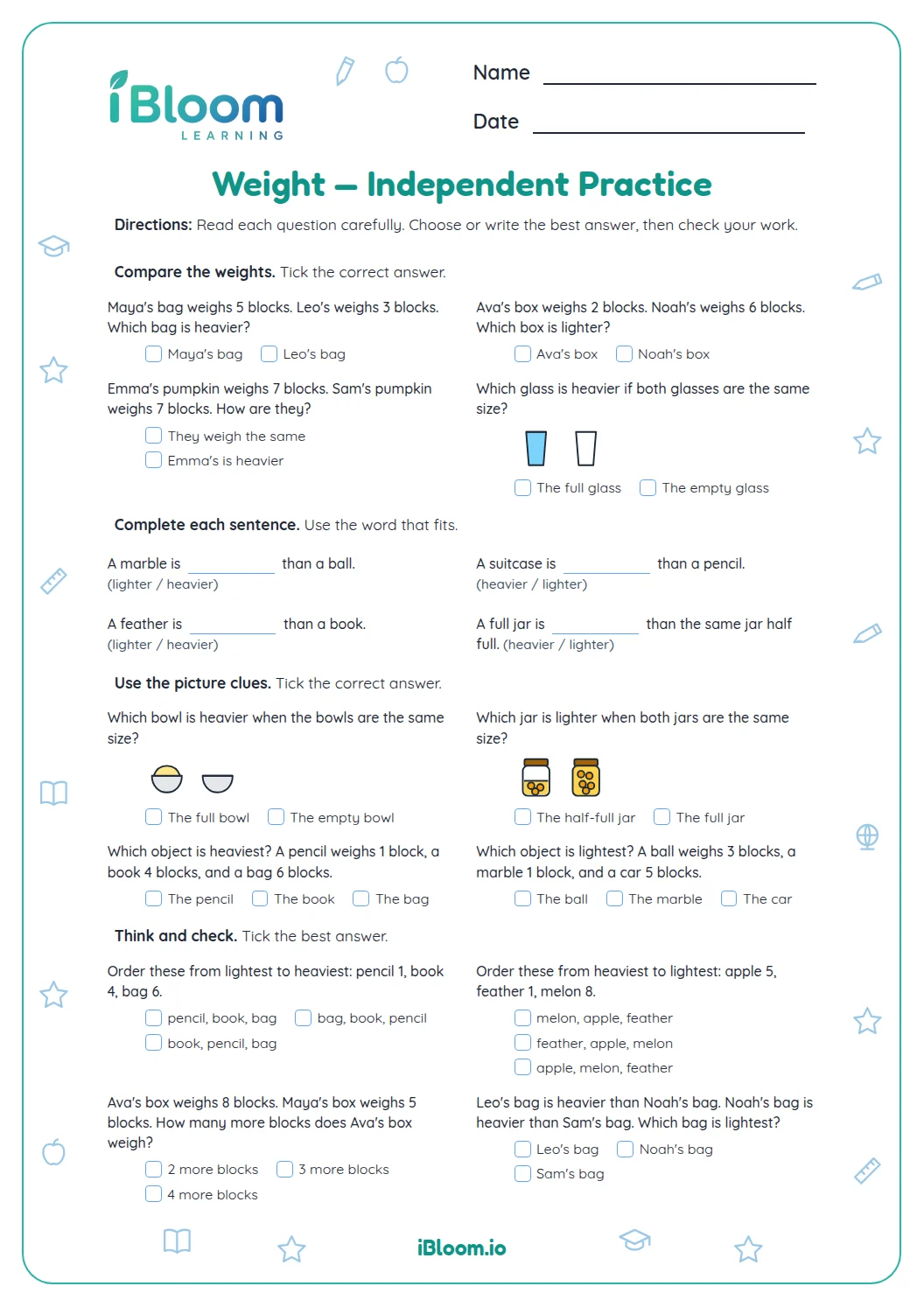
The Compare section names Maya and Leo, Ava and Noah, and Emma and Sam. It asks about full and half-full glasses, empty and full jars, and two half-full bowls. Discuss the amount inside each container before selecting a name or comparison.
For full-versus-half-full comparisons, use matching containers when demonstrating with real objects. A full small cup and a half-full large bowl need a different comparison because their capacities differ. The printed questions about glasses and bowls are best discussed with that equal-size assumption made explicit.
Read and discuss the capacity words
- 1Read the Learn section together and point to each container illustration.
- 2Skip the nearly-full item while using this draft; its choices and key need correction.
- 3Complete the four sentence blanks using the printed word choices.
- 4Use matching cups to discuss the three named comparison situations.
- 5Finish the four math-word blanks and reread each completed sentence.
Mistakes to watch for
The mistake
Treating “full” as another word for a large container.
The fix
Talk about the amount inside. A small cup can be full, and a large container can be empty.
The mistake
Assuming any two half-full containers contain equal amounts.
The fix
Use containers of the same size and shape when comparing their fill levels.
The mistake
Using “more” when the sentence asks who has less.
The fix
Name the empty or lower amount first, then reread the question before choosing.
Common Core alignment
Compare containers and describe amounts using more, less and about the same.
On this sheet: The comparison questions ask children to describe which container has more or less and identify equal amounts.
Show the official wordingHide the official wording
Directly compare two objects with a measurable attribute in common, to see which object has “more of”/”less of” the attribute, and describe the difference. For example, directly compare the heights of two children and describe one child as taller/shorter.
What to practice next
Make more practice
Further reading
Questions parents and teachers ask
What does capacity mean?
Capacity is how much a container can hold. This worksheet also asks children to describe the amount currently inside, using fill-level words such as empty, half full, and full in the illustrated containers. In the opening questions, children point to the container that matches the word.
How is capacity different from the amount inside?
Capacity describes how much a container can hold when full, while fill level describes how much is inside now. The sheet uses equal-size containers for direct comparisons so children can compare amounts fairly. A picture example reinforces the difference before children work with the word choices.
What words will children practice?
Children identify empty, full, and half full, then use more, less, and about the same. They read a short sentence or compare the fill levels in container drawings to practice the words in context. Adults can invite children to say the full sentence after choosing an answer.
Why compare containers of the same size?
Equal-size containers make fill levels easier to compare. A half-full cup contains less liquid than a full cup of the same size, while different-sized containers could make the comparison unclear for a beginning learner. The drawings make the comparisons concrete, and the sentence gives children the word to use.
Can an adult read the worksheet aloud?
Yes. Read each short prompt and let the child point to a container or say the missing word. The fill-level pictures make each question concrete, and the answer key supports a quick check together. Read together at a comfortable pace; children can point first and then name what they see.