





About this worksheet
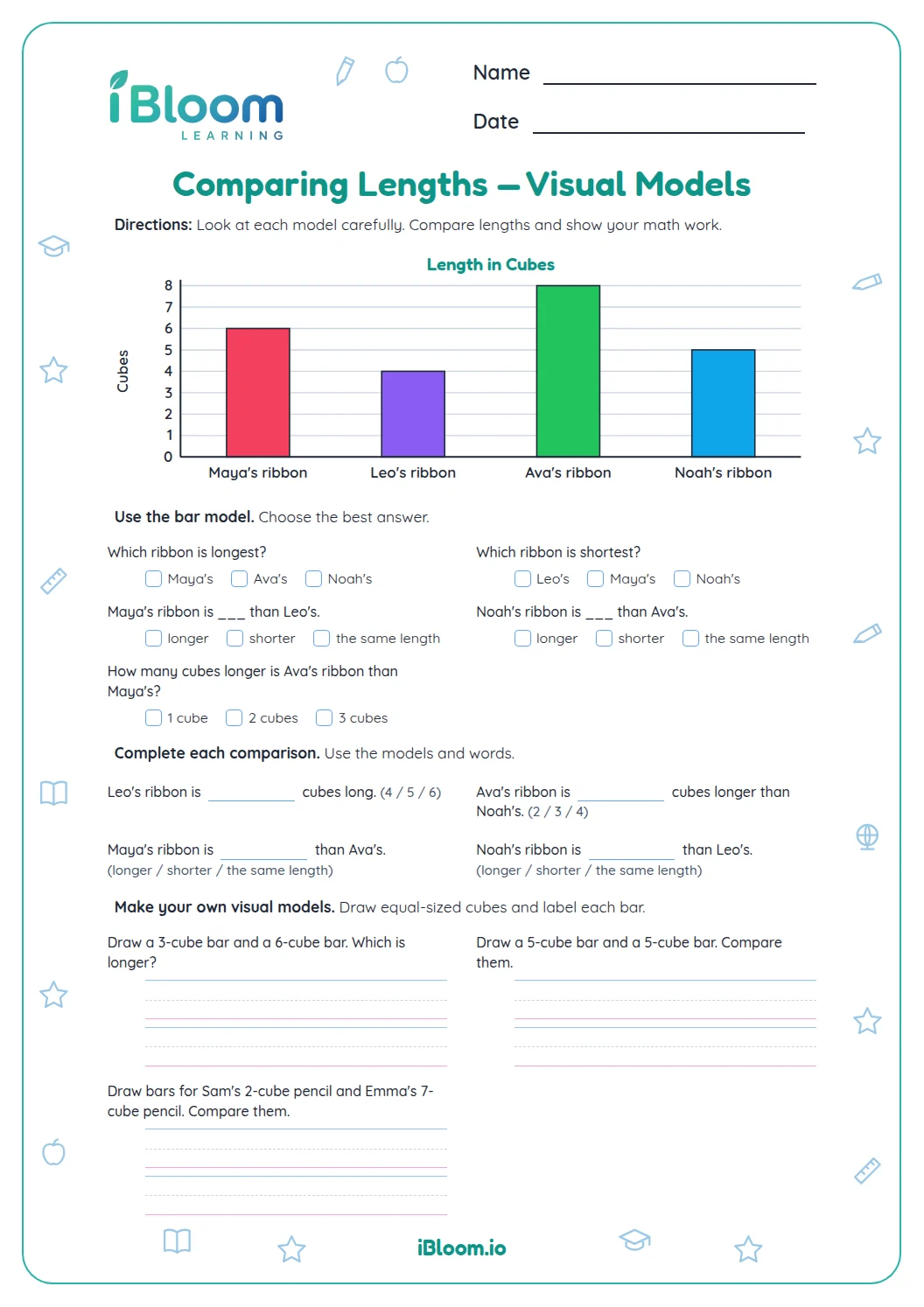
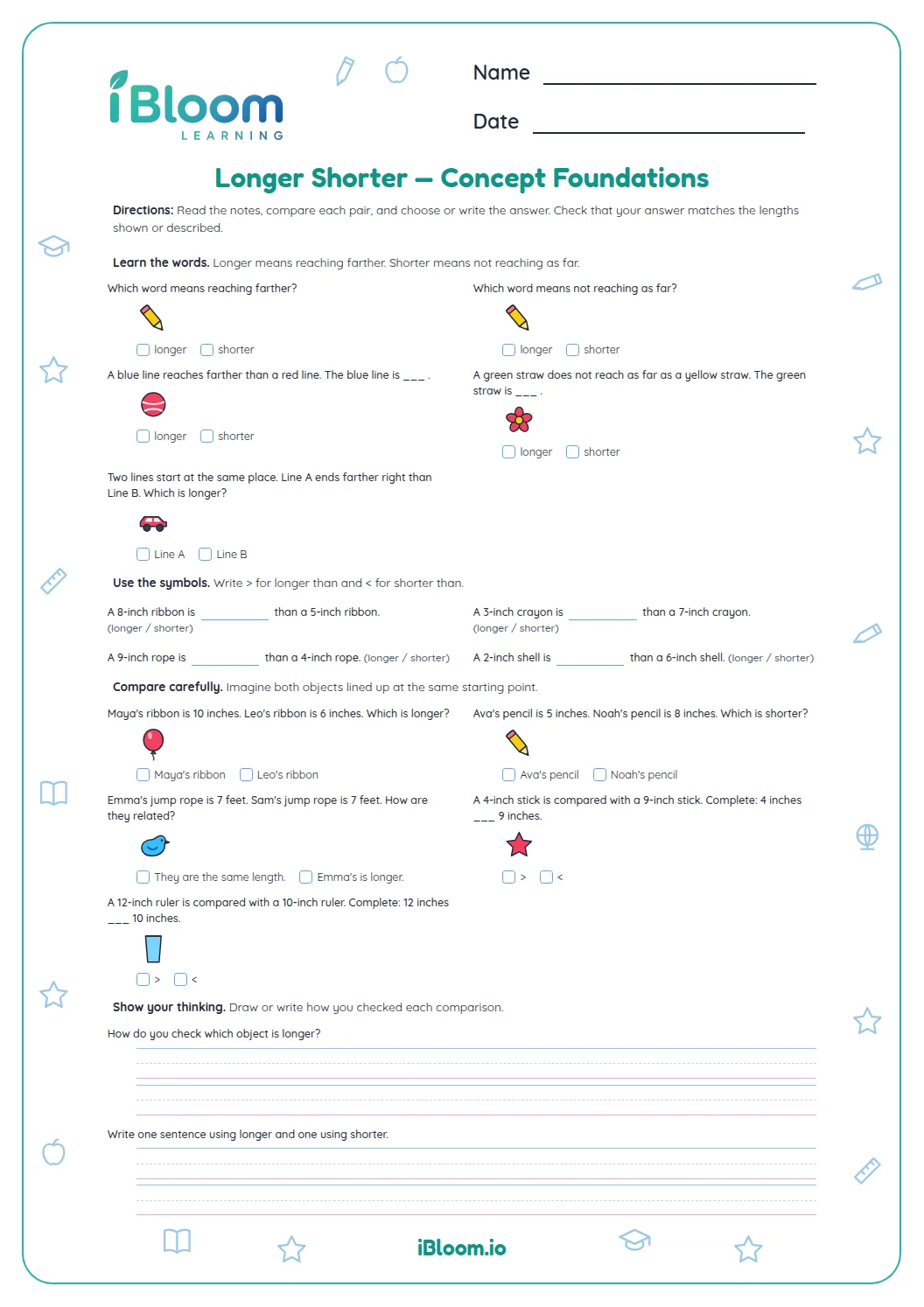
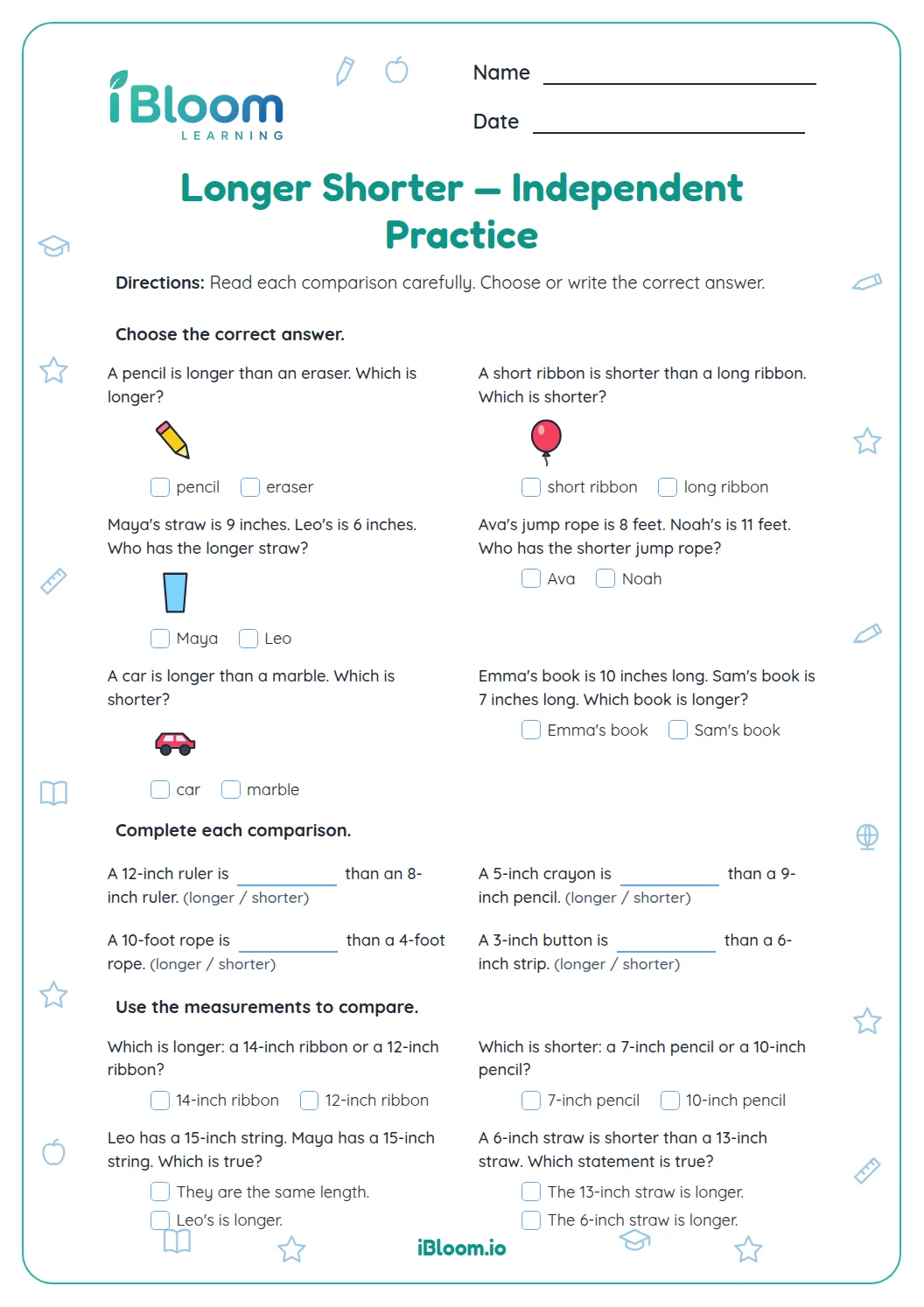
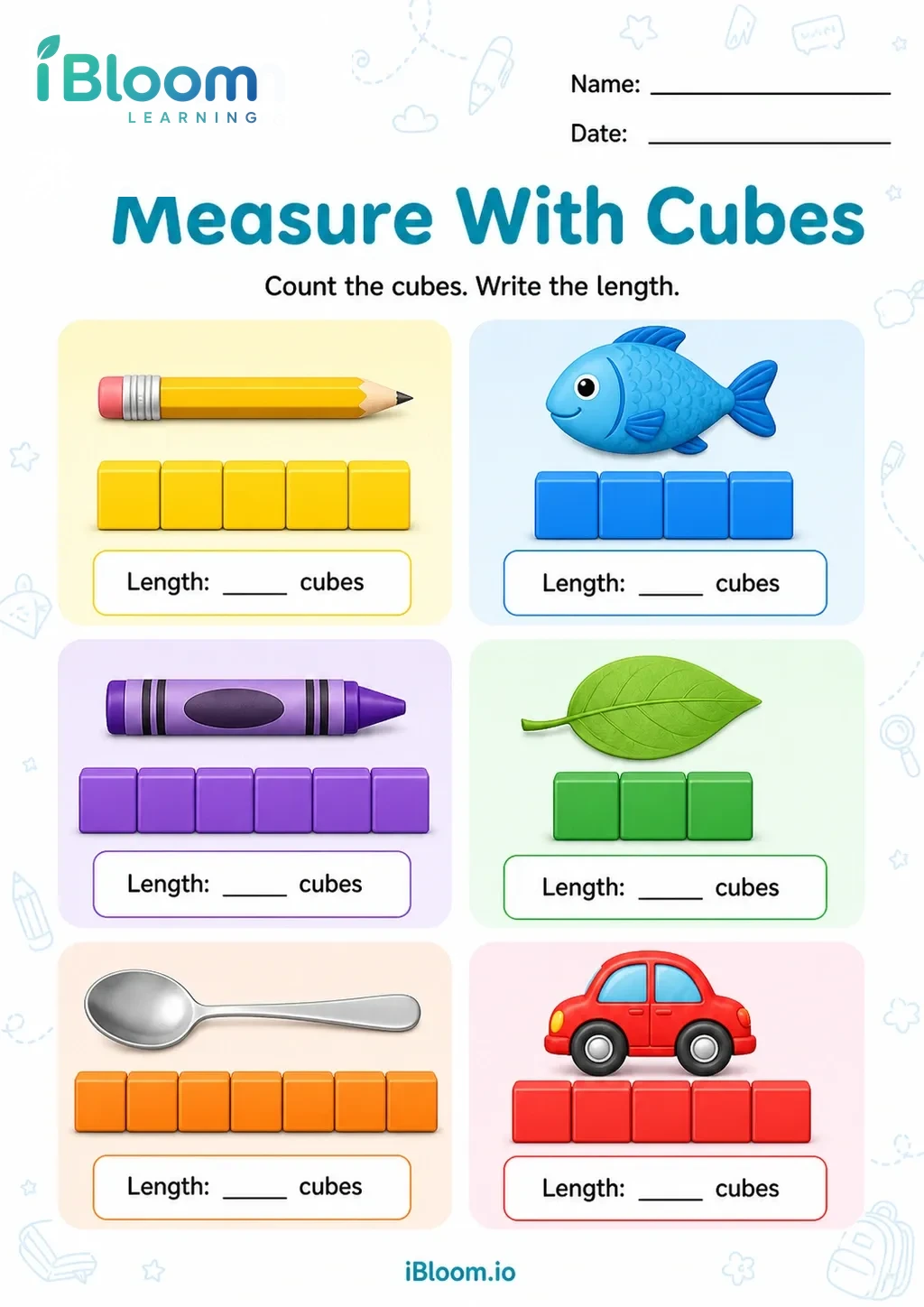
This free Grade 1 worksheet gives children 14 questions about comparing lengths. Part A asks them to compare two objects or order three measurements, all in inches. Part B asks how many inches longer one object is than another. It practices CCSS 1.MD.A.1 by comparing lengths and ordering objects. The answer key is included.
Aligned to 1.MD.A.1
How do you compare two lengths?
Part A begins with three pairs of objects measured in inches. Choose whether the first length is greater, less, or the same as the second.
- 1A pencil is 6 inches; a crayon is 3 inches.
- 26 is greater than 3.
- 3The pencil is longer.
How do you put three lengths in order?
The rest of Part A gives three measurements to arrange from shortest to longest. Start with the least number, then check that each next length is greater.
How do you find a missing length difference?
Part B asks how many inches longer one object is. Subtract the shorter measurement from the longer one, then write the missing number. For question 8, 9 − 5 = 4, so the ribbon is 4 inches longer.
How can you use this worksheet?
- 1Read both measurements and check that they use inches.
- 2For questions 1–3, compare the two lengths.
- 3For questions 4–7, put the values from least to greatest.
- 4For questions 8–14, subtract the shorter length from the longer one.
- 5Check a difference by adding it to the shorter length.
What mistakes can learners check?
The mistake
Choosing the smaller number as longer.
The fix
Compare the numbers before naming an object.
The mistake
Putting the longest measurement first in a shortest-to-longest list.
The fix
Start with the least number and check the order left to right.
The mistake
Subtracting the longer length from the shorter.
The fix
Take the smaller length away from the larger one.
Curriculum alignment
This page gives learners focused practice with the stated skill.
Compare two lengths and order three objects by length.
On this sheet:
Show the official wordingHide the official wording
Order three objects by length; compare the lengths of two objects indirectly by using a third object.
What to practice next
Make more practice
Further reading
Questions parents and teachers ask
How does the worksheet compare lengths?
Part A uses measurements in inches so learners can compare the numbers directly. Three questions compare two objects, and four put three lengths in order from shortest to longest. For example, a 6-inch pencil is longer than a 3-inch crayon.
How many questions are included?
There are 14 questions in two parts. Part A has three pair comparisons and four ordering choices. Part B has seven short problems asking how many inches longer one object is than another. The answer key lists a response for each item.
What does “how many inches longer” mean?
It asks for the difference between two lengths. Subtract the shorter measurement from the longer one and write the number of inches. If a branch is 7 inches and a twig is 2 inches, the branch is 5 inches longer.
Does the worksheet include an answer key?
Yes. A separate key lists answers to the comparisons, ordering questions, and missing differences. Learners can check a difference by adding it to the shorter length; the total should match the longer measurement, which is a quick way to confirm the subtraction. This check works for all seven Part B items.
How can a child check an ordering answer?
Read the three measurements from left to right and confirm each number is greater than the one before it. For a shortest-to-longest order, begin with the least length and end with the greatest. All three measurements on this sheet use inches.