

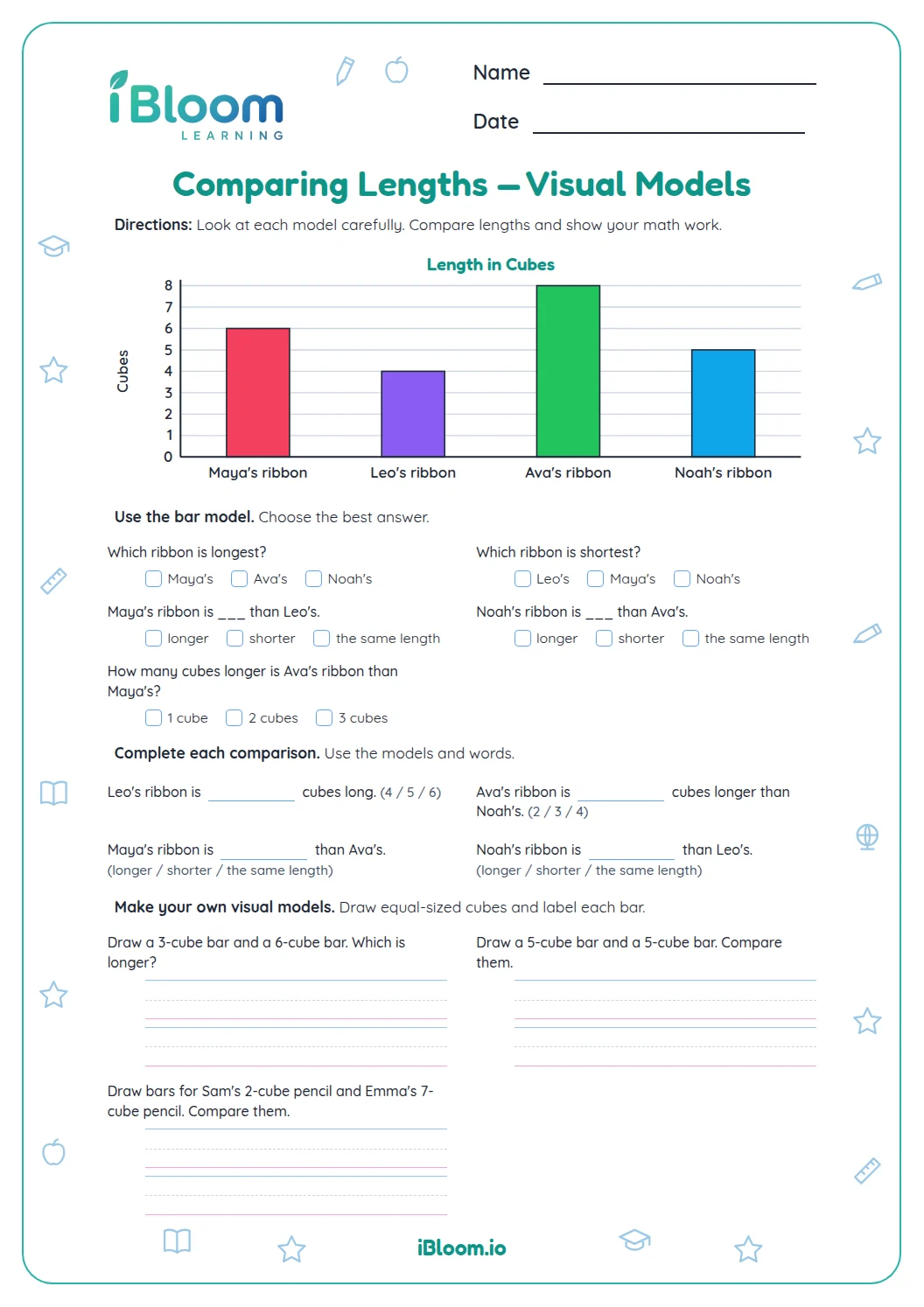

About this worksheet
This Grade 1 printable helps children compare lengths and describe differences using inches and centimeters. The 14 questions include five short measurement situations, five longer/shorter/same choices, two difference problems, and two reasoning items. Part A compares objects with stated measurements; Part B practices comparison words; Part C asks for differences and explanations, including an indirect comparison of three objects. The separate key lists answers and sample reasoning. The page practices CCSS 1.MD.A.1 by comparing and ordering lengths.
Aligned to 1.MD.A.1
How do children compare two lengths?
Read both measurements in the same unit. The larger number names the longer length. If the question asks “how much longer,” find the difference.
Compare both measurements in the same unit. Name the greater or smaller measurement as asked.
- 1Crayon: 5 inches
- 2Pencil: 7 inches
- 37 is greater than 5, so the pencil is longer.
Why should the units match?
A number alone does not tell the whole length. Compare inches with inches or centimeters with centimeters.
How can a difference describe the comparison?
Subtract the shorter measure from the longer measure. A difference of 3 cm means one length is 3 cm longer.
How can I use this worksheet?
- 1Read the name and unit for each object.
- 2Check that both measurements use the same unit.
- 3Compare the numbers to find longer, shorter, or same length.
- 4For “how much longer,” subtract the smaller number from the larger.
- 5Draw or label a line from the same starting point when checking.
Common mistakes and quick fixes
The mistake
Comparing 8 cm with 6 inches as if the units match.
The fix
Compare measurements in the same unit or convert first with adult guidance.
The mistake
Choosing shorter when the number is larger.
The fix
The greater measurement is longer when units match.
The mistake
Giving the longer length instead of the difference.
The fix
For “how much longer,” subtract the shorter measurement.
Common Core alignment
This worksheet practices the following Common Core skill.
Compare lengths directly and use a third object to compare two lengths indirectly.
On this sheet: The three-object comparison uses a middle object to order lengths indirectly.
Show the official wordingHide the official wording
Order three objects by length; compare the lengths of two objects indirectly by using a third object.
What to practice next
Make more practice
Questions parents and teachers ask
How do children decide which measured length is longer?
Read both measurements and check that the units match. When the units are the same, the larger measurement is longer. The questions use familiar objects and measurement situations, then ask children to compare lengths or find a difference.
What does “how much longer” mean?
It asks for the difference between the measurements. Subtract the shorter length from the longer one and keep the same unit. If one ribbon is 8 cm and another is 5 cm, the first is 3 cm longer.
Why are units included with the numbers?
Units tell what is being measured. Eight inches and eight centimeters are not the same length, so children should compare inches with inches or centimeters with centimeters. The worksheet keeps units in its short stories and answers. Learners can say the full measure, including its unit, before deciding which object is longer.
How does the three-object question work?
Question 13 says the paper strip is longer than the crayon, and the crayon is longer than the eraser. The eraser must be shortest. This uses the crayon as a third object to compare the other two indirectly.
Is there an answer key?
Yes. A separate key gives the comparison words, differences, and sample explanations. For the open-response item, accept a different explanation if it correctly compares the stated lengths and keeps the units clear. Check the key after the learner tries each problem.