
About this worksheet
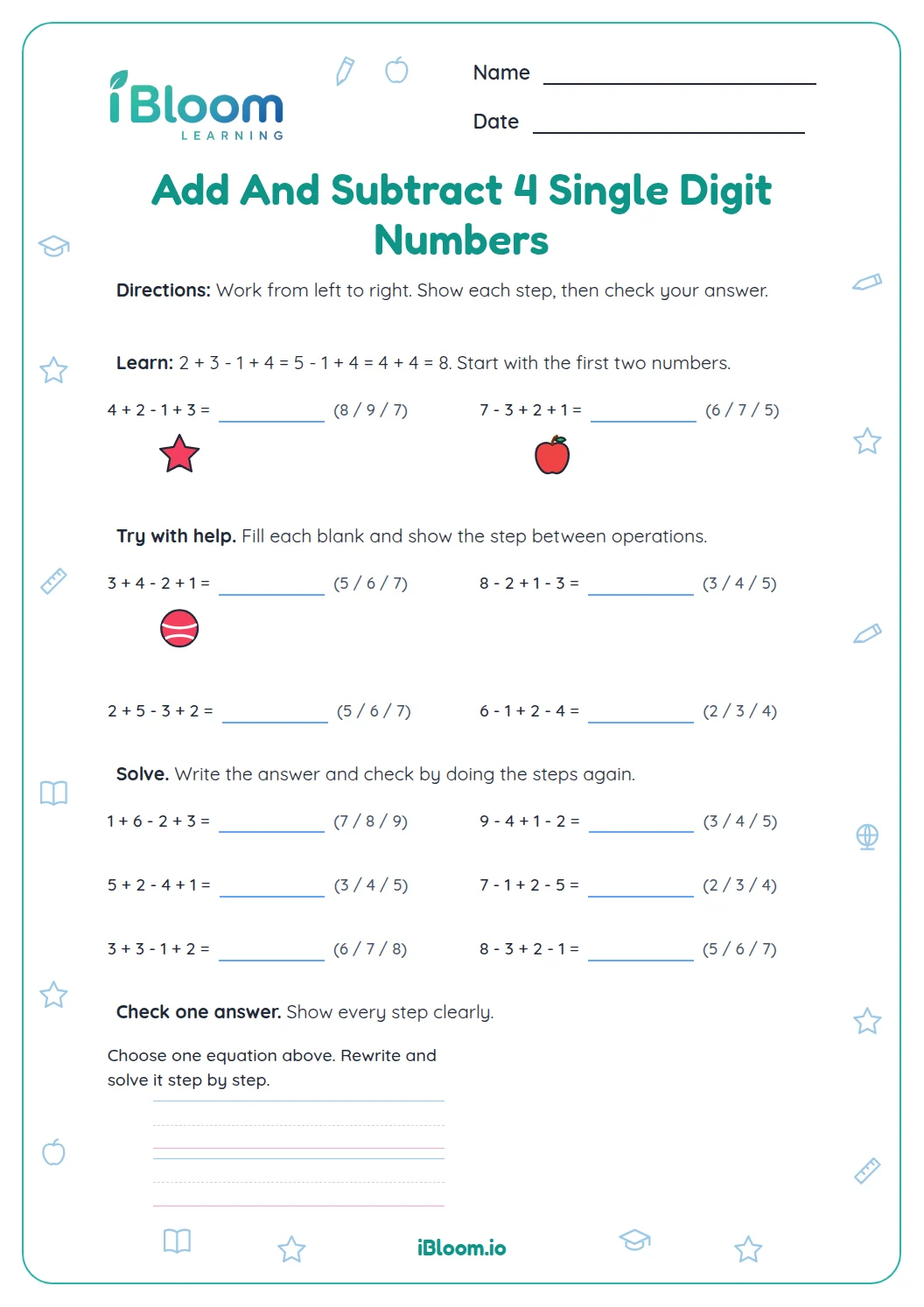
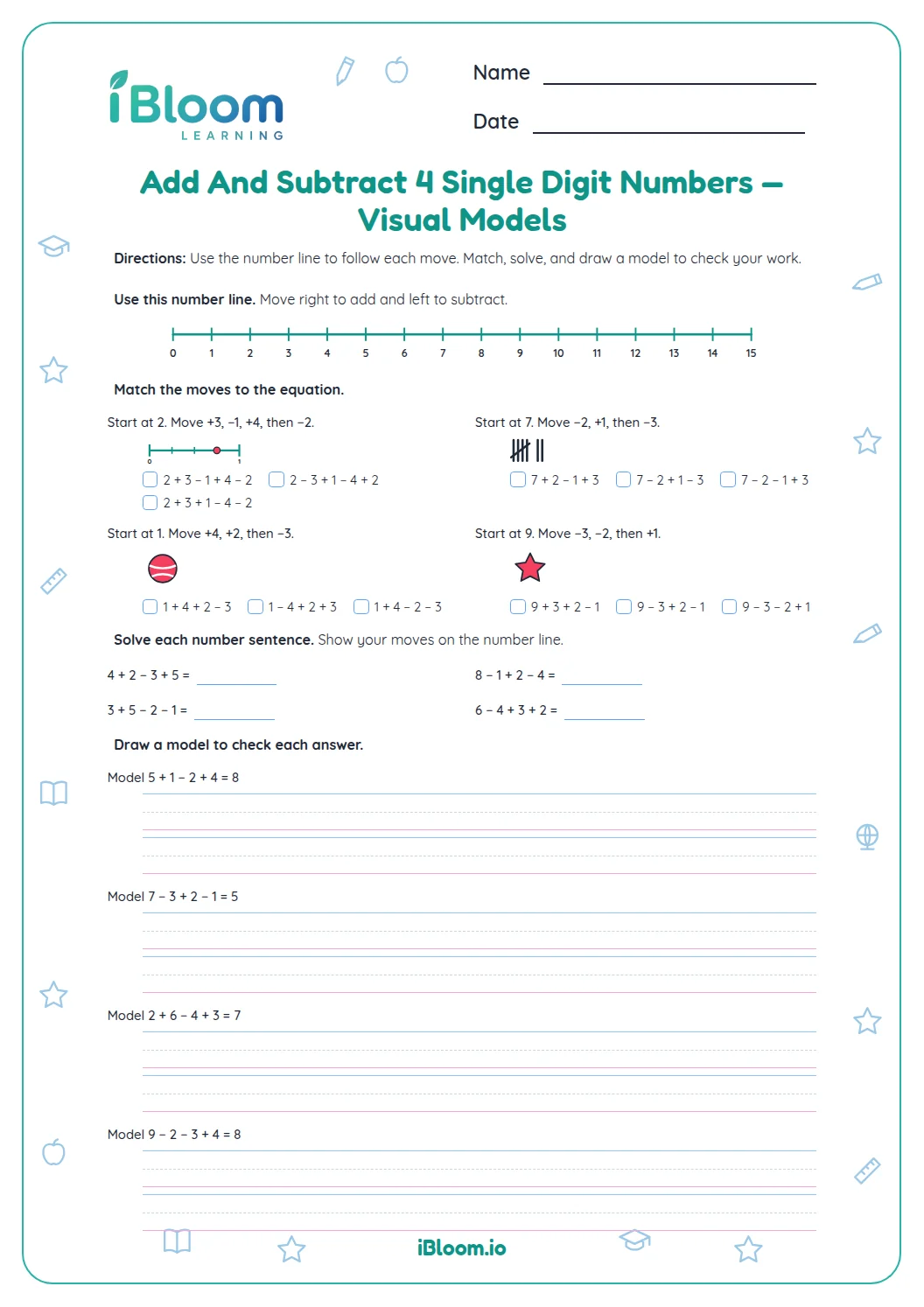
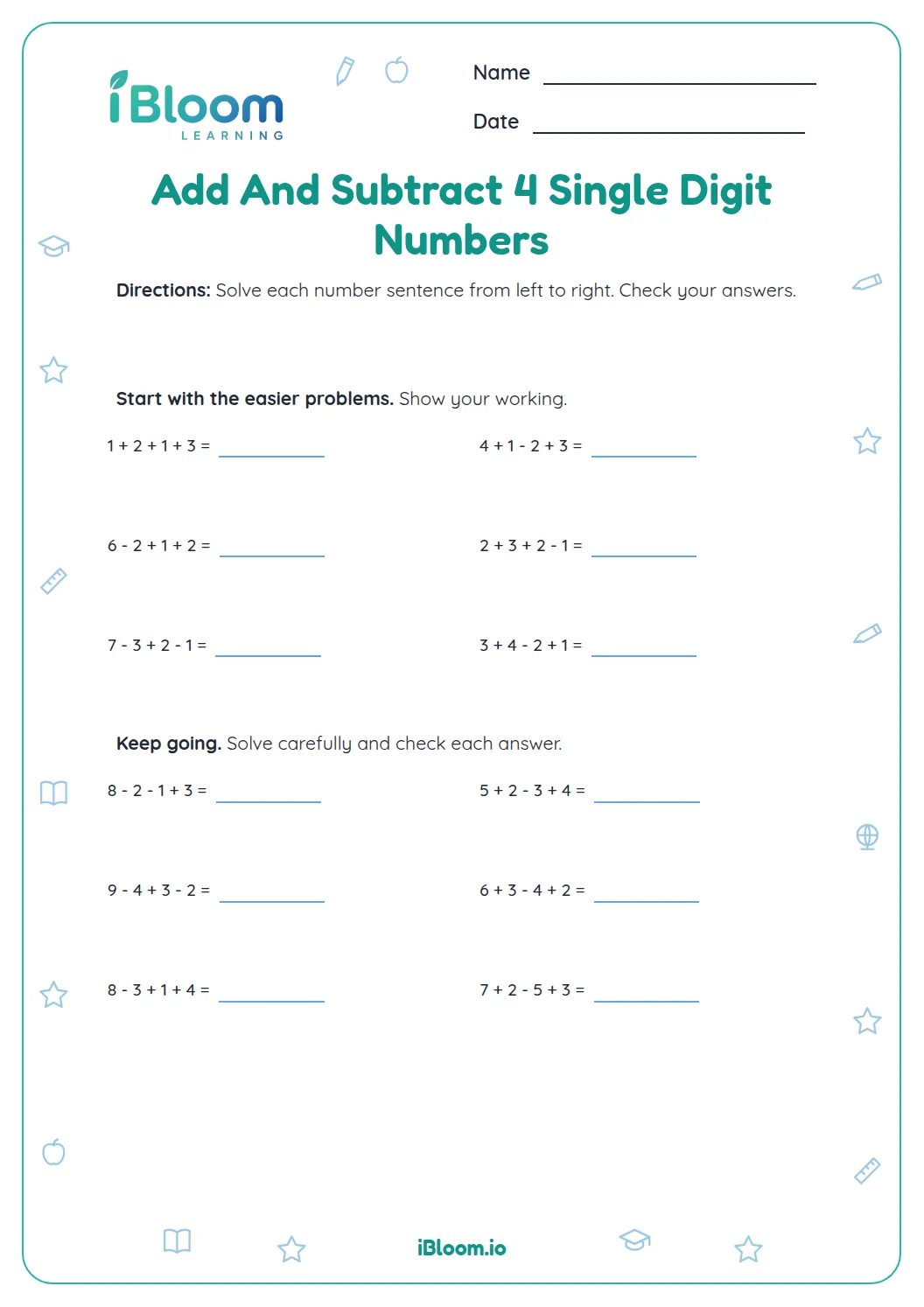
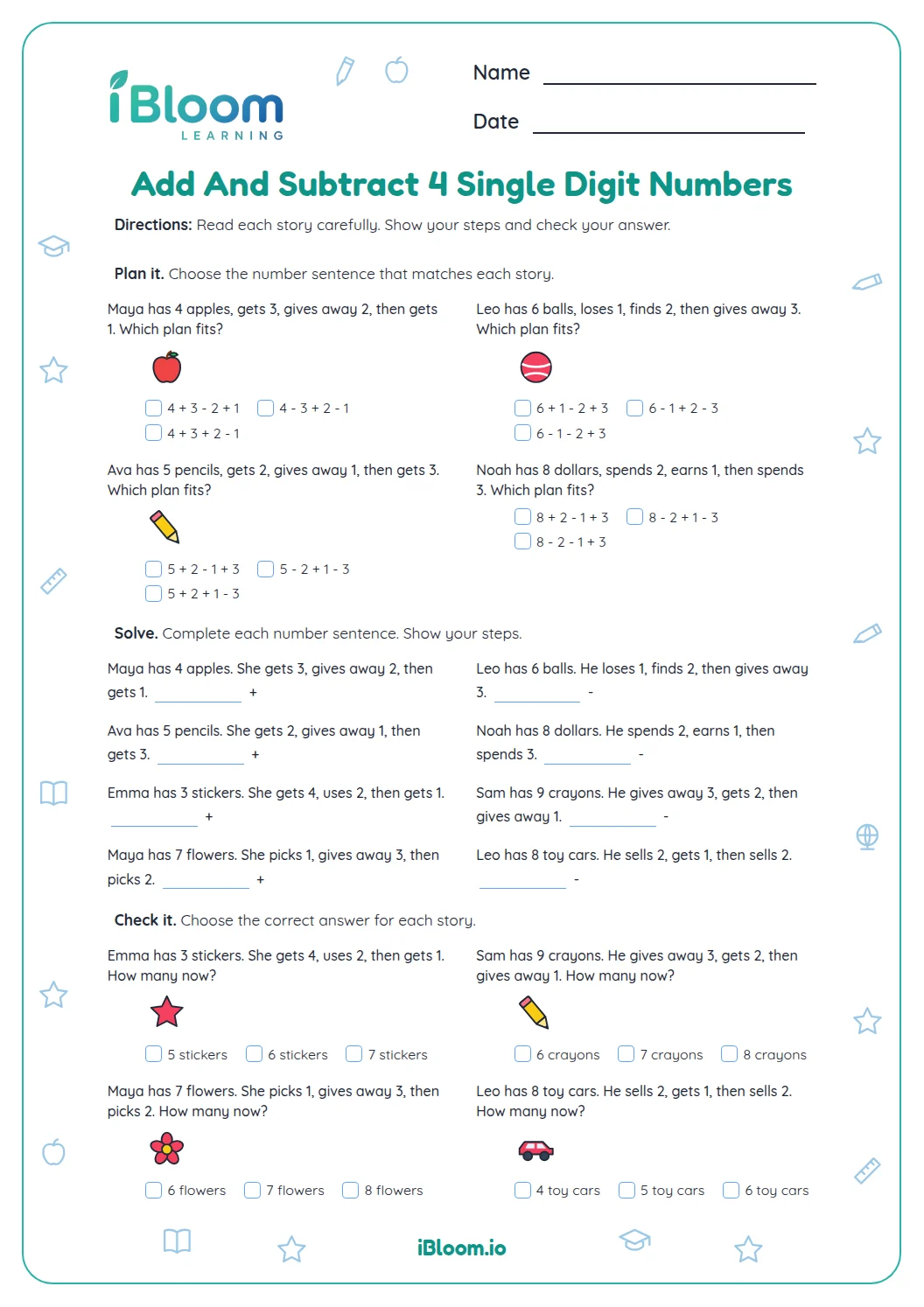
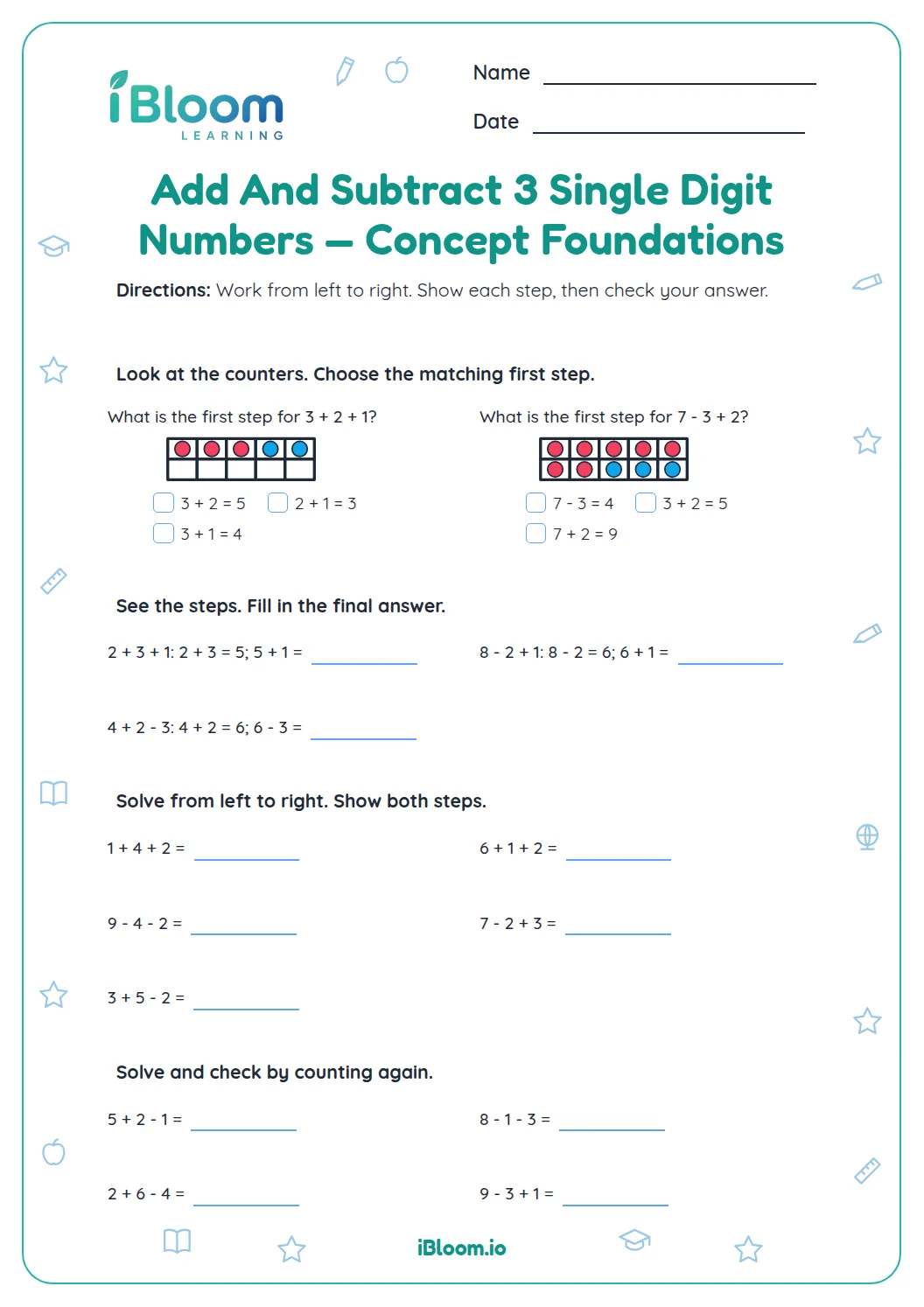
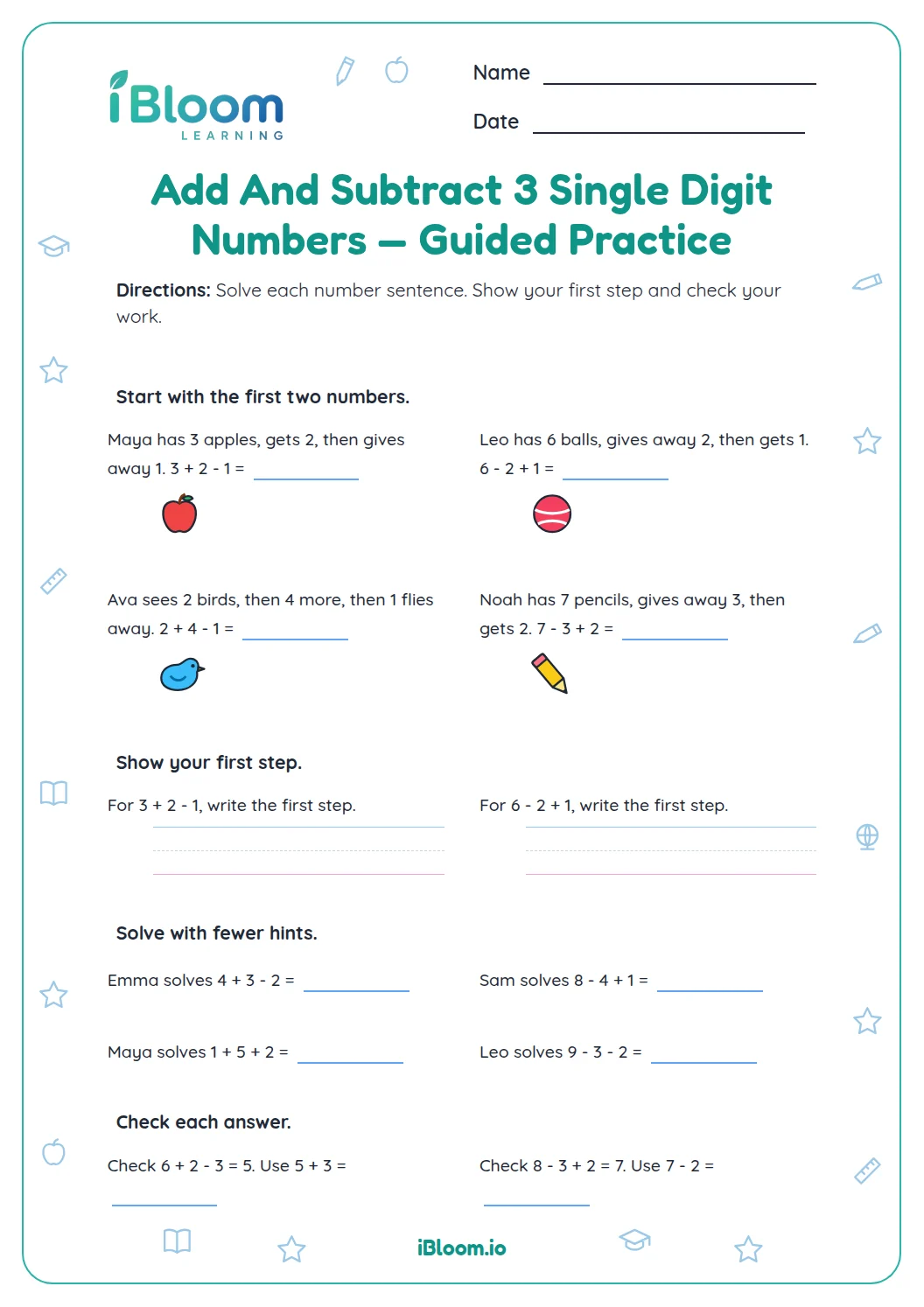
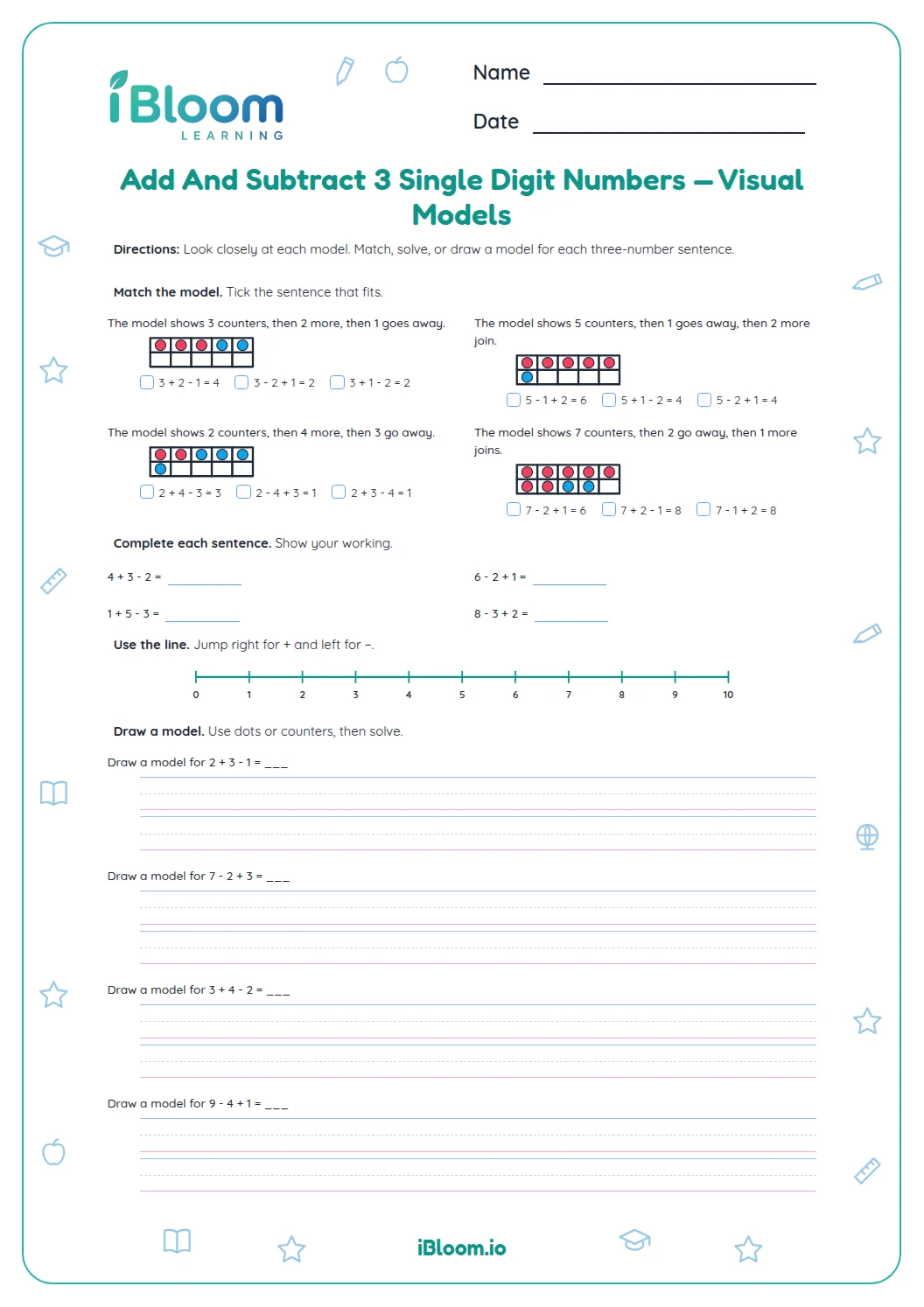
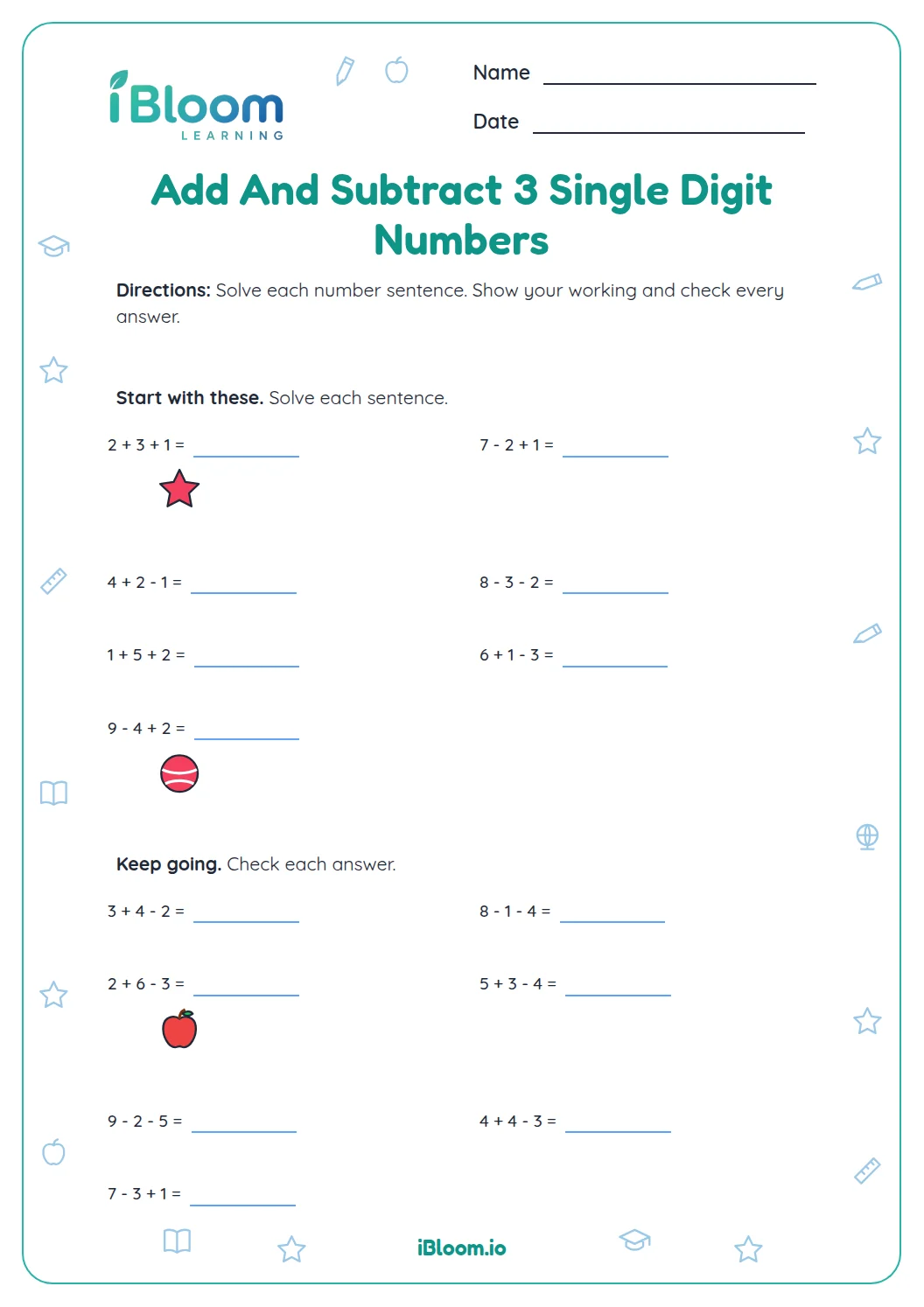
This free Grade 1 worksheet helps children keep track of a total as they add and subtract four single-digit numbers. Part A supplies the first two steps of four calculations. Part B has two choices about a final step, Part C gives eight equations to solve, and Part D has two short stories. Every running total stays between 0 and 20, practicing CCSS 1.OA.C.6. A parent or teacher can read the guidance aloud, then let the child finish each calculation. The separate answer key gives all 16 results.
Aligned to 1.OA.C.6
Why do four numbers take three steps?
Four numbers are joined by three operation signs. Start with the first number and use each sign in order. After each step, the answer becomes the starting number for the next step. A child can point to each sign while saying “add” or “take away.”
Part A makes those changing totals visible. It gives two completed steps for each question and asks the child to finish the third. Read all three steps together so the last blank stays connected to the full problem.
How does the guided example work?
Question 1 starts with 6, adds 2, takes away 3 and adds 1. Ask the child to explain why the last step starts at 5. That explanation checks whether the child is following the total through the whole calculation.
- 16 + 2 − 3 + 1
- 26 + 2 = 8
- 38 − 3 = 5
- 45 + 1 = 6
How can children move from guidance to independent work?
Part B provides two running totals and asks children to choose the third; reading the final sign is essential. In Part C, children supply every step themselves. They can jot the first two totals beside the equation before writing the final answer.
Part D transfers the same routine to beads and ducks. The bead story becomes 5 + 3 − 2 + 1 = 7. The duck story becomes 9 − 2 + 1 − 3 = 5. Have children identify what happens first, next and last before calculating.
A routine for four-number calculations
- 1Read question 1 aloud and point to its three signs.
- 2Say the first two totals together, then let the child finish the last step.
- 3In Part B, ask the child to name the final operation before choosing.
- 4Cover the guidance and try all three steps independently in Part C.
- 5For each story, write the four numbers and three signs in story order.
- 6Use the key to check; revisit the first step where the running total changed incorrectly.
Mistakes to check together
The mistake
Stopping at the second total, such as 5 in question 1.
The fix
Touch all three signs and make sure the final + 1 has been used.
The mistake
Treating every sign as addition in 8 − 3 − 2 + 4.
The fix
Say “take away 3, take away 2, add 4” before computing.
The mistake
Starting over from the first number at each step.
The fix
Write the current total above the next sign; use that total for the next calculation.
Common Core alignment
Add and subtract within 20 using a sequence of manageable steps.
On this sheet: All 16 questions use addition and subtraction steps with running totals from 0 to 20.
Show the official wordingHide the official wording
Add and subtract within 20, demonstrating fluency for addition and subtraction within 10. Use strategies such as counting on; making ten (e.g., 8 + 6 = 8 + 2 + 4 = 10 + 4 = 14); decomposing a number leading to a ten (e.g., 13 - 4 = 13 - 3 - 1 = 10 - 1 = 9); using the relationship between addition and subtraction (e.g., knowing that 8 + 4 = 12, one knows 12 - 8 = 4); and creating equivalent but easier or known sums (e.g., adding 6 + 7 by creating the known equivalent 6 + 6 + 1 = 12 + 1 = 13).
What to practice next
Make more practice
Further reading
Questions parents and teachers ask
Does every problem use four single-digit numbers?
Yes. Each full calculation uses four single-digit numbers, including the two stories about beads and ducks. Part A also prints the first two steps, so a running total such as 10 appears in the guidance. Children finish three operations to reach the final total.
Should my child add before subtracting?
On this sheet, use the signs from left to right. For question 4, start with 8 − 3 = 5, then subtract 2 to get 3, and finally add 4 to get 7. Encourage your child to keep a finger beside the next sign.
Can we use counters for these calculations?
Yes, counters can help children follow the changing total. For question 1, set out six counters, add two, remove three, and add one. Count the six that remain, then compare each action with the printed guidance. Move counters only for the step currently being read.
How much help should I give in Part A?
Read the supplied steps aloud and ask your child to finish the last calculation. After an answer, ask where the number starting the last step came from. In question 2, that number is 7 because 5 + 2 = 7. This keeps attention on the whole sequence.
What does the answer key include?
The separate answer key gives the final answer to all 16 questions, including the two multiple-choice selections and both story totals. Check the child’s intermediate work as well. A correct total is more useful when the child can explain how each sign changed the number.